Coronary CT in China: A Heart Scan Guide for Foreign Patients
Coronary CT in China: A Heart Scan Guide for Foreign Patients
What if you could get a coronary CT scan — the test that looks inside the arteries feeding your heart — for a fraction of what your local hospital quotes, without waiting months for the appointment? That question is exactly why so many international patients now search for the coronary CT scan cost in China before they search for anything else.
Here is the short answer: at a top-tier Chinese public hospital, a coronary CT angiography typically runs between $150 and $500 out of pocket. At a private international hospital, expect $600 to $1,500. In the United States, the same study often bills at $1,000 to $3,000 or more, depending on the facility and your insurance status.
But price is only one part of the picture. Accuracy, radiation dose, who reads the images, and how you actually get on the schedule as a foreigner matter just as much. This guide covers all of it.
How This Actually Works, Step by Step
Getting a coronary CT in China is not like booking a hotel room. The public hospital system runs on same-day registration and in-person queues, so the sequence matters. Here is the realistic path our team walks patients through.
Step one: You gather your existing records — recent ECG, lipid panel, blood pressure history, any prior stress test or echocardiogram report, and a list of current medications. These get translated into Chinese by a medical translator. Machine translation is not acceptable here; a cardiologist needs to read the indication for the scan correctly.
Step two: We send those records to the international department of a shortlisted hospital — often one of the 340+ top-ranked hospitals in our database — and request a written assessment. A cardiac specialist reviews whether a CT angiogram is even the right test for you. Sometimes it is not. If your calcium score is already sky-high or you have an irregular rhythm, the team may steer you toward a different study.
Step three: Once the indication is confirmed, the hospital’s international office reserves a slot. This is the part most patients do not know: standard outpatient registration at a Chinese public hospital cannot be booked from overseas. You either arrive and queue, or you go through the international/VIP channel, which costs roughly 1.5 to 2 times the standard rate but gives you English-speaking staff and a locked-in appointment time.
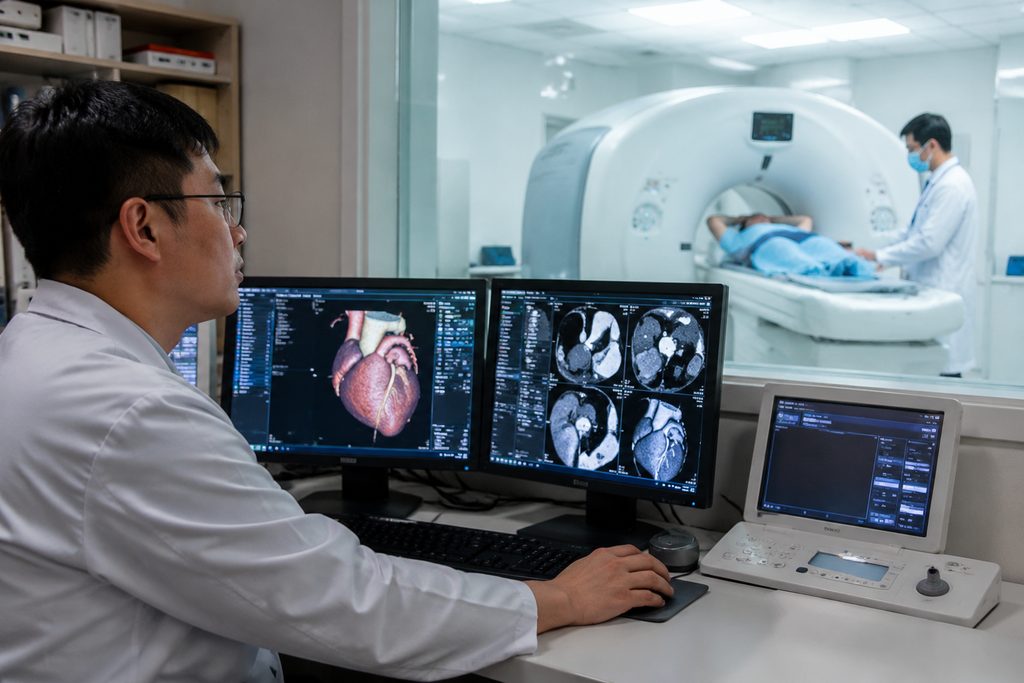
Step four: You arrive, complete the hospital medical card registration, pay upfront (public hospitals require prepayment; private international hospitals often bill your insurer directly), and have the scan. The study itself takes about 15 minutes on the table, though you should budget two to three hours for the whole visit.
Step five: A radiologist and cardiologist issue a report, usually within 24 to 72 hours. If you have already flown home, the report can be delivered digitally with an English translation.
What a Coronary CT Actually Shows — and How Accurate It Is
A coronary CT angiogram (CCTA) is a non-invasive imaging study that uses contrast dye and a fast scanner to map the coronary arteries. It answers one central question: is there plaque narrowing the vessels that supply your heart muscle?
How accurate is coronary CT angiography? For ruling out significant coronary artery disease, large multicenter trials have consistently reported a negative predictive value above 95% — meaning a clean scan is strong evidence that you do not have a major blockage. Sensitivity for detecting stenosis above 50% generally lands in the 85–95% range across modern 64-slice-and-above scanners. That is genuinely good. It is not perfect, and it is not a substitute for invasive angiography when a blockage is already strongly suspected.
Two caveats are worth stating plainly.
- Heavy coronary calcification can cause overestimation of stenosis. Older patients with long-standing risk factors sometimes get a less definitive read.
- Image quality depends on heart rate control. If your heart beats too fast during the scan, the images blur. Chinese cardiac centers routinely administer a short-acting beta-blocker before the study when there is no contraindication — this is standard practice, not an unusual step.
Scanner generation matters too. Third-generation dual-source CT and 320-row scanners deliver sharper images at lower radiation doses than older equipment. When we shortlist hospitals, scanner model is one of the questions we ask.
Is Coronary CT Safe in China?
Most hospitals deliver the written report within 24 to 72 hours. Complex cases requiring multidisciplinary review can take longer. If you need the report in English, request translation at the time of booking — it is rarely automatic.
Modern protocols deliver roughly 1 to 5 mSv, compared with about 3 mSv of natural background radiation per year. That is a modest exposure. The clinical benefit of detecting significant coronary disease generally outweighs the risk when the test is appropriately indicated — which is why a specialist review before booking matters.
Sometimes, but rarely automatically. Most insurers require prior authorization for elective imaging abroad. Contact your insurer before scheduling and ask specifically whether a coronary CT angiogram performed at a Chinese hospital is reimbursable. Keep all itemized receipts.
The hospital will recommend next steps, which may include a cardiology consultation, medication adjustment, or further testing. Any surgery or stent placement requires an in-person consultation first. Nothing is booked on the basis of imaging alone. Our team can help coordinate that next phase if you choose to stay.
Your Next Step
A coronary CT in China can cost a fifth of what you would pay in the US, and the leading cardiac centers are genuinely world-class in imaging volume and technology. The friction is not the medicine — it is the logistics: records, translation, appointment access, visa category, and language.
We are China Medical Services, a patient coordination team that connects international patients with top-ranked Chinese hospitals. We do not provide medical care, and we do not guarantee appointments or outcomes. What we do is translate your records, request a specialist review, coordinate the booking through official hospital channels, and put a bilingual companion beside you on the day.
If you would like to understand your options before committing to anything, start with a free consultation. No pressure, no obligation — just a clear picture of what is possible.
This article is for general information only and is not medical advice. Always consult a qualified physician about your individual situation before undergoing any diagnostic procedure.
Frequently Asked Questions
Yes. The hospitals used for international patients are JCI-accredited and follow the same international safety standards as top hospitals in the US and Europe. Surgical teams perform high volumes of procedures — often more than their Western counterparts — which studies show leads to better outcomes.
Costs vary by procedure and hospital, but international patients typically save 40-80% compared to US prices — even when factoring in travel and accommodation. A consultation with our team will give you an exact, all-inclusive quote with no hidden fees.
Send us your existing medical reports to get started. We handle everything from hospital selection and appointment scheduling to visa assistance and post-operative recovery planning. Your medical records are reviewed by the specialist before you even book a flight.
For more medical information and treatment options in China, visit chinamedservices.com (China Medical Services).
