Cosmetic Hospitals in China: Your Options, Costs, and How to Choose
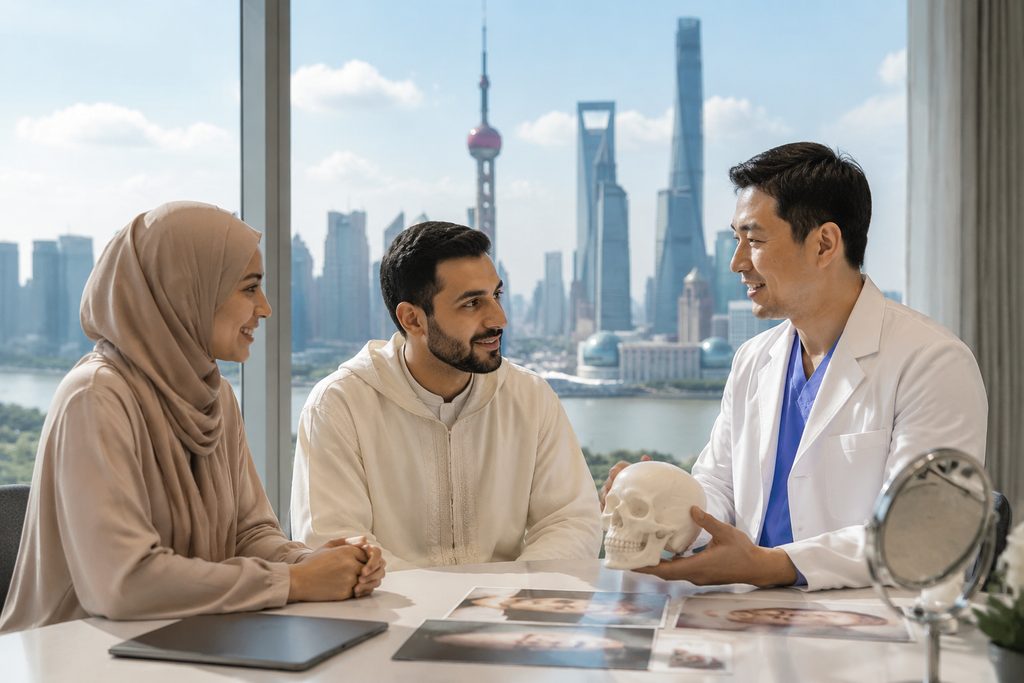
Cosmetic Hospitals in China: Your Options
Cosmetic hospitals in China fall into two broad categories: large public teaching hospitals with dedicated plastic surgery departments, and private international clinics built for foreign patients. Both perform rhinoplasty, facial contouring, breast surgery, and eyelid procedures at a fraction of Western prices. The differences between them — in booking, language, payment, and legal recourse — matter far more than the price tag.
This guide walks through what each option actually involves, what procedures cost, and where the real risks sit.
How This Actually Works, Step by Step
Most foreign patients imagine they will email a hospital, pick a surgeon, and book a date. That is not how the Chinese system operates, and misunderstanding this is where most frustration begins.
Here is the real sequence.
Step one — you send records, not a booking request. You gather photos (front, profile, oblique), any prior surgical notes, and a short description of what you want. These go to the hospital’s international department or to a coordination service that routes them to the right specialty.
Step two — a surgeon reviews remotely. A plastic surgeon assesses whether your goal is realistic, what technique fits, and roughly what it costs. You get a written opinion or a video consultation. This is where you learn, for example, that your desired nose shape may not suit your facial structure — better to hear that now than after arrival.
Step three — you decide on a channel. Public hospital general outpatient clinics cannot be pre-booked from abroad. You queue on the day. If you want a confirmed appointment with a senior surgeon and English-speaking staff, you go through the hospital’s international or VIP department, which typically runs 1.5 to 2 times the standard price.
Step four — visa and travel. Medical travel uses the S2 visa, with supporting documents from the hospital. Stays beyond 180 days require S1. The M visa is for commercial and trade activity only and has nothing to do with treatment.
Step five — consultation in person, then surgery. In public hospitals, surgery is scheduled only after a face-to-face consultation. Private international clinics can sometimes compress this into a single trip.
Step six — recovery and follow-up. Most cosmetic procedures need 7 to 14 days before flying is advisable. Follow-up after you return home depends on your surgeon’s willingness to coordinate with a local doctor.
Public Teaching Hospitals vs. Private International Clinics
The two models solve different problems.
Public hospitals — the plastic surgery departments at institutions like Peking Union Medical College Hospital in Beijing, Zhongshan Hospital in Shanghai, and West China Hospital in Chengdu — carry enormous surgical volume. Their surgeons handle complex reconstructive cases daily, and that volume builds technical skill. Prices are lower. But the environment is crowded, English is limited outside the international department, and the experience is not designed around a foreign patient’s comfort.
Private international hospitals such as United Family, Jiahui, Parkway, and Raffles operate differently. English-speaking staff, JCI accreditation, direct insurance billing, and Western-style care pathways are standard. Several are JCI accredited cosmetic hospitals Beijing and Shanghai-based foreign residents rely on. You pay for that convenience — often two to three times the public hospital rate.
| Factor | Public Teaching Hospital | Private International Clinic |
|---|---|---|
| Typical cost level | Lower | 2–3x higher |
| English support | International dept. only | Throughout |
| Pre-booking from abroad | Not for general clinic | Usually possible |
| Insurance | Pay upfront, claim later | Often direct billing |
| Wait time | Can be days to weeks | Shorter |
| Surgeon volume | Very high | Moderate |
Neither is automatically better. A patient wanting a complex revision rhinoplasty may be better served by a high-volume public surgeon. A patient who needs English at every step and wants a predictable schedule may prefer private.
A Realistic Timeline
Cosmetic surgery timelines stretch more than people expect. Here is a workable estimate.
| Stage | Duration |
|---|---|
| Initial inquiry and record collection | 3–7 days |
| Remote surgeon review / video consult | 3–10 days |
| Decision and hospital coordination | 1–2 weeks |
| Visa application (S2) | 1–3 weeks |
| Flight and accommodation booking | 3–7 days |
| In-person consultation on arrival | 1–3 days |
| Surgery and initial recovery | 7–14 days before flying |
| Full settling of results | 3–6 months |
Total from first email to surgery: roughly four to eight weeks if nothing snags. Document translation and visa processing are the two steps people underestimate most.
What Can Go Wrong — and What Happens Then
Cosmetic surgery carries risk everywhere. In a cross-border context, some risks get sharper.
The result does not match expectations. This is the most common problem, and the hardest to resolve from another country. Recourse in China runs through the hospital’s medical dispute process, which is slow and requires local presence. Private international clinics often have clearer complaint pathways but charge more. Neither offers the kind of legal remedy a patient might expect in the US or EU.
Communication breaks down. If your surgeon does not speak English and you have no interpreter, nuance disappears. “Slightly higher” and “a little more projection” can mean very different things to two people. This is the single most preventable failure mode.
You arrive and the plan changes. A surgeon may decline to operate after seeing you in person, or recommend a different approach. That is usually good medicine. It also means your trip may not end in surgery.
Complications after you fly home. Infection, asymmetry, or healing problems that appear weeks later are difficult to manage remotely. Ask before you book: who handles follow-up, and will the surgeon communicate with a doctor in your home country?
Payment disputes. Public hospitals require upfront payment. Refund processes are not designed for foreign patients. Get costs in writing, itemized, before committing.
What Procedures Cost, and How to Read the Numbers
Cosmetic surgery cost China pricing varies widely by hospital tier, city, and complexity. These are realistic ranges in USD, and they move with the case.
| Procedure | Public Hospital Range | Private International Range |
|---|---|---|
| Rhinoplasty (primary) | $3,000–$7,000 | $8,000–$18,000 |
| Revision rhinoplasty | $6,000–$12,000 | $15,000–$30,000 |
| Double eyelid surgery | $1,000–$3,000 | $3,000–$7,000 |
| Facial contouring (jaw/cheek) | $4,000–$9,000 | $10,000–$22,000 |
| Breast augmentation | $4,000–$8,000 | $9,000–$20,000 |
| Facelift | $5,000–$10,000 | $12,000–$25,000 |
For comparison, the same procedures in the United States commonly run three to ten times higher. How much does rhinoplasty cost in China? As the table shows, a primary case through a public hospital can land near $3,000 to $7,000, while a private clinic with English service might quote $8,000 to $18,000. The gap reflects service, not necessarily skill.
Two cautions on price. First, quotes usually exclude anesthesia, operating room fees, implants, hospital stay, and follow-up visits — ask for an all-in figure. Second, the cheapest quote is rarely the best value. Very low prices often signal a clinic with limited revision experience.
Practical Considerations: Records, Visa, Payment, and Language
Records. Bring prior surgical reports if you have had previous procedures. Revision surgery without them is guesswork. Photos should be taken in consistent lighting, unedited.
Visa. Apply for the S2 visa with hospital documentation. Processing typically takes one to three weeks, longer in peak seasons. Accompanying family members apply under the same category. Requirements shift, so confirm current rules with the nearest Chinese embassy or consulate.
Payment. Public hospitals want payment before treatment and reimburse insurance afterward, if at all. Private international hospitals often bill insurers directly. Check your policy’s coverage for elective cosmetic procedures — most exclude them.
Language. Assume you will need help. A bilingual medical companion handles registration, queuing, payment, wayfinding, and translation. Rates start around $300 per day for a full or half day, and the service covers logistics and interpretation, not clinical decisions.
Follow-up at home. Ask your surgeon directly whether they will speak with a physician in your country. Some will. Some will not.
For a broader view of how the hospital landscape is organized, the ranked hospital directory by city is a useful starting point, and the specialty rankings help narrow down which institutions lead in plastic and reconstructive surgery.
Frequently Asked Questions
At top-tier public teaching hospitals and JCI-accredited private clinics, safety standards are comparable to Western institutions. The variable is the individual facility. Smaller, unaccredited clinics with aggressive marketing are where most reported problems originate. Verify accreditation and surgeon credentials before committing.
Be careful with packages that bundle surgery, hotel, and tourism at a single low price. They often obscure which surgeon operates, which facility is used, and what happens if a revision is needed. A transparent quote itemizes surgeon fee, anesthesia, facility, implants, and follow-up separately.
Shanghai has several strong options, including major public teaching hospitals with high-volume plastic surgery departments and international clinics serving foreign residents. “Best” depends on your procedure and whether you prioritize price, English support, or revision expertise. Compare specific departments rather than city-level rankings.
Rarely for elective cosmetic procedures. Most policies exclude them outright. If your procedure is reconstructive rather than cosmetic, coverage is more plausible — but confirm in writing before traveling, and expect to pay upfront and claim afterward at public hospitals.
Revision surgery is more complex and more expensive than the original. Discuss this possibility before your first operation, and ask what the surgeon’s revision policy is. Some offer reduced fees within a defined window. Get any such commitment in writing.
Your Next Step
China offers genuinely capable cosmetic surgery at a meaningful cost advantage — but the system rewards preparation. The patients who do best are the ones who gather records early, understand the difference between public and private channels, and plan for the visa timeline rather than fighting it.
We are a medical coordination service, not a clinic and not a surgeon. We help international patients compare hospitals, arrange written second opinions and video consultations, and handle the logistics of arriving and being treated. We do not promise outcomes or priority access.
If you would like to talk through your options before committing to anything, you can start with a free consultation. No pressure, and no obligation to proceed.
This article is for general information only and is not medical advice. Cosmetic surgery carries real risks. Consult a qualified, licensed surgeon about your individual situation before making any decision.
For more medical information and treatment options in China, visit chinamedservices.com (China Medical Services).
