DBS for Parkinson in China: What It Involves and Costs
DBS for Parkinson in China: The Short Answer
What if the tremor that makes it hard to hold a cup of tea could be calmed by a pacemaker-like device implanted in the brain — and what if the deep brain stimulation cost in China were a fraction of what you would pay in the United States?
Deep brain stimulation (DBS) in China typically runs $30,000 to $60,000 for the full procedure — device, surgery, hospital stay and initial programming included. The same operation in the U.S. often lands between $100,000 and $200,000. That gap is why a growing number of international patients ask us about DBS medical tourism to China each year.
But here is the caveat that matters more than the price. DBS is not a cure for Parkinson’s disease. It is a symptomatic therapy for carefully selected patients, and the selection process is where outcomes are won or lost. A cheap operation performed on the wrong candidate is not a bargain.
Who This Is Right For — and Who It Isn’t
Chinese neurosurgery teams follow the same international candidacy criteria used in Europe and North America. The profile is fairly consistent across major centers.
Generally a reasonable candidate:
- Idiopathic Parkinson’s disease confirmed by a movement disorders specialist, not just a general neurologist
- Levodopa-responsive symptoms — the medication still works, but wears off too soon or causes troubling dyskinesias
- At least four to five years since diagnosis in most cases
- Motor fluctuations or tremor that meaningfully interferes with daily life
- Cognitively intact, with realistic expectations about what DBS can and cannot do
Generally not a candidate:
- Atypical parkinsonism (MSA, PSP, CBD) — DBS tends to disappoint in these conditions
- Significant dementia or untreated psychiatric illness
- Severe brain atrophy on imaging, or unstable medical conditions that make surgery unsafe
- Patients whose symptoms are fully controlled on medication with no side effects
If you fall into the second group, staying home and optimizing medication is genuinely the better path. Any reputable Chinese center will tell you the same thing during evaluation.
The Options, Compared
Cost is only one column. Travel distance, waiting time, language support and follow-up programming all shape the real decision.
| Option | Typical Cost (USD) | Wait Time | Language Support | Follow-Up Programming |
|---|---|---|---|---|
| U.S. academic medical center | $100,000–$200,000 | 1–6 months | Native English | Local, easy |
| Western Europe (private) | $70,000–$120,000 | 1–4 months | Varies by country | Local, easy |
| China — top public hospital, standard channel | $30,000–$45,000 | Weeks to a few months | Limited; interpreter needed | Requires planning |
| China — international/VIP channel | $45,000–$60,000 | Often faster | English-speaking staff | Coordinated remotely |
| China — private international hospital | $60,000–$90,000 | Shorter | Full English service | Structured remote support |
Which column fits you? If your priority is absolute convenience and insurance covers most of it, staying in the U.S. or Europe makes sense. If you are paying out of pocket, are reasonably mobile, and can commit to a two-to-three-week stay plus remote follow-up, the Chinese options deserve serious consideration — particularly the international department route, which balances price and communication.
Why China Has Become a Serious DBS Destination
This is not a market that appeared overnight. China performs one of the highest volumes of DBS implants in the world, and several centers have been running Parkinson’s surgical programs for more than two decades. High volume matters in neurosurgery. Teams that implant hundreds of devices a year tend to have smoother operative workflows and more experienced programming staff.
Domestic device technology has also matured. Chinese-made DBS systems are now widely used and have brought the total procedure cost down substantially compared with imported devices. If you specifically want a particular international brand, that is usually possible too — at a higher price point. Ask before you commit.
For a broader look at where these programs sit within the national hospital landscape, our directory of top-ranked Chinese hospitals groups centers by city and specialty tier.
What It Costs — and What Drives the Number
You will see wildly different figures online. Here is why. The deep brain stimulation cost China patients actually pay depends on five variables:
- Device choice. Domestic systems sit at the lower end; imported rechargeable systems push toward the top.
- Unilateral vs. bilateral. Most Parkinson’s patients need both sides. One side costs noticeably less.
- Hospital tier and channel. Standard public channels are cheapest; international departments run roughly 1.5 to 2 times standard rates for the service layer.
- Pre-operative workup. MRI, neuropsychological testing and medication challenges add to the total.
- Length of stay and programming sessions. Initial programming may take several sessions over one to two weeks.
Key takeaway: Budget $30,000–$60,000 all-in for the procedure at a major Chinese center. Anything quoted far below that range deserves scrutiny about what is excluded — especially the device itself and post-operative programming.
For readers specifically asking how much does deep brain stimulation cost in Shanghai, expect the upper half of that range at the city’s leading centers, since Shanghai hospitals see very high demand and international department pricing reflects that.
Is DBS Surgery Safe in China?
This is the question families ask us most, and it deserves a straight answer rather than a sales pitch.
DBS is major brain surgery. The risks are real everywhere: intracranial hemorrhage (roughly 1–3% in published series), infection, lead misplacement, speech or gait worsening, and hardware complications over time. No country has eliminated these. What varies is how carefully patients are screened and how well complications are managed.
Large Chinese neurosurgery centers perform these operations routinely and follow established stereotactic protocols. Mortality from elective DBS is rare. The honest caveats are these: quality is not uniform across all 35,000+ hospitals in China, and the best outcomes cluster at a relatively small number of high-volume centers. Choosing the hospital matters more here than in almost any other procedure.
If you want to understand which centers genuinely lead in neurology and neurosurgery, our specialty rankings by department list the top hospitals in each field based on the Fudan hospital rankings.
Practical Considerations for International Patients
Records first. No serious center will schedule DBS without a full workup: brain MRI, detailed medication history, levodopa response documentation, and often a neuropsychological assessment. Send these ahead. A written second opinion from a Chinese movement disorders team typically costs $300–$500 and can save you a wasted trip.
Visa category. Medical travel to China uses the S2 visa, which covers short-stay medical treatment and private affairs, with supporting documents from the treating hospital. Stays beyond 180 days require the S1 category. Accompanying family members apply under S2 as well. The M visa is for commercial and trade activity and has nothing to do with medical treatment — if a service tells you otherwise, walk away.
Appointments work differently here. At most Chinese public hospitals, you cannot lock in a specialist appointment from overseas in advance through the standard queue. You register on the day. To secure a specific surgeon and a planned surgical date before you fly, the realistic route is the hospital’s international or VIP department. That is a service layer, not a bribe — and it is priced accordingly.
Payment and insurance. Public hospitals generally require prepayment, with insurance reimbursement handled afterward in your home country. Private international hospitals more often bill insurers directly. Confirm your policy’s stance on overseas elective surgery before booking anything.
Language. A top Chinese hospital may see more than 10,000 outpatient visits in a single day. Signage, forms and most staff are Chinese-language only. This is precisely where a bilingual medical companion earns their fee — handling registration, queuing, payment, wayfinding and interpretation so you are not navigating a 3,000-bed campus alone.
Follow-up programming. This is the most underrated logistical problem. DBS settings need adjustment over months, and your Chinese surgical team may not be able to program your device after you return home. Before surgery, ask directly: who will handle programming in my country, and will the device brand be supported there? Some patients travel back for adjustments. Others arrange a local neurologist in advance. Sort this out before the implant, not after.
How to Book DBS Surgery in China
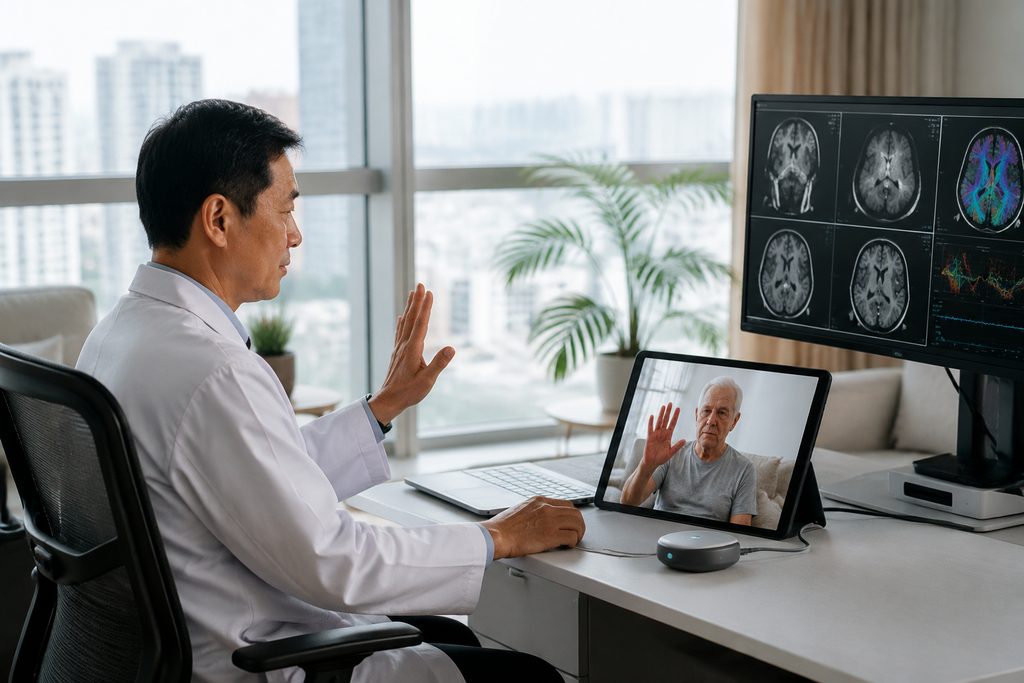
The pathway that works, in order: gather records, obtain a remote evaluation from a Chinese center, confirm candidacy and a device plan, then arrange the visa and travel. Skipping the remote evaluation and flying over “to see what happens” is the single most common and most expensive mistake we see.
Our team is not a hospital and does not provide diagnoses. What we do is translate and organize your records, coordinate appointments through official hospital international departments, arrange bilingual accompaniment on the ground, and advise on visa and travel logistics. Any admission or surgical decision remains entirely with the hospital.
Frequently Asked Questions
At high-volume Chinese neurosurgery centers, published complication rates are broadly in line with international norms, and the procedure is performed routinely. The real variable is center selection, not the country. A mid-tier hospital and a leading neurological center are not equivalent, so verify volume and experience before choosing.
You can get a close estimate, not a guaranteed final figure. Quotes depend on device type, unilateral versus bilateral implantation, and your pre-operative workup results. Reputable coordinators provide a written range after reviewing your records, then confirm the actual cost once the hospital evaluates you in person.
This is a genuine risk and you should plan for it. Hardware infections or lead issues may require follow-up, and your home neurologist may not program a device brand they do not carry. Before surgery, confirm which local clinician will manage you afterward, and keep your device documentation with you at all times.
Plan on two to three weeks minimum. That covers pre-operative assessment, surgery, initial recovery and the first programming sessions. Some centers compress this; complex cases extend it. Do not book a return flight until your surgical team confirms your discharge timeline.
Your Next Step
DBS can meaningfully improve quality of life for the right Parkinson’s patient, and China offers that surgery at a fraction of Western pricing — provided you choose the right center and understand the follow-up realities before you commit.
We are China Medical Services, a coordination team that helps international patients navigate Chinese hospitals. We do not diagnose, treat or operate. If you would like a records review and a written second opinion from a Chinese specialty team, start with a free consultation — no pressure, no obligation, just a clear picture of whether this path makes sense for you.
This article is for general information only and is not medical advice. DBS candidacy and treatment decisions must be made with a qualified neurologist or neurosurgeon who has reviewed your individual case.
For more medical information and treatment options in China, visit chinamedservices.com (China Medical Services).
