Dental Care in China or Turkey: Costs, Safety, and How to Choose
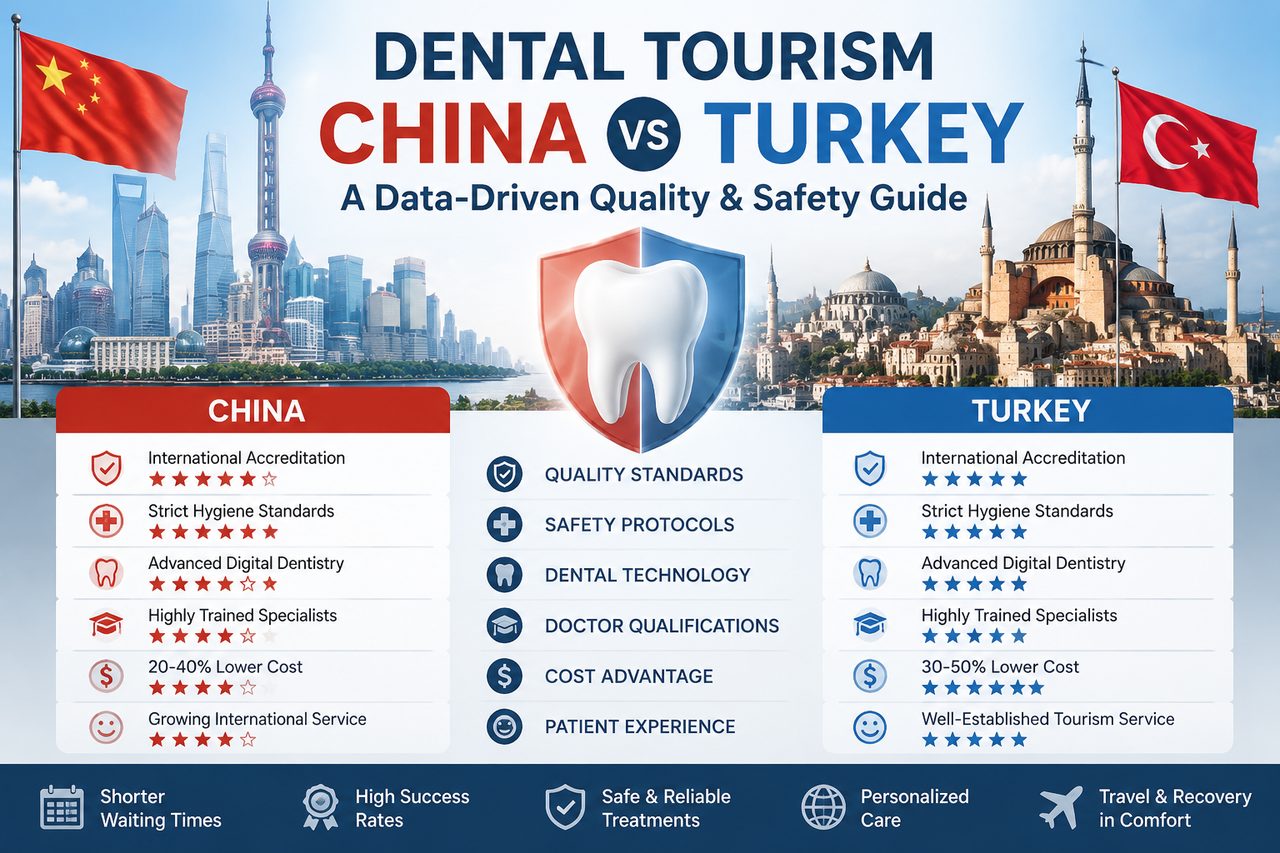
Dental Care in China or Turkey? An Honest Comparison for International Patients
If you are weighing dental care abroad, the dental implants cost China vs Turkey question usually comes down to three numbers: what you pay, how long you stay, and how confident you feel about the clinic doing the work. Both countries have built real reputations in dental tourism, but they are not interchangeable. Turkey leans on high-volume, package-style clinics concentrated in Istanbul and Antalya. China leans on large hospital-affiliated dental centers and international clinics in cities like Shanghai and Beijing, where care is often delivered inside a broader medical system.
Here is the part most articles skip. The cheapest quote is rarely the full cost. Travel, revisions, and the risk of redoing work six months later all belong in the math. So do the rules about who can treat you and how quickly.
Key takeaway: Turkey generally wins on headline price for implants and veneers. China generally wins on hospital infrastructure, sterility standards, and integration with other medical care. The right choice depends on case complexity, not the brochure.
Who This Is Right For — and Who It Isn’t
Dental tourism suits a specific kind of patient. It does not suit everyone, and pretending otherwise wastes your money.
You are likely a good candidate if:
- You need a defined procedure — a single implant, a crown, a bridge, or a set of veneers — not open-ended reconstruction.
- Your imaging and records are already done, so a clinic abroad can plan before you fly.
- You have 7 to 14 days available, or you can return for a second trip.
- You are healthy enough for routine oral surgery, with no uncontrolled diabetes or bleeding disorder.
You should probably not pursue this if:
- You need full-arch reconstruction with bone grafting and sinus lifts. These cases need staged visits and careful follow-up.
- You have active gum disease that has not been treated. Implants placed into infected tissue fail at higher rates.
- You cannot return for a follow-up appointment. Prosthetic fit issues often surface weeks later.
- You are choosing purely on price and cannot verify the clinic’s credentials.
That last point matters more than any table. A $400 implant that fails costs more than a $1,200 implant that lasts twenty years.
The Options, Compared
Below is a realistic comparison. Prices are typical private-clinic ranges in US dollars and vary by hospital, city, and case complexity. They are not quotes.
| Factor | China (Shanghai, Beijing) | Turkey (Istanbul, Antalya) | United States |
|---|---|---|---|
| Single implant (fixture + abutment + crown) | $900 – $2,500 | $500 – $1,200 | $3,000 – $6,000 |
| Porcelain veneer (per tooth) | $350 – $800 | $150 – $400 | $900 – $2,500 |
| Root canal (molar) | $150 – $450 | $100 – $250 | $700 – $1,500 |
| Typical stay needed | 7 – 14 days | 5 – 10 days | Local |
| English-speaking staff | Common at international clinics | Common at tourism clinics | Standard |
| Regulatory oversight | Hospital-grade, national health authority | National health ministry, varies by clinic | State dental boards |
| Best fit for | Complex cases, medical tourists with other health needs | Straightforward cosmetic and implant work | Patients who want local follow-up |
Read the table by column, not by row. If your case is simple and your budget is tight, Turkey’s column fits. If you have a medical history that needs coordination — cardiac issues, diabetes, anticoagulants — China’s hospital-linked dental departments give you something Turkey’s standalone clinics often cannot: access to specialists in the same building.
Is Dental Work in China Safe?
This is the question that decides most people’s answer, and it deserves a straight response. Is dental work in China safe? At accredited hospitals and established international clinics, yes — the standards are comparable to Western dental practices. Sterilization protocols follow national health regulations, implant systems are typically imported from the same European and Korean manufacturers used worldwide, and many clinics hold international quality certifications.
The catch is variation. China has more than 35,000 hospitals and tens of thousands of dental clinics. Quality is not uniform. A dental department inside a top-tier public hospital or a JCI-accredited international clinic operates very differently from a small private shop in a second-tier city.
Verify three things before committing: the clinic’s license and accreditation, the implant brand and its traceability documentation, and whether the treating dentist will be the same person who handles your follow-up. Ask for these in writing.
For patients who want to combine dental work with a broader medical checkup or treatment, China’s hospital system is genuinely useful. Our directory of top-ranked Chinese hospitals by city includes the major centers where dental departments sit alongside cardiology, oncology, and other specialties. That integration is hard to replicate in a standalone dental tourism clinic.
How Much Do Veneers Cost in China — and What Drives the Price
How much do veneers cost in China depends on material and clinic tier more than on geography. A basic porcelain veneer at a mid-tier private clinic in Chengdu might run $350. The same veneer at an international clinic in Shanghai’s financial district can reach $800. Zirconia and layered e.max veneers sit at the top of the range; composite resin sits at the bottom.
Four things move the number:
- Material. Feldspathic porcelain, e.max, and zirconia cost more than composite.
- Clinic tier. International departments and private hospitals charge 1.5 to 2 times standard public-hospital rates.
- Number of teeth. Cosmetic veneer cases are usually 6 to 10 teeth. Prices are per unit, so the total scales fast.
- Preparation needed. Gum contouring, bite adjustment, or replacing old crowns adds cost.
Turkey undercuts China on veneers by roughly 40 to 60 percent. That gap is real. Whether it is worth it depends on how much you value being inside a hospital system versus a dedicated cosmetic clinic.
Booking Dental Implant Surgery in China: What the Process Actually Looks Like
Here is where expectations usually break. You cannot simply book dental implant surgery in China as a package on a website and show up. Public hospitals generally require an in-person consultation before any surgical appointment is scheduled. That is a national rule, not a bureaucratic quirk.
The realistic path runs like this:
- Step one: Send your panoramic X-ray, CBCT scan, and dental history to a clinic or coordinator for remote review.
- Step two: Get a written treatment plan and cost estimate before you book flights.
- Step three: Schedule an in-person consultation. At public hospitals, this is a same-day queue process. International departments and private clinics allow advance booking.
- Step four: Surgery is scheduled after that consultation, often within the same trip if your case is straightforward.
- Step five: Follow-up and prosthetic fitting, which may require a second visit.
This staged approach is exactly why remote consultation exists. It reduces the chance of flying somewhere and discovering the plan does not fit your mouth or your budget.
If you are considering China specifically, our department-by-department hospital rankings help you identify which institutions handle the volume and complexity you need. For a broader look at how the system works for foreign patients, the main site walks through hospital matching, visas, and logistics.
Practical Considerations: Visas, Payment, and Follow-Up
Visas. For medical treatment in China, the applicable short-stay category is the S2 visa, used for medical treatment and private affairs, subject to the latest embassy and consulate requirements and supporting hospital documents. Family members accompanying you apply under the same category. The M visa is for commercial and trade activities and has nothing to do with medical care — do not let anyone tell you otherwise. Stays beyond 180 days fall under the S1 category.
Payment. Chinese public hospitals require prepayment, with insurance reimbursement handled afterward in your home country. Private international clinics often bill insurers directly. Turkey’s dental tourism sector is heavily cash-and-package oriented, with some clinics offering installment plans.
Language. Major Chinese hospitals see tens of thousands of outpatients daily. Signs and forms are in Chinese. Without a Chinese speaker, navigation is genuinely difficult — this is the single most common complaint from foreign patients. Bilingual medical companions exist for exactly this reason: they handle registration, queuing, payment, and translation throughout your visit.
Follow-up. This is the weak point of dental tourism everywhere. If a crown loosens eight months later, you are back home. Ask upfront what remote support the clinic offers and get it in writing.
Frequently Asked Questions
For full-arch cases, China’s hospital-linked dental centers generally offer better infrastructure and access to bone-grafting specialists. Turkey remains cheaper. Neither is automatically better — the deciding factor is whether your case needs multidisciplinary support.
Typical savings run 60 to 80 percent versus US private-practice rates. A single implant that costs $4,500 in the US might run $900 to $2,500 in China or $500 to $1,200 in Turkey. Add airfare, hotel, and time off work to get the true figure.
Implant failure within the first year is uncommon but possible, usually from infection or poor bone integration. Most reputable clinics offer a warranty on the fixture itself, but not on travel costs or your time. Confirm the warranty terms in writing before surgery, and arrange a local dentist for monitoring.
Yes — the S2 category covers short-stay medical treatment, subject to current embassy requirements and supporting hospital documentation. Approval is never guaranteed, and requirements can change, so confirm with the nearest Chinese embassy before booking.
Your Next Step
The honest summary: Turkey is cheaper, China is more integrated with hospital-grade medicine, and both can deliver excellent results in the right hands. The variable that matters most is not the country. It is the specific clinic, the specific dentist, and whether anyone verifies your case before you fly.
We are China Medical Services, a coordination service — not a hospital, and we do not diagnose or treat. We help international patients review records, obtain written second opinions, connect with appropriate hospitals, and navigate the logistics of treatment in China. If you want a clear picture before committing to anything, start with a free consultation and we will tell you plainly whether China makes sense for your case.
For more medical information and treatment options in China, visit chinamedservices.com (China Medical Services).
