Dental Implants with Bone Loss in China: Full-Service Graft and Implant Packages
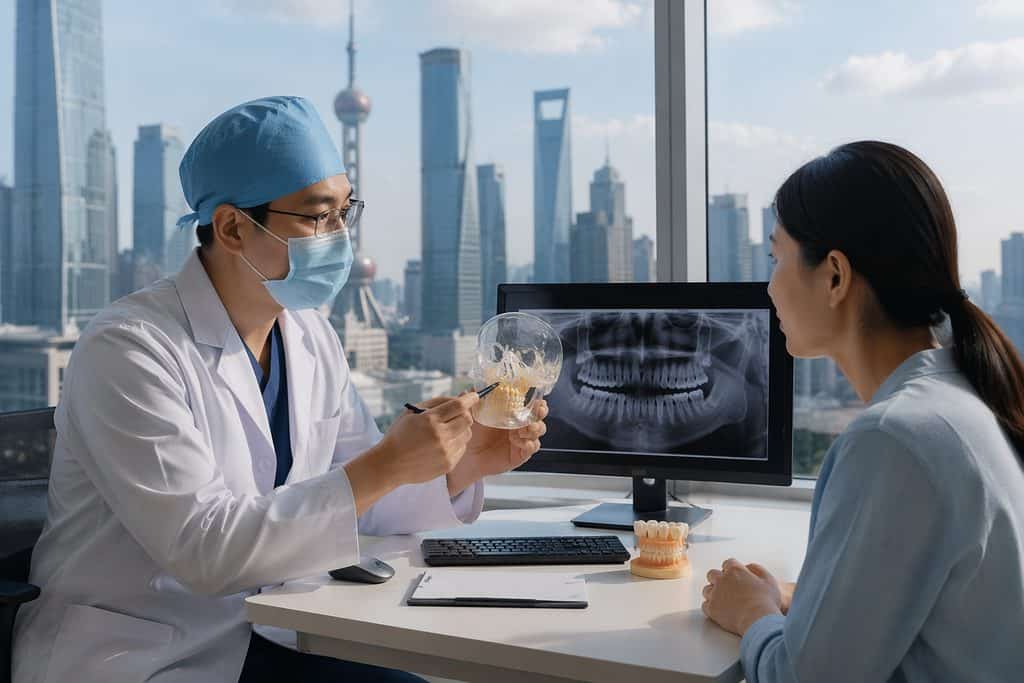
A dental implant is basically an artificial tooth root, a small titanium post placed into your jawbone to hold a replacement tooth. Bone loss complicates this. It means the foundation isn’t solid enough to anchor that post. You’ve been told you need a bone graft first, and you’re looking at a long, expensive road at home. Our team connects patients with China’s top maxillofacial surgical teams who handle complex bone graft and implant full service cases daily. We’ve seen the relief when a patient learns the entire process—grafting, implant placement, and the final crown—can be coordinated in one trip, at a fraction of the cost they were quoted locally.
Key Takeaways
- Full-mouth rehabilitation with bone grafting in China typically runs from $15,000 to $25,000, compared to $45,000+ in the US, with no clinical compromise when using top-tier hospitals.
- The key structural advantage is the high-volume surgical exposure of Chinese maxillofacial specialists, who perform complex grafting procedures like sinus lifts and ridge splits on a weekly, not monthly, basis.
- Bone grafting adds 3-6 months of healing time before implants can be placed, meaning a single-coordination trip requires a staged surgical plan and clear communication about the timeline.
- You should understand that not all “bone loss” is the same; the specific type and location of your jawbone deficiency dictate whether a simple graft, a block graft, or a zygomatic implant is the right path.
The Problem: When Your Jawbone Says No
Bone loss in the jaw is not a rare edge case. Studies suggest that after a tooth is lost, the surrounding alveolar bone can lose up to 25% of its width in the first year alone. This is a silent, progressive condition. You might not feel it, but your CT scan shows it clearly. For many patients in the US, the UK, or Australia, the diagnosis brings a crushing financial reality. A single implant with a straightforward graft can run $4,000 to $6,000. A full arch? The quotes often start at $45,000 and climb past $60,000. That’s a house deposit in some cities.
And it’s not just the money. The timeline stretches out. You see a surgeon. They schedule a graft. You heal for four months. You come back for the implant. You heal again. Months turn into a year of appointments, temporary flippers, and soft-food diets. The system isn’t broken—it’s just slow and staggeringly expensive for anyone without premium insurance. That’s the exact pain point that pushes people to look beyond their borders.
Why a Chinese Maxillofacial Team Delivers Predictable Results
The question isn’t just “can I get it cheaper?” It’s “can I get it done well?” The answer rests on three structural realities of China’s top-tier hospital system. We are not talking about small dental clinics. We connect patients with the stomatology departments of hospitals ranked in the Fudan University specialty reputation list, places that function as high-volume centers of excellence.
Surgical Volume You Won’t Find at a Local Practice
A busy private implantologist in the West might place 100-200 implants a year. A maxillofacial surgeon at a top Chinese hospital, like the Peking University School of Stomatology or the Shanghai Ninth People’s Hospital, works in a different league. They handle complex trauma reconstruction, oncology cases, and full-arch rehabilitations daily. A surgeon there might perform a sinus lift bone graft procedure 5 to 8 times a week. That repetition breeds a level of intraoperative decision-making that is hard to match. When a surgeon has seen every possible variation of a resorbed posterior maxilla, your difficult case becomes their standard Tuesday morning. This volume is a key reason patients search for the best dental implant clinic Shanghai has available—they are looking for that deep, specialized experience.
Technology Integrated Into the Workflow
Digital dentistry is not an upsell in these departments; it’s the default workflow. A typical full-arch bone graft and implant package China hospitals offer starts with a cone-beam CT (CBCT) scan. The data feeds into surgical guide design software. The guide is 3D-printed and used during surgery to place the graft material and, later, the implants with sub-millimeter precision. This cuts down surgical time and reduces the risk of damaging the inferior alveolar nerve. For the patient, it means a less traumatic procedure and a more predictable aesthetic result. You are not paying extra for a “digital smile design” consultation; it’s baked into the protocol.
The Cost Structure: Why the Math Works
Let’s be direct. A full-service dental implants with bone loss cost China patients pay is lower for structural reasons, not because of inferior materials. The implant systems used are the same global brands you know—Straumann, Nobel Biocare, Astra Tech. The bone graft materials are often the same Bio-Oss or synthetic allografts. The difference is labor economics and hospital efficiency. A surgical suite in a Chinese public hospital runs at a much lower operational cost per hour than a private clinic in Beverly Hills or London’s Harley Street. The implant itself costs the hospital roughly the same wholesale price. But the fee for the surgical team, the anesthesiologist, and the facility is fundamentally different. You are paying for world-class technical skill without the Western overhead.
How a Bone Graft and Implant Full Service Actually Works in China
If you’re researching how to get dental implants with bone loss in China, you need to understand the staged reality. This is not a one-appointment fix. A full-service package coordinates the entire timeline, often requiring two distinct treatment trips.
The first trip is the foundation. You arrive, and our team takes you for a comprehensive CBCT scan at the hospital. The surgeon reviews the 3D model of your skull with you. If you have a thin, knife-edged ridge, they might plan a block bone graft, taking a small piece of bone from your own jaw or using a donor graft. If the issue is in the upper back jaw, near the sinus, they plan a sinus lift. The surgery is performed, often under IV sedation. You recover locally for a few days. This is the critical part: you then go home. The graft needs to integrate and form a solid, vascularized base. This takes 3 to 6 months. Anyone promising immediate implants in a severely resorbed jaw without a healing period is taking a risk you shouldn’t accept.
The second trip is the restorative phase. A new CBCT confirms the graft has taken. The surgeon places the titanium implants. In some cases, if the graft is mature and the implant achieves high primary stability, a temporary fixed bridge can be loaded immediately. More commonly, the implants are buried under the gum to heal for another 2-4 months before you return (or stay) for the final zirconia or porcelain bridge. A well-coordinated full mouth dental implants with bone grafting abroad service manages this entire timeline for you, scheduling the surgeries and the lab work so your final teeth are ready the day the implants are uncovered.
Can I Get Dental Implants if I Have Jawbone Loss? The Realistic Options
The short answer is almost always yes, but the method depends entirely on the severity. When patients ask us “can I get dental implants if I have jawbone loss,” we explain that modern maxillofacial surgery has a ladder of solutions. You don’t need to accept a life of dentures.
For moderate horizontal bone loss, a minor guided bone regeneration (GBR) at the time of implant placement is often enough. For severe vertical bone loss in the upper jaw, a sinus lift is the gold standard. For the lower jaw, where a major nerve runs, a block graft or a ridge split technique can rebuild the height. And for the most extreme cases—where the bone is essentially gone—there are zygomatic implants. These are long implants that anchor into the cheekbone (zygoma) instead of the jawbone. They bypass the graft entirely. This is a highly specialized surgery, and the teams we work with in China perform it regularly. It transforms a “hopeless” case into one that can receive a fixed bridge in a matter of days, not months.
| Procedure | Bone Loss Type | China Cost Range (USD) | US Cost Range (USD) |
|---|---|---|---|
| Single Implant + Minor GBR | Mild Horizontal | $1,500 – $2,500 | $4,000 – $6,000 |
| Sinus Lift + Implant (per side) | Moderate-Severe Upper Jaw | $3,000 – $5,000 | $8,000 – $15,000 |
| Full Arch (All-on-4/6) + Grafting | Severe Full-Arch | $12,000 – $18,000 | $30,000 – $50,000 |
| Zygomatic Implants (Full Arch) | Extreme, No Jawbone | $20,000 – $28,000 | $55,000 – $80,000+ |
Costs are estimates for the surgical and prosthetic fees at top-tier public hospital stomatology departments and vary by case complexity and implant brand. They do not include travel or accommodation.
Practical Considerations: Records, Visas, and Recovery Abroad
Coordinating surgery overseas is not a casual decision. The logistics are real, and being prepared saves you stress and money. The process starts long before you get on a plane. You will need a recent panoramic X-ray or, ideally, a CBCT scan in DICOM format. Without this, no credible surgeon can give you a preliminary treatment plan. Our team helps you get these records translated and reviewed by the department head. This written second opinion, which typically costs $300–500, is not a prescription—it’s a roadmap. It tells you whether you’re a candidate for a simple graft or a zygomatic solution, and it lets you budget accurately.
For the trip itself, most of our patients apply for an S2 visa, which is the short-stay category used for private affairs including medical treatment. You’ll need an invitation letter from the hospital, which we help coordinate. Language is the other big barrier. A top surgeon might read international journals but prefer to discuss your case in Mandarin. That’s where a bilingual medical companion becomes essential—not just for translation, but for navigating the massive hospital campus, paying fees at different windows, and understanding post-operative instructions. You are not just buying surgery; you need a logistical bridge.
Frequently Asked Questions
Top Chinese hospitals use the same internationally certified graft materials used in the US and Europe. This includes xenografts like Bio-Oss (bovine-derived) and synthetic alloplastic materials. The sourcing is strictly regulated, and you can always ask to see the packaging of the graft material before surgery. We have never had a patient report an issue with graft rejection or contamination when treated at a Fudan-ranked hospital.
Implant failure is a biological reality, not a sign of malpractice. The average survival rate for implants in grafted bone is around 90-95%. If a graft fails, it usually means the site gets infected or the body resorbs the material. In the full-service packages we coordinate, the surgeon will typically regraft the area at a reduced cost, or in some cases, at no additional surgical fee. You would still need to cover the hospital and anesthesia charges. Get this clearly outlined in your treatment plan before you consent.
For the grafting surgery alone, plan for 7-10 days. This allows for the pre-op consultation, the surgery day, and a week of local recovery before you fly home. For the implant placement trip, another 7-10 days is standard. If you are doing a full-arch immediate-load protocol like All-on-4, you might stay for 2-3 weeks to ensure the temporary bridge is comfortable and stable before you depart. The final permanent bridge is often delivered on a third, shorter trip.
Your Next Step
Living with missing teeth and a shrinking jawbone is exhausting. It affects how you eat, speak, and smile. You’ve now seen that a path exists to rebuild your foundation with a coordinated bone graft and implant full service, without the financially crippling price tag you face at home. Our team at China Medical Services exists to make that path walkable. We are not a hospital, and we don’t give medical advice. We are your boots-on-the-ground logistics team, connecting you with the right maxillofacial department, translating your records, and handling the appointment coordination so you can focus on healing. If you have a recent scan and a clear idea of what you need, we can help you take the first concrete step. Learn more about how we work and start the conversation on our patient coordination page. The right team is waiting for you.
For more medical information and treatment options in China, visit chinamedservices.com (China Medical Services).
