Dental Work in China: One-Stop Clinics for Implants, Veneers & Crowns
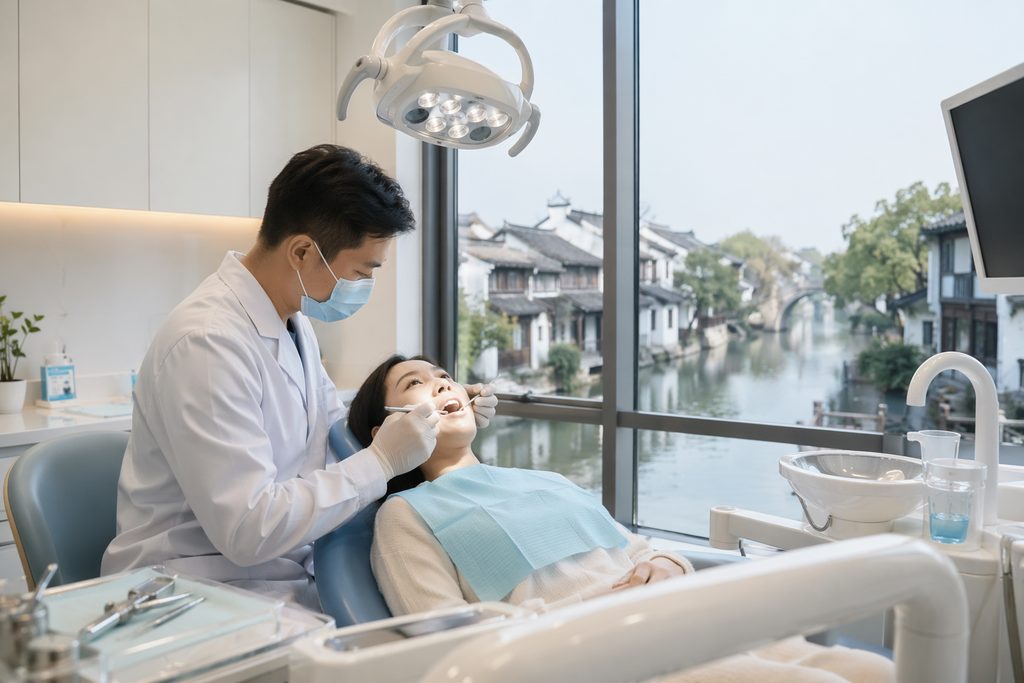
Dental Work in China: One-Stop Clinics for Implants, Veneers & Crowns
A dental implant that costs $4,500 in the United States can be placed in a top-tier Chinese clinic for roughly $800 to $1,800. That gap is why searches for dental implants cost China have climbed so sharply among patients in the US, UK, Australia and the Gulf. A “one-stop” dental clinic in China means one facility handles the scan, the surgery, the crown fabrication and the follow-up — no bouncing between three providers over six months.
But the cheap headline hides the real question. Is the clinic actually good? Who places the implant? What happens if it fails after you fly home? This guide walks through the honest version — pricing, safety, clinic selection, and the logistics nobody mentions until you’re already in the chair.
Dental Implants Cost China vs. the US: The Short Answer
Expect to pay 60–80% less in China than in the US for comparable implant work, and 40–60% less than in the UK or Australia. A single implant with abutment and crown runs $800–$1,800 at a reputable Chinese clinic. The same tooth in America: $3,000–$5,000.
That’s the number. The caveat is that “China” is not one market. A private international clinic in Shanghai charges three to four times what a public hospital dental department in Chengdu charges for the same procedure. Both can be excellent. They serve different patients.
Key takeaway: The savings are real, but they depend on which tier of clinic you choose and how much of the work is done in one visit versus staged over months.
Who This Is Right For — and Who It Isn’t
Dental tourism to China suits a specific kind of patient. It is not for everyone, and pretending otherwise wastes your money and your time.
Typically a good fit:
- You need multiple implants, full-arch work, or a smile makeover — cases where the per-tooth savings multiply into thousands.
- You’re already traveling to Asia for work, family or another medical reason.
- You have recent X-rays or a CBCT scan, or you’re willing to get one on arrival.
- You can stay 7–14 days for surgery, or you accept a two-trip protocol.
- You’re comfortable in a large, busy hospital environment with English-speaking staff at the international department.
Probably not a good fit:
- You have uncontrolled diabetes, active gum disease, or a bleeding disorder that a dentist hasn’t cleared.
- You’re a heavy smoker unwilling to stop — implant failure rates climb sharply.
- You need a single simple filling or cleaning. The travel cost wipes out the savings.
- You expect a Western-style boutique experience at a public hospital price. That combination does not exist.
- You need bone grafting plus immediate loading in one short trip. Some cases genuinely require staging.
The Options, Compared
Here’s how the main pathways stack up. Prices are 2026 ranges and vary by hospital, city and case complexity.
| Option | Typical Cost (Single Implant + Crown) | Wait Time | English Support | Best For |
|---|---|---|---|---|
| US private dental office | $3,000–$5,000 | 1–3 weeks | Native | Insurance-covered, single tooth |
| UK private dentist | £2,000–£3,000 | 2–6 weeks | Native | Patients wanting local follow-up |
| China public hospital dental dept. | $700–$1,200 | Same-day to 1 week | Limited | Budget-focused, flexible travelers |
| China private international clinic | $1,500–$2,800 | 1–3 days | Full | Foreigners wanting comfort + speed |
| China one-stop implant center | $900–$1,800 | 3–7 days | Moderate to full | Multi-implant and full-arch cases |
Which column fits you? If you have insurance that covers dental in your home country, staying home often wins. If you’re paying cash for four or more implants, the math flips hard toward China.
Finding the Best Dental Clinic Shanghai for Foreigners — and Elsewhere
Shanghai and Beijing carry the deepest bench of English-speaking dental providers, but they’re not the only options. Guangzhou, Shenzhen and Chengdu all have international departments with strong implant and prosthodontic teams.
What separates a genuinely good clinic from a marketing operation? Look for these signals:
- CBCT imaging on site. A 3D scan before implant planning is non-negotiable. If a clinic plans implants from a 2D panoramic X-ray alone, walk away.
- Named, licensed implantologists. You should know who is placing the implant and their training. Not “our expert team.”
- Branded implant systems. Straumann, Nobel Biocare, Zimmer, Osstem. These have global documentation and replacement parts. Unbranded “Korean-style” implants at rock-bottom prices are harder to service abroad.
- A written treatment plan with staged costs. Extraction, grafting, implant, abutment, crown — itemized. Not a single bundled number.
- Realistic timelines. A clinic promising same-day permanent teeth on a grafted jaw is cutting corners.
Practical tip: Ask the clinic to send your post-op X-rays and implant passport (brand, lot number, size) in English before you leave the country. Your home dentist will need it.
For a broader look at how international departments operate across Chinese hospitals, the private international hospital directory breaks down which facilities offer direct insurance billing and English-language care.
Is Dental Work in China Safe? The Honest Answer
Yes, at a properly selected clinic — and the evidence supports that. China trains more dentists annually than any other country, and its top dental schools (Peking University, Sichuan University, Shanghai Jiao Tong) run hospital programs that meet international standards. Many Chinese implantologists trained or practiced abroad.
The risk isn’t the country. It’s the clinic you pick. Sterilization protocols, implant brand, and the surgeon’s case volume vary enormously. A busy hospital implant center placing hundreds of implants a year will outperform a storefront clinic chasing tourist volume.
Three things reduce your risk dramatically:
- Choose a hospital-affiliated dental center or a JCI-accredited private clinic over a standalone shop.
- Insist on a CBCT scan and a written plan before any drilling.
- Confirm the implant brand and get the documentation.
Caution: Be skeptical of packages priced far below market — a $400 implant usually means an unbranded fixture with no follow-up support if it fails.
If you’re weighing other procedures too, the same due-diligence logic applies across specialties. Our guide to China’s top-ranked hospitals explains how the Fudan rankings work and why tier matters more than city.
How Much Do Veneers Cost in Beijing — and What About All-on-4?
Veneers and full-arch implants are the two biggest drivers of dental tourism, so they deserve their own numbers.
Veneers in Beijing: $250–$600 per tooth at a reputable clinic, depending on material (porcelain vs. composite) and whether the case is a simple cosmetic job or a full smile redesign. Compare that to $900–$2,500 per veneer in the US. A 10-tooth smile makeover in Beijing: roughly $3,000–$6,000. In America: $12,000–$25,000.
All-on-4 implants China price: a full-arch restoration (four implants supporting a fixed prosthesis) typically runs $6,000–$12,000 per arch at a quality Chinese clinic. The same procedure in the US: $20,000–$30,000 per arch. Note that All-on-4 is a specific Nobel Biocare trademarked protocol — other clinics offer equivalent “full-arch” solutions at similar or lower prices.
These ranges move based on:
- Implant brand (premium vs. value tier)
- Whether bone grafting is needed
- Provisional vs. final prosthesis on the day of surgery
- Clinic tier — public hospital department vs. private international clinic
- City — Beijing and Shanghai run 20–40% above Chengdu or Xi’an
Want a specific quote? A written second opinion from a Chinese dental specialist, based on your existing X-rays, typically costs $300–$500 and tells you whether the plan you’ve been offered is reasonable. That fee is credited in full toward coordination services if you proceed within 90 days.
Practical Considerations: Records, Visa, Payment, Follow-Up
Dental treatment is short compared to surgery, but the logistics still matter.
Records. Bring recent X-rays (within 12 months) and any CBCT scan on a USB drive or via cloud link. If you don’t have them, a CBCT in China costs $50–$150.
Visa. For medical or dental treatment, the applicable short-stay category is the S2 visa, which covers medical treatment and private affairs. Accompanying family members apply under the same category. The M visa is for commercial and trade activities — it is not a medical visa. Requirements change, so confirm current documentation with your nearest Chinese embassy or consulate and with the treating hospital, which will need to issue supporting documents.
Payment. Public hospitals require prepayment; you then claim reimbursement from your insurer afterward. Private international clinics often bill insurance directly. International credit cards work at most private clinics; public hospitals may prefer local payment methods, so carry a backup.
Language. At a large Chinese hospital, English is not guaranteed outside the international department. A bilingual medical companion — from $300 per day for a half or full day — handles registration, queueing, payment, translation and navigation. That’s the difference between a smooth trip and a stressful one.
Follow-up. Implants need monitoring at 3, 6 and 12 months. Ask your Chinese clinic to send records to your home dentist, and confirm your home dentist is willing to take over maintenance before you commit.
For patients considering a broader health check while in China, the specialty department directory shows which hospitals rank highest across 45 clinical areas.
Frequently Asked Questions
Sometimes. A single implant with an immediate temporary crown can be completed in 7–10 days, with the permanent crown fitted on a second trip or made remotely from a digital scan. Full-arch cases often require two visits several months apart. Any clinic promising permanent teeth in three days on a grafted jaw is cutting corners.
Usually yes, if you bring documentation. Ask for the implant brand, lot number, size, and post-op X-rays in English. Some dentists are reluctant to take over another provider’s work — a conversation before you travel prevents awkwardness later.
Implant failure within the first year is uncommon but real, with published rates typically in the low single digits for healthy non-smokers. Most branded implants carry a manufacturer warranty on the fixture itself, though not on surgical fees. Repair usually means returning to China or paying a local dentist to redo the work. Budget accordingly and choose a clinic with a written aftercare policy.
A coordination service is not a hospital and does not perform dental work. What a reputable service does is translate records, help you compare clinics, coordinate appointments through official international departments, and provide bilingual accompaniment. Be wary of anyone quoting a single bundled price without showing you the clinic’s own itemized fee schedule.
The S2 visa is the applicable short-stay category for medical treatment and private affairs, subject to current embassy requirements and supporting hospital documents. It is not the M visa, which covers commercial and trade activities only. Confirm the latest rules with your nearest Chinese embassy before booking flights.
Your Next Step
Dental work in China can save you thousands without sacrificing quality — provided you choose the right clinic, confirm the implant brand, and plan for follow-up. The savings are real; the shortcuts some clinics take are equally real.
We’re China Medical Services. We are not a hospital and we don’t diagnose or treat anyone. What we do is connect international patients with vetted Chinese dental and medical facilities, translate records, coordinate appointments through official international departments, and provide bilingual support on the ground. If you’d like a written opinion on a treatment plan you’ve already been quoted, or help comparing clinics in Shanghai, Beijing or elsewhere, you can request a free consultation — no obligation, no pressure.
This article is for general information only and is not medical advice. Treatment decisions should be made with a qualified dental professional who has reviewed your individual case.
For more medical information and treatment options in China, visit chinamedservices.com (China Medical Services).
