Musculoskeletal Imaging Review Service China: Joint and Spine MRI Orthopedic Specialist Read
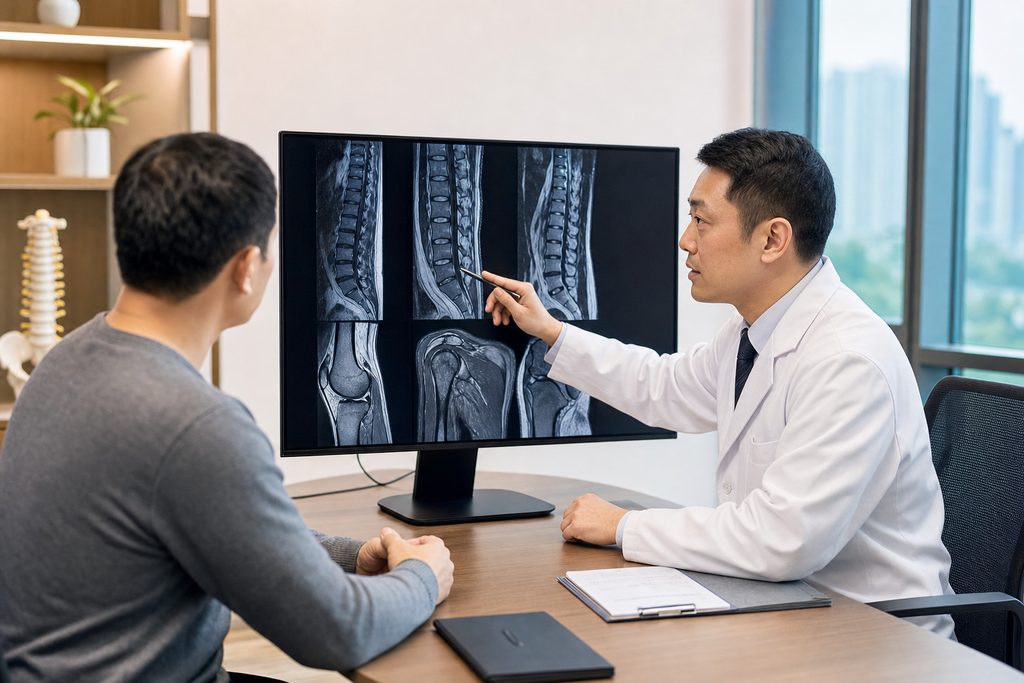
Key Takeaways
- A remote MRI second opinion from a top Chinese orthopedic radiologist typically costs $300–500, compared to $1,000–3,000 in the U.S. for a comparable subspecialist read.
- China’s busiest orthopedic hospitals handle imaging volumes that are simply not seen in any Western institution, which builds a diagnostic acumen that is hard to replicate.
- Navigating hospital portals, payment systems, and language barriers alone is genuinely difficult—most international patients hit a wall within the first 48 hours of trying.
- A written second opinion is for reference only. It is not a prescription. It does not replace an in-person consultation, but it can clarify whether traveling for treatment is the right next step.
The Problem: A Life-Altering Diagnosis Deserves a Second Set of Eyes
You are sitting with an MRI report that uses words like “severe foraminal stenosis” or “full-thickness chondral defect.” Your local orthopedist has recommended surgery. But something does not sit right. You want another read—a truly independent assessment from a specialist who looks at hundreds of these scans every month. The wait for a subspecialist appointment in your home country? Four months. The cash price for a second opinion at a major U.S. academic center? Often $1,500 to $3,000. That is the gap we help close. A joint and spine mri second opinion China cost runs a fraction of that, and the turnaround can be measured in days, not seasons.
Around 1 in 4 adults globally lives with some form of musculoskeletal condition, according to the WHO. Spine and joint disorders lead that list. MRIs are ordered by the millions. But the quality of the read—the interpretation that decides whether you go under the knife—varies enormously. A 2020 study in The Spine Journal found that when lumbar MRI reports from community radiologists were re-reviewed by spine specialists, the interpretation changed in nearly 40% of cases. That is not a typo. Forty percent. The scan is the same. The eyes looking at it are not.
Who We Are
We are not a hospital. We do not employ radiologists or orthopedic surgeons. We do not provide clinical diagnoses. What we do is act as your logistical bridge to China’s top-tier musculoskeletal imaging specialists. Our team handles the unglamorous, essential work: translating your medical records into clinical Chinese, identifying the right subspecialist at the right hospital, coordinating the upload of your DICOM files, and ensuring the final report comes back to you in clear, actionable English. Think of us as your case managers for the diagnostic journey—not the doctors, but the people who make sure the doctors can focus entirely on your images.
Why a Musculoskeletal Imaging Review from China Delivers Results
The value here is not just about price. It is about volume and specialization. China’s hospital system is structured on a scale that creates unintentional centers of excellence. A single orthopedic hospital in Beijing may handle more complex spine cases in a quarter than a regional U.S. hospital sees in three years. That repetition sharpens diagnostic skills in ways that smaller systems cannot match.
Clinical Volume Drives Diagnostic Precision
Beijing Jishuitan Hospital, one of the country’s premier orthopedic centers, performs over 40,000 orthopedic surgeries annually. Its radiology department reads musculoskeletal images all day, every day. The subspecialists there—the ones who only look at knees, or only look at lumbar spines—see rare presentations, subtle fractures, and tricky post-surgical changes with a frequency that builds pattern recognition no textbook can teach. When you request a musculoskeletal imaging review service Shanghai or Beijing, you are tapping into that concentrated experience. The radiologist reviewing your scan has likely seen your exact pathology hundreds of times before.
Technology and Efficiency at Scale
Chinese hospitals have invested heavily in imaging infrastructure over the past decade. 3T MRI machines are standard at top-tier public hospitals. PACS (Picture Archiving and Communication Systems) are mature and widely interoperable. What does that mean for you? Your DICOM files—whether from a CD burned in Toronto or a portal download in London—can be uploaded, routed, and displayed on a specialist’s workstation in Shanghai within hours. The bottleneck is rarely the technology. It is knowing which hospital’s portal to use, which department accepts external second-opinion requests, and how to format the clinical history so it meets local standards. That is the coordination layer we provide.
Cost Advantage Without Quality Compromise
Let us address the obvious question directly. A joint and spine mri second opinion China cost is lower because the underlying economics are different—not because the expertise is inferior. A senior orthopedic radiologist in China earns a strong professional salary by local standards, but that salary is structurally lower than what a comparable subspecialist commands in the U.S. or Switzerland. Hospital overhead, malpractice insurance structures, and administrative costs all follow the same pattern. The clinical training, however, is world-class. Many of the radiologists reading these scans trained at Fudan, Peking Union, or West China medical schools and have published in international journals. The quality of the read is not discounted. The price reflects local economics, not local competence.
What You Need to Know Before Going Alone
We are direct about this because it saves everyone time. Trying to navigate this process independently is hard. Not impossible—but genuinely hard. Here are the specific barriers that trip up most international patients.
- Hospital Portals Are Not Built for Foreign Patients: Most Chinese hospital second-opinion platforms operate entirely in Mandarin. They require a local phone number for verification. They ask for a national ID number format that does not match a foreign passport. You can spend three frustrating hours just trying to create an account.
- Payment Channels Are a Maze: Hospital billing departments typically accept WeChat Pay, Alipay, or domestic bank transfers. Your Visa or Mastercard will often be declined. International wire transfers take days to clear and require precise invoicing details in Chinese that the hospital may not proactively provide.
- Medical History Translation Is Clinical, Not Conversational: Google Translate will butcher a phrase like “anterolisthesis with bilateral pars defects.” The radiologist receiving a poorly translated history may miss critical context. Your previous surgical notes, contrast allergy status, and the specific clinical question you need answered must be rendered in precise medical Chinese. This is not a task for a bilingual friend. It requires a medical translator who understands both orthopedic terminology and the reporting conventions of Chinese radiology departments.
How We Help You Navigate This
These barriers exist for structural reasons, not because anyone is trying to make it difficult. Our process is designed to dissolve them one by one.
It starts with your images and your story. You send us your DICOM files, your existing radiology report, and a brief explanation of what you need clarified. Our medical translators render your clinical history into precise Chinese. We then identify the right subspecialist—not just any orthopedic radiologist, but one whose daily caseload matches your specific condition. A knee specialist for a meniscus question. A spine surgeon for a stenosis debate.
We handle the hospital registration, the file upload, and the payment. When the report comes back in Chinese, our team translates it into clear English, preserving every clinical nuance. You receive a written document you can take to your local doctor. The entire process, from file receipt to final English report, typically takes 5 to 10 business days. The written second opinion costs between $300 and $500. That fee covers the hospital’s charge, our translation work, and our coordination time.
And here is the part that matters if you decide to take the next step. If, within 90 days of receiving that written opinion, you choose to come to China for in-person treatment, every dollar of that second-opinion fee is credited toward our on-the-ground coordination service. The credit applies to our coordination fee—not to hospital treatment charges—but it means your diagnostic investment is never lost. It becomes the first step in a larger journey, if you choose to take it.
How to Get an Orthopedic MRI Read by a Specialist in China
The phrase how to get orthopedic mri read by specialist in China implies a simple transaction. It is not. But the steps are clear once you understand the landscape. You need your images in DICOM format—not JPEGs, not a PDF of the report. You need a focused clinical question. “Please review my knee MRI” is too vague. “Please assess the integrity of my ACL graft and evaluate for any meniscal tear missed on the initial read” gives the radiologist a target. You need patience with administrative timelines. And you need a partner on the ground who can speak to the hospital in their language, through their systems, on their terms. That is the service we provide.
Some patients ask us: is remote spine mri interpretation from China reliable? The answer depends on the radiologist, not the geography. A remote read from a fellowship-trained spine radiologist at a major Chinese orthopedic center is as reliable as a remote read from a comparable specialist anywhere else. The key variables are the quality of the uploaded images, the completeness of the clinical history, and the subspecialty match between the radiologist and the pathology. Get those three things right, and the interpretation will be solid. Get them wrong, and even the best radiologist is working with incomplete information.
Choosing the Best Hospital for Joint MRI Review Abroad
Not every hospital excels at every body part. When patients ask us about the best hospital for joint mri review abroad, we point them toward institutions with dedicated musculoskeletal radiology departments and high surgical volumes in the relevant subspecialty. Beijing Jishuitan Hospital is the reference point for orthopedics. Shanghai Sixth People’s Hospital is renowned for limb and joint work. For spine-specific questions, the orthopedics department at Peking University Third Hospital is among the country’s strongest. These are all public, top-tier hospitals in China’s Fudan-ranked top 100 system. Their radiology departments handle volumes that create genuine subspecialization.
If you prefer an English-speaking environment from the start, private international hospitals like United Family or Jiahui offer radiology second opinions with Western-trained specialists. The cost will be higher—closer to $800–1,000 for a written read—but the entire interaction happens in English, and the reports are formatted in a style familiar to Western referring physicians.
Booking an Online Musculoskeletal Imaging Specialist in China
Probably not directly. Most Western insurance plans do not have pre-existing relationships with Chinese hospitals for remote second opinions. You will likely pay out of pocket and can then submit the receipt to your insurer for possible out-of-network reimbursement. Check with your plan administrator. We provide a detailed invoice in English that meets standard insurance documentation requirements.
That is exactly why you seek a second opinion. A disagreement is not a problem—it is information. You take both reports to your treating physician and have a more informed conversation. The Chinese radiologist’s report is one data point in your decision-making process. It carries weight because of the volume and specialization behind it, but it does not override your local doctor’s clinical judgment. It adds to it.
No. A written second opinion is for reference only. It is not a surgical clearance, not a treatment plan, and not a substitute for an in-person consultation. If the opinion suggests that surgery is warranted and you want to pursue treatment in China, the next step is an in-person evaluation. The surgeon will conduct their own physical exam and review your imaging before scheduling any procedure.
We transfer DICOM files through hospital-provided secure upload portals or encrypted file transfer services. We do not store your images on our own servers beyond the time needed to complete the case. The hospitals we work with are subject to China’s data protection regulations, and we have internal protocols to delete patient files after case closure unless you request otherwise.
Your Next Step
A second opinion does not commit you to anything. It clarifies what you are dealing with and whether the recommended path forward makes sense. China’s top orthopedic radiologists offer a level of subspecialized volume that is genuinely rare, and the cost of accessing that expertise is a fraction of what you would pay at home. If you have your DICOM files and a question you need answered, we can help you get that answer. Reach out through our consultation page and tell us about your case. No pressure. Just a conversation about what is possible.
Frequently Asked Questions
Yes. We work with JCI-accredited and major Grade 3A tertiary hospitals that follow international safety standards comparable to top hospitals in the US and Europe. Surgical teams perform high volumes of procedures — often more than their Western counterparts — which studies show leads to better outcomes.
Costs vary by procedure and hospital, but international patients typically save 40-80% compared to US prices — even when factoring in travel and accommodation. A consultation with our team will give you an exact, all-inclusive quote with no hidden fees.
Send us your existing medical reports. The relevant specialty reviews them and gives you a written opinion, including treatment direction and options, before you commit to any travel. From there you can add a video consultation with the doctor, or have us attend an appointment on your behalf.
For more medical information and treatment options in China, visit chinamedservices.com (China Medical Services).
