Dermatology Hospitals in China: How to Choose the Right Clinic
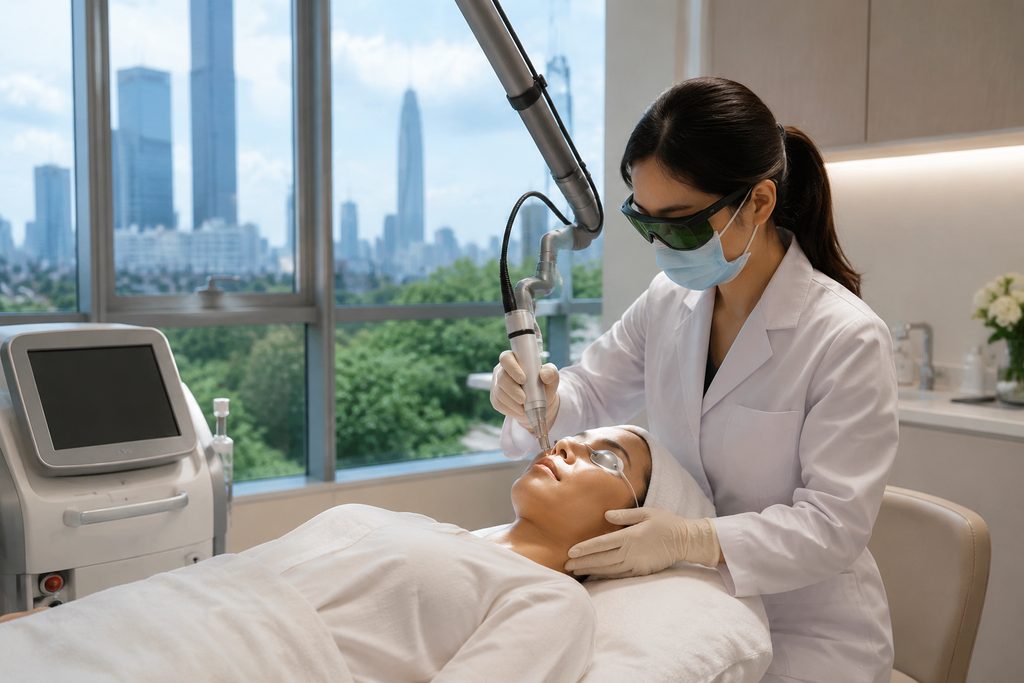
Key Takeaways
- China’s top dermatology departments sit inside large public hospitals ranked by Fudan University; a private international clinic in Shanghai or Beijing offers English-language care at roughly 1.5–2x the public price.
- Laser and skin procedures often cost 40–70% less than in the US or Western Europe, but pricing varies sharply by hospital tier, device type, and how many sessions your case needs.
- Public hospital outpatient slots cannot be reserved from abroad in advance. Surgery and certain procedures require an in-person consultation first — that is a national rule, not a hospital quirk.
- Any treatment decision belongs with a licensed dermatologist who has examined your skin. This article explains the system, not your diagnosis.
What if the hardest part of treating your skin wasn’t the condition itself, but figuring out where in the world to get it treated well — and at a price that doesn’t require a second mortgage?
That question sends thousands of international patients to search for dermatology hospitals in China every month. And the honest answer is that China has genuinely world-class skin care, but the system works nothing like the one you’re used to. Understanding dermatology hospital cost China-wide means understanding three separate tracks — public tertiary hospitals, private international clinics, and traditional Chinese medicine — each with its own pricing, booking rules, and pace.
The Problem: Western Dermatology Is Expensive and Slow
In the United States, the average wait to see a dermatologist for a non-urgent concern runs four to six weeks in many metropolitan areas, according to physician recruitment surveys. In the UK, NHS dermatology waiting lists have stretched past 12 weeks for routine referrals in several regions. Meanwhile, a single laser session for acne scarring in a US clinic commonly runs $500 to $1,500, and a full course of six sessions can pass $6,000 before insurance — which frequently classifies cosmetic skin treatment as non-covered.
Cost isn’t the only friction. Patients describe the same pattern again and again: a rushed 10-minute consultation, a prescription handed over without much explanation, and a follow-up appointment booked three months out. For chronic conditions like psoriasis, eczema, melasma, or severe acne, that rhythm is exhausting. And for anyone paying out of pocket, it’s expensive on top of being slow.
So people start looking elsewhere. That’s when China enters the picture — not because it’s trendy, but because the numbers are hard to ignore.
Why China’s Dermatology Departments Deliver Real Value
Clinical Volume That Western Clinics Rarely Match
A senior dermatologist at a major Chinese tertiary hospital may see 60 to 100 outpatients in a single day. That sounds overwhelming — and it is — but it also means these physicians have pattern recognition that comes only from volume. Rare presentations of common conditions get identified faster because the doctor has literally seen thousands of them.
China’s top hospitals also run dedicated subspecialty clinics: pigmentary disorders, hair and scalp disease, pediatric dermatology, dermatologic surgery, and phototherapy units. A patient with stubborn melasma isn’t sent to a generalist; they land in a clinic that treats little else.
Technology and Efficiency at Scale
Large Chinese hospitals invest heavily in laser platforms. It’s common to find a single dermatology department operating multiple device types — Q-switched Nd:YAG, fractional CO2, picosecond lasers, intense pulsed light, and excimer systems — under one roof. In the US or Europe, a private clinic typically owns one or two devices and refers you elsewhere for anything outside its inventory.
That concentration matters practically. If your treatment plan needs a combination approach, it can often happen in one department across a compressed timeline rather than being split across three providers over six months.
Cost Advantage Without the Quality Trade-Off
Here’s the objection worth addressing directly: does lower cost mean lower quality? Not in the top-tier hospitals. The structural reasons for the price gap are straightforward — physician salaries, facility overhead, and drug and device procurement costs are all substantially lower in China. Volume spreads fixed costs further. The clinical training at Fudan, Peking Union, and similar institutions is rigorous, and many department heads have trained or published internationally.
What you’re buying at a top Chinese hospital is expertise and equipment. What you’re not buying is a marble lobby and a concierge desk — unless you choose the private international track, which we’ll get to.
Public vs. Private vs. TCM: Which Track Fits Your Case
This is the decision that actually determines your experience. The three tracks are not ranked by quality — they’re ranked by what you need.
| Factor | Public Tertiary Hospital | Private International Clinic | TCM Hospital |
|---|---|---|---|
| Typical consultation fee | $15–$60 | $150–$400 | $10–$40 |
| Laser session (per session) | $80–$400 | $300–$900 | Rarely offered |
| English support | Limited; international department helps | Full English service | Limited |
| Advance booking from abroad | Generally not for standard outpatient | Usually yes | Generally not |
| Insurance direct billing | No — pay first, claim later | Often yes with international plans | No |
| Best suited for | Complex or chronic conditions, cost-sensitive patients | Convenience, English care, straightforward cases | Chronic management, rehabilitation, adjunct care |
Prices vary by hospital and case complexity, and the ranges above are indicative rather than quoted. A private clinic in Shanghai’s Jing’an district and one in a second-tier city can differ by 50% for the identical procedure.
If your priority is a specific subspecialist at a top-ranked public hospital, the international department or VIP channel is the realistic route — expect roughly 1.5 to 2 times standard pricing for that access and English-language coordination.
How to Actually Book Dermatology Care in China
This is where most international patients hit a wall, so let’s be precise about the sequence.
Step one: get your records translated and organized. Biopsy reports, prior treatment history, photos of the condition over time, and any lab work. Chinese dermatologists work fast; arriving with a clean, translated summary saves an entire appointment.
Step two: decide whether you need a written second opinion or a video consultation first. A written second opinion from a top-hospital specialist typically runs $300–$500. A video consultation with a standard tertiary international department runs $100–$300, and with a top specialist, $500–$800. For complex cases, a multidisciplinary team consultation runs $1,500–$2,000. These let you hear a real assessment before booking flights.
Step three: understand the consultation rule. Standard public hospital outpatient slots cannot be reserved from overseas in advance. You register on the day. Any procedure — laser, excision, injectable — requires an in-person consultation first. No exceptions, no workarounds. If someone promises you a guaranteed surgery date before you’ve been seen, that’s a red flag.
Step four: handle the visa correctly. Medical travel to China uses the S2 visa with a treatment annotation; stays beyond 180 days use S1. Accompanying family members apply for S2 as well. Note that the M visa is for commercial and trade activity only — it is not a medical visa, despite what some outdated blogs claim. Always confirm current requirements with the nearest Chinese embassy or consulate, and bring your hospital’s supporting documents.
Step five: plan payment. Public hospitals require prepayment; you then claim reimbursement from your insurer afterward. Private international clinics frequently bill your insurance directly if your plan has a China network. Bring a card that works internationally and confirm daily transaction limits with your bank before you travel.
Safety, Standards, and What to Ask Before You Commit
Is dermatology treatment in China safe? At accredited top-tier hospitals and JCI-certified private clinics, the standards for sterilization, device maintenance, and informed consent are comparable to Western norms. The variable isn’t the country — it’s the specific facility.
Ask these questions before booking anywhere:
- Which laser platform and model will be used, and how old is it?
- Who performs the procedure — a board-certified dermatologist or a technician?
- How many sessions does the plan include, and what’s the total cost rather than the per-session cost?
- What does aftercare look like, and who do I contact if I have a reaction after flying home?
- Is there a written treatment plan in English?
Be cautious with any clinic that quotes a single fixed price for a package before examining your skin. Skin responds individually, and honest providers build in that uncertainty. Also be wary of “medical tourism skin treatment packages China” offers that bundle flights, hotels, and procedures at a suspiciously round number — the clinical assessment should drive the plan, not the package.
One more honest note: China is not the right choice for every case. If you have a rare dermatologic condition requiring a highly specialized multidisciplinary team, or if continuity with one physician over years matters most to you, staying closer to home may serve you better. And if travel itself is medically risky for you, that outweighs any cost saving.
Frequently Asked Questions
At a top public hospital in Beijing, a single fractional laser session commonly falls between $100 and $400, versus $500 to $1,500 in a typical US clinic. Private international clinics in Beijing sit higher, often $300 to $900 per session. Total cost depends on how many sessions your condition needs, which only a dermatologist can determine after examining you.
For private international clinics, usually yes. For standard public hospital outpatient departments, generally no — you register in person on the day. What can be arranged in advance is a written second opinion or a video consultation, and for public hospitals, coordination through the international department or VIP channel. Surgery and procedures always require an in-person consultation first, and no service can guarantee a specific doctor or date.
At accredited tertiary hospitals and JCI-certified private clinics, yes — safety standards are broadly comparable to Western facilities. The main risks for foreign patients are communication gaps and choosing an unaccredited clinic based on price alone. Bring translated records, ask who performs the procedure, and confirm aftercare instructions in writing before you leave.
Some international health plans reimburse treatment at Chinese public hospitals, but you typically pay upfront and file a claim afterward. Private international clinics more often offer direct billing if your insurer has a China network. Check your policy’s overseas coverage terms and any pre-authorization requirements before traveling — this is the single most common source of surprise bills.
Your Next Step
Choosing a dermatology hospital in China comes down to matching the right track — public, private, or TCM — to your specific condition, timeline, and budget. The system rewards preparation, and the biggest mistake is booking a procedure before you’ve had a proper assessment.
China Medical Services is a coordination service, not a hospital and not a provider of medical diagnoses. We help international patients compare hospitals, arrange written second opinions and video consultations, coordinate appointments, and provide bilingual medical companions on the ground. If you’d like to understand your options before committing to anything, start with a free consultation and we’ll walk you through what’s realistic for your case.
For more medical information and treatment options in China, visit chinamedservices.com (China Medical Services).
