DEXA Scan in China: Bone Density Check Costs and Top Hospitals
Key Takeaways
- A DEXA scan in China typically costs $60–$250 at top-tier public hospitals — often 70–90% less than the same test in the United States.
- China’s leading hospitals run DEXA on the same Hologic and GE Lunar equipment used in Western clinics, with T-scores reported in the standard WHO format your home doctor can read.
- Public hospital imaging departments generally do not accept overseas advance bookings — you register on the day, which is why coordination matters.
- Radiation from a DEXA scan is extremely low, but no scan replaces a conversation with a qualified physician about your individual risk.
When 58-year-old Margaret from Portland learned her mother had fractured a hip at 79, she did what a lot of women do — she called her insurance company. The receptionist told her a routine DEXA scan would be covered, but the earliest appointment at her local imaging center was eleven weeks out. Eleven weeks to find out whether her bones were quietly thinning. She started searching for alternatives and stumbled onto something she hadn’t considered: flying to Asia for a test that takes twelve minutes.
That story isn’t unusual. Osteoporosis affects roughly 1 in 5 women over 50 in the United States, according to the CDC, and a large share of them never get screened on schedule. Wait times, deductibles, and referral bottlenecks keep pushing the test to next year. So the question becomes practical: what does a DEXA scan cost in China, and is it worth building a trip around?
This guide answers that in plain language. We’ll cover pricing, accuracy, safety, how to book a bone density test in Beijing or Shanghai, and what to watch out for.
The Problem: Screening Gets Delayed Until It’s Too Late
Osteoporosis is often called a silent disease for a reason. You feel nothing as bone mineral density drops. The first symptom is frequently a fracture — a wrist, a vertebra, a hip — and by then you’ve lost years of treatment time. The International Osteoporosis Foundation estimates that worldwide, one in three women and one in five men over 50 will break a bone because of osteoporosis.
A DEXA scan (dual-energy X-ray absorptiometry) is the gold standard for catching this early. It’s fast, painless, and produces a T-score that tells your doctor exactly where you stand. So why do so many people skip it? Cost is one factor. In the US, a self-pay DEXA scan runs $150–$300 at many centers, and that’s before any follow-up consultation. Access is another. Rural and even suburban clinics can be booked months out.
Then there’s the insurance maze. If you’re between jobs, on a high-deductible plan, or traveling abroad for an extended period, a preventive scan can fall through every crack.
Why China Delivers Results for Bone Density Testing
China’s healthcare system is enormous and uneven, but at the top tier — the hospitals that dominate the Fudan ranking and hold JCI accreditation — imaging quality is genuinely world-class. Here’s what makes it worth considering.
Equipment and Reporting Standards Match Western Clinics
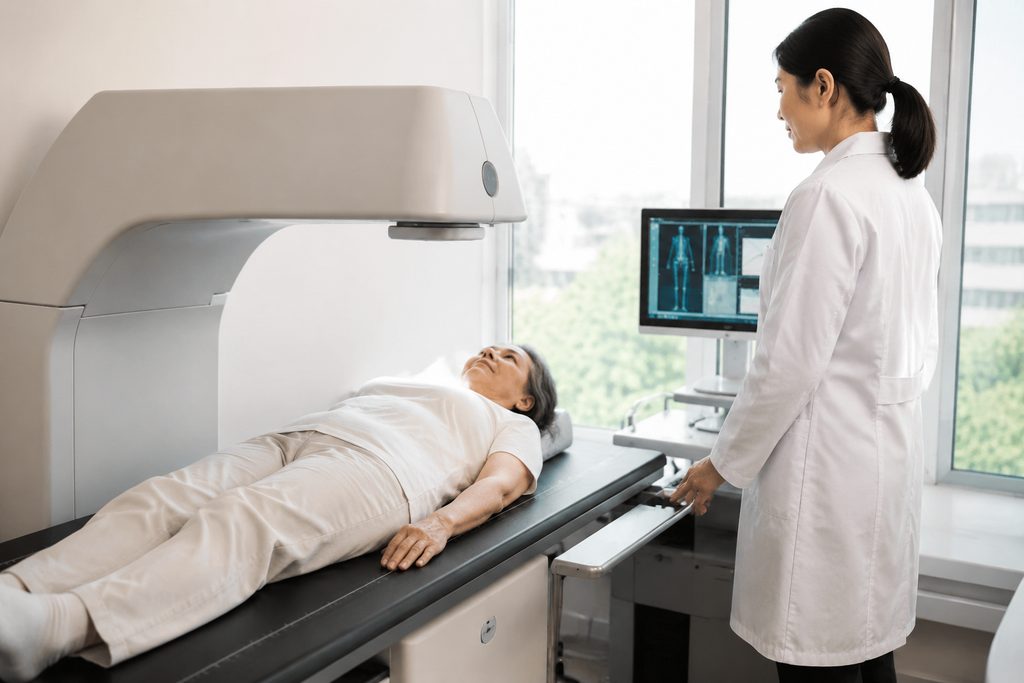
Top Chinese hospitals use the same DEXA platforms you’d find at Massachusetts General or the Mayo Clinic: Hologic Discovery series and GE Lunar Prodigy systems, calibrated to the same reference databases. T-scores are reported using the WHO diagnostic thresholds — normal (above -1.0), osteopenia (-1.0 to -2.5), osteoporosis (below -2.5). Your physician back home can read the report without translation gymnastics.
That matters more than people realize. A scan is only useful if the numbers travel with you.
Volume and Speed
A major Chinese tertiary hospital may perform hundreds of DEXA scans weekly. That throughput means appointments move quickly, results are typically ready within 24–48 hours, and the radiologist reading your scan has seen thousands of similar cases. The learning curve is steep when you do this every day.
Cost Without the Compromise
Here’s where China separates itself. The same scan, on comparable equipment, with a board-certified radiologist reading it, costs a fraction of Western pricing. Labor economics, hospital efficiency, and sheer patient volume all push the number down. It’s not a discount because something is missing — it’s a discount because the system is structured differently.
| Location | Typical DEXA Scan Cost (USD) | Wait Time |
|---|---|---|
| United States (self-pay) | $150 – $300 | 2–12 weeks |
| United Kingdom (private) | £100 – £250 (~$130–$320) | 1–4 weeks |
| China — top public hospital | $60 – $150 | Same day to 3 days |
| China — private international hospital | $150 – $250 | 1–5 days, English service |
Prices vary by hospital and case complexity, and a scan is only one line item. If you’re combining the test with a broader health checkup, the total changes. Our team can walk you through realistic numbers for your situation.
How to Book a DEXA Scan in Beijing: A Step-by-Step Walkthrough
This is the part most guides skip. Booking a DEXA scan in Beijing — or Shanghai, Guangzhou, or Chengdu — is not the same as booking one in Chicago. Public hospitals don’t operate on the Western appointment model.
Step 1: Choose your hospital tier. Public tertiary hospitals (the ones in the Fudan Top 100 list) offer the lowest prices but require you to register in person. Private international hospitals like United Family or Jiahui offer English-speaking staff, direct insurance billing, and easier scheduling at roughly 1.5–2x the public price.
Step 2: Prepare your records. Bring any prior DEXA reports, medication lists (especially steroids or hormone therapy), and a brief medical history in English. Chinese radiologists can read English reports, but having a translated summary speeds things up.
Step 3: Register on the day at public hospitals. You’ll queue for a registration number, pay the imaging fee upfront, then proceed to the nuclear medicine or radiology department. Total time from arrival to scan completion: often 2–4 hours.
Step 4: Get your results. Reports are typically issued within 24–48 hours. Some hospitals provide English-language reports on request.
Step 5: Follow-up. If your T-score indicates osteopenia or osteoporosis, you’ll want a consultation with an endocrinologist or rheumatologist. This is where having a bilingual companion makes a real difference — discussing treatment options in a language you don’t speak is stressful.
Is a DEXA Scan Safe in China? Accuracy, Radiation, and What to Verify
Safety is the first question we hear, and it’s a fair one. Let’s address it directly.
Radiation exposure. A DEXA scan delivers roughly 1–10 microsieverts — about the same as a few hours of natural background radiation, or a fraction of a single chest X-ray. It is one of the lowest-dose imaging studies in medicine. The equipment and protocols at accredited Chinese hospitals follow international standards.
Accuracy. How accurate is a DEXA scan for osteoporosis? When performed on a calibrated machine and read by a trained radiologist, DEXA has a precision error of about 1–2% at the lumbar spine and hip. That’s excellent. The catch is that accuracy depends on machine calibration and technologist technique — which is why choosing an accredited facility matters.
What to verify. Ask whether the hospital uses Hologic or GE Lunar equipment, whether the department participates in external quality assurance programs, and whether the report includes both T-scores and Z-scores. A reputable facility will answer these questions without hesitation.
One more point: a DEXA scan is a screening and monitoring tool, not a diagnosis in itself. The result needs interpretation by a clinician who knows your history.
Practical Considerations: Visas, Payment, and Follow-Up
At public hospitals, generally no — registration happens on the day. Private international hospitals and some VIP international departments can arrange appointments in advance. This is one of the practical reasons patients work with a coordination service: we handle the scheduling logistics so you’re not navigating a Chinese-language registration system on arrival.
Most top hospitals can provide an English-language report on request, and the T-score format follows WHO standards that any physician recognizes. That said, not every doctor will accept a scan performed abroad without question. Bringing the full report — not just the summary — gives you the best chance of seamless continuity.
That’s a conversation to have with a qualified physician, ideally an endocrinologist or rheumatologist. Treatment options range from lifestyle changes and calcium/vitamin D supplementation to bisphosphonates and other medications. A scan is the starting point, not the answer.
Your Next Step
A DEXA scan is one of the simplest, lowest-risk ways to understand your bone health — and doing it in China can be fast, affordable, and accurate when you choose the right facility. The information above should give you a clear picture of what’s involved. If you’d like help identifying the right hospital, understanding costs for your specific situation, or coordinating the logistics, our team at China Medical Services is here to help. We’re not a hospital and we don’t provide medical diagnoses — we connect international patients with China’s top hospitals and handle the coordination so you can focus on your health. Reach out for a free consultation whenever you’re ready.
This article is for informational purposes only and does not constitute medical advice. Always consult a qualified healthcare provider about your individual health needs.
Frequently Asked Questions
Yes. The hospitals used for international patients are JCI-accredited and follow the same international safety standards as top hospitals in the US and Europe. Surgical teams perform high volumes of procedures — often more than their Western counterparts — which studies show leads to better outcomes.
Costs vary by procedure and hospital, but international patients typically save 40-80% compared to US prices — even when factoring in travel and accommodation. A consultation with our team will give you an exact, all-inclusive quote with no hidden fees.
Send us your existing medical reports to get started. We handle everything from hospital selection and appointment scheduling to visa assistance and post-operative recovery planning. Your medical records are reviewed by the specialist before you even book a flight.
For more medical information and treatment options in China, visit chinamedservices.com (China Medical Services).
