Gastroscopy in Hangzhou: Cost and Booking for International Patients
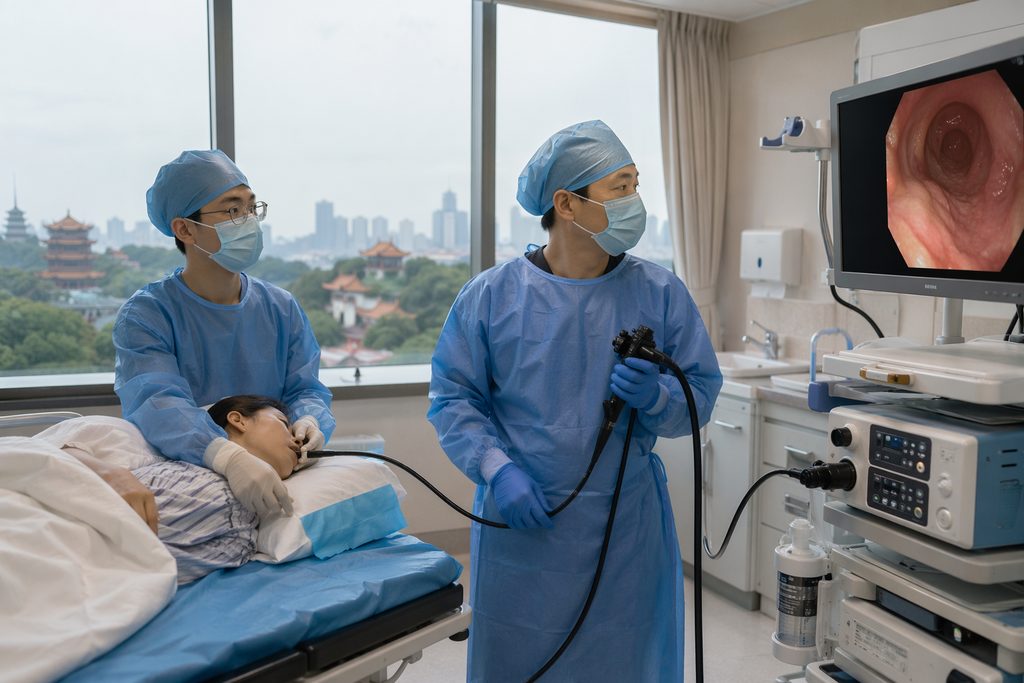
Gastroscopy in Hangzhou: Cost and Booking for International Patients
You’ve probably heard that arranging a medical procedure in China means guesswork, cash upfront, and a language wall you cannot climb. For a gastroscopy in Hangzhou, the reality is more manageable than the rumor — and considerably cheaper than the same scope in the United States. A diagnostic upper endoscopy at a top-tier Hangzhou hospital typically runs $150 to $500 depending on whether sedation, biopsy, and pathology are included. The gastroscopy cost Hangzhou hospitals quote to international patients sits far below the $1,500–$3,000 range common in American outpatient centers. What actually trips people up is not the price. It is the booking.
How This Actually Works, Step by Step
Start with what you have in hand: your symptoms, your existing reports, and a rough travel window. From there, the sequence is fairly predictable.
First, you send us your medical records — prior endoscopy reports, bloodwork, imaging, medication list, and a short note on what you’re hoping to rule out or confirm. Our team translates the relevant documents and routes them to the gastroenterology department of a Hangzhou hospital that fits your case. Not every hospital handles every situation equally well, and matching matters more than brand name.
Second, you receive a written assessment or, if you prefer, a video consultation with the specialty team. This is where you learn whether a gastroscopy is even the right next step. Sometimes it is. Sometimes the doctor wants a different test first. That conversation saves people from flying across the world for a procedure they didn’t need.
Third, once the plan is clear, we coordinate the appointment. Here is the part most guides skip: at Chinese public hospitals, you generally cannot pre-book an ordinary outpatient slot from overseas. Registration happens on the day, in person. What we can do is arrange access through the hospital’s international or VIP channel, where an English-speaking coordinator helps you register, pay, and move through the department without standing in the wrong queue for two hours.
Fourth, you arrive, complete the scope, and receive a preliminary report the same day in most cases. Biopsy results, if taken, usually come back within three to seven working days.
What a Gastroscopy Costs in Hangzhou — and Why the Number Moves
Price transparency is where most medical tourism content falls apart. So let’s be specific about what drives the gastroscopy cost Hangzhou patients actually pay.
| Service Component | Typical Range (USD) | Notes |
|---|---|---|
| Standard diagnostic gastroscopy (no sedation) | $150 – $300 | Public hospital, ordinary channel |
| Gastroscopy with sedation | $250 – $450 | Anesthesia fee added separately |
| Biopsy + pathology | $50 – $150 | Per specimen, varies by lab |
| International/VIP channel surcharge | 1.5x – 2x base | English service, faster scheduling |
| Private international hospital | $600 – $1,200 | Direct insurance billing possible |
Three factors push the number up or down. Sedation adds cost but most international patients request it. Biopsies add cost and are common when the doctor sees anything worth sampling. And the channel you choose — ordinary versus international — can nearly double the total. None of these are hidden fees; they are simply itemized differently than in Western billing.
For comparison, a diagnostic upper endoscopy in the US averages well over $1,000 even before pathology, and can climb past $3,000 with facility fees. That gap is the reason Hangzhou has become a realistic stop for people already traveling in Asia, or willing to combine a procedure with a few days in the city.
Final pricing always varies by hospital and case complexity. Anyone quoting you a single fixed figure before seeing your records is guessing.
A Realistic Timeline
Here is how the calendar usually unfolds for someone starting from scratch.
| Stage | Typical Duration | What Happens |
|---|---|---|
| Record collection & translation | 2 – 5 days | You send reports; we translate and forward |
| Specialist review / consultation | 3 – 7 days | Written opinion or video call |
| Appointment coordination | 1 – 3 weeks | Depends on hospital schedule and channel |
| Visa (S2) processing | 1 – 2 weeks | Requires hospital invitation documents |
| Travel and procedure | 3 – 5 days on the ground | Registration, scope, preliminary report |
| Biopsy results (if taken) | 3 – 7 working days | Sent digitally, with translation if needed |
Total elapsed time from first contact to walking out of the endoscopy suite: usually three to six weeks. The steps people forget are document translation and visa lead time. Both are quiet bottlenecks.
What Can Go Wrong — and What Happens Then
Honest failure modes matter more than glossy promises.
Your preferred date is unavailable. Endoscopy units at busy hospitals book out, especially the international channel. The recourse is straightforward: we offer alternative dates or a different hospital in the same city. If we cannot secure the appointment you were quoted, the coordination fee is refunded in full.
The doctor decides a gastroscopy isn’t indicated. This happens more than people expect. Maybe your symptoms point elsewhere. You get that answer before you travel, which is the entire point of remote review.
Something is found that needs follow-up. A polyp, an ulcer, a suspicious lesion. The scope itself is diagnostic; treatment is a separate conversation. You will not be pressured into a procedure on the spot. You will get a report, a recommendation, and time to decide.
Language breaks down at the hospital. This is the most common friction point and the easiest to prevent. A bilingual companion stays with you through registration, payment, and the procedure itself.
Insurance won’t reimburse. Public hospitals in China generally require payment upfront, with reimbursement handled afterward by your insurer. Private international hospitals may bill directly, but not all policies qualify. Check before you commit.
Choosing the Best Hospital for Gastroscopy in Hangzhou
Hangzhou is not Beijing or Shanghai, but it holds its own. The city’s leading public hospitals sit within China’s top tier, and several appear in the Fudan rankings that classify the country’s best institutions. For gastroenterology specifically, you want a hospital with a high-volume endoscopy unit — volume correlates with experienced hands and smoother procedures.
Three practical criteria when weighing the best hospital for gastroscopy in Hangzhou:
- Endoscopy volume and whether the unit handles complex cases routinely
- Availability of an international department with English-speaking staff
- Turnaround time on pathology reports, which matters if you’re flying home soon
Our database of 340+ top-ranked hospitals across 37 cities includes Hangzhou institutions rated in the Fudan Top 100, alongside private international hospitals with JCI accreditation and direct insurance billing. If English-language comfort is your priority over price, the private route is worth the premium. If you want the strongest clinical unit, the public international channel is the better bet.
You can also browse specialty rankings by department through our gastroenterology and digestive disease listings to see which Hangzhou hospitals rank in their field.
Is Gastroscopy Safe in China?
Yes, at accredited hospitals — and the standards are not looser than what you’d find in Europe or North America. Major Chinese hospitals follow comparable sterilization protocols, use the same generation of endoscopes from Olympus, Fujifilm, and Pentax, and staff their units with gastroenterologists who perform hundreds of scopes annually.
The safety question people are really asking is different: can I trust a system I don’t understand? That’s a fair worry. The answer is that safety in any endoscopy unit depends on the specific hospital, the operator’s experience, and whether you can communicate your medical history clearly. The first two you can verify. The third is where a bilingual companion earns their fee.
Sedation carries the same risks it does anywhere — reaction to the anesthetic, breathing complications in rare cases. You will be asked about allergies and prior reactions. Answer honestly, and bring records if you have them.
Practical Considerations: Records, Visa, Payment, and Follow-Up
Records. Bring your prior endoscopy reports, H. pylori test results, current medications, and any allergy documentation. If your records are in English, we handle translation into Chinese for the reviewing physician.
Visa. Foreign patients coming to China for medical treatment use the S2 visa, which covers short stays for medical treatment and private affairs; stays exceeding 180 days fall under S1. Accompanying family members apply for S2 as well. Note that the M visa is for commercial and trade activities — it has nothing to do with medical treatment, despite what some outdated guides suggest. Visa issuance is always subject to the latest embassy or consulate requirements and the supporting documents your hospital provides. No one can guarantee approval.
Payment. Public hospitals require prepayment. Private international hospitals often accept direct insurance billing. Bring a card that works internationally, and confirm accepted payment methods in advance.
Language. Assume nothing will be in English at a public hospital, including signage, forms, and the consent document. Our bilingual medical companion service covers registration, queuing, payment, translation, and accompaniment through the procedure itself.
Follow-up at home. Ask for your report and images in digital form before you leave. Your local gastroenterologist will want them, and requesting copies later from overseas is slow.
Frequently Asked Questions
You send your existing records for specialist review, receive a written opinion or video consultation, and then we coordinate the appointment through the hospital’s international channel. You cannot typically pre-book an ordinary public hospital slot from overseas — registration happens in person on the day.
At accredited hospitals, yes. Equipment and sterilization standards match international norms, and endoscopy units at major Hangzhou hospitals are high-volume. The bigger variable is communication — make sure someone can accurately convey your medical history and any sedation reactions.
Expect $150–$500 at a public hospital depending on sedation and biopsy, or $600–$1,200 at a private international hospital. The international channel adds a 1.5x–2x surcharge. Final pricing varies by hospital and case complexity.
The S2 visa covers short-stay medical treatment and private affairs. Accompanying family members apply under the same category. Approval depends on the latest consulate requirements and your hospital’s supporting documents, and cannot be guaranteed.
Often yes. Many international patients pair an endoscopy with a general physical or additional screening during the same trip. This is worth raising during your initial consultation so the schedule can be built around a single visit.
Your Next Step
A gastroscopy in Hangzhou is affordable, clinically sound, and entirely navigable — provided you plan the booking rather than improvising it. The procedure itself takes fifteen minutes. The coordination around it is what determines whether the trip feels smooth or stressful.
We are China Medical Services. We connect international patients with top-ranked Chinese hospitals, coordinate appointments through official international departments, and provide bilingual support on the ground. We are not doctors, and we do not promise clinical outcomes or guaranteed access to any specific specialist.
If you’d like a straight answer on whether Hangzhou makes sense for your situation, start with a conversation. No pressure, no obligation — just a clear picture of your options. Request a free consultation here, and we’ll take it from there.
This article is for general information only and does not constitute medical advice. Always consult a qualified physician regarding your individual condition and treatment.
For more medical information and treatment options in China, visit chinamedservices.com (China Medical Services).
