Doppler Ultrasound in China: Cost, Prep, and What to Expect
Doppler ultrasound cost in China typically runs from $40 to $150 at a public tertiary hospital, and $200 to $500 at a private international clinic. That is the short answer. The number moves depending on which vessel your doctor wants imaged, whether the scan is done at a 3A facility or an international wing, and whether a bilingual coordinator is standing beside you while it happens.
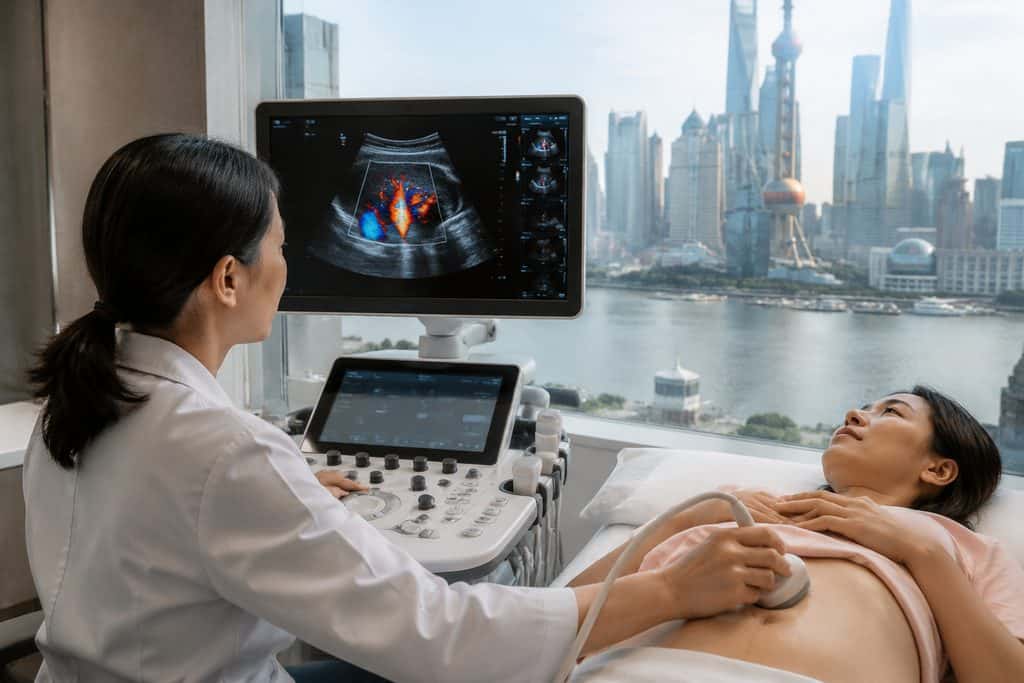
A Doppler ultrasound is simple to describe. It is the same painless scan used in pregnancy, except the software is tuned to measure how fast blood moves through your arteries and veins. No needles, no radiation, no dye unless a contrast study is specifically ordered. The doctor presses a probe against your skin, watches a screen, and within 20 to 40 minutes can tell whether a clot is sitting in your leg or an artery in your neck is narrowing.
What makes China complicated is not the machine. It is the queue.
Doppler Ultrasound Cost China: The Numbers in Plain English
Public hospitals in Beijing, Shanghai, and Guangzhou charge between $40 and $150 for a standard Doppler study. Carotid and lower-limb scans sit at the low end. Renal, portal-vein, and transcranial Doppler sit higher because they take longer and require a more experienced sonographer. A private international hospital such as United Family or Jiahui will quote $200 to $500 for the same exam, and the report arrives in English the same day.
| Setting | Typical Price (USD) | Report Language | Wait Time |
|---|---|---|---|
| Public 3A hospital, standard queue | $40 – $90 | Chinese | Same day to 3 days |
| Public 3A international wing | $120 – $250 | English available | 1 – 5 days |
| Private international hospital | $200 – $500 | English standard | Often 24 – 48 hours |
| Same scan in the United States | $500 – $1,500 | English | Days to weeks |
Read the table this way. If you are already in China and can navigate a Chinese-language hospital, the public queue gives you an accurate study for the price of a nice dinner. If you are flying in, scheduling around a tight itinerary, or need the report in English for a surgeon back home, the international wing or a private hospital is worth the premium.
Who This Is Right For — and Who It Isn’t
Doppler studies are ordered for a narrow set of reasons. If yours fits one of them, China is a genuinely sensible place to have it done.
Good candidates:
- You have leg swelling, calf pain, or a history of deep vein thrombosis and need a surveillance scan.
- You are being worked up for carotid artery disease after a TIA or a bruit was heard.
- You need a pre-operative vascular map before bypass, dialysis access, or a liver procedure.
- You are already in China for another reason and want a fast, low-cost vascular check.
- You are combining the scan with a broader executive health package at a top-tier facility.
Who should think twice:
- Anyone with an acute, unstable presentation — chest pain, sudden shortness of breath, one cold blue leg. That is an emergency room problem, not a scheduled scan.
- Patients who need immediate intervention based on the result. A scan without a treating physician attached to it is just a picture.
- Anyone whose insurance only reimburses at home and who cannot float the cost upfront.
- Travelers on a 72-hour visa-free transit who assume they can walk into a top hospital and be scanned the same afternoon. You usually cannot.
Preparing for a Doppler Scan: What Actually Matters
Preparation depends entirely on which body part is being imaged. This is the single most common source of wasted trips.
Carotid, leg, or arm Doppler: no fasting, no special prep. Wear loose clothing and skip the turtleneck. The sonographer needs access to your neck or groin.
Abdominal, renal, or portal-vein Doppler: fast for 8 to 12 hours. Water is fine. Food in your stomach creates gas that scatters the sound waves and ruins the image. If you eat breakfast and show up at 9 a.m., you may be sent home and rebooked.
Pelvic Doppler: you will likely be asked to arrive with a full bladder. Drink one liter of water about an hour before and hold it. Uncomfortable, but it gives the probe a clearer acoustic window.
Bring every prior scan, stent card, or surgical report you have. Vascular disease is judged by change over time, and a sonographer with a 2022 baseline produces a far more useful report than one starting from zero.
How to Book a Doppler Ultrasound in China as a Foreign Patient
Here is the part most guides skip. Public hospitals in China generally do not accept overseas appointment bookings for routine outpatient imaging. Registration happens on the day, in person, in Chinese, at a kiosk or a window, and the queue starts early. Surgery and admission require an in-person consultation first — that is the standard rule, not a bureaucratic quirk.
So how do international patients actually get scanned?
Two routes work. The first is the hospital’s international department or VIP wing, where English-speaking staff handle registration and the price runs roughly 1.5 to 2 times the standard channel. The second is a private JCI-accredited hospital, where direct insurance billing is often available and the entire visit feels closer to a Western clinic. You can browse which facilities fall into each category on our private international hospitals page.
For anything beyond a single scan — say a vascular workup that includes a cardiology consult and a follow-up — the practical move is to have someone local handle registration, payment, and translation while you focus on the medical conversation. That is the gap our bilingual medical companion service exists to fill.
Is Doppler Ultrasound Safe in China?
Yes. The physics do not change at the border. Doppler ultrasound uses high-frequency sound waves, not ionizing radiation, and there is no known cumulative risk from diagnostic exposure. The machines in China’s top hospitals are the same GE, Philips, and Siemens units used in Boston and Berlin.
The real variable is operator skill and reporting quality, not safety. A carotid study read by an experienced vascular sonographer at a Fudan-ranked hospital is as reliable as anything you would get in the West. A rushed scan at an understaffed clinic is not. This is why we steer patients toward facilities with an established vascular imaging department rather than the nearest open slot.
One caveat worth stating plainly: China’s 35,000-plus hospitals vary enormously in quality. The top 5% — the roughly 340 facilities ranked by Fudan and JCI — are world-class. The rest are not, and the gap is wider than most foreigners expect. Choosing the right hospital matters more than choosing the right country.
Doppler Ultrasound Price in Shanghai vs. Other Cities
Shanghai and Beijing sit at the top of the price range for private care, simply because international demand is highest there. A private carotid Doppler in Shanghai runs $250 to $500. The same scan in Chengdu or Xi’an, at an equally capable 3A hospital, often lands under $100.
Public hospital pricing is set by provincial health authorities and varies less than you would think. The bigger difference is access. Beijing has 21 hospitals in the Fudan Top 100; Shanghai has 18; Guangzhou has 10. If you want a specific subspecialty read, the city choice follows the department, not the price list. Our department-by-department rankings show which cities lead in vascular and cardiac imaging.
For patients combining a scan with a broader workup, cities like Chengdu and Hangzhou offer a quieter, cheaper experience with genuinely excellent tertiary hospitals. The trade-off is fewer English-speaking staff outside the international wings.
Practical Considerations: Records, Visas, and Payment
Records. Bring your referral letter, prior imaging, medication list, and any allergy documentation. Chinese hospitals will accept foreign reports, but a translated summary speeds things up considerably.
Visa. If you are entering China specifically for medical treatment, the applicable short-stay category is the S2 visa, annotated for medical treatment purposes. Accompanying family members apply under the same category. Note that the M visa is for commercial and trade activities and has nothing to do with medical care — a distinction that trips up a surprising number of applicants. Requirements shift, so confirm current rules with your nearest Chinese embassy or consulate before booking flights.
Payment. Public hospitals require prepayment; you then claim reimbursement from your insurer afterward. Private international hospitals frequently bill your insurance directly. Bring a card that works internationally, and carry some cash for smaller facilities.
Language. Outside international wings, assume zero English. Radiology technicians rarely speak it. If your scan result will inform a decision back home, having the report translated and explained is not a luxury.
Follow-up. A Doppler is a snapshot. If you return home with a report, hand it to your own physician. We do not interpret scans or offer diagnoses, and no responsible coordinator should.
Frequently Asked Questions
Expect $40 to $150 at a public tertiary hospital and $200 to $500 at a private international clinic. The final figure varies by hospital, city, and the specific vessels being studied. Contrast-enhanced studies cost more than standard ones.
For neck, arm, or leg scans, no preparation is needed. For abdominal or renal studies, fast for 8 to 12 hours and drink only water. For pelvic scans, arrive with a full bladder. Getting this wrong is the most common reason a scan gets rescheduled.
Not directly at most public hospitals — routine outpatient registration happens in person on the day. International departments and private hospitals can sometimes pre-schedule. A local coordinator can often secure a slot where an individual cannot.
Yes. It uses sound waves rather than radiation, and top Chinese hospitals operate the same equipment found in Western centers. Safety is not the concern; operator experience and report quality are what vary.
At private international hospitals, usually yes. At public hospitals, the report will be in Chinese, and you will need translation. Budget for that if a surgeon back home will be reading it.
Your Next Step
A Doppler scan in China costs a fraction of the Western price and can often be scheduled within days rather than weeks — provided you know which door to walk through. The scan itself is easy. The navigation is not.
We are a medical concierge service, not a hospital and not a clinic. We do not diagnose, treat, or interpret your results. What we do is match you to the right facility, coordinate the appointment through official international channels, and put a bilingual companion beside you for the registration, payment, and translation that would otherwise swallow your morning. If it helps to talk it through first, you can request a free consultation — no pressure, and no obligation to book anything.
This article is for general information only and does not constitute medical advice. Prices are estimates and vary by hospital and case complexity. Always consult a qualified physician about your own condition and treatment.
For more medical information and treatment options in China, visit chinamedservices.com (China Medical Services).
