Elbow MRI in China: What to Expect, From Cost to Scheduling
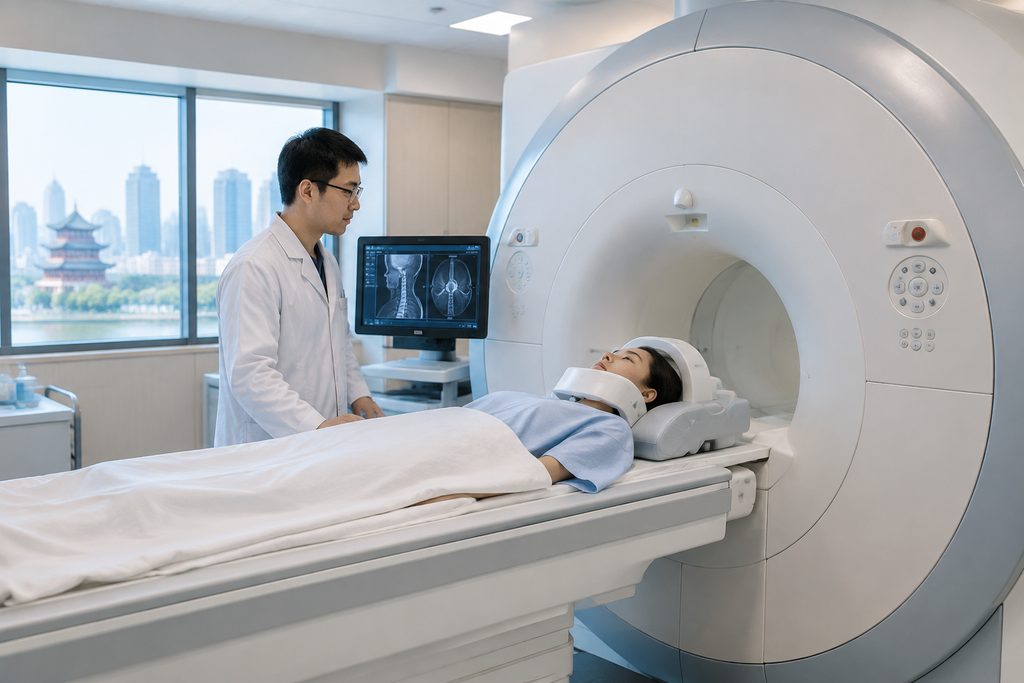
When 44-year-old Daniel from Melbourne tore something in his right elbow during a weekend climbing trip, his orthopedic surgeon back home handed him a referral and a two-week wait. Two weeks for the scan. Another ten days for the radiologist’s report. By the time anyone could tell him whether he needed surgery or just rest, he had already lost most of a month. Daniel started searching for alternatives — and landed on a question thousands of patients now ask: what does an elbow MRI in China actually involve, and is it worth the trip?
Here is the short version. An elbow MRI at a top-tier Chinese hospital typically costs between $250 and $900 depending on the facility, the scanner strength, and whether contrast dye is used. Appointments at private international hospitals can often be arranged within days. At public hospitals, the timeline is different — and that difference matters more than most people realize.
Elbow MRI in China: The Short Answer
You can get a high-quality elbow MRI in China for roughly one-fifth to one-tenth of what the same scan costs in the United States, where an elbow MRI without contrast averages $1,200 to $3,000 depending on location and insurance negotiations. Chinese public tertiary hospitals and private international hospitals both operate modern 1.5T and 3T MRI scanners, and many are accredited by international bodies.
But the price is not the hard part. The hard part is access. Most public hospitals in China do not allow foreign patients to book an outpatient slot from overseas in advance. You show up, you register on the day, you queue. For a scan that takes 30 minutes, the logistics can eat two days. That single fact reshapes how you should plan.
Key takeaway: The scan itself is fast and affordable. The scheduling system is the variable. Patients who understand this before they book save themselves the most frustration.
Who This Is Right For — and Who It Isn’t
An elbow MRI in China makes sense for a specific kind of patient. It makes much less sense for others.
Typically a good fit:
- You have a diagnosed or suspected soft-tissue injury — ligament tear, tendon rupture, nerve compression — and need detailed imaging to guide treatment
- You are already traveling to China for other reasons, or you are combining the scan with a consultation at a specialist center
- Your home country has a long wait for non-urgent MRI, and you are paying out of pocket anyway
- You want a second read on images you already have, plus a specialist opinion in the same trip
Probably not the right move:
- You have an acute fracture or open wound. Go to the nearest emergency department. Do not plan a trip around it.
- You have a pacemaker, certain implanted devices, or metal fragments near the joint. MRI safety screening is strict everywhere, and some implants are absolute contraindications.
- You need the scan covered by insurance that only pays in-network providers in your home country. Chinese public hospitals generally require prepayment, with reimbursement handled afterward — and many Western insurers will not reimburse overseas elective imaging.
- You cannot tolerate lying still for 30 to 45 minutes, or you have severe claustrophobia and no access to an open MRI.
Being honest about the second list is what makes the first list trustworthy. No responsible coordinator will tell you that a foreign MRI trip is right for every elbow.
The Options, Compared
Three realistic paths exist for a foreign patient. The table below uses typical figures; actual pricing varies by hospital and case complexity.
| Path | Typical Cost (USD) | Booking Lead Time | English Support | Payment Model |
|---|---|---|---|---|
| Public tertiary hospital, standard channel | $250–$450 | Same-day registration only; no overseas pre-booking | Limited | Prepay, reimburse later |
| Public hospital international/VIP department | $500–$900 | Several days to two weeks, often bookable ahead | Yes, dedicated staff | Prepay, some insurance coordination |
| Private international hospital | $700–$1,400 | Often within 2–5 days | Yes, English-speaking throughout | Direct insurance billing common |
Which column suits you depends on what you value. If cost is the only variable, the standard public channel wins — provided you can navigate a hospital that sees tens of thousands of patients daily, in Chinese. If your time is worth more than the difference, the private route is genuinely simpler. The middle option, a public hospital’s international department, is where many patients land: senior specialists, English service, and pricing roughly 1.5 to 2 times the standard channel.
How Much Does an Elbow MRI Cost in Shanghai — and Why Beijing Differs
Shanghai tends to sit at the higher end of the public-hospital range, partly because its international departments are busier and partly because demand from expatriates and medical travelers is concentrated there. A non-contrast elbow MRI at a Shanghai tertiary hospital’s international wing commonly falls between $500 and $800. The same scan at a standard outpatient channel in the same city can be under $400.
Beijing follows a similar pattern, with one wrinkle: the concentration of top-ranked hospitals is higher. Beijing holds 21 of the hospitals on the Fudan Top 100 list, more than any other city. That density means more choice, and sometimes shorter waits at less famous institutions. If you want to book elbow MRI in Beijing, the practical advice is to decide first whether you need a household-name hospital or simply a good 3T scanner and a competent musculoskeletal radiologist. For most elbow injuries, the second is enough.
Other cities — Guangzhou, Chengdu, Hangzhou — often offer the same equipment at lower prices and with shorter queues. You can compare facilities by city on our directory of top-ranked Chinese hospitals.
Is Elbow MRI Safe in China Hospitals?
Yes, with the same caveats that apply anywhere. MRI does not use ionizing radiation, so there is no radiation risk. The safety questions are about magnets, contrast agents, and screening protocols — and Chinese tertiary hospitals follow internationally recognized standards on all three.
Two practical points deserve attention. First, gadolinium contrast, used when a doctor needs to see inflammation or subtle ligament detail, carries a small risk of allergic reaction and is not appropriate for patients with severe kidney impairment. This is a universal medical rule, not a China-specific one. Second, screening interviews may be conducted in Chinese at standard channels. If you have any implant, device, or surgical history, you must be able to communicate it clearly. This is one of the strongest arguments for having a bilingual companion present.
Many private international hospitals in China hold JCI accreditation, and several public hospital international departments operate to comparable standards. You can review accredited private facilities on our private international hospital page.
Practical tip: Bring your implant card or device documentation in English, with the model number. Radiology staff can verify MRI compatibility against manufacturer databases, but only if they know exactly what is inside you.
What a Medical Tourism Elbow MRI Package Actually Includes
Sometimes, but do not assume it. Many Western insurers cover overseas emergency care but exclude elective diagnostic imaging. Public hospitals require upfront payment with reimbursement handled afterward. Private international hospitals often bill insurers directly, but only if your plan includes them. Get written confirmation from your insurer before booking anything.
That is precisely when the trip’s value becomes clearest — or most complicated. A Chinese specialist can review the images and recommend treatment, and in some cases surgery can be scheduled after an in-person consultation. But no one can promise admission, priority access, or a particular outcome. If you are diagnosed with a serious condition abroad, weigh the disruption of staying in China against the value of returning home to your existing care team. There is no universal right answer.
For a private hospital with pre-booked appointment: as little as three to five days on the ground. For a public hospital standard channel: plan for two days minimum, one for registration and one for the scan, with the report usually ready within 24 to 48 hours. Adding a specialist consultation extends the timeline by a day or two.
Your Next Step
The core message is simple: an elbow MRI in China is affordable, technically excellent, and logistically uneven. The scan is easy. The system around it is not. Patients who plan for that gap — by choosing the right hospital tier and arranging language support in advance — get a fast, accurate diagnosis at a fraction of Western prices.
We are China Medical Services, a coordination service, not a hospital. We do not diagnose or treat anyone. What we do is match your case to the right facility among 340+ top-ranked hospitals across 37 cities, handle appointment coordination, arrange bilingual companions, and guide you through the S2 visa process. If you would like to talk through your situation with no obligation, you can start with a free consultation here — and decide the rest when you are ready.
This article is for general information only and does not constitute medical advice. MRI suitability depends on your individual medical history, including implants and kidney function. Always consult a qualified physician before undergoing any imaging study or treatment.
Frequently Asked Questions
Yes. The hospitals used for international patients are JCI-accredited and follow the same international safety standards as top hospitals in the US and Europe. Surgical teams perform high volumes of procedures — often more than their Western counterparts — which studies show leads to better outcomes.
Costs vary by procedure and hospital, but international patients typically save 40-80% compared to US prices — even when factoring in travel and accommodation. A consultation with our team will give you an exact, all-inclusive quote with no hidden fees.
Send us your existing medical reports to get started. We handle everything from hospital selection and appointment scheduling to visa assistance and post-operative recovery planning. Your medical records are reviewed by the specialist before you even book a flight.
For more medical information and treatment options in China, visit chinamedservices.com (China Medical Services).
