Elderly Spouse Support Service China: Care for Your Partner During Treatment
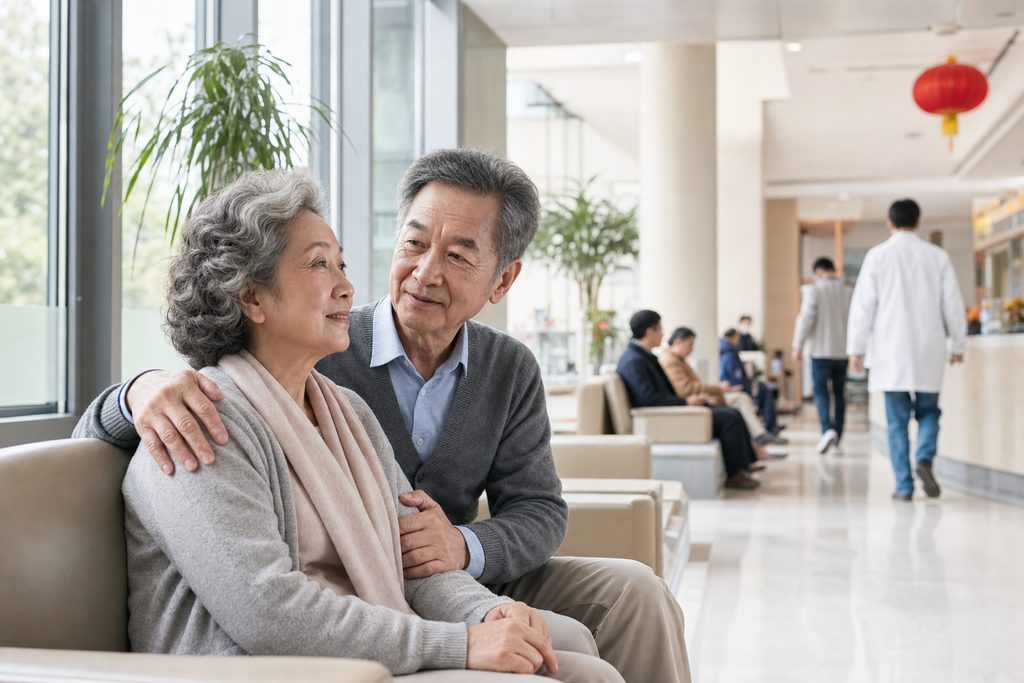
You have probably heard that traveling abroad for medical care means leaving your partner behind. The assumption is that an elderly spouse cannot manage the journey, the language, or the disruption. The reality is different. Our team has coordinated care for hundreds of couples where one partner needed treatment and the other needed support. The solution is not separation. It is parallel care.
Key Takeaways
- China’s top hospitals now offer integrated support services that accommodate both the patient and an elderly companion, with dedicated international wards that include family resting areas.
- The cost of companion care in China runs from approximately $200 per day for a bilingual escort, compared to $25-35 per hour for equivalent support in the US — a structural cost difference that makes full-time spousal support financially feasible.
- Language barriers in Chinese public hospitals are real and formidable. A single-day outpatient visit can involve six to eight separate queues, each requiring Mandarin interaction. Without a bilingual companion, an elderly spouse is functionally stranded.
- Visa rules are specific. Both the patient and the accompanying spouse must apply for an S2 visa with medical treatment annotation. A standard tourist visa does not cover medical stays, and getting this wrong at the consulate can delay treatment by weeks.
The Problem: When One Partner Needs Treatment and the Other Needs Care
Medical travel is rarely a solo decision. When a patient considers flying to China for a cardiac procedure, an orthopedic surgery, or an oncology consultation, the first question is often not about the hospital. It is about the person sitting next to them. Roughly 1 in 4 medical travelers to China are over 60. Many arrive with a spouse who is equally elderly, equally anxious, and equally in need of logistical support.
The spouse who stays home worries. The spouse who travels faces a gauntlet of unfamiliar systems. Neither option feels safe. And the standard advice from most medical tourism agencies is thin: book a hotel nearby, hire a translator, figure out the rest. That advice ignores the central problem. An elderly partner is not a piece of luggage. They need meals, medication reminders, bathroom assistance, and someone who can explain what is happening in a language they understand. When the patient is sedated for a procedure, the spouse is alone in a waiting room where no one speaks English.
We have seen this play out. A patient from Manchester arrived in Shanghai for a knee replacement. His wife, 74, had mild cognitive decline. She got separated from him during the hospital admission process. It took two hours and three staff members to locate her. The surgery went fine. The stress on the family was unnecessary and preventable. That case is why we built our spousal support protocols. It is not an add-on. It is core to how we coordinate care.
Who We Are
We are not a hospital. We do not provide medical treatment or clinical diagnoses. Our team functions as your logistical architects — we bridge the gap between you and China’s 340+ top-ranked hospitals across 37 cities. We handle hospital matching, appointment coordination, visa guidance, bilingual medical companionship, and the parallel care needs of your traveling spouse. We connect you with the right clinical team. Then we make sure the entire non-clinical experience — from airport pickup to post-operative accommodation — runs without friction for both of you.
Elderly Spouse Care During Medical Treatment China: How the Support System Works
The core question patients ask us is direct: can my elderly husband stay with me during treatment in Shanghai? The answer is yes. But the quality of that stay depends entirely on how it is arranged. A spouse who books a hotel and tries to navigate the hospital independently will struggle. A spouse supported by a coordinated care plan will have a fundamentally different experience.
Here is what parallel care actually looks like on the ground. The patient is admitted to an international ward at a hospital like Zhongshan Hospital Fudan University. The international ward has private rooms with a companion bed. The spouse stays in the same room. While the patient undergoes pre-operative testing, a bilingual companion remains with the spouse — escorting them to the hospital cafeteria, explaining the day’s schedule, and handling any pharmacy runs for the spouse’s own medications. When the patient is in surgery, the companion sits with the spouse in a private waiting area, translating updates from the surgical team in real time. After discharge, the companion coordinates rehabilitation appointments for the patient while arranging follow-up care for the spouse if needed — a blood pressure check, a prescription refill, a consultation with a geriatric specialist.
This is not luxury concierge fluff. It is task-level logistics. Someone has to remember that the spouse takes a beta-blocker at 8 a.m. Someone has to know which pharmacy near the hospital stocks international medications. Someone has to be there when the patient is wheeled into the operating room and the spouse’s hands start shaking. That someone is us.
How to Arrange Care for an Elderly Partner While in Hospital in China
The process of arranging spousal support starts well before you board a plane. Here is the sequence we follow for every couple.
Step one: dual assessment. We evaluate both the patient’s medical needs and the spouse’s care requirements. Does the spouse have mobility limitations? Cognitive issues? Dietary restrictions? A medication schedule that cannot be interrupted? We document everything. This assessment informs every downstream decision — hospital selection, accommodation type, companion staffing ratios.
Step two: hospital matching with spousal accommodation. Not every top-ranked hospital has international wards with companion beds. We direct patients to facilities that do. Our database of 340+ top-ranked hospitals includes detailed information on international ward configurations, private room availability, and policies on overnight companions. A hospital that ranks highly for cardiac surgery but has no companion bed is not suitable for a couple. We filter accordingly.
Step three: visa coordination for both travelers. The patient and the spouse each require an S2 visa annotated for medical treatment purposes. The application requires an invitation letter from the Chinese hospital, proof of medical appointment, and documentation of the relationship between the patient and the accompanying spouse. We guide families through this paperwork. A single error on a visa application can mean a two-week delay and a missed surgical slot. We do not let that happen.
Step four: companion staffing. Based on the spouse’s assessed needs, we assign one or more bilingual medical companions. A spouse with full independence may need only part-time escort support — someone to handle translation during key moments and provide orientation to the hospital campus. A spouse with significant care needs may require a dedicated full-time companion who remains with them throughout the patient’s hospitalization. Our companion service starts from $200 per day for an 8-hour shift. The cost varies by case complexity and the companion’s specific qualifications.
Step five: accommodation and logistics. We arrange serviced apartments or hotel suites within walking distance of the hospital for pre-admission and post-discharge periods. These accommodations are selected for accessibility — ground-floor units, grab bars in bathrooms, elevator access, proximity to pharmacies. We also coordinate airport transfers, local SIM cards, and meal delivery if needed.
The Cost of Companion Care for a Spouse During Surgery Abroad
Families want to know what this costs. Let us be direct.
Bilingual medical companion services in China start from $200 per day for a full 8-hour shift. A half-day shift of 4 hours is also available at a proportionally lower rate. For comparison, private companion care or home health aide services in the United States typically run $25 to $35 per hour — roughly $200 to $280 for the same 8-hour period, but without the medical translation capability and hospital navigation expertise that our companions provide.
The structural cost difference matters. In China, labor costs for skilled bilingual professionals are lower than in Western markets. That means a couple can afford full-time companion support for a two-week hospital stay at a total cost of approximately $2,800 to $4,000. In the US or UK, equivalent support with medical translation would be difficult to find at any price, and if available, would cost three to five times as much.
Also, companion care costs in China are often bundled with broader coordination services. When a family books our VIP end-to-end coordination, which ranges from $5,000 to $8,000 depending on case complexity, spousal companion support is integrated into the service package. There is no separate line item for “spouse care.” It is part of the case management fee.
For families on tighter budgets, we recommend a hybrid model: full companion support during the first three days of hospitalization when disorientation peaks, then part-time support for the remainder of the stay. This approach keeps total companion costs under $2,000 while ensuring the spouse is never alone during critical moments.
Medical Tourism Packages in China with Caregiver Support
Some international patient coordinators sell fixed packages. A knee replacement package. A cardiac surgery package. A health screening package. These packages typically include the hospital procedure, a hotel room, and airport transfers. They rarely include dedicated spousal support.
Our approach is different. We do not sell pre-configured packages because no two couples have the same needs. A 68-year-old patient traveling with a fully independent 65-year-old spouse has radically different requirements from a 72-year-old patient traveling with an 80-year-old spouse who uses a walker and takes six daily medications. The first couple might need only part-time translation support. The second needs a comprehensive parallel care plan.
That said, there are common configurations that emerge from our casework. A typical arrangement for a couple where the spouse has moderate care needs looks like this:
| Service Component | Description | Estimated Cost (USD) |
|---|---|---|
| Hospital matching & appointment coordination | Selection of international ward with companion bed; surgical scheduling | From $300 |
| Dual S2 visa guidance | Documentation support for patient and spouse visa applications | Included in coordination |
| Airport transfer (round-trip) | Private vehicle with English-speaking driver | $200 |
| Bilingual companion (full-day, 14 days) | Dedicated companion for spouse during patient’s hospitalization | From $2,800 |
| Serviced apartment (14 nights) | Accessible unit near hospital for pre-admission and post-discharge | $1,200–2,000 |
| VIP coordination fee | End-to-end case management, credited toward companion and logistics | $5,000–8,000 |
These figures are estimates. Final costs depend on the hospital selected, the city, the season, and the specific care needs of the spouse. We provide a detailed cost breakdown after the initial assessment — never before we understand the full picture.
Can My Elderly Husband Stay with Me During Treatment in Shanghai?
This is one of the most frequent questions we receive. The short answer: yes, absolutely. The practical answer: it requires planning.
Shanghai’s top hospitals, including Zhongshan Hospital, Ruijin Hospital, and Huashan Hospital, all operate international wards that permit overnight companions. These wards are designed for foreign patients and their families. Rooms are private, typically with an en-suite bathroom, a patient bed, and a companion bed or fold-out sofa. Nursing staff in these wards generally speak functional English. The international ward is a separate unit from the general wards, with lower patient-to-nurse ratios and more flexible visiting policies.
But here is what families need to understand. The international ward is inside a massive Chinese public hospital. Step outside the ward, and everything is in Mandarin. Signage. Cafeteria menus. Pharmacy labels. The spouse who wants to buy a bottle of water or find a restroom will encounter a language barrier immediately. This is why we insist on companion support even when the hospital itself has English-speaking staff. The companion bridges the gap between the international ward and the rest of the hospital.
For spouses with significant care needs, we also arrange private accommodation near the hospital with accessibility features. Some couples prefer this arrangement: the spouse stays in a serviced apartment during the day and visits the patient in the international ward during designated hours, accompanied by a bilingual companion. This gives the spouse a quiet place to rest while ensuring the patient is never without support.
Book a Medical Trip to China with Elderly Spouse Assistance: The Practical Sequence
Yes, but with important caveats. A spouse with advanced dementia who requires constant supervision and is prone to wandering will need a dedicated full-time companion — not part-time support. This increases costs and requires specific companion qualifications. We are transparent about this from the first conversation. In some cases, we may recommend that the spouse remain at home with a local caregiver while the patient travels with a different family member or a hired companion. We make this recommendation when we believe the stress of international travel would be harmful to the spouse. Our goal is not to book every case. It is to give honest guidance.
Medical timelines are unpredictable. A surgery scheduled for a 5-day hospitalization can extend to 10 days if complications arise. We build flexibility into every plan. Our companion staffing is adjusted dynamically — if your stay extends, we extend the companion’s schedule. Accommodation bookings are made with flexible cancellation and extension policies where possible. Visa extensions can be processed in-country if medical documentation supports the need. We handle the administrative adjustments so you can focus on recovery. The one thing we cannot control is hospital discharge timing. That is a clinical decision made by your attending physician.
Every companion in our network undergoes a background verification process that includes credential checks, language proficiency testing in both English and Mandarin, and reference calls with previous clients. Many of our companions are former nurses or medical interpreters with specific training in geriatric care. We match companions to cases based on the spouse’s needs — a companion with dementia care experience for a spouse with cognitive decline, a companion with mobility assistance training for a spouse with physical limitations. When you book with us, we tell you exactly who will be with your spouse and what their qualifications are.
Your Next Step
Bringing an elderly spouse to China for medical treatment is not a logistical impossibility. It is a coordination challenge with clear
Frequently Asked Questions
Yes. We work with JCI-accredited and major Grade 3A tertiary hospitals that follow international safety standards comparable to top hospitals in the US and Europe. Surgical teams perform high volumes of procedures — often more than their Western counterparts — which studies show leads to better outcomes.
Costs vary by procedure and hospital, but international patients typically save 40-80% compared to US prices — even when factoring in travel and accommodation. A consultation with our team will give you an exact, all-inclusive quote with no hidden fees.
Send us your existing medical reports. The relevant specialty reviews them and gives you a written opinion, including treatment direction and options, before you commit to any travel. From there you can add a video consultation with the doctor, or have us attend an appointment on your behalf.
For more medical information and treatment options in China, visit chinamedservices.com (China Medical Services).
