Endoscopy in China: What to Expect, Cost & How to Book It
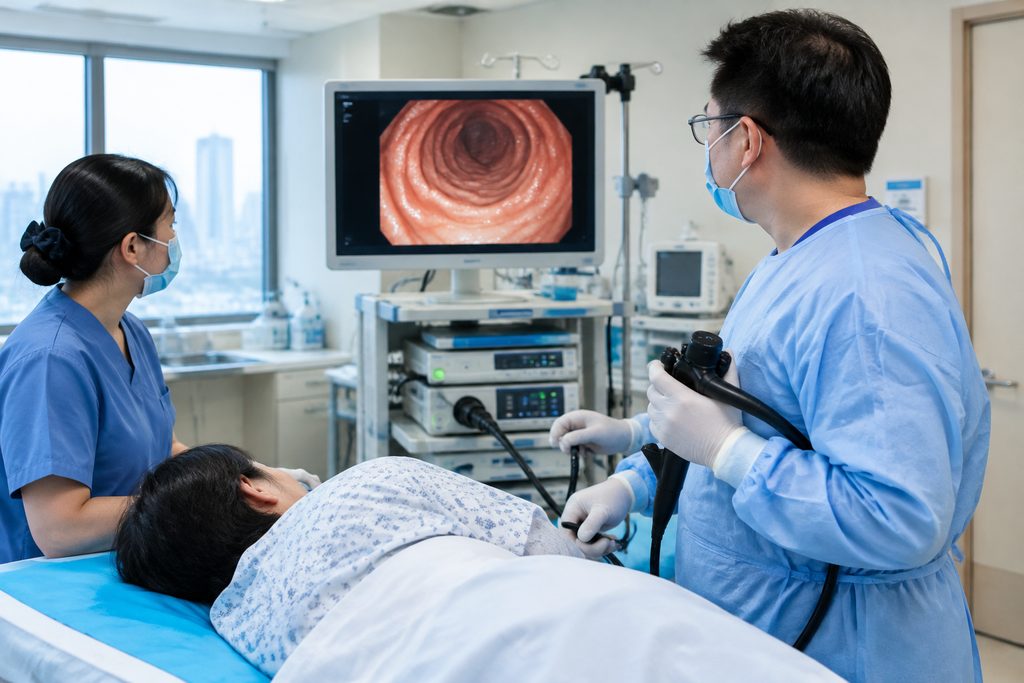
Key Takeaways
- An upper GI endoscopy at a top-tier Chinese public hospital typically runs $150–$500, versus $1,500–$3,500 in the United States — the same procedure, the same scope technology.
- China’s leading gastroenterology centers perform tens of thousands of endoscopies annually, and many offer dedicated international departments with English-speaking staff.
- The hard part is not the procedure. It is the logistics: public hospital outpatient slots cannot be reserved from abroad, so you queue on the day unless you route through an international or VIP channel.
- Before booking anything, understand which visa category applies, how payment works, and what your follow-up plan looks like once you fly home.
Quick answer: Endoscopy in China is generally safe, fast, and dramatically cheaper than in the US or Western Europe. The main friction points are appointment access, language, and paperwork — not clinical quality.
The Problem: Why Patients Start Looking Abroad
In the United States, a diagnostic colonoscopy can cost between $2,000 and $6,000 before insurance, and even insured patients frequently face several hundred dollars in out-of-pocket costs. In countries like Canada and the UK, the barrier is not price — it is time. Routine diagnostic endoscopy wait times in parts of Canada have stretched past six months in recent reporting, and UK NHS waiting lists for gastroenterology procedures remain among the longest of any specialty.
That combination — high cost in one system, long waits in another — is exactly what pushes people to look at options overseas. A patient in Vancouver with unexplained reflux, or a self-paying patient in Texas facing a $3,000 colonoscopy deductible, is asking the same question: is there somewhere I can get this done properly, quickly, and without financial strain?
China has quietly become one of the answers. Not because it markets itself as a medical tourism destination for endoscopy — it mostly doesn’t — but because the volume, infrastructure, and pricing are simply there.
Why China Delivers on Endoscopy: Volume, Speed, and Price
Understanding why China works for this procedure requires looking at how its hospital system actually operates. Three structural factors matter.
Clinical volume that most Western centers cannot match
China’s top gastroenterology departments are enormous by any international standard. A single leading hospital may perform more than 50,000 endoscopic procedures a year, including advanced therapeutic work like EUS, ERCP, and endoscopic submucosal dissection. That kind of throughput produces something hard to buy elsewhere: pattern recognition. Physicians who scope dozens of patients a day see variations that lower-volume operators encounter rarely.
For routine diagnostic work — gastroscopy, colonoscopy, biopsy — this volume translates into efficiency and consistency. For complex cases, it means the referral pathways to advanced interventional endoscopy already exist inside the same building.
Equipment and technique are current, not dated
Top Chinese hospitals run the same platforms you would find in a US academic center: high-definition and magnification endoscopes, narrow-band imaging, and AI-assisted polyp detection that flags suspicious lesions in real time. Several Chinese centers were early adopters of AI-assisted colonoscopy and have published on it in peer-reviewed gastroenterology journals.
What differs is not the hardware. It is the workflow. A department handling hundreds of scopes a day has standardized prep, sedation, recovery, and reprocessing into an assembly-line rhythm. That is why a diagnostic gastroscopy in China often takes 15–20 minutes of actual procedure time, with total facility time of two to three hours including preparation and recovery.
The cost gap is structural, not a quality signal
This is the objection worth addressing directly. Lower price does not automatically mean lower quality, and in endoscopy the reasons for the gap are easy to trace: physician salaries, facility overhead, and the absence of the administrative billing layers that inflate US procedure costs. The scope, the sedation drugs, the pathology lab, and the physician’s training are not cheaper versions — they are the same inputs priced in a different economic system.
| Procedure | China (top public hospital) | United States | Typical duration |
|---|---|---|---|
| Diagnostic gastroscopy (upper GI) | $150–$400 | $1,500–$3,000 | 15–20 min |
| Diagnostic colonoscopy | $200–$500 | $2,000–$6,000 | 20–40 min |
| Gastroscopy + colonoscopy together | $350–$800 | $3,000–$8,000 | 40–60 min |
| Endoscopic ultrasound (EUS) | $600–$1,500 | $3,000–$7,000 | 30–60 min |
| Therapeutic ERCP | $1,500–$4,000 | $8,000–$25,000 | 45–90 min |
Figures are indicative and vary by hospital, city, sedation type, and case complexity. Final pricing is confirmed by the hospital after clinical review.
What Actually Happens: A Step-by-Step Walkthrough
Here is the honest version of how an endoscopy in China unfolds for an international patient, from first contact to discharge.
Step 1 — Records review. You send your existing reports: prior imaging, blood work, referral notes, medication list. A gastroenterology team reviews them and confirms whether endoscopy is indicated, and which type.
Step 2 — Appointment coordination. This is where the system gets tricky on its own. Chinese public hospitals generally do not allow overseas patients to reserve a standard outpatient slot in advance. You register on the day. International departments and VIP channels are the exception — they can pre-arrange a specific date and time, at roughly 1.5–2x the standard fee.
Step 3 — Pre-procedure prep. For colonoscopy, you receive a bowel prep protocol, usually a split-dose polyethylene glycol regimen. Instructions come in English at international departments. Follow them precisely — inadequate prep is the single most common reason a colonoscopy gets repeated.
Step 4 — The procedure itself. Most diagnostic scopes use conscious sedation or deep sedation. A gastroscopy takes 15–20 minutes. A colonoscopy runs 20–40 minutes. If polyps are found, they are typically removed during the same session.
Step 5 — Recovery and results. You rest 30–60 minutes. Preliminary findings are usually explained the same day. Biopsy results take three to seven days, and can be sent to you digitally if you have already left China.
Timing tip: If you are flying in specifically for endoscopy, plan a minimum of three to four days on the ground — one day for consultation and prep instructions, one for the procedure, and one to two buffer days for results and any follow-up questions.
Choosing a Provider: What to Check Before You Commit
A diagnostic gastroscopy typically runs $150–$400 in China versus $1,500–$3,000 in the US, and a colonoscopy $200–$500 versus $2,000–$6,000. Combined upper and lower endoscopy usually lands between $350 and $800. These are indicative ranges — final pricing varies by hospital, city, sedation choice, and whether pathology or polyp removal is involved.
At standard public hospital outpatient clinics, generally no — registration happens on the day, and procedures are scheduled after an in-person consultation. International departments and VIP channels are the exception and can often pre-arrange a date. This is one of the practical reasons patients use a coordination service rather than arriving unannounced.
The procedure itself takes 15–20 minutes for a gastroscopy and 20–40 minutes for a colonoscopy, plus preparation and recovery time of roughly two to three hours total. For the trip, plan three to four days minimum to cover consultation, the procedure, and results review.
Serious complications from diagnostic endoscopy — perforation, significant bleeding, sedation reactions — are uncommon, and top Chinese hospitals are equipped to manage them, with surgical backup on site. The realistic risk is not emergency care; it is administrative friction: unclear pricing, missing English documentation, or difficulty reaching your physician afterward. Confirming these details in advance, and having someone who can communicate on your behalf, addresses the majority of what actually goes wrong in practice.
Your Next Step
Endoscopy in China is a genuinely practical option for international patients — safe at established centers, fast, and priced at a fraction of Western rates. The clinical side is rarely the problem. The coordination side usually is.
We are China Medical Services, a patient coordination service, not a hospital and not a provider of medical diagnoses. We help international patients review their records with Chinese specialists, arrange appointments through official international departments, and handle the bilingual logistics on the ground. If you would like to understand your options, you can start with a free consultation through our patient support page — no commitment, just clarity.
This article is for general information only and does not constitute medical advice. Treatment decisions should always be made with a qualified physician who has reviewed your individual case.
Frequently Asked Questions
Yes. The hospitals used for international patients are JCI-accredited and follow the same international safety standards as top hospitals in the US and Europe. Surgical teams perform high volumes of procedures — often more than their Western counterparts — which studies show leads to better outcomes.
Costs vary by procedure and hospital, but international patients typically save 40-80% compared to US prices — even when factoring in travel and accommodation. A consultation with our team will give you an exact, all-inclusive quote with no hidden fees.
Send us your existing medical reports to get started. We handle everything from hospital selection and appointment scheduling to visa assistance and post-operative recovery planning. Your medical records are reviewed by the specialist before you even book a flight.
For more medical information and treatment options in China, visit chinamedservices.com (China Medical Services).
