Endoscopic Submucosal Dissection in China: Zhongshan Hospital’s 90%+ En Bloc Resection Rate
Key Takeaways
- Zhongshan Hospital in Shanghai reports an en bloc resection rate exceeding 90% for early gastrointestinal cancers using ESD, a figure that aligns with top international centers.
- The endoscopic submucosal dissection cost in China typically runs 70-80% lower than comparable procedures in the United States, without sacrificing the quality of the endoscopic equipment or the pathologist’s expertise.
- Navigating a foreign hospital system alone is the single biggest barrier for international patients. Language gaps during consent and discharge can turn a successful procedure into a stressful recovery.
- You need a clear understanding of the S2 visa process, the mandatory in-person consultation, and the pathology workflow before you book a flight.
The Problem: A Cancer Diagnosis Should Not Mean Choosing Between Your Savings and Your Stomach
Getting a diagnosis of early gastric cancer or a large precancerous polyp in the esophagus or colon is terrifying. The clock starts ticking. And then the second shock hits when you see the quote from your local hospital. In the United States, an endoscopic submucosal dissection cost can range from $25,000 to $45,000 depending on the lesion location and hospital fees. For patients with high-deductible insurance plans or those paying out of pocket, that number is not just a bill. It is a mortgage payment. It is a year of college tuition. Globally, gastric cancer remains the fifth most common malignancy and the fourth leading cause of cancer death, with approximately 1.1 million new cases diagnosed in 2020 alone, according to the World Health Organization. The burden falls heaviest on East Asia, which means one thing: the centers with the deepest experience are here. Not in New York. Not in London. Right here in Shanghai, where physicians have been refining the ESD technique for over two decades.
Many Western patients assume traveling abroad for a complex endoscopic procedure is riskier than staying home. That assumption deserves a closer look. Delaying treatment while you try to negotiate with an insurance company carries its own biological risk. A lesion that is resectable today by ESD might, in six months, require a far more invasive surgical resection with a portion of the stomach removed. The math is brutal. And it is why understanding your options at a center like Zhongshan Hospital is not medical tourism. It is a rational clinical decision.
Who We Are
We are China Medical Services. We are not a hospital. We do not diagnose, treat, or prescribe. Our team functions as your logistical architects—we bridge the gap between you and China’s most experienced gastroenterology teams. We handle the friction that stops most Western patients from accessing care here: the visa paperwork, the hospital registration labyrinth, the language barrier during a procedure where you are sedated and vulnerable. We have built working relationships with the international patient departments at hospitals across our network of 340+ top-ranked institutions across 37 cities. We know which endoscopy suites are equipped for complex ESD cases and which are not. We tell you the truth, even when the truth is inconvenient.
Why Zhongshan Hospital’s ESD Program Delivers Results
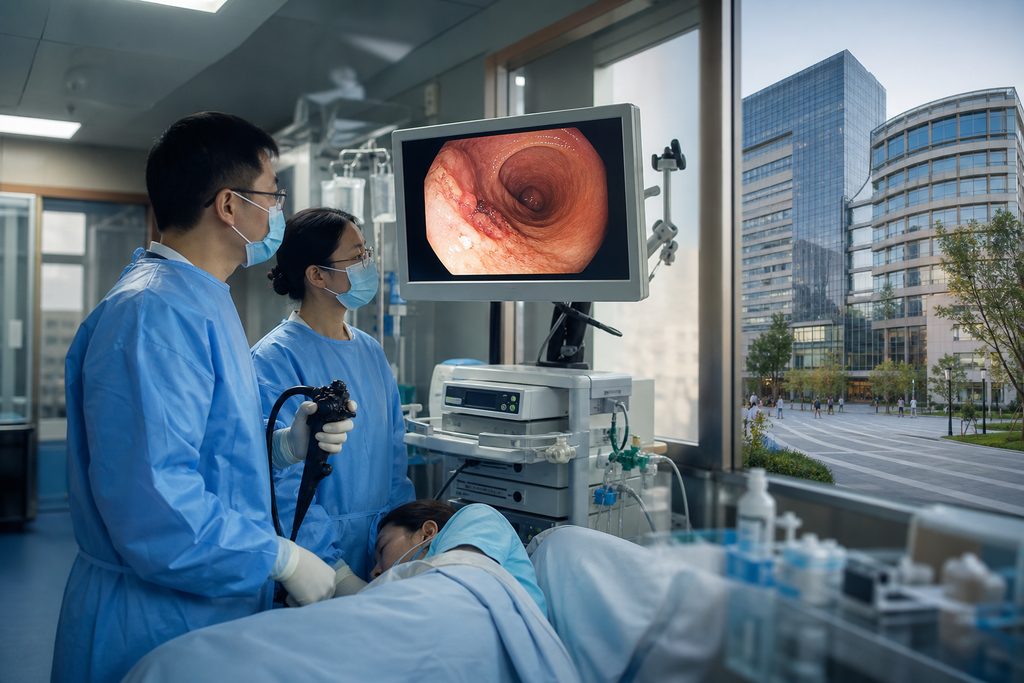
Endoscopic submucosal dissection is not a new curiosity in Shanghai. It is a mature, high-volume subspecialty. To understand the Zhongshan Hospital ESD en bloc resection rate, you have to understand what “en bloc” actually means for your cancer prognosis. When an endoscopist removes a tumor in one intact piece, the pathologist can examine the margins under a microscope with complete certainty. No guesswork. If the deep and lateral margins are clear, you are cured by the procedure alone—no chemotherapy, no radical surgery. When a tumor is removed piecemeal, those margins are impossible to assess reliably. That uncertainty can lead to additional procedures or a recommendation for surgical resection “just to be safe.” En bloc is the gold standard. And it is technically demanding. The endoscopist uses a specialized electrosurgical knife to dissect through the submucosal layer beneath the lesion, working parallel to the muscle wall, millimeter by millimeter, often for over an hour on a single lesion.
Clinical Volume Creates a Skills Gap No Simulation Lab Can Close
The average Western gastroenterologist might perform 20 to 30 ESD procedures a year. At a high-volume Chinese center like Zhongshan, a single specialist may perform over 200 ESD cases annually. That gap matters. ESD has a steep learning curve. Studies published in journals like Gastrointestinal Endoscopy have documented that approximately 80 to 100 supervised cases are needed to achieve competency in gastric ESD, and even more for colorectal lesions due to the thinner wall and tortuous anatomy. When you ask how safe is ESD for early gastric cancer in China, the answer lies partly in this volume. A team that sees multiple cases every single day has encountered and managed the rare complications—the intra-procedural bleeding, the tiny perforation that needs immediate clipping. They are not reading about these scenarios in a textbook. They have lived them. The published data from Zhongshan Hospital’s endoscopy center, one of the largest in the world, consistently shows en bloc resection rates above 90% for early gastric cancer, with perforation rates well under 3% and manageable bleeding rates that reflect the aggressiveness required for a complete resection.
What is the success rate of ESD in Chinese hospitals? It varies by center, which is precisely why you do not choose a country. You choose a specific hospital and a specific team. At top-tier university hospitals like Zhongshan, the long-term outcomes for early gastric cancer treated by ESD show 5-year disease-specific survival rates exceeding 95%. These numbers are not marketing. They are published, peer-reviewed, and consistent with the best centers in Japan and South Korea. The difference for Western patients is access and cost.
Technology Without the Administrative Bloat
The endoscopy suites at Zhongshan Hospital are equipped with high-definition narrow-band imaging (NBI) and magnification endoscopy that allow the endoscopist to delineate the lesion borders with microscopic precision before making the first incision. This is not unique to China—you will find similar Olympus or Fujifilm equipment in major US centers. The operational difference is the workflow. In a Chinese public hospital, the endoscopic unit functions with an efficiency that prioritizes patient throughput. A patient may have a diagnostic endoscopy in the morning, a CT scan by noon, and a multidisciplinary discussion by the afternoon. This speed is a double-edged sword: it gets you answers fast, but it can feel overwhelming and impersonal if you do not speak the language and do not understand where to go next. That is the gap we fill.
The Cost Equation: Structural, Not a Compromise
Let us address the question that brings most patients to our inbox: the endoscopic submucosal dissection cost China comparison. At a top public hospital’s international department in Shanghai, the all-inclusive hospital fee for a gastric ESD—including the procedure, anesthesia, single room stay for 2-3 nights, and histopathology—typically ranges from $6,000 to $10,000 USD. A complex colorectal ESD might push toward the higher end of that range. This is 70-80% below the US cash price. The lower cost does not reflect lower quality. It reflects a fundamentally different economic structure. Physician salaries, hospital administrative overhead, and malpractice insurance costs in China are a fraction of those in the US. The endoscope is the same. The electrosurgical knife is the same. The pathology stain is the same. What you are not paying for is the inflated cost of the American healthcare bureaucracy.
| Procedure | Estimated US Cash Price (USD) | Estimated Shanghai International Dept. Price (USD) |
|---|---|---|
| Gastric ESD (early cancer) | $25,000 – $45,000 | $6,000 – $9,000 |
| Colorectal ESD (large polyp) | $20,000 – $35,000 | $7,000 – $10,000 |
| Esophageal ESD (Barrett’s related) | $22,000 – $38,000 | $6,500 – $9,500 |
These are hospital fees only. They vary by lesion size, location, and the specific international department’s pricing schedule. Our team provides a detailed cost estimate after reviewing your medical records and the hospital’s current fee schedule. We never give a fixed price without that review.
What You Need to Know Before Going Alone
We have seen patients try to arrange this independently. Some succeed. Many give up. The Chinese public hospital system does not bend for a single international patient who arrives without preparation. Here is what you are up against.
- Visa Requirements Are Non-Negotiable: Medical treatment in China requires an S2 visa with a specific annotation for medical purposes. This is not a tourist visa you can obtain online. You will need an invitation letter from the hospital, a detailed treatment plan, and proof of sufficient funds. Your accompanying family member needs their own S2 visa. A business visa, the M category, is irrelevant here and will get you turned away at the hospital registration desk. The consulate will scrutinize your documents. A single error can mean a rejected application and a delayed procedure.
- You Cannot Schedule Surgery Remotely as a New Patient: This is the rule that surprises most Western patients. In the Chinese public hospital system, even through the international VIP channel, a surgeon or endoscopist will not book you for a definitive procedure based solely on overseas records. You must have an in-person consultation first. The specialist will review your slides, possibly repeat a diagnostic endoscopy to map the lesion themselves, and then schedule the ESD. You will be in Shanghai for at least a week before the procedure date, and likely 10-14 days total including recovery and pathology review. There is no shortcut around this.
- Payment Happens Upfront, in Full: The hospital will require a deposit before admission, typically covering the estimated procedure cost plus a buffer. Credit cards are accepted at international departments, but daily limits on foreign cards can cause problems. We advise patients on how to structure payments and, if needed, how to arrange a wire transfer in advance. Insurance reimbursement is between you and your insurer after the fact. The hospital will provide itemized receipts and translated medical records to support your claim, but they will not bill your US or European insurer directly.
How We Help You Navigate This
These barriers exist for structural reasons, not because anyone is trying to make your life difficult. A public hospital that serves 10,000 outpatients a day cannot pause its workflow to hand-hold an English-speaking patient through registration. That is not their job. It is ours.
Our process begins with a free consultation where we review your existing endoscopy report, pathology slides, and imaging. We do not offer medical opinions. We assess logistical fit. We identify which hospital’s international department has the subspecialty expertise for your specific lesion—gastric, esophageal, or colorectal—and confirm their willingness to accept your case. We coordinate the invitation letter for your S2 visa application. When you land in Shanghai, a bilingual medical companion meets you at the airport and stays with you through every step: the initial consultation, the repeat endoscopy if needed, the hospital admission, and the ESD procedure itself. While you are under sedation, your companion is in the waiting area, ensuring the resected specimen is sent to pathology with the correct labeling and priority. After discharge, we collect the final pathology report, have it professionally translated, and explain what it means for your follow-up surveillance schedule. If the margins are clear, you go home with a surveillance plan. If they are not, we coordinate the next step.
We also handle the small things that become big problems when you are recovering: the pharmacy run for post-procedure proton pump inhibitors, the diet progression from clear liquids to soft foods, the follow-up appointment to remove sutures if any were placed. Our bilingual medical companion service starts from $200 per day. Hospital appointment coordination starts from $300. Any fees paid for a remote consultation or second opinion are credited in full toward on-the-ground coordination if you proceed with treatment within 90 days. This is a one-time credit applied to our coordination fee, never to hospital charges.
Frequently Asked Questions
This is a fair and important question. At a university hospital like Zhongshan, the pathology department handles an enormous volume of GI cases daily. Their GI pathologists sub-specialize in nothing but gastrointestinal specimens. The diagnostic criteria for early gastric cancer, margin assessment, and lymphovascular invasion are standardized internationally according to WHO and Japanese Gastric Cancer Association guidelines. You can request a second-opinion pathology read at your home institution after the procedure. The paraffin block belongs to you. We help arrange its transfer.
Bleeding and perforation are the two most common intra-procedural complications of ESD. The published perforation rate at experienced centers is below 3%. The key difference at a high-volume center is that the endoscopist is trained to recognize and immediately close a perforation using endoscopic clips, often without the need for emergency surgery. Zhongshan Hospital has an in-house surgical team on standby for the rare case where endoscopic closure is insufficient. You should understand that any invasive procedure carries risk, and ESD is no exception. The question is not whether risk exists. It is whether the team managing that risk has seen it a hundred times before.
You can try. The hospital’s international medical center has English-speaking staff who can register you. But booking the procedure requires navigating a system designed for Chinese-speaking residents. You will need to physically present yourself, pay a registration fee, queue for a specialist consultation, and then schedule the procedure date. The specialist may not speak English. The consent form will be in Chinese. The discharge instructions will be in Chinese. It is possible to do this alone. Many patients find the stress cancels out the cost savings. Our role is to remove that stress so you can focus on your recovery.
Endoscopic mucosal resection (EMR) uses a snare to capture and cut the lesion, typically in pieces for anything larger than 2 cm. ESD uses a specialized knife to dissect beneath the lesion, allowing en bloc removal regardless of size. For early gastric cancer, en bloc resection with ESD is the standard of care because it allows definitive margin assessment. For a large but benign-appearing colon polyp, EMR may be sufficient. The choice depends on your specific lesion characteristics. The specialist at Zhongshan will make this determination during your in-person consultation, not before.
Your Next Step
An early GI cancer diagnosis gives you a narrow window of time and a critical decision. The endoscopic submucosal dissection cost in China makes definitive treatment accessible for patients who would otherwise face financial ruin or delayed care. The clinical outcomes at Zhongshan Hospital are not a secret—they are published, peer-reviewed, and consistent with the world’s best centers. The barrier is not the medicine. It is the logistics. We exist to solve that specific problem. If you have your endoscopy report and pathology slides ready, we can tell you within a few days whether this path is viable for you. No pressure. No sales pitch. Just a clear-eyed assessment of your options.
Learn more about how we coordinate your care from start to finish on our patient coordination page. For a broader look at the institutions we work with, visit our directory of top-ranked hospitals or explore our specialty department rankings to see where gastroenterology teams stand in the Fudan rankings.
For more medical information and treatment options in China, visit chinamedservices.com (China Medical Services).
