Endoscopy in China: Sedation Safety, Cost, and How to Book
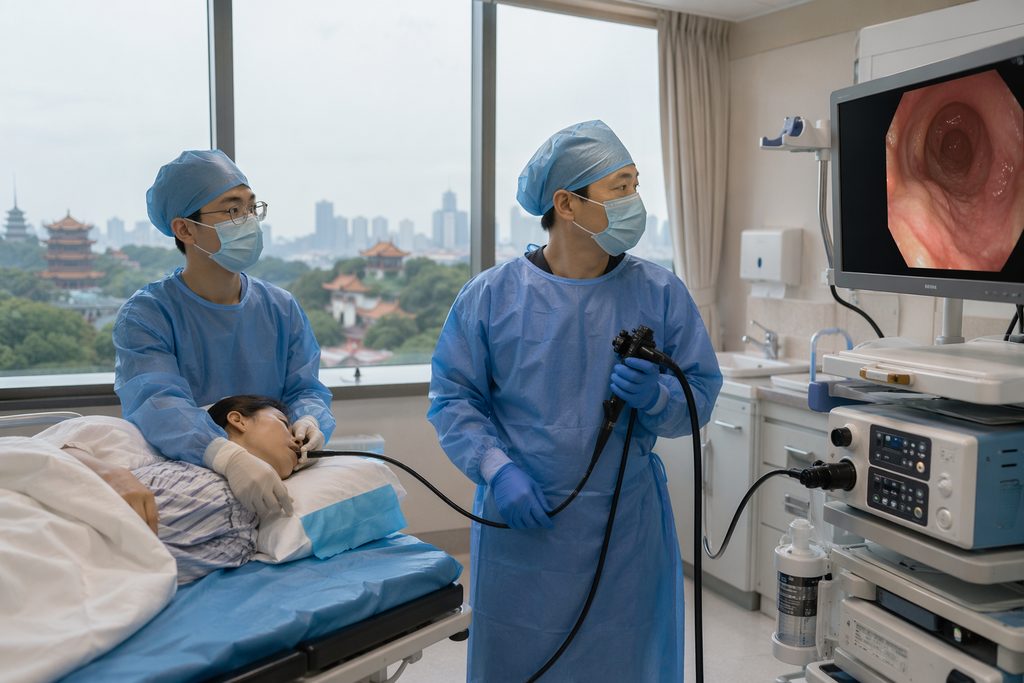
Key Takeaways
- A sedated endoscopy at a top-tier Chinese hospital typically lands between $250 and $900 all-in, versus $1,500–$4,000 in the US — but the figure swings with hospital tier and whether polyps are removed.
- Sedation safety in China’s major hospitals follows the same drug families used in the West: propofol, midazolam, and fentanyl, administered by an anesthesia team with continuous monitoring.
- The real friction is not clinical quality — it is logistics. Most public hospital endoscopy slots cannot be reserved from overseas without going through an international department.
- Anyone with sleep apnea, a high BMI, or a history of sedation complications needs a pre-procedure anesthesia review, wherever the scope is done.
The Problem: A $3,000 Bill and a Three-Month Wait
When 44-year-old Daniel from Portland started passing blood in early spring, his gastroenterologist ordered a colonoscopy. The quote that came back stopped him cold: $2,850 after insurance, with the first available slot eleven weeks out. He had already watched his father die of colon cancer at 61. Eleven weeks felt like a gamble he could not afford to take.
His situation is not unusual. A 2023 analysis published in JAMA Network Open found that the median out-of-pocket cost for a screening colonoscopy among commercially insured Americans ran into the high hundreds even when the procedure was supposed to be covered, because of facility fees and anesthesia billing. Add a diagnostic (rather than screening) indication, and the number climbs fast.
Waiting is its own risk. Studies from the past decade suggest that every additional month between an abnormal finding and a diagnostic scope modestly raises the chance of a later-stage diagnosis. That math is what pushes people to start looking overseas. The question they ask us most often is not “is it cheaper” — it obviously is. It is “is it safe, and how do I actually arrange it.”
Why China’s Top Hospitals Handle Endoscopy Well
Volume is the quiet advantage. A single large Chinese tertiary hospital may run 200 to 400 endoscopic procedures in a day across its endoscopy center. That throughput produces a level of routine competence that is hard to replicate in a smaller Western unit.
Sedation Protocols Match Western Standards
The drugs are the same. For moderate sedation, Chinese endoscopy centers typically use midazolam combined with an opioid such as fentanyl. For deep sedation — increasingly the default for colonoscopy — propofol is standard, often delivered by an anesthesiologist or a dedicated sedation nurse. Continuous pulse oximetry, blood pressure cycling, and capnography are routine in the larger centers.
This matters because the question “is sedation safe for endoscopy in China” is really a question about monitoring, not nationality. A 2021 consensus statement from the Chinese Society of Anesthesiology mirrors American Society of Anesthesiologists guidance on fasting intervals, airway assessment, and discharge criteria. The equipment is imported. The training is comparable.
Cost Structure, Not Cost Cutting
Lower prices come from labor economics and volume, not from skipping safety steps. An anesthesiologist’s time in a Chinese public hospital costs a fraction of a US equivalent. Consumables are purchased at national scale. The hospital is not trying to recover the cost of a $4 million endoscopy suite from twelve patients a day.
Speed Without Cutting Corners
A diagnostic gastroscopy or colonoscopy at a major hospital can often be scheduled within days of an in-person consultation. That is the practical difference for someone with an abnormal CT or a positive fecal immunochemical test.
What Endoscopy Actually Costs in China
Endoscopy cost China figures vary by city, hospital tier, and whether the procedure is diagnostic or therapeutic. The table below reflects typical ranges at public tertiary hospitals and private international hospitals. All figures are in USD and exclude travel and accommodation.
| Procedure | Public Tertiary Hospital | Private International Hospital | Typical US Range |
|---|---|---|---|
| Diagnostic gastroscopy (moderate sedation) | $250–$450 | $700–$1,300 | $1,500–$2,800 |
| Colonoscopy with sedation | $350–$650 | $900–$1,800 | $2,000–$4,000 |
| Colonoscopy with polyp removal | $500–$900 | $1,200–$2,400 | $2,500–$5,500 |
| Endoscopic ultrasound (EUS) | $600–$1,100 | $1,500–$2,800 | $3,000–$6,000 |
| ERCP (biliary) | $1,200–$2,500 | $3,000–$5,500 | $8,000–$15,000 |
These are reference ranges, not quotes. Final pricing depends on hospital and case complexity — anesthesia time, number of polyps, whether a biopsy is sent for pathology, and whether the patient stays overnight. A sedated endoscopy package Beijing hospitals advertise often bundles the pre-procedure consult, anesthesia, and pathology, but you should confirm exactly what is included before committing.
Moderate vs. Deep Sedation: Choosing What Fits You
Two sedation levels dominate endoscopy in China, and the choice is usually made with the anesthesia team, not by the patient alone.
Moderate sedation uses midazolam plus a short-acting opioid. You stay responsive to voice, breathe on your own, and recover within 30 to 60 minutes. It is common for gastroscopy and for shorter colonoscopies. The trade-off is that some patients remember fragments of the procedure.
Deep sedation uses propofol, usually titrated by an anesthesia professional. You are asleep and typically remember nothing. Recovery is fast — most people are alert within 20 to 40 minutes — but it requires a dedicated sedation provider and closer airway monitoring. In Chinese tertiary centers, propofol sedation for colonoscopy has become the default rather than the exception.
There is a third option: unsedated endoscopy. Some patients choose it to avoid anesthesia entirely, and Chinese endoscopy teams are highly experienced with it because of sheer volume. It is faster and cheaper. It is also uncomfortable, and for a long colonoscopy, most people would rather not.
Booking a Sedated Endoscopy: What the Process Really Looks Like
Here is where expectations need adjusting. Chinese public hospitals generally do not allow overseas patients to book a procedure slot directly from abroad. The standard pathway is: in-person outpatient consultation first, then the endoscopy is scheduled. That rule exists at almost every tertiary hospital.
There are two workable routes for a foreign patient.
- International or VIP department: These units are designed for overseas patients, offer English-speaking staff, and can often compress the consult-and-scope sequence into one or two visits. Expect to pay roughly 1.5 to 2 times the standard public rate.
- Private international hospital: Names like United Family, Jiahui, Parkway, and Raffles operate on a Western model — appointment-based, English throughout, and often direct insurance billing. Higher cost, less friction.
If you want to book endoscopy with sedation in China without flying blind, the practical sequence is a written second opinion first. You send your existing reports — prior scopes, imaging, lab work — and the relevant Chinese specialty reviews them and tells you whether a scope is even the right next step, and which hospital tier fits your case. That single step saves people from booking flights for a procedure they may not need.
Practical Considerations: Visas, Records, and Payment
For medical travel to China, the applicable short-stay visa category is S2, used for medical treatment and private affairs, subject to the latest embassy or consulate requirements and supporting hospital documents. Accompanying family members apply under the same category. Note that the M visa is for commercial and trade activity and has nothing to do with medical treatment — a mistake we see in a lot of online advice.
Bring your records. Specifically: prior endoscopy reports and pathology, recent blood work including coagulation studies, a list of current medications (especially anticoagulants and diabetes drugs), and any history of anesthesia complications. If you take warfarin, clopidogrel, or a direct oral anticoagulant, the prescribing physician and the endoscopist need to agree on a bridging plan before you travel.
Public hospitals require prepayment; you then file for reimbursement with your insurer at home. Private international hospitals frequently bill your insurer directly. Travel insurance that covers medical evacuation is worth having regardless of where you go.
If you want to see which hospitals in a given city handle high-volume endoscopy, our directory of top-ranked Chinese hospitals groups facilities by city and rank tier, and the gastroenterology specialty rankings list the leading centers for digestive disease.
Frequently Asked Questions
At major tertiary and international hospitals, yes — the drugs, monitoring equipment, and protocols align with Western standards. The variable that matters most is the individual facility and the presence of a dedicated sedation provider, not the country. Ask directly who will administer and monitor your sedation.
Midazolam with fentanyl for moderate sedation, and propofol for deep sedation. Propofol is increasingly standard for colonoscopy. Muscle relaxants and general anesthesia are reserved for advanced therapeutic procedures like ERCP.
Rarely through a public hospital’s standard channel, because a face-to-face consultation is usually required first. International departments and private hospitals are more flexible. A remote written review of your records is the realistic first step.
At a public tertiary hospital, expect roughly $350–$650 for a diagnostic colonoscopy with sedation. Private international hospitals in Beijing run higher, typically $900–$1,800. Package inclusions vary, so confirm what is bundled.
Chinese tertiary hospitals have full resuscitation capability and intensive care on site. Before booking, ask about the hospital’s emergency pathway and whether English-speaking staff are available around the clock. It is a fair question, and good hospitals answer it without hesitation.
Your Next Step
The core message is simple: sedation for endoscopy in China is clinically comparable to what you would receive in the West, at a fraction of the price, provided you choose the right facility and plan the logistics properly. The barrier is navigation, not medicine.
We are a medical concierge service, not a hospital and not a provider of diagnoses. Our team helps international patients match with appropriate Chinese hospitals, coordinate appointments, arrange bilingual accompaniment, and prepare visa documentation. If you would like a straight assessment of your options, you can start with a free consultation — no obligation, and no pressure.
For more medical information and treatment options in China, visit chinamedservices.com (China Medical Services).
