Esophageal Cancer Screening in China: Endoscopy Costs & Top Hospitals
Esophageal Cancer Screening in China: Endoscopy Costs, Top Hospitals, and What International Patients Should Know
When 54-year-old Robert from Oregon learned his father had been treated for esophageal cancer, his gastroenterologist in Portland handed him a familiar piece of advice: get a screening endoscopy. Then came the bill estimate. Nine hundred dollars for the procedure alone, plus facility fees and anesthesia, with a wait of nearly three months for a non-urgent slot. Robert started searching for alternatives and found himself typing a phrase thousands of patients now type every month: esophageal cancer screening cost China. What he discovered surprised him — and it may surprise you too.
This guide walks through what upper endoscopy screening actually costs in China’s top hospitals, why the quality is often higher than patients expect, how the process works from overseas, and what can go wrong. We are not doctors. We are a medical concierge team that connects international patients with 340+ top-ranked Chinese hospitals across 37 cities, and we have watched hundreds of screening journeys unfold.
How This Actually Works, Step by Step
Here is the real sequence, not the brochure version. It starts before you buy a plane ticket.
Step one: You gather your existing records — prior endoscopy reports, pathology results, family history notes, current medication list, and any recent imaging. These get translated into Chinese by a certified medical translator. That step takes two to five business days and matters more than most patients realize, because Chinese hospital systems run on Chinese-language documentation.
Step two: We submit your file to the international department of a shortlisted hospital. A gastroenterologist or oncology specialist reviews it and confirms whether screening endoscopy is appropriate for your risk profile. Not everyone needs one. If your risk is low, a good Chinese specialist will tell you so — that honesty is part of the value.
Step three: The hospital issues an appointment confirmation, usually within one to three weeks for international department slots. You then apply for an S2 visa, which is the correct category for short-stay medical travel to China. Note that the M visa is for commercial and trade activities — it has nothing to do with medical treatment.
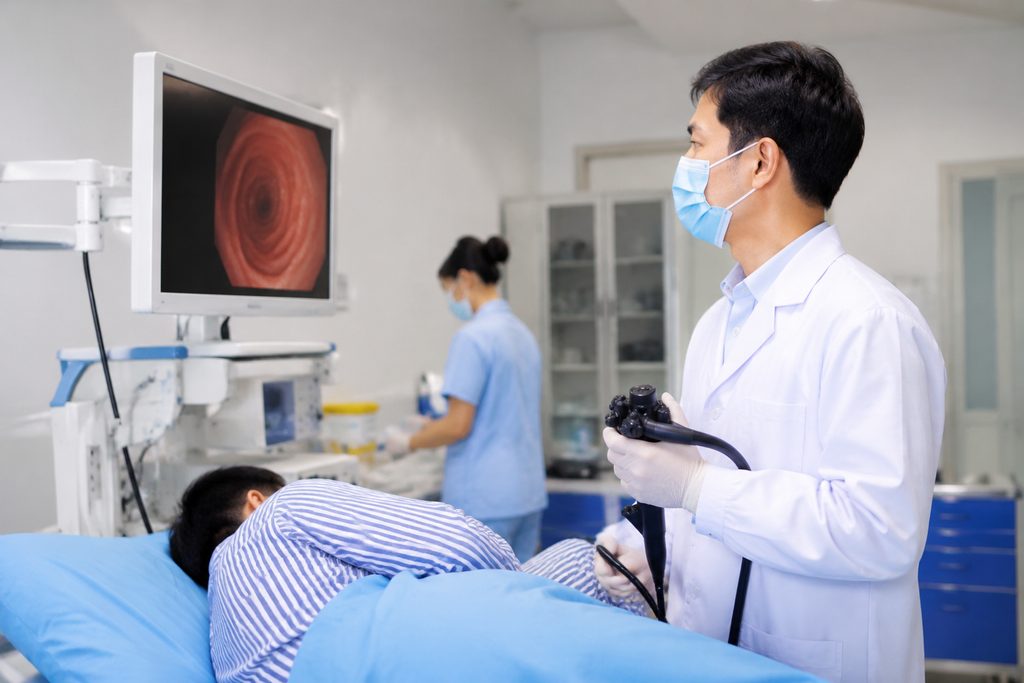
Step four: You arrive, complete pre-procedure checks (blood work, ECG, anesthesia clearance), and undergo the endoscopy. Most diagnostic upper endoscopies take 15 to 30 minutes of procedure time, with the full hospital visit running two to four hours including preparation and recovery.
Step five: Results. Biopsy samples, if taken, typically return in three to seven days. You leave with a written report in English, and we help you route it back to your physician at home.
What Endoscopy Screening Costs in China — and Why
Let’s put numbers on the table. A standard diagnostic upper endoscopy at a top-tier Chinese public hospital’s international department generally runs $250 to $600, all-in. That figure includes the physician fee, endoscope use, sedation where required, and basic pathology if a biopsy is taken. Private international hospitals such as United Family or Jiahui sit higher, roughly $600 to $1,200, but offer English-speaking staff, direct insurance billing, and a Western-style experience.
Compare that with the United States, where the same procedure commonly bills between $1,500 and $3,500 before insurance negotiation, or Western Europe, where private endoscopy frequently lands between €800 and €1,800.
| Setting | Typical Endoscopy Cost | Wait Time | English Support |
|---|---|---|---|
| Top Chinese public hospital (international dept.) | $250–$600 | 1–3 weeks | Yes, via international dept. |
| Private international hospital in China | $600–$1,200 | 3–10 days | Full English service |
| United States (private insurance) | $1,500–$3,500 | 4–12 weeks | Yes |
| Western Europe (private) | €800–€1,800 | 3–10 weeks | Varies |
Prices vary by hospital and case complexity. If your screening includes chromoendoscopy, narrow-band imaging, or multiple biopsies, expect the upper end of the range. Sedation choice also moves the number — conscious sedation is cheaper than general anesthesia.
Finding the Best Hospital in China for Endoscopy Screening
China has more than 35,000 hospitals. The top 5% — the ones worth your flight — are ranked annually by Fudan University and independently accredited by JCI. For gastrointestinal screening, you want a hospital with a strong gastroenterology or oncology reputation, high annual endoscopy volume, and an established international department.
Shanghai and Beijing lead the pack. Shanghai alone hosts 18 Fudan Top 100 hospitals, and several run dedicated international health screening centers. A Shanghai hospital esophageal cancer screening package often bundles endoscopy with consultation, blood work, and a written report for overseas patients — a format that suits travelers who want one clean visit rather than three separate appointments.
You can browse ranked options by specialty on our departments page, where gastroenterology and oncology sit alongside 43 other specialties with their top-10 hospital lists. For city-level planning, the Shanghai hospital directory is a good starting point if you are combining screening with a broader health check.
A Realistic Timeline
Patients consistently underestimate the admin time. Here is what a realistic schedule looks like from first inquiry to results in hand.
| Stage | Typical Duration | What Happens |
|---|---|---|
| Record collection & translation | 2–5 business days | You send reports; we translate to Chinese |
| Specialist review & hospital selection | 3–7 days | Hospital confirms suitability and slot |
| Appointment confirmation | 1–3 weeks | International dept. issues date |
| S2 visa application | 4–10 business days | Embassy processing, varies by country |
| Travel & pre-procedure checks | 2–3 days in China | Blood work, anesthesia clearance |
| Endoscopy procedure | 2–4 hours total visit | 15–30 min procedure plus recovery |
| Biopsy results | 3–7 days | Written English report issued |
Total realistic window: three to six weeks from first contact to results, assuming no complications with visa processing. If you need to compress it, private international hospitals can move faster but cost more.
What Can Go Wrong — and What Happens Then
Honest failure modes matter more than success stories. Here are the ones we see.
The screening turns up something. This is the big one. A polyp, a suspicious lesion, or early-stage changes may require follow-up biopsy, endoscopic resection, or oncology consultation. That is the entire point of screening — catching things early — but it means your trip may extend. Build flexibility into your return flight. We can coordinate extended stays and specialist referrals, though admission and treatment decisions always rest with the hospital.
The visa is delayed. S2 processing times vary by consulate and season. If your appointment is in three weeks and your visa is not back, you may need to reschedule. Hospitals generally allow one free reschedule with notice; after that, fees may apply.
The specialist decides screening is not indicated. If your risk profile is low, a good hospital will say so. You lose the consultation fee but save the procedure cost and the trip. This happens more often than patients expect, and it is a feature, not a bug.
Language friction at a public hospital. Even with an appointment, public hospital corridors are chaotic — thousands of outpatients daily, signage in Chinese, payment at kiosks. This is precisely where a bilingual medical companion earns their fee. Without one, a straightforward screening can turn into a stressful half-day of guesswork.
Is Esophageal Cancer Screening Safe in China?
Upper endoscopy is one of the safest routine procedures in medicine, with complication rates well under 1% for diagnostic exams. Perforation, the most serious risk, occurs in roughly 1 in 2,500 to 1 in 10,000 procedures. Bleeding after biopsy is rarer still.
The safety question for international patients is less about the procedure and more about the setting. Top Chinese hospitals perform endoscopy at enormous volume — some centers exceed 50,000 procedures annually — which means their endoscopists are highly practiced. Equipment at Fudan-ranked hospitals is current-generation, often the same Olympus and Fujifilm platforms used in the U.S. and Europe.
What you should verify: that your chosen hospital has a dedicated international department, that English-language consent and reporting are available, and that emergency backup exists on-site. All three are standard at the hospitals in our network. For a broader view of what quality looks like across Chinese institutions, our Fudan-ranked hospital directory groups them by tier and city.
Practical Considerations: Records, Visa, Payment, Follow-Up
Records. Bring everything. Prior endoscopy images on disc, pathology slides if available, medication lists, allergy documentation. Missing records are the single most common cause of delay.
Visa. Apply for S2 with a supporting letter and appointment confirmation from the Chinese hospital. Family members accompanying you apply for S2 as well. Requirements shift — always confirm with your nearest Chinese embassy or consulate before submitting.
Payment. Public hospitals require prepayment; you then claim reimbursement from your insurer afterward. Private international hospitals frequently bill insurance directly. Bring a card that works in China and expect to pay before the procedure, not after.
Language. Assume nothing is in English outside international departments. A bilingual medical companion costs from $300 per day and covers registration, queueing, payment, wayfinding, and translation — not a promise of a specific doctor or date, just competent hands on the ground.
Follow-up at home. Ask for the full report, images, and pathology in English before you leave China. Your gastroenterologist at home will want all of it.
Frequently Asked Questions
The procedure itself runs 15 to 30 minutes. Including check-in, pre-procedure preparation, sedation, and recovery, plan on two to four hours at the hospital. Biopsy results, if taken, return in three to seven days.
Yes, through a hospital’s international department or a private international hospital. You cannot book a standard public outpatient slot from overseas — that requires same-day registration. International departments exist precisely to handle foreign patients, and working through a coordinator is the practical route.
Diagnostic upper endoscopy carries a complication rate under 1% anywhere in the world, and top Chinese hospitals perform it at very high volume. The larger risk for foreign patients is administrative — language barriers, payment confusion, missing records — not the procedure itself.
Typically a gastroenterology consultation, the endoscopy itself, sedation, biopsy if indicated, pathology, and a written English report. Some packages add blood work or imaging. Contents vary by hospital, so confirm the exact inclusions before booking.
You need an S2 visa for short-stay medical treatment, supported by hospital documentation. The M visa is for commercial and trade activities and does not apply to medical care. Always verify current requirements with your nearest Chinese consulate.
Your Next Step
Screening endoscopy in China is affordable, fast, and performed at a technical standard that matches or exceeds what most Western patients expect. The hard part is not the medicine — it is the logistics of records, visas, appointments, and language. That is the gap we fill. We do not diagnose, treat, or promise outcomes; we translate your file, coordinate with hospital international departments, and put a bilingual companion beside you on the day. If you would like a free, no-pressure conversation about whether screening in China makes sense for your situation, start here and we will walk through it with you.
This article is for general information only and is not medical advice. Screening decisions should be made with a qualified physician who knows your personal risk factors. Prices are estimates and vary by hospital and case complexity.
For more medical information and treatment options in China, visit chinamedservices.com (China Medical Services).
