Eye and Hearing Tests in a China Checkup: What Foreigners Pay
Eye and Hearing Tests in a China Checkup: What Foreigners Actually Pay
Most Western patients assume a Chinese hospital checkup means crowded corridors, unclear pricing, and equipment they cannot trust. The reality runs the other way. The eye and hearing test cost China hospitals charge foreign patients is often 70 to 90 percent lower than the same screening in the United States, performed on the same imported diagnostic platforms — Zeiss optical coherence tomography, pure-tone audiometry calibrated to international standards — inside hospitals ranked in the top 5 percent of more than 35,000 nationwide.
What that low price does not buy is convenience. Public hospital checkup centers operate on their own rhythm, and almost nothing can be reserved from overseas in advance.
That gap between cost and access is exactly where foreign patients get stuck. So here is the honest version of how eye and hearing screening works in a Chinese checkup, what it should cost, and where the friction points sit.
Eye and Hearing Tests in a China Checkup: The Short Answer
A standard foreigner health checkup package in China that includes vision screening, intraocular pressure, fundus photography, pure-tone audiometry, and tympanometry typically runs from $150 to $600 at a top-tier public hospital, or $400 to $1,200 at a private international facility. The core eye and hearing components alone usually add $60 to $250 to a base package. Prices vary by hospital tier, city, and how many add-on tests you request.
The complication is not money. It is scheduling. Public hospital checkup centers rarely accept overseas bookings for a specific date, and results interpretation often comes in Chinese only.
Who This Is Right For — and Who It Isn’t
Not every reader searching for a medical checkup package China for foreigners should actually book one. Being clear about that up front saves people a wasted trip.
You are likely a good fit if:
- You are already traveling to China for work, family, or another medical appointment and want screening folded into the same trip.
- You need a documented health certificate for a Chinese work permit, residence permit, or university enrollment.
- You have a family history of glaucoma, macular degeneration, or age-related hearing loss and want a baseline at a fraction of Western prices.
- You want a second set of imaging or audiometry results to compare against what you were given at home.
You should probably not pursue this if:
- You have an acute eye injury, sudden hearing loss, or active infection. Those need same-day emergency care, not a scheduled checkup package.
- You expect a Western-style primary care conversation. Chinese checkup centers are efficient and protocol-driven; they screen and report, they do not counsel at length.
- You need the results within 48 hours for a legal deadline. Report turnaround varies and cannot be guaranteed.
The Options, Compared
Foreign patients realistically choose between three settings. The differences matter more than the headline price.
| Setting | Typical eye + hearing screening cost | English support | Booking from overseas | Insurance billing |
|---|---|---|---|---|
| Public top-tier hospital, standard checkup center | $60–$250 add-on to base package | Limited; interpreter usually needed | Generally not available in advance | Pay upfront, claim reimbursement later |
| Public hospital international / VIP department | $200–$600 | Yes, dedicated English staff | Often possible with coordination | Pay upfront, itemized receipt provided |
| Private international hospital (JCI-accredited) | $400–$1,200 | Yes, English-first environment | Yes, online or by phone | Direct billing with many international insurers |
If your priority is cost and you have patience for queues, the standard public checkup center wins on price by a wide margin. If your priority is a predictable appointment time and a conversation you can follow without an interpreter, the private international route is worth the premium. The middle option — a public hospital’s international department — is where most of our clients land, because it keeps top-tier clinical quality while removing the language barrier.
What a Chinese Checkup Actually Screens — and Where Eye and Hearing Fit
Foreigners often arrive expecting a Western annual physical. Chinese checkup packages are built differently: broader on imaging and laboratory panels, lighter on the conversational history-taking.
A typical mid-tier package includes blood counts, liver and kidney function, lipid panel, fasting glucose, urinalysis, chest imaging, abdominal ultrasound, and an electrocardiogram. Eye and hearing screening are usually optional modules rather than defaults, which surprises people. You often have to ask for them explicitly.
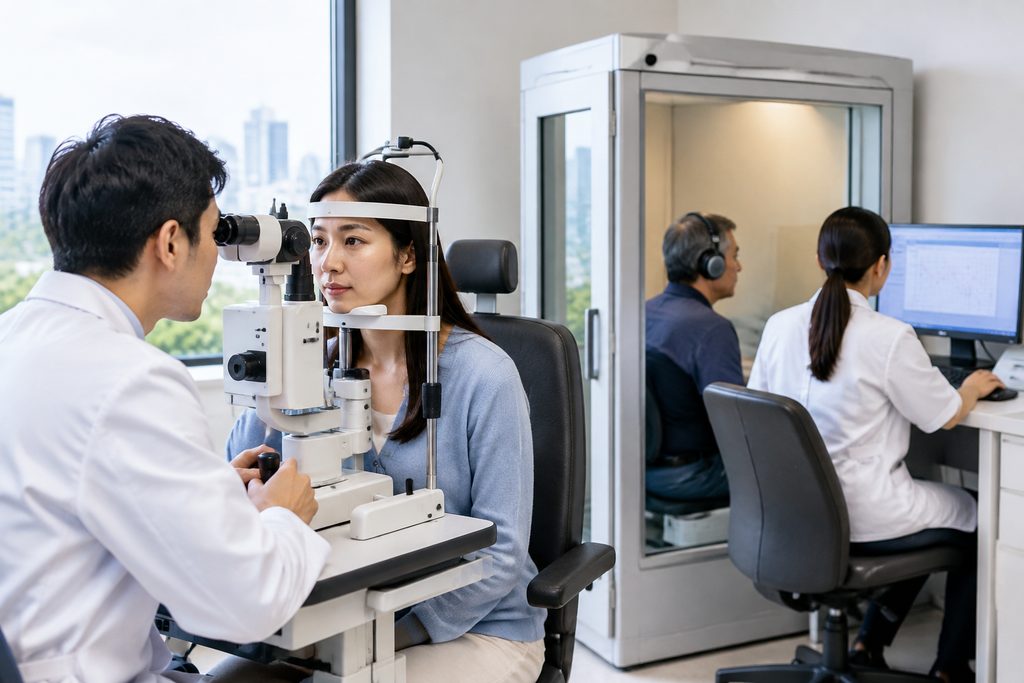
The eye module generally covers visual acuity, refraction, intraocular pressure, and fundus photography. Some hospitals add optical coherence tomography for an extra fee. The hearing module typically means pure-tone audiometry across standard frequencies, and sometimes tympanometry to assess middle-ear function.
If you are building a package around a specific concern — say, a family history of glaucoma or years of occupational noise exposure — it helps to start from the specialty rather than the package. Our department-by-department hospital rankings show which institutions lead in ophthalmology and otolaryngology, so you can match the screening to the right department instead of buying a generic bundle.
What It Costs, Line by Line
Variance in eye and hearing test cost China hospitals charge comes from four things: hospital tier, city, whether an interpreter is involved, and how many add-on tests you accept.
- Basic vision and refraction: roughly $10–$30
- Intraocular pressure and fundus photography: $25–$80
- Optical coherence tomography, if added: $60–$150
- Pure-tone audiometry: $20–$60
- Tympanometry: $15–$50
- Full checkup package containing all of the above: $150–$600 public, $400–$1,200 private
Two cost drivers catch people off guard. First, hospital tier: an international department charges roughly 1.5 to 2 times the standard channel for the same tests, because you are paying for English service and shorter waits, not different equipment. Second, interpretation: if you need a bilingual companion to navigate registration, payment, and results collection, that is a separate service, typically from $300 per day.
For context on how far the savings stretch, the same pattern holds across major procedures. A cardiac bypass at a top Chinese public hospital runs roughly $12,000–$20,000 against $120,000 or more in the United States. Screening is simply the smallest-scale version of the same pricing gap.
Practical Considerations: Booking, Records, and Getting Results Home
Here is where the plan either works or falls apart.
Booking. Standard public outpatient checkups generally cannot be reserved from abroad. You register on the day, in person, in Chinese. International and VIP departments are more flexible, and coordination through a service can secure a slot — though never a guarantee of a specific doctor or a specific hour. If you want to book eye and hearing test Shanghai appointments specifically, the international departments at the major teaching hospitals are the realistic target.
Records. Bring any prior audiograms, visual field tests, or OCT scans you have. Chinese specialists read comparison trends well, and having a baseline from home makes the new results far more useful. Digital copies are fine; printed copies are better.
Visa. If the checkup is the main purpose of your trip, the applicable short-stay category is S2, used for medical treatment and private affairs, subject to the latest embassy or consulate requirements and supporting hospital documents. Family members accompanying you apply under the same category. Note that the M visa is for commercial and trade activity and has nothing to do with medical travel.
Payment. Public hospitals require upfront payment, and you claim reimbursement from your insurer afterward. Private international hospitals frequently bill insurers directly. Bring a card that works internationally, and expect some public counters to prefer local payment methods.
Results. Reports usually arrive in Chinese. Ask for an English translation, or arrange one, before you leave the city. Following up from another country is far harder than asking at the counter.
Follow-up at home. Screening results travel well. Treatment plans do not always. If a Chinese checkup flags something, your home physician should review the raw images and reports before any decision is made.
Frequently Asked Questions
Yes. Pure-tone audiometry and tympanometry are non-invasive, painless, and carry no risk. The equipment at major Chinese hospitals is typically imported and calibrated to international standards. The realistic concern is not safety — it is whether you can understand the technician’s instructions without a Chinese speaker present.
Standard public checkup centers generally require same-day, in-person registration, and this cannot be bypassed from overseas. International and VIP departments at larger hospitals are more accommodating, and coordination can secure an appointment window. What no one can promise is a specific specialist at a specific time.
Sometimes, but rarely as a direct claim. Most international insurers treat routine screening as elective and reimburse only partially, if at all. Private international hospitals with direct billing arrangements are the exception, and coverage depends entirely on your specific policy. Confirm with your insurer before you travel, not after.
That is a real possibility with any screening, anywhere. A Chinese checkup can identify a problem, but acting on it means a proper consultation with a qualified physician — in China or at home. Screening is a starting point, not a diagnosis, and no checkup package replaces a full clinical evaluation.
Your Next Step
The takeaway is simple: eye and hearing screening in China is affordable, technically solid, and logistically awkward without local help. The price advantage is real, but so is the language and booking friction.
We are China Medical Services, a coordination service — not a hospital, and we do not diagnose or treat. Our team helps international patients match with the right institution among 340+ top-ranked hospitals across 37 cities, arrange appointments, and provide bilingual support on the ground. If you want to understand what a checkup would realistically involve for your situation, you can start with a free consultation and decide from there. No pressure, and no obligation to travel.
This article is for general information only and does not constitute medical advice. Screening decisions and the interpretation of any test result should be made with a qualified physician who knows your history.
For more medical information and treatment options in China, visit chinamedservices.com (China Medical Services).
