Family Access Portal Service China: Let Loved Ones Track Your Treatment Securely
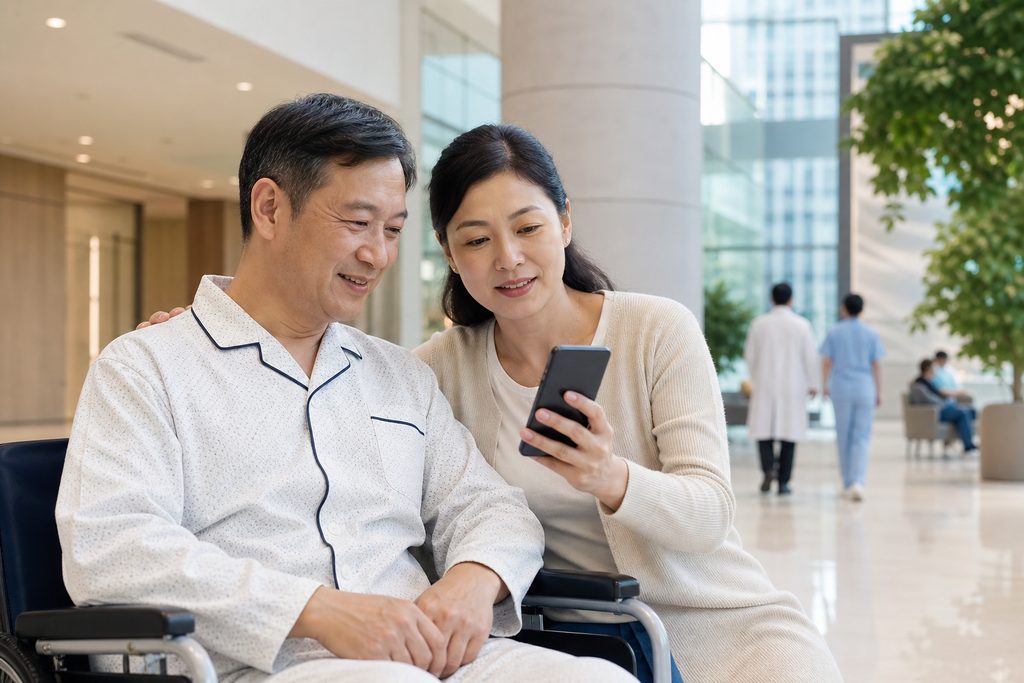
You have probably heard the nightmare stories. A family member flies overseas for a major surgery. Then comes the silence. Hours pass. No updates. Phone calls go unanswered because of time zones and language barriers. You are left refreshing your email, imagining the worst. The reality of seeking medical care abroad does not have to feel like sending someone into a communication black hole. We have built our entire coordination framework to solve exactly this.
The anxiety does not come from the procedure itself. It comes from the information vacuum that surrounds it. A 2023 survey by the Medical Tourism Association found that 67% of prospective medical travelers cited “family’s concern about communication during treatment” as a primary barrier to booking care abroad. Not cost. Not quality. Communication. That is a fixable problem. And it is the problem we focus on solving every day.
Key Takeaways
- Over 340 top-ranked hospitals in China now offer structured international patient pathways, with many supporting secure digital or coordinator-facilitated family access to treatment updates.
- A dedicated bilingual patient coordinator can cut family anxiety by providing twice-daily structured updates, eliminating the fear of the unknown during a loved one’s hospital stay.
- China’s public hospital system does not offer the kind of self-service patient portal Western families expect; navigating this gap requires a human bridge, not just a login page.
- Understanding the real communication workflow before you book a surgery ensures your family is prepared, not panicked, during every phase of treatment.
The Problem: Your Family Is 6,000 Miles Away and Knows Nothing
Imagine your spouse is in a Shanghai operating room. The surgery started two hours ago. You are in London. Or Houston. Or Dubai. Your last WhatsApp message sits unread. Nobody has called. You do not know if the procedure is going well, if there were complications, or even if it started on time. That gnawing feeling in your stomach is not irrational. It is the predictable result of a system that was never designed for international families.
A 2022 report in the Journal of Medical Internet Research examined patient portals across 15 countries. The finding was stark. China’s hospital information systems, while clinically advanced, rarely extend patient-facing portal access to family members abroad. Most domestic portals require a Chinese national ID for registration. They send SMS verification codes to local phone numbers. The interface is in Mandarin. For a family sitting in another country, these portals might as well not exist. That gap is exactly what the best hospitals in China with family access portal functionality aim to close — but the solution looks different than what a Western patient might expect.
We see this play out every week. A patient arrives well-prepared for their procedure but completely unprepared for their family’s emotional experience. The stress leaks back to the patient. Recovery suffers. It does not have to go this way.
Who We Are
We are not a hospital. We do not provide medical treatment or clinical diagnoses. We are your logistical architects — we bridge the gap between you and China’s top-tier medical expertise. Our team handles the invisible work that makes a medical journey feel seamless: hospital matching, appointment coordination, bilingual medical companions on the ground, and structured family communication protocols. We do not replace doctors. We make sure you and your family understand exactly what the doctors are saying, every step of the way.
What “Family Access Portal” Actually Means in China’s Best Hospitals
Western patients often arrive with a specific expectation. They want a web portal. A login. A dashboard with real-time vitals, lab results, and physician notes — the kind of system they use at their local hospital back home. Let us be direct. That exact product rarely exists in Chinese public hospitals, even among the best hospitals in China with family access portal services. What does exist, however, can be more effective: a human-mediated access layer that translates clinical reality into meaningful updates for your family.
This is not a downgrade. It is a different model. And for many families, it works better.
The Coordinator Is the Portal
When you hear “portal,” think person, not platform. Our bilingual medical companions serve as the secure bridge. They are physically present on the hospital floor. They speak with the surgical team when your family cannot. They translate the surgeon’s post-operative briefing into plain English and deliver it to your relatives via a pre-arranged channel — encrypted messaging, a scheduled video call, or a written summary. The update is not automated. It is curated. That matters when the raw clinical data would only confuse and frighten a non-medical family member.
Some international hospital systems in China do offer digital patient portals. Private institutions like United Family Healthcare and Jiahui International Hospital provide English-language apps where patients can view lab results and appointment schedules. These are the exception, not the rule. If a digital login is non-negotiable for your family, we can direct you toward private international hospitals in China that support this. But for most patients seeking the highest clinical expertise at major public academic centers — Fuwai Hospital for cardiac surgery, Peking Union Medical College Hospital for complex diagnostics — the coordinator model is the reality. We make that reality work smoothly.
How Can My Family Check My Medical Status in China? The Real Workflow
This is the question that sits behind every inquiry we receive. A daughter in Toronto wants to know her father’s surgery outcome. A husband in Berlin needs to understand his wife’s treatment plan. The question “how can my family check my medical status in China” is not technical. It is emotional. Here is the actual workflow we deploy for every patient.
Before you even board your flight, we establish a Family Communication Protocol. This is a simple document. It names exactly one family point of contact. It specifies the preferred communication channel — Signal, WhatsApp, email, or phone. It sets the update frequency: twice daily during active treatment, once daily during recovery, with an immediate alert protocol for any unexpected events. The patient signs a consent form authorizing us to share specific categories of information with that designated person. This is not a casual arrangement. It is a structured, privacy-compliant system.
On the ground, our companion executes the protocol. After morning rounds, the family receives a summary: what the doctors said, any changes to the treatment plan, how the patient is feeling. After the evening shift change, another update. If surgery is involved, the companion waits outside the operating theater, speaks with the surgeon immediately post-op, and transmits the outcome within 30 minutes of the patient entering recovery. No family member sits for eight hours wondering if their loved one made it through.
Does China Medical Tourism Offer Patient Status Updates for Relatives?
The short answer is yes — but the quality varies enormously. The question “does China medical tourism offer patient status updates for relatives” reveals a deeper anxiety about accountability. Who is responsible for keeping your family informed? What happens if that person goes home for the night?
In a purely self-arranged medical trip, the answer is often nobody. The hospital’s nursing staff are clinically excellent but not resourced to provide personalized updates to international families. Language barriers compound the problem. A nurse may try to call your spouse using a hospital phone, reach a voicemail in a foreign language, and give up. This is not negligence. It is a system designed for domestic patients whose families are physically present in the hospital lobby.
Structured medical tourism facilitation changes this. Reputable coordination services build family communication into their service level agreements. It is not an add-on. It is core to the offering. When evaluating any provider, ask to see their written communication protocol. If they do not have one, they are not serious about family access.
Why China’s Top Hospitals Deliver Results Worth the Journey
We have spent a lot of time on communication because that is what families lose sleep over. But the reason patients choose China in the first place is clinical. The outcomes are compelling. And understanding those outcomes helps families feel the journey is worth the temporary communication friction.
Clinical Volume Drives Surgical Precision
Surgeons get better the more they operate. This is not controversial. It is established medical fact. A 2023 study in The BMJ found a clear inverse relationship between surgical volume and patient mortality across 14 procedure types. China’s top hospitals operate at a scale that is difficult to grasp from outside the country. Fuwai Hospital in Beijing performs over 14,000 cardiac surgeries annually — more than any other center on earth. A cardiac surgeon there may complete more valve replacements in a month than a surgeon at a respected regional US hospital does in a year. For families asking “how can my family check my medical status in China,” the underlying question is often: “Is this safe?” Volume data is part of that answer.
Technology Deployed at Scale
Chinese hospitals have invested heavily in surgical robotics, hybrid operating theaters, and AI-assisted diagnostics. The difference is not the presence of the technology. It is the throughput. A Da Vinci surgical robot at a major Chinese urology center might complete 15 prostatectomies in a week. The same machine in a European hospital might do three. This concentrated experience translates into refined protocols and fewer surprises. For families tracking a patient’s progress, fewer surprises is exactly what you want.
Cost Without Compromise
Let us address the elephant in the room. Many families researching “China medical treatment price with secure family login” are comparing costs. They should. A cardiac bypass that costs $120,000 in the United States runs $12,000 to $20,000 at a top Chinese public hospital. A hip replacement quoted at $40,000 in Australia might cost $8,000 to $15,000 in China. These are not discount procedures at discount hospitals. These are the same hospitals ranked in the top 5% of China’s 35,000-plus medical institutions, as evaluated by the Fudan University hospital rankings. The cost difference comes from structural economics — lower labor costs, higher patient volumes, and a system built for efficiency — not from cutting corners on safety or outcomes.
That price gap matters because it changes what families can afford. A patient who would be financially devastated by a US hospital bill can pay for Chinese treatment, a companion, and a structured family communication plan — and still save 70 to 80 percent. The China medical treatment price with secure family login question is really about value: can we get excellent care and keep our family connected without going bankrupt? The answer is yes.
What You Need to Know Before Going Alone
Some patients try to arrange everything independently. We understand the impulse. But the barriers are real and they hit hardest exactly when your family needs information most.
- Visa requirements are unforgiving: Medical travelers to China need an S2 visa with treatment documentation from the receiving hospital. Accompanying family members also need S2 visas. This is not a tourist trip. Submitting the wrong paperwork means delays that can derail a surgical schedule. We have seen families separated for days because one member’s visa was processed differently.
- Hospital payment systems do not talk to foreign banks: Chinese public hospitals require prepayment, often via UnionPay or local bank transfer. International credit cards are frequently declined. A family trying to wire funds from overseas while their loved one waits in a hospital lobby faces a genuine crisis. We handle this before it becomes an emergency.
- Medical records and consent forms are in Mandarin: Your family cannot make informed decisions about your care if they cannot read what they are signing. A bilingual companion ensures that consent is truly informed — not just a signature on a document nobody understands.
How We Help You Navigate This
These barriers exist for structural reasons, not because anyone is trying to make your life difficult. China’s hospital system evolved to serve a domestic population of 1.4 billion people. International patients are a tiny fraction of the patient load. The system does not bend for us. We bend around the system — and we have been doing it long enough to make it look smooth.
Before you travel, we match you with the right hospital from our database of 340-plus top-ranked institutions across 37 cities. We do not just send a list. We review your medical records, consult our network, and recommend specific departments with documented outcomes in your condition area. If your family insists on a digital portal, we steer you toward private international hospitals that offer one. If clinical excellence at a major academic center is the priority, we explain the coordinator model and set expectations clearly.
During your treatment, your family receives structured updates on the schedule we agreed upon. They are never left guessing. If something unexpected happens — a change in surgical plan, an extended recovery — they learn about it from a human being who can explain what it means, not from a cryptic text message or an automated alert they cannot interpret. This is the real answer to the question “does China medical tourism offer patient status updates for relatives.” Yes, when the coordination is done properly, it offers something better than a portal. It offers context.
After discharge, the communication does not stop. We relay discharge instructions, medication schedules, and follow-up appointment details to your family in their language. If you need a video consultation with your Chinese surgeon six weeks later, we arrange it. Your family can participate from their living room. The loop stays closed.
For patients who want to book surgery in China with family portal access, the process starts with a consultation. We assess your clinical needs, identify the right hospital, confirm that the surgeon accepts international patients, and build the communication plan before any money changes hands for the procedure itself. Our hospital appointment coordination service starts from $300, and our bilingual medical companions from $200 per day. These are the human infrastructure that makes family access real.
Frequently Asked Questions
In most Chinese public hospitals, no. The patient portals that exist are designed for domestic patients with Chinese ID numbers and local phone numbers. Private international hospitals like United Family and Jiahui do offer English-language patient portals that family members abroad can access with the patient’s consent. We can help you choose a hospital that offers this if a digital login is a hard requirement for your family. For most patients at top academic centers, the secure family access comes through a human coordinator, not a web dashboard.
Our communication protocol includes an immediate alert pathway. If an unexpected event occurs during your treatment — a surgical complication, an adverse reaction, a change in clinical status — your designated family contact is notified within one hour. The notification comes from a bilingual professional who can explain the clinical situation in plain language and outline what happens next. This is not a panicked phone call from an unknown number. It is a structured update from someone who understands both the medicine and your family’s need for clarity.
Our bilingual companions do not interpret medical information. They relay it. The distinction matters. When a surgeon delivers a post-operative briefing, the companion translates the surgeon’s exact words — not their own summary or opinion. For complex clinical discussions, we recommend recording the conversation (with the surgeon’s consent) so your family can review the primary source. If a written second opinion is needed, we can arrange a formal written second opinion from a top specialist for $300 to $500, which your family can review at their own pace.
They can try. The reality is that hospital switchboards in China rarely have English-speaking operators. Nursing stations are busy and not staffed to handle international family inquiries. A call that gets through may result in a Mandarin speaker hanging up because they cannot understand the caller. This is not rudeness. It is a hospital system operating at maximum capacity. Relying on direct calls as your family communication strategy is a recipe for frustration. A dedicated coordinator eliminates this problem entirely.
Your Next Step
Choosing to travel to China for medical care is a significant decision. Your family’s peace of mind during that journey is not a luxury. It is a clinical necessity. Stressed families create stressed patients. Informed families create supported patients. The best hospitals in China with family access portal services — whether digital or human-mediated — understand this connection. We have built our entire coordination model around it.
If you are considering treatment in China and your family needs to stay connected throughout the process, start with a conversation. No commitment. No pressure. Just a clear discussion of your clinical situation, your communication needs, and whether our approach fits. Visit our patient coordination page to learn more about how we work, or explore our full range of services for international patients. Your family should never have to wonder
For more medical information and treatment options in China, visit chinamedservices.com (China Medical Services).
