Family Health Checkup in China: Costs, Top Hospitals & How to Book
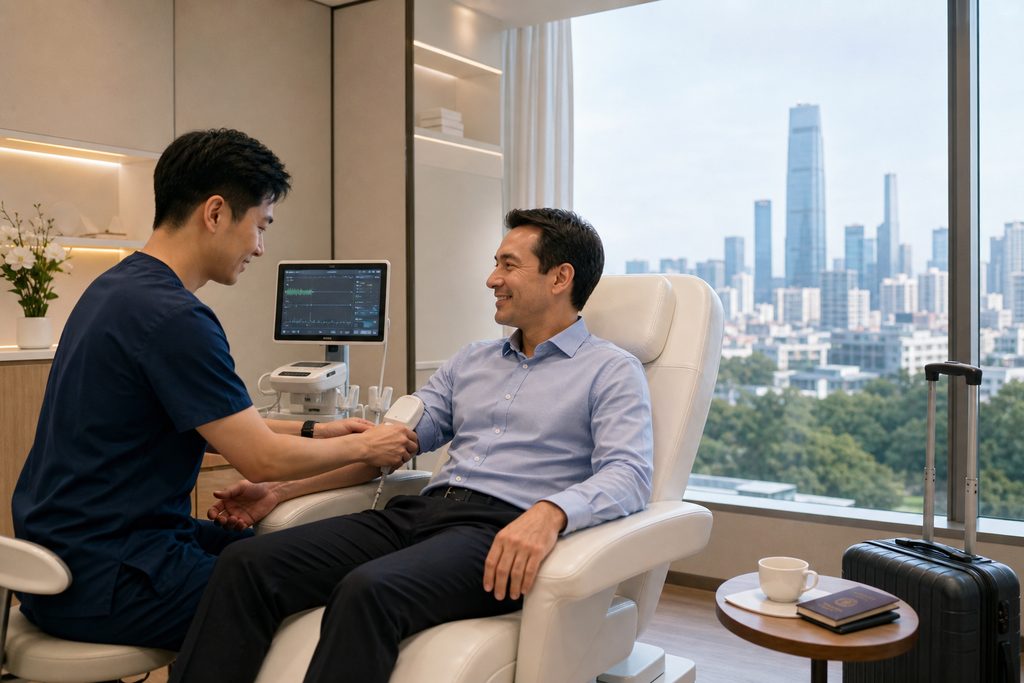
Family Health Checkup in China: What It Costs and How Families Book It
When 46-year-old David from Seattle started looking into a family health checkup in China, his reasons were practical. His father had just turned 74, his wife wanted a full cardiac workup, and his own company physical had been a fifteen-minute affair that told him almost nothing. The family health checkup package China cost estimates he found online ranged from $400 to $4,000, and none of the pages explained what the difference actually bought. That confusion is normal. It is also solvable.
This guide walks through what a family health checkup in China really involves — the price bands, the hospital tiers, the booking mechanics, the visa category, and the parts nobody warns you about.
How This Actually Works, Step by Step
The sequence for a family checkup in China is different from the West, and knowing it upfront saves weeks of frustration. Here is the real order of operations.
Step one: gather records and preferences. Each family member sends us their existing reports — recent bloodwork, imaging, medication lists, prior diagnoses, and any specific concerns. A 70-year-old with hypertension needs a different panel than a 35-year-old with no history. We also ask which city you prefer and your rough travel window.
Step two: hospital and package matching. Our team reviews the records and proposes two or three hospitals with checkup centers that fit your family’s needs. A public tertiary hospital’s international department, a private international hospital, or a TCM hospital each serve different purposes. You see the actual package contents and price ranges before committing.
Step three: appointment coordination. We contact the hospital’s international office or VIP channel to reserve checkup slots. This matters because standard public hospital checkup queues generally cannot be booked from overseas in advance. The international channel can, and it comes at a premium.
Step four: arrival and the checkup day itself. Most comprehensive checkups run half a day to a full day. Blood draws happen early, often before 8 a.m., because fasting is required. A bilingual companion stays with your family through registration, each department, payment, and the report collection point.
Step five: results and interpretation. Preliminary results often come the same day. Full reports take three to seven working days. A physician explains findings, and if something needs follow-up, we help arrange that specialist visit before you fly home.
What a Family Health Checkup Package in China Actually Costs
Price depends on three variables: hospital tier, how many people, and how deep the screening goes. A basic package at a public hospital might cover bloodwork, ultrasound, chest X-ray, and an ECG. A premium executive package adds cardiac CT, MRI, tumor markers, endoscopy, and specialist consultations.
| Package Level | Typical Price (per person) | What’s Included |
|---|---|---|
| Basic public hospital | $200 – $500 | Blood panel, urinalysis, ECG, chest X-ray, abdominal ultrasound |
| Standard executive | $500 – $1,200 | Above plus tumor markers, thyroid, cardiac ultrasound, specialist review |
| Premium executive (international dept.) | $1,200 – $3,000 | Above plus MRI or CT, endoscopy, VIP scheduling, English physician |
| Private international hospital | $1,500 – $4,000+ | Western-style service, English staff, direct insurance billing, same-day comfort |
These figures are reference ranges. Final pricing varies by hospital and case complexity, and the numbers shift depending on which city you choose. Beijing and Shanghai sit at the higher end; secondary cities cost less for comparable screening depth.
Key takeaway: For a family of four, a mid-tier executive checkup in a major Chinese city typically lands between $2,500 and $5,000 total — often a fraction of what the same depth of screening costs in the United States.
Is It Safe to Get a Full Body Checkup in China?
This is the question families ask most, and it deserves a direct answer. China’s top-ranked hospitals operate at a technical standard comparable to leading Western institutions. Many hold Joint Commission International accreditation. Equipment at hospitals like Peking Union Medical College Hospital, Ruijin Hospital, and West China Hospital is current-generation, and imaging volumes are enormous — which means radiologists read thousands of scans a year.
Two honest caveats. First, not every hospital is equal. China has over 35,000 hospitals, and quality varies widely. The gap between a top-tier tertiary hospital and a mid-tier facility is significant. Second, screening quality depends on who reads your results. A rushed reading is a rushed reading anywhere in the world.
For families, the practical answer is to stick to hospitals on the Fudan ranking’s top tiers or JCI-accredited private facilities. Our database of 340+ top-ranked hospitals across 37 cities exists precisely to make that filter easy.
A Realistic Timeline
Families consistently underestimate how long the front end takes. Documents need translation. Appointments need lead time. Visas need processing. Here is what a realistic schedule looks like.
| Stage | Timeframe | What Happens |
|---|---|---|
| Records gathering | Days 1–7 | Collect reports, translate medical documents if needed |
| Hospital matching | Days 7–14 | Review options, confirm package contents and pricing |
| Appointment coordination | Days 14–28 | Hospital confirms slots; international departments respond faster |
| Visa application (S2) | 2–4 weeks | Apply with hospital invitation letter and supporting documents |
| Travel and checkup | Days 30–45 | Arrival, checkup day, preliminary results |
| Full reports and follow-up | Days 45–60 | Complete results, specialist consultation if needed |
Compressed timelines are possible. They are also riskier, especially if a visa delay collides with a fixed appointment.
What Can Go Wrong — and What Happens Then
Honesty here is more useful than reassurance.
The appointment doesn’t materialize. Public hospital standard checkup queues cannot be pre-booked from abroad. If you are counting on walking in and getting a slot during a peak period, you may wait days. The fix is going through the international or VIP channel, which is bookable in advance but costs roughly 1.5 to 2 times the standard rate.
A finding requires follow-up. This is common and usually benign — a borderline thyroid nodule, an elevated marker, a shadow on a scan. The problem is that a specialist follow-up in China typically requires an in-person consultation before anything further is scheduled. If you have already booked your return flight, you may need to extend. Build buffer days into your trip.
Language breaks down at the wrong moment. Top Chinese hospitals see tens of thousands of outpatients daily. Signage is often Chinese-only outside international departments. A family navigating a checkup across six departments without language support will lose hours. This is the single most common friction point, and the easiest to prevent.
Results arrive after you leave. Full reports can take a week. If nobody is collecting and translating them for you, they sit in a hospital system you cannot access from abroad. Arrange report delivery before departure.
Payment surprises. Public hospitals require prepayment; insurance reimbursement happens afterward, at home. Private international hospitals often bill insurance directly. Know which model applies to your chosen facility before you arrive.
How to Choose: Public Hospital, Private International, or TCM
Each tier serves a different family profile.
Public tertiary hospitals offer the deepest diagnostic capability and the lowest prices. They are the right choice when you want thorough screening — cardiac CT, endoscopy, advanced imaging — at the best value. The trade-off is scale and crowds. A bilingual companion is close to essential.
Private international hospitals — United Family, Jiahui, Parkway, Raffles among them — provide English-speaking staff, JCI accreditation, Western-style comfort, and direct insurance billing. Prices run higher, but for families with children or elderly members who value a calm environment, the premium often pays for itself in reduced stress. Our guide to private international hospitals in China covers what each one does well.
TCM hospitals suit a different goal entirely: constitution assessment, chronic condition management, and recovery-oriented care. Acupuncture, tuina, and herbal consultation can complement a Western checkup rather than replace it. Families often add a TCM consultation day after their standard screening.
If you are weighing cities, Shanghai and Beijing lead on international-department infrastructure. For families specifically searching for the best hospital in Shanghai for family health screening, the concentration of English-capable checkup centers is the strongest in the country.
Practical Considerations: Records, Visas, Payment, and Follow-Up
Records. Bring every relevant report — recent bloodwork, imaging discs, medication lists, surgical history. Translated summaries help, though hospital international departments can work with English originals in most cases.
Visa. Foreigners traveling to China for medical purposes, including a checkup, apply for the S2 visa, which covers short-stay medical treatment and private affairs. Accompanying family members apply for S2 as well. Stays exceeding 180 days fall under S1. Requirements shift, so confirm current documentation with the nearest Chinese embassy or consulate — and note that the M visa is for commercial and trade activity, not medical travel.
Payment. Public hospitals require prepayment, with insurance reimbursement handled after you return home. Private international hospitals frequently bill insurers directly. Confirm your coverage before booking.
Insurance. Many Western insurers reimburse overseas preventive care, but policies vary enormously. Get written confirmation of what your plan covers for a checkup performed in China.
Follow-up at home. Ask for full reports in English, including imaging files. Your primary care physician at home can then interpret findings in context. Without those files, the checkup’s value drops sharply.
Practical tip: Schedule the checkup for day two or three of your trip, not day one. Jet lag distorts blood pressure readings and bloodwork results more than most people expect.
Frequently Asked Questions
A basic package at a Beijing public hospital runs roughly $200 to $500 per person. Executive packages with cardiac imaging and tumor markers range from $800 to $2,500. International department and private hospital pricing in Beijing sits at the higher end of the national range, typically $1,500 to $4,000 depending on screening depth. Final pricing varies by hospital and case complexity.
Yes, but only through the right channel. Standard public hospital checkup queues generally cannot be reserved from overseas. International departments and VIP channels can be booked in advance, usually at 1.5 to 2 times the standard rate. Private international hospitals also accept advance bookings and often handle the scheduling in English.
At top-tier hospitals, yes. Facilities ranked in the Fudan top tiers and JCI-accredited private hospitals meet international standards for equipment, hygiene, and physician training. The variance across China’s 35,000+ hospitals is real, which is why hospital selection matters more than the country itself. Stick to ranked or accredited institutions.
The S2 visa covers short-stay medical treatment and private affairs, and accompanying family members apply under the same category. Stays beyond 180 days fall under S1. Requirements change periodically, so verify current documentation with your nearest Chinese embassy or consulate before applying.
This is the scenario families worry about most, and it is worth planning for. If a finding requires specialist follow-up, an in-person consultation is typically needed before further testing or treatment is scheduled. Build two to three buffer days into your itinerary. If you need to extend your stay, we can help coordinate specialist visits and, where appropriate, hospital communication for any subsequent admission — always subject to hospital rules.
Your Next Step
A family checkup in China can deliver screening depth that would cost several times more at home, provided the hospital is chosen well and the logistics are handled before arrival. The two things that most often derail a family trip are an unbookable appointment and a language gap at the wrong moment — both preventable with preparation.
China Medical Services helps international families match with ranked hospitals, coordinate checkup appointments through official international departments, and arrange bilingual companions for the day itself. We are not a hospital and we do not provide medical advice or guarantee any particular appointment or outcome. If you would like a straightforward conversation about what your family needs, start with a free consultation — no pressure, no obligation.
For more medical information and treatment options in China, visit chinamedservices.com (China Medical Services).
