Staying with Family in Chinese Hospitals: What International Patients Need to Know
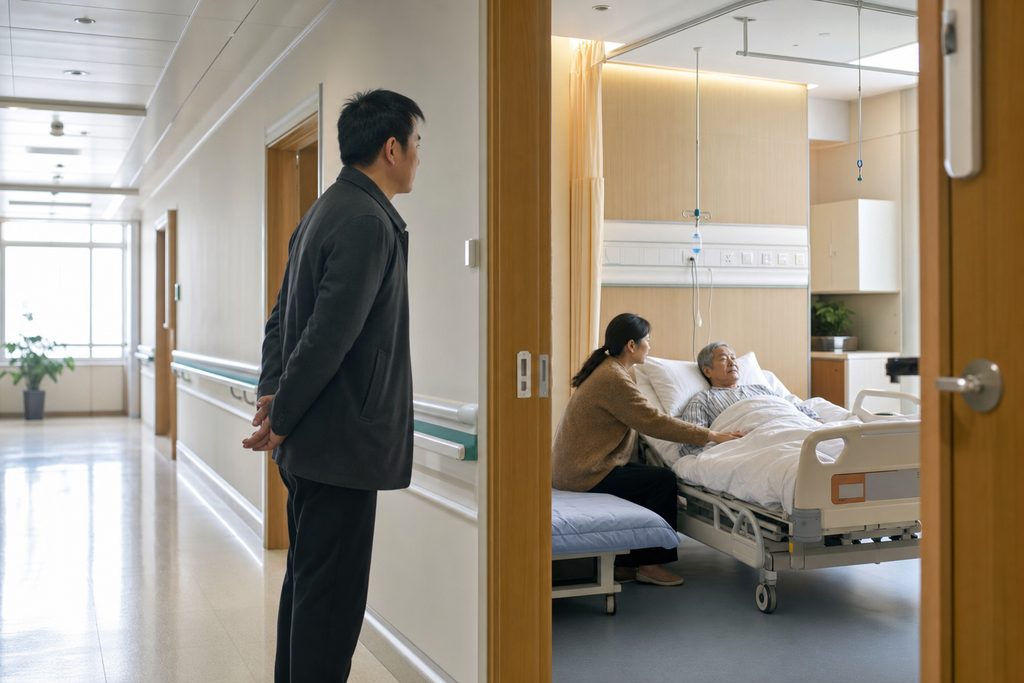
Can Family Stay with Patients in Chinese Hospitals: The Short Answer
Yes, family can stay with a patient in a Chinese hospital — but the can family stay with patient in Chinese hospital question has a more complicated answer than most international families expect. Public ward policies rarely allow overnight stays. Private rooms in the international medical wing often do. The gap between what you imagine and what you’ll encounter on arrival is where stress lives.
We’ve watched families book flights assuming a recliner by the bedside, only to discover the hospital’s visiting hours end at 8 p.m. sharp. Others pay for a premium suite and feel genuinely cared for. The difference comes down to hospital tier, room type, and whether you planned for family presence before you booked the appointment.
Chinese public hospitals treat over 10,000 outpatients daily in major centers like West China Hospital in Chengdu or Ruijin Hospital in Shanghai. Space is at an absolute premium. A standard three-bed or six-bed ward simply cannot accommodate overnight family members. There is no physical room. There are no fold-out cots. The nursing model assumes family leave at night. That’s the baseline reality.
But the international departments of China’s top-ranked hospitals operate under different rules. Private single rooms with a dedicated family bed or sofa bed are standard in facilities built for medical travelers. United Family Healthcare, Jiahui International Hospital, and the VIP wings of Peking Union Medical College Hospital all offer this. You just need to know which hospitals provide it and what it costs before you commit.
Who This Setup Works For — and Who It Doesn’t
Bringing a family member to stay overnight in a Chinese hospital works beautifully for some patients and creates genuine problems for others. Being honest about which group you fall into saves everyone a difficult conversation later.
This typically works well for:
- Patients who speak limited Mandarin and need a family translator even with hospital interpreter services available
- Elderly patients who feel disoriented in unfamiliar clinical environments without a familiar face nearby
- Pediatric cases where a parent’s presence is medically and emotionally necessary — most children’s hospitals in China explicitly permit one parent to room in
- Patients undergoing major surgery who want a family advocate present during the first 24-48 hours of recovery
- Families who can afford the private room premium and understand the cultural norms around hospital stays in China
This setup creates friction when:
- The family member expects hotel-like amenities and becomes frustrated with hospital limitations — shared bathrooms even in some private rooms, limited food options, hard sleeping surfaces
- The patient is in a public general ward and the family insists on staying overnight — staff will simply enforce visiting hours, and arguments at the nurses’ station damage relationships
- Multiple family members rotate through the room — most hospitals cap overnight visitors at one person, and exceeding this causes security issues
- The family member has their own medical needs — hospital rooms are not equipped for two patients, and staff cannot provide care to relatives
The Options, Compared
Not all hospital accommodations are created equal. Here’s what exists across China’s medical landscape for families who need to stay:
| Accommodation Type | Overnight Family Stay | Typical Cost per Night | Available At |
|---|---|---|---|
| Public general ward (3-6 beds) | Not permitted | $15-40 (patient bed only) | All public hospitals |
| Public semi-private room (2 beds) | Rarely permitted; no dedicated family bed | $40-80 | Some public hospitals, limited availability |
| Public hospital VIP/international wing single room | Yes — dedicated family sofa bed or cot | $150-400 | Top-tier public hospitals with international departments |
| Private international hospital single room | Yes — family bed standard; some have separate family sleeping areas | $300-800 | United Family, Jiahui, Parkway, Raffles |
| Private international hospital suite | Yes — separate family room or living area with pull-out bed | $600-1,500+ | Premium rooms at United Family, Jiahui, Raffles |
If you’re searching for Chinese hospitals that allow family members to stay overnight, the shortlist is clear: international departments of major public hospitals and private international hospitals. The public general ward system — where the vast majority of Chinese patients receive care — was not designed with family overnight stays in mind. That’s not a flaw in the system. It’s a different model of care delivery, one where nursing staff handle overnight monitoring and families return in the morning.
The private room with family accommodation hospital China price range varies dramatically by city. Beijing and Shanghai command the highest rates. A VIP single room at Peking Union Medical College Hospital’s international department runs $250-400 per night. The same setup in Guangzhou or Chengdu might cost $150-250. Private international hospitals in Shanghai’s Pudong district can exceed $800 nightly for a suite with separate family quarters.
What “Family Accommodation” Actually Means Inside a Chinese Hospital Room
Let’s be specific about what you’re paying for. The phrase “family accommodation” covers a wide spectrum, and international patients sometimes arrive with expectations shaped by private hospital experiences in Dubai, London, or Bangkok. Chinese hospital rooms — even excellent ones — operate differently.
In a public hospital VIP single room, the family bed is typically a convertible sofa that folds flat. It’s firm. Chinese mattresses are firmer than what most Western patients expect. The room will have a private bathroom, a television, a small wardrobe, and a nurse call button. Air conditioning is standard. What it won’t have: a mini-fridge stocked with drinks, room service menus, or a comfortable armchair. This is a hospital room with a sleeping surface for a relative, not a hotel suite with medical equipment.
Private international hospitals close that gap considerably. United Family’s standard single rooms include a dedicated family zone with a proper pull-out bed, a small desk area, and often a separation curtain for privacy. Suites at Jiahui International Hospital in Shanghai feature a living room area where family members can work or rest without being directly in the clinical space. These rooms feel closer to what Western patients recognize as a private hospital room.
If you’re specifically looking to book hospital with family room China, you need to ask precise questions during the coordination phase. “Does the family bed have a mattress or is it a wooden board with thin padding?” “Is there a separate entrance to the family area, or does everyone enter through the patient zone?” “Can two family members rotate, or is it strictly one person per night?” The answers vary by hospital and even by floor within the same facility.
For families searching for is there accommodation for relatives in Beijing hospitals, the answer depends heavily on which hospital. Beijing United Family and the international department of Peking Union Medical College Hospital both offer rooms with family sleeping arrangements. Beijing Hospital’s international wing has limited single rooms — book far in advance. But standard wards at Beijing’s massive public general hospitals do not accommodate overnight relatives. Nearby hotels become the default solution, and we typically recommend booking something within a 10-minute walk.
What This Costs — and What Drives the Price
In a public general ward, no. The policy is firm and enforced by nursing staff who have no authority to make exceptions. In a semi-private room at a public hospital, you might get a tentative yes from one shift supervisor and a firm no from the next — inconsistency is the norm, not the exception. The only reliable path is booking a room type where family stay is explicitly included from the start. That means a VIP single room in a public hospital’s international wing or a private room at an international hospital. Trying to negotiate your way into an overnight stay in a ward not designed for it wastes energy you’ll need for recovery.
Pediatric wards are the one area where Chinese hospitals consistently permit overnight family presence. One parent or guardian can typically stay with the child, often sleeping on a cot or chair-bed provided by the hospital. Some children’s hospitals have rooms with a dedicated parent bed. This applies to both public and private pediatric units. For adult patients, bringing a child as the overnight companion is generally discouraged — the environment is not suitable, and staff may refuse on grounds of infection control and the child’s wellbeing.
In major medical cities, hotels cluster around large hospital complexes. Near Peking Union Medical College Hospital in Beijing, the Beijing Hotel and nearby mid-range options put you within a 5-10 minute walk. Around Huashan Hospital in Shanghai’s Jing’an district, multiple hotels range from budget to four-star. In Guangzhou, the area near Sun Yat-sen University Cancer Center has accommodations at various price points. Expect $50-120 per night for a clean, functional hotel room within walking distance. During major Chinese holidays, availability tightens and rates rise — book refundable reservations early.
Your Next Step
Understanding where and how family can stay during a hospital admission in China changes the planning calculus entirely. The hospitals that welcome overnight relatives are concentrated in specific tiers and specific cities. Knowing which ones before you book the appointment saves you from arriving to a six-bed ward with a 8 p.m. curfew and nowhere for your spouse to sleep.
Our team at China Medical Services helps international patients match with hospitals that fit their clinical needs and their practical requirements — including family accommodation. We are not a hospital. We do not provide medical advice or diagnoses. What we do is connect you with China’s top-ranked medical institutions, coordinate the logistics of international department admissions, and ensure the room you book is the room that actually exists. If you’re weighing options and need clarity on which hospitals in which cities can accommodate both patient and family, reach out for a free consultation. No pressure. Just practical answers from a team that has navigated this before.
Frequently Asked Questions
Yes. The hospitals used for international patients are JCI-accredited and follow the same international safety standards as top hospitals in the US and Europe. Surgical teams perform high volumes of procedures — often more than their Western counterparts — which studies show leads to better outcomes.
Costs vary by procedure and hospital, but international patients typically save 40-80% compared to US prices — even when factoring in travel and accommodation. A consultation with our team will give you an exact, all-inclusive quote with no hidden fees.
Send us your existing medical reports to get started. We handle everything from hospital selection and appointment scheduling to visa assistance and post-operative recovery planning. Your medical records are reviewed by the specialist before you even book a flight.
For more medical information and treatment options in China, visit chinamedservices.com (China Medical Services).
