Fluoroscopy in China: When It Is Used and What It Costs
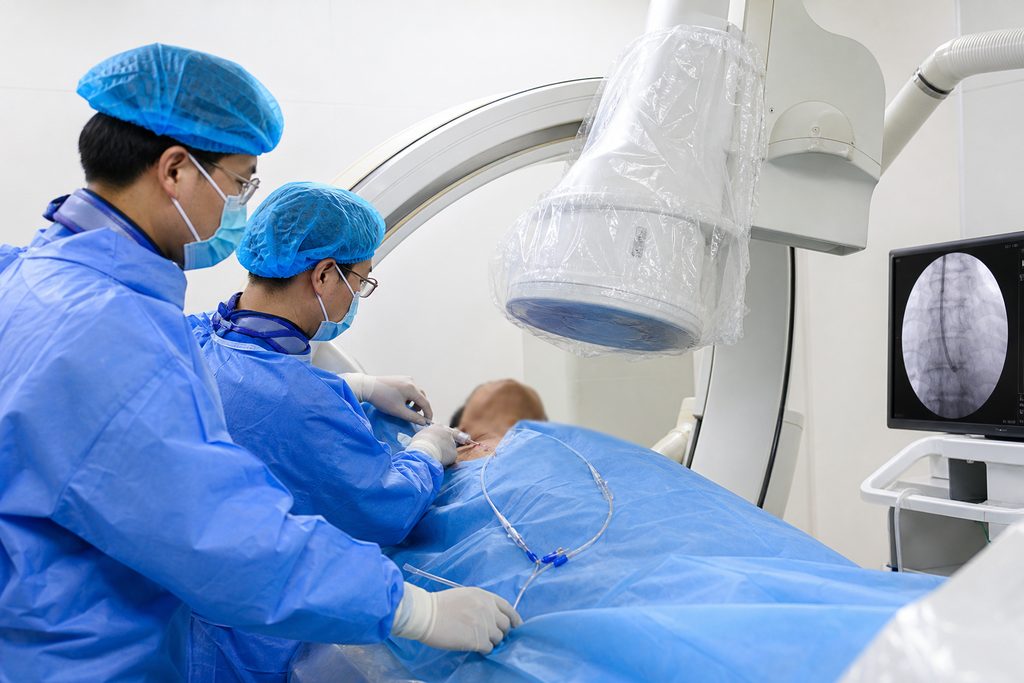
Fluoroscopy in China: When It Is Used
Most international patients assume that advanced imaging means MRI or CT. Fluoroscopy rarely enters the conversation. Yet this real-time X-ray technique sits behind some of the most common procedures performed in Chinese hospitals every day — from swallowing studies to cardiac catheterization. And for patients comparing fluoroscopy cost China versus prices at home, the gap is often startling.
Here is the part that surprises people. Fluoroscopy is not a test you book like a blood draw. It is a tool a physician uses during something else — a procedure, a placement, a dynamic study of movement inside your body. Understanding when it is used tells you far more about your treatment plan than any price list can.
How This Actually Works, Step by Step
Say you have a report from your home country recommending a procedure that involves fluoroscopy. A barium swallow study. A coronary angiogram. A spinal injection. Here is the real sequence.
You send us your existing examination reports — imaging files, lab results, physician notes, and the specific question your doctor at home wants answered. Our team translates the relevant documents and routes them to the appropriate specialty at a Chinese hospital. Not a generalist. The department that actually performs the study.
Within several business days, that specialty reviews your file and returns a written second opinion: whether the procedure is appropriate, what alternative imaging might work, and what the hospital would need before scheduling. That is a written second opinion, priced from $300 to $500 depending on the hospital tier. It is a document for your consideration — not a prescription, and not a substitute for your own physician’s judgment.
If you want to speak with the team directly, a video consultation adds a live conversation. You describe your symptoms and goals. They explain what they would do and why. Standard international departments run $100 to $300; top-specialist sessions $500 to $800.
Only after that does travel make sense. And that ordering matters, because fluoroscopy-guided procedures sometimes turn out to be unnecessary once a specialist actually looks at the films.
When Fluoroscopy Is Actually Used — and When It Is Not
Fluoroscopy is essentially an X-ray movie. Instead of one still image, it captures continuous real-time pictures, usually with a contrast agent moving through your body. That real-time view is the whole point. It shows function, not just anatomy.
So where does it show up?
- Swallowing and digestive studies. A barium swallow or barium enema tracks how contrast moves through your esophagus, stomach, or colon. A static X-ray cannot show that.
- Cardiac catheterization and angiography. Cardiologists watch dye flow through coronary arteries in real time to locate blockages. This is one of the highest-volume uses in China, where major heart centers perform thousands of these annually.
- Interventional pain procedures. Epidural injections, nerve blocks, and joint injections use live imaging to confirm the needle reaches the right spot.
- Orthopedic hardware placement. Surgeons use fluoroscopy during fracture fixation and spinal fusion to verify screw and implant positioning.
- Urological and gastrointestinal stenting. Placing a stent or tube often requires watching it travel.
- Foreign body retrieval. Swallowed objects, in children especially, are frequently located and removed under live imaging.
And when is it not used? If your question is about soft tissue detail — a tumor’s margins, a brain lesion, a ligament tear — MRI or CT does the job better. Fluoroscopy gives you motion and instrument guidance. It does not give you fine anatomical resolution.
Is Fluoroscopy Safe in China Hospitals?
This is the question that matters most, and it deserves a direct answer.
Fluoroscopy uses ionizing radiation. That is a real consideration, not a marketing footnote. Dose depends on procedure type, duration, and equipment. A barium swallow exposes you to far less than a lengthy cardiac intervention. Modern hospitals manage this with pulsed fluoroscopy, dose monitoring, and the principle of keeping screening time as short as clinically acceptable.
So, is fluoroscopy safe in China hospitals? At the top tier, the equipment and safety protocols match international standards. China’s leading hospitals — the ones ranked in the Fudan Top 100 and accredited by JCI — operate the same imaging platforms you would find in Western academic centers. Radiation safety officers, dose tracking, and shielding protocols are standard.
What varies is not the technology. It is the communication. A Chinese public hospital may see ten thousand outpatients in a day. Without someone who speaks the language, you cannot ask the technician about dose, cannot confirm what the radiologist saw, cannot advocate for yourself in the room. That gap — not the equipment — is where risk creeps in.
For context on where these hospitals sit globally, our overview of China’s top-ranked hospitals by city shows how the Fudan ranking system works and why the top tier is a small slice of the country’s 35,000+ hospitals.
A Realistic Timeline
Patients consistently underestimate the administrative runway. Here is what the calendar actually looks like.
| Stage | Typical Duration | What Happens |
|---|---|---|
| Records gathering | 3–10 days | You collect imaging, labs, and physician notes from home providers |
| Translation and routing | 3–5 business days | Our team translates and sends files to the relevant specialty |
| Written second opinion | 5–10 business days | Specialty reviews and returns written analysis |
| Video consultation (optional) | Schedule 1–2 weeks out | Live discussion with the clinical team |
| Appointment coordination | 1–3 weeks | Registration, medical card creation, scheduling through the international department |
| Visa (S2, medical purpose) | 1–3 weeks | Requires hospital supporting documents; timing varies by consulate |
| Travel and in-person visit | — | Consultation, procedure, and follow-up as clinically indicated |
Total from first contact to a procedure in China: roughly four to eight weeks in a straightforward case. Longer if your case needs multidisciplinary review, or if consulate processing runs slow.
What Can Go Wrong — and What Happens Then
Honest failure modes, because you deserve them.
The procedure turns out to be unnecessary. This happens more than people expect. A specialist reviews your films and concludes that a non-invasive study answers the question. You have spent the cost of a second opinion and saved a trip. That is a good outcome, even if it feels anticlimactic.
The hospital cannot schedule the date you want. Public hospital outpatient slots cannot be reserved from overseas in the ordinary channel. Surgery requires an in-person consultation first — that is the rule, not a sales tactic. The international or VIP channel can sometimes compress this, at roughly 1.5 to 2 times the standard price. If we cannot secure the appointment you ordered, the coordination fee is refunded in full.
Your visa is delayed. S2 applications require supporting hospital documents, and consulate timelines shift. We provide the paperwork and guidance. We cannot guarantee approval — no one can, honestly.
The clinical picture changes on arrival. New findings may mean a different procedure, a different department, or a staged plan. Admission and treatment decisions always remain with the hospital.
Something goes wrong clinically. Complications are possible with any procedure involving contrast or catheterization. This is exactly why the top tier matters — these hospitals handle high volumes and have established complication protocols. But no provider, anywhere, can promise a specific outcome.
Cost, and How to Evaluate What You Are Quoted
Now the number everyone wants. Fluoroscopy cost China varies enormously because the procedure varies enormously. A barium swallow is not a coronary angiogram.
What we can say with confidence: for comparable procedures at top-tier Chinese public hospitals, total costs commonly run one-fifth to one-tenth of US prices. A cardiac procedure billed at $120,000 or more in the United States is frequently in the $12,000 to $20,000 range at a leading Chinese heart center. Imaging-guided injections and diagnostic studies sit far below that.
Public hospitals require prepayment, with insurance reimbursement handled afterward in your home country. Private international hospitals often bill insurance directly and provide English-speaking staff throughout — at a higher price point. Our guide to private international hospitals with direct insurance billing covers that trade-off.
Three things to check in any quote:
- Does it include the contrast agent, or is that billed separately?
- Is the physician fee bundled, or itemized?
- What is the policy if the procedure is modified mid-course?
Be wary of any provider quoting a single fixed price before seeing your records. Real quotes require real clinical information.
Practical Considerations: Records, Visa, Payment, Language
Records. Bring original imaging on disc, not just reports. Radiologists in China will want to read the actual images. Get your home physician’s specific clinical question in writing.
Visa. Medical travel to China uses the S2 visa, annotated for medical treatment purposes. Family accompanying you applies for S2 as well. Stays beyond 180 days fall under S1. Note carefully: the M visa is for commercial and trade activity and has nothing to do with medical treatment. Requirements shift, so confirm current rules with the relevant Chinese embassy or consulate.
Payment. Public hospitals: prepay, then seek reimbursement at home. Private international hospitals: often direct billing. Bring a payment method that works internationally.
Language. This is the practical crux. A bilingual medical companion handles registration, queuing, payment, wayfinding, and interpretation — from $300 per day, half-day or full-day. They do not guarantee access to a specific named specialist. They make sure you understand what is happening to you.
Follow-up at home. Ask before you leave what imaging and reports you will receive, and in what format. You will need them for your physician back home.
Frequently Asked Questions
Not directly through the standard public outpatient channel — those appointments are issued on the day, and procedures requiring sedation or surgery need an in-person consultation first. What you can arrange in advance is a written second opinion, a video consultation, and coordination through a hospital’s international department. That is the realistic path for booking a fluoroscopy procedure in China as an international patient.
At the top tier, the imaging platforms and radiation safety protocols are equivalent to Western academic centers. The genuine variable is communication — whether you can ask questions and understand answers in the room. A bilingual companion closes that gap, which is why we treat it as a clinical safety issue rather than a convenience.
It depends entirely on what the study is for. A swallowing study, a coronary angiogram, and a spinal injection belong to three different departments with three different leading centers. There is no single answer. The Fudan specialty rankings list the top hospitals by department, and our department-by-department hospital rankings let you match the procedure to the right specialty rather than the right city.
Some bundled offerings do, but we would caution against buying a package before a specialist has reviewed your records. Fluoroscopy medical tourism packages in China vary widely in what they actually cover — contrast, physician fees, and follow-up are frequently excluded. A staged approach, starting with a written opinion, usually costs less and produces a better decision.
It ranges from a few hundred dollars for a simple diagnostic study to $12,000–$20,000 or more for complex cardiac interventions at top public hospitals. Final pricing depends on hospital tier, procedure complexity, and whether you use the standard or international channel. Any quote given before your records are reviewed should be treated as an estimate only.
Your Next Step
Fluoroscopy is a real-time tool, used when a physician needs to watch function or guide an instrument — and at China’s top hospitals, the equipment and safety standards hold up. What most patients actually need first is not a plane ticket. It is a specialist’s eyes on their existing films.
We are China Medical Services. Our team translates your records, routes them to the right specialty, and coordinates appointments through official hospital international departments. We are case managers, not clinicians — we do not diagnose, and we never promise a specific outcome or a guaranteed slot with a named physician. If you would like a straightforward assessment of whether a fluoroscopy-guided procedure in China makes sense for your situation, start with a free consultation. No pressure, no obligation — just a clear answer about your options.
This article is for general information only and does not constitute medical advice. Always consult a qualified physician about your individual condition and treatment decisions.
For more medical information and treatment options in China, visit chinamedservices.com (China Medical Services).
