Foot Surgery China Canada: Bunion Repair Without the 18-Month Wait
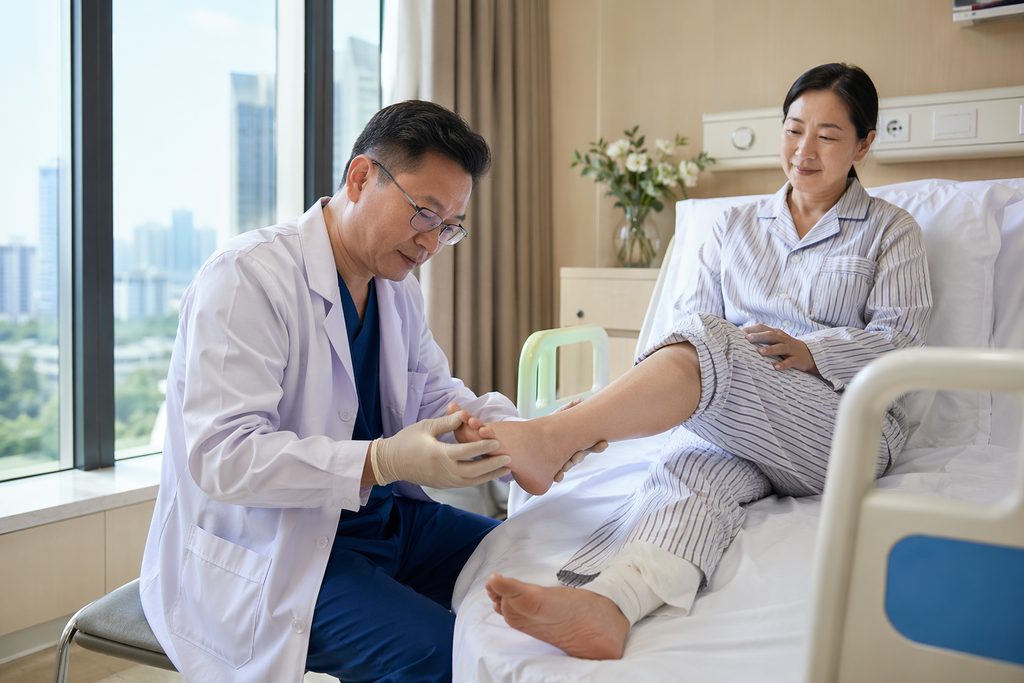
When 54-year-old Sarah from Vancouver realized she’d stopped wearing anything but orthopedic sandals, she’d already been on a surgical waitlist for 14 months. Her bunion had progressed from a mild annoyance to a constant ache that altered her gait. Her surgeon’s office couldn’t give her a date. The provincial health system estimated another 6 to 8 months. She started searching for alternatives.
That search brought her here.
Canadians face some of the longest orthopedic surgery wait times in the developed world. The median wait for bunion repair in Canada stretches to 197 days after the specialist consult—and that’s after the months spent getting the referral in the first place. Meanwhile, a first metatarsal osteotomy in a top-tier Chinese orthopedic center can be scheduled within two to three weeks of arrival. The bunion surgery cost China ranges from $3,500 to $6,000 USD, depending on the technique and hospital tier. In Canada, the same procedure billed privately runs $8,000 to $12,000 CAD. For those without extended health coverage, the math is stark.
Our team connects patients like Sarah with China’s leading foot and ankle surgeons. We don’t perform surgery. We handle the logistics—hospital matching, appointment coordination, visa guidance, and bilingual accompaniment—so you can make a decision based on clinical quality and real timelines, not frustration.
How This Actually Works, Step by Step
The process moves faster than most people expect. Here’s the sequence, from first contact to walking comfortably in recovery shoes.
You send us your existing medical records. That means X-rays, any MRI or CT imaging, your physician’s referral notes, and a brief description of your symptoms and goals. Our team translates these documents into clinical Chinese and forwards them to the orthopedic department at one or more of our partner hospitals.
Within 3 to 5 business days, you receive a written second opinion. The Chinese surgical team evaluates whether you’re a candidate for minimally invasive bunionectomy, traditional open osteotomy, or a lapidus fusion—and explains why. They flag any complicating factors. They provide a tentative surgical plan and a cost estimate. This written opinion costs between $300 and $500 USD.
If the plan makes sense, we schedule a video consultation with the surgeon. You speak directly with the specialist who would operate. This is where you ask the hard questions. What technique do you recommend and why? How many of these procedures have you performed? What’s your revision rate? The video consultation costs $500 to $800 USD for a top-tier specialist.
After you decide to proceed, we lock in a surgical date. The hospital requires a deposit—typically 30% to 50% of the estimated procedure cost. We coordinate your S2 visa application, which requires the hospital’s formal invitation letter and treatment plan. Visa processing takes 5 to 10 business days at most Canadian consulates.
You fly to China. Our bilingual medical companion meets you at the airport and accompanies you through every step: hospital registration, pre-operative testing, the surgical admission, and post-operative follow-up visits. You’re never alone with a language barrier.
Ninety days later, if you upgrade to our on-the-ground coordination service, every dollar you spent on remote consultations is credited back. That’s a full credit toward the coordination fee—not the hospital charges, but the service fee that keeps your entire journey on track.
What Bunion Surgery Actually Costs in China vs. Canada
Let’s put numbers on the table. The bunion surgery cost China breaks down differently than what Canadians see at home, and the comparison rewards close attention to what’s included versus what’s billed separately.
| Cost Component | China (Top Public Hospital, International Wing) | Canada (Private Clinic, Self-Pay) |
|---|---|---|
| Surgeon’s fee | $1,200 – $2,500 | $3,000 – $5,500 |
| Anesthesia | $400 – $800 | $800 – $1,500 |
| Hospital facility (1-2 nights) | $800 – $1,500 | $2,500 – $4,000 |
| Imaging & pre-op labs | $200 – $400 | $500 – $1,000 |
| Post-op boot & supplies | $100 – $200 | $300 – $600 |
| Total procedure cost | $3,500 – $6,000 | $8,000 – $12,000 CAD |
| Coordination & bilingual companion (10 days) | $2,000 – $3,000 | N/A |
| Flights & accommodation (2 weeks) | $2,500 – $4,000 | Included if local |
The Chinese figures come from the international departments of hospitals ranked in the top 5% of China’s 35,000+ medical institutions—hospitals that appear on the Fudan University hospital rankings or hold JCI accreditation. The Canadian private-pay figures reflect current market rates in Vancouver, Toronto, and Calgary.
Sarah’s total in Shanghai came to $5,200 for the procedure plus $2,800 for travel and our coordination service. Her quote in Vancouver had been $10,500 CAD, and that was before the clinic added a $1,200 facility fee. She saved roughly 40% all-in, and she walked into the operating room three weeks after her first video consultation.
The question of how much is bunion surgery in China for Canadians depends on the specific technique. A straightforward distal chevron osteotomy on one foot sits at the lower end. A bilateral correction or a lapidus fusion with hardware pushes toward the higher end. Every case gets priced individually after the surgeon reviews your films.
A Realistic Timeline
Here’s what the calendar actually looks like. This isn’t the best-case scenario. It’s the typical case, with the waiting steps most people forget to count.
| Stage | What Happens | Duration |
|---|---|---|
| Days 1–3 | You gather and send medical records; we translate and submit | 2–3 days |
| Days 4–8 | Chinese surgical team reviews; written second opinion delivered | 3–5 business days |
| Days 9–14 | Video consultation scheduled and conducted with surgeon | 3–5 days for scheduling |
| Days 15–25 | S2 visa application with hospital invitation letter | 5–10 business days |
| Days 26–35 | Travel to China, pre-op testing, surgical admission | 3–5 days after arrival |
| Day 36 | Surgery | 1–2 hours |
| Days 37–42 | Hospital observation, initial wound check, discharge | 1–2 nights inpatient |
| Days 43–52 | First follow-up, suture removal, mobility guidance | 7–10 days post-op |
| Week 6 | Transition to weight-bearing as tolerated; return to Canada | Most patients fly home |
| Month 3 | Return to normal footwear; follow up with Canadian podiatrist | Ongoing |
The timeline from first contact to surgery runs about five weeks. That’s the window most Canadians should plan for. Faster is possible if your records are complete and the hospital has an opening. Slower happens if the surgeon requests additional imaging or if visa processing hits a backlog.
Notice the gap most people underestimate: document translation and surgical review. You can’t rush a careful radiographic assessment. A surgeon who’s going to operate on your foot wants to see weight-bearing X-rays with specific angles. If your Canadian images don’t include the right views, the hospital will ask for new films—and that adds a week.
What Can Go Wrong—and What Happens Then
No honest conversation about medical travel skips the failure modes. Here are the real ones for bunion surgery in China, and what recourse looks like for each.
The surgeon reviews your films and says no. It happens. Maybe your bunion is too mild to justify surgery. Maybe you have vascular insufficiency that makes elective foot surgery risky. A reputable Chinese orthopedic department will decline cases that shouldn’t proceed. If this happens, you’re out the cost of the written second opinion and the video consultation—$800 to $1,300 total. That’s the price of an honest answer. You haven’t booked a flight.
You arrive and the pre-op labs find something unexpected. An elevated A1C. A cardiac arrhythmia. The hospital’s anesthesiology team flags it and the surgery gets postponed. This is rare but real. Our team helps you navigate the next step—whether that’s a cardiology consult in the same hospital or a decision to return home and address the underlying issue first. The hospital refunds the unused portion of your surgical deposit, minus the cost of any tests already performed.
The outcome isn’t what you hoped. Bunion surgery has a satisfaction rate north of 85% in published series, but that leaves a minority of patients with persistent stiffness, nerve irritation, or recurrence. The surgeon who operated on you is responsible for your immediate post-operative care. Once you’re back in Canada, your local podiatrist or orthopedic surgeon manages longer-term follow-up. You need to establish that relationship before you travel. We tell every patient: identify your home follow-up provider and confirm they’ll see you post-op before you book a flight.
You get a bill you didn’t expect. This shouldn’t happen if the written estimate is detailed, but hospitals sometimes add charges for extended recovery room time or additional hardware. Ask for a line-item estimate during the video consultation. The international department at a top Chinese hospital will honor its written quote for the planned procedure. Anything outside that—a longer stay, a different implant—gets priced transparently.
Is Bunion Surgery in China Safe for Foreigners? How to Evaluate a Surgeon
The question is bunion surgery in China safe for foreigners deserves a direct answer. The safety of your procedure depends on the hospital and the surgeon—not on the country.
China’s top orthopedic centers operate at volumes that most Canadian hospitals can’t match. A foot and ankle surgeon at a major Shanghai or Beijing teaching hospital may perform 200 to 400 bunion corrections per year. Volume correlates with outcomes in forefoot surgery. A 2019 study in the Journal of Foot and Ankle Surgery found that surgeons performing more than 50 hallux valgus procedures annually had significantly lower revision rates than lower-volume colleagues.
How do you evaluate a specific surgeon? Ask these questions during your video consultation:
What’s your annual volume for this specific procedure? A focused foot and ankle surgeon should have a clear number. Vague answers are a red flag.
What technique do you use most often, and why? There are over 100 described bunion procedures. The right surgeon explains why a scarf osteotomy, chevron, or minimally invasive approach fits your specific intermetatarsal angle and joint status.
What’s your personal revision rate? Every surgeon has cases that need reoperation. An honest surgeon gives you a number and explains the common reasons.
Can I speak with a former international patient? Many hospitals have patient coordinators who can connect you with someone from your home country who went through the same process.
The hospitals we work with fall into two categories. Public teaching hospitals with dedicated international wings—places like the orthopedics department at a major Fudan-ranked institution—offer the highest surgical volumes and most experienced subspecialists. Private international hospitals provide English-speaking staff, JCI accreditation, and direct insurance billing. The surgical volume is lower, but the patient experience is more familiar to Western expectations. Both are valid choices. The right one depends on your priority: maximum subspecialty volume or maximum comfort.
The question of can I get immediate bunion surgery in China has a qualified answer. Yes, the timeline is dramatically shorter than Canada’s public system. No, it’s not walk-in surgery. You still need a thorough pre-operative evaluation, and any responsible surgeon will require it. What you skip is the 18-month queue.
Practical Considerations: Records, Visa, Payment, and Follow-Up
Let’s cover what you actually need to have in order before you start.
Medical records matter more than you think. The single most common delay is inadequate imaging. You need weight-bearing dorsoplantar and lateral X-rays taken within the last six months. If your Canadian physician ordered non-weight-bearing films, the Chinese surgical team will ask for new ones. Get the right images before you send anything.
Your visa is an S2 visa, annotated for medical treatment. This is not an M visa—M is for commercial and trade activities and has nothing to do with healthcare. The S2 is a short-stay visa for private affairs, including medical treatment. Your accompanying family member applies for the same category. You’ll need the hospital’s formal invitation letter, which specifies the treatment plan and dates. Our team guides you through the documentation, but approval rests with the Chinese consulate. We never guarantee visa outcomes.
Payment works on a pre-payment model at public hospitals. You deposit funds at admission, and the hospital draws against that deposit as services are rendered. Any surplus is refunded at discharge. Private international hospitals may bill your insurance directly. Check with your Canadian extended health provider before you travel—some plans cover out-of-country surgery at a reduced rate, and you’ll want pre-authorization in writing.
Language is the friction point most patients underestimate. A top Chinese orthopedic surgeon may read English medical literature fluently but speak limited conversational English. The nursing staff on the orthopedic floor almost certainly speaks Mandarin only. This is where a bilingual medical companion changes the experience. From registration to discharge instructions, you have someone who translates in real time and advocates for your needs.
Follow-up at home requires planning. Before you leave Canada, book an appointment with your podiatrist or family physician for two to three weeks after your return. Send them the Chinese operative report and discharge summary—we provide certified English translations. Your Canadian provider manages wound checks, physical therapy referrals, and the gradual return to activity. The Chinese surgeon remains available by email for specific clinical questions, but your day-to-day recovery happens at home.
Frequently Asked Questions
The procedure itself runs $3,500 to $6,000 USD at a top Chinese hospital’s international wing. Add $2,000 to $3,000 for coordination and bilingual companion services, plus $2,500 to $4,000 for flights and accommodation. Total all-in: $8,000 to $13,000 USD. A comparable private-pay procedure in Canada costs $8,000 to $12,000 CAD for the surgery alone, without travel costs. For Canadians already considering private surgery, China is often cheaper even after flights. For those stuck on a public waitlist, the trade is money for time.
The best foot surgeon China for bunion repair isn’t one person—it’s a surgeon at a high-volume orthopedic center who performs your specific procedure regularly. Look for a foot and ankle subspecialist at a hospital ranked in the Fudan University orthopedics top 10. During your video consultation, ask about annual procedure volume, preferred technique, and revision rate. A surgeon who answers those questions with specific numbers is the one you want. Our team matches you with departments that meet these criteria, but the final choice is always yours.
Not immediate in the sense of showing up and having surgery the next day. You need a pre-operative evaluation, and any responsible surgeon requires it. But the timeline from first contact to surgery is typically five weeks—compared to 18 months or more in Canada’s public system. That’s the difference. You trade a long bureaucratic queue for a short clinical preparation period. If you have complete, recent imaging and no complicating health issues, the process moves faster. If you need additional testing, it takes longer.
Is bunion surgery in China safe for foreigners who don’t speak Mandarin?
At a top-tier hospital’s international department, yes—with the right support. The surgical standards at Fudan-ranked orthopedic centers are high, and infection rates are comparable to Western hospitals. The
For more medical information and treatment options in China, visit chinamedservices.com (China Medical Services).
