Carpal Tunnel Syndrome Care in China: How the Pathway Works
Carpal Tunnel Syndrome Care in China: The Short Answer
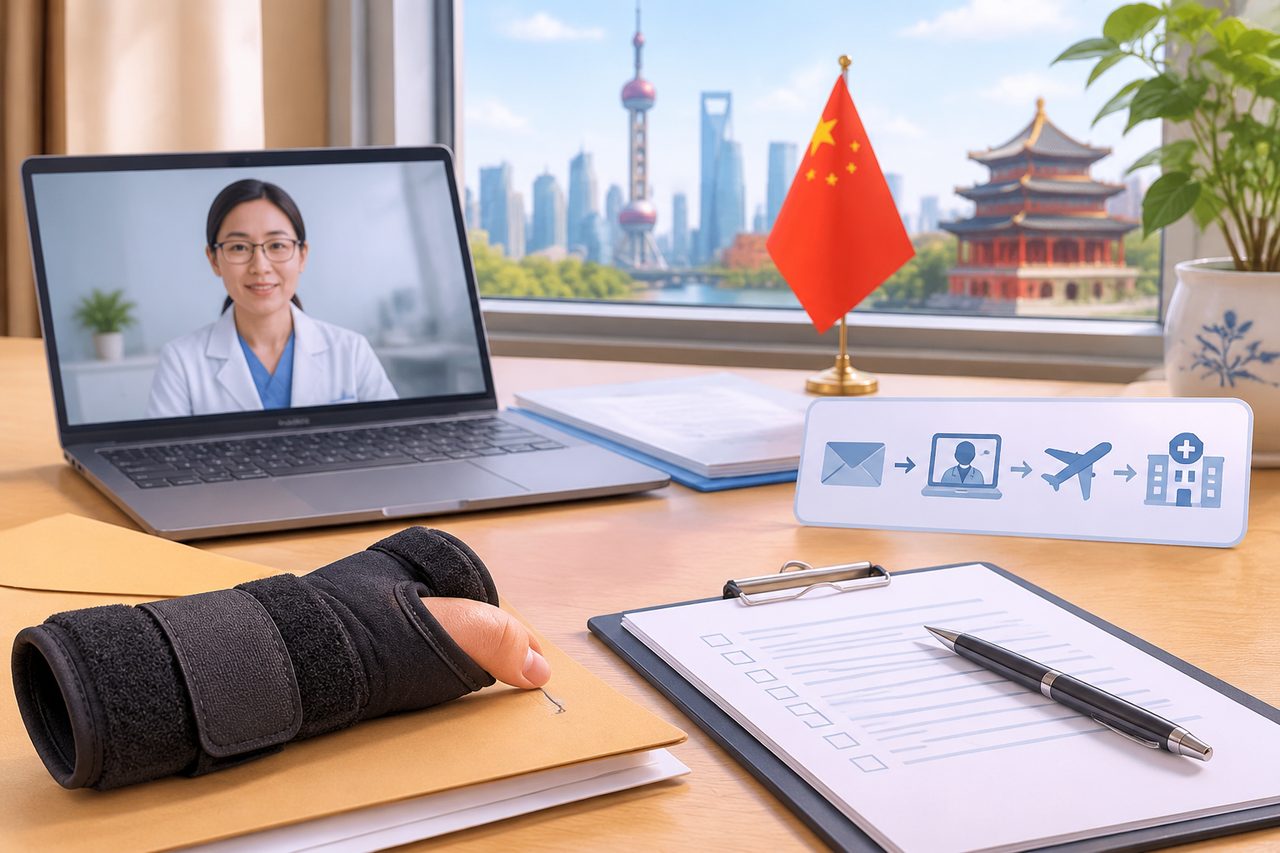
Carpal tunnel syndrome care in China usually follows a staged pathway: you send existing nerve-conduction studies and imaging for a written second opinion, speak with a hand or orthopedic specialist by video, and only then decide whether to travel. Surgery, when it is recommended, is generally arranged after an in-person consultation at the hospital.
That last point matters more than most guides admit. At most Chinese public hospitals, an outpatient appointment cannot be reserved from abroad in advance, and an operation cannot be scheduled before a doctor has examined you in person. Understanding where those gates sit is the difference between a smooth pathway and an expensive wasted trip.
Who This Is Right For — and Who It Isn’t
Carpal tunnel syndrome is common, and most cases do not require a flight. Being honest about that is the best place to start.
Typically a reasonable fit:
- You have a confirmed diagnosis (nerve conduction study or electromyography) and a clear surgical recommendation at home, and you want an independent expert review before committing.
- You are facing a long public wait for surgery in your own system and want to understand what a realistic timeline in China would look like.
- You are already traveling to China for family, work, or another reason and want continuity of hand care while there.
- You want a written second opinion on whether surgery is appropriate at all, or whether splinting, activity modification, or a steroid injection should be tried first.
Usually not the right path:
- Mild, intermittent symptoms that have never been formally tested. Start with a local physician; a remote surgical pathway is premature.
- You have significant coexisting disease that makes anesthesia or travel risky, and your own doctors have advised against long-haul flights.
- You need emergency care. Acute hand trauma, rapidly progressive weakness, or sudden loss of sensation is a same-day local problem, not a medical-travel project.
- You expect a guaranteed operation date before anyone has examined you. That is not how Chinese public hospitals work, and no coordination service can change hospital rules.
The Options, Compared
Most readers are weighing three realistic routes rather than choosing between countries in the abstract. The table below sets out what each actually involves.
| Route | Typical first step | Who examines you | Scheduling reality | Main cost driver |
|---|---|---|---|---|
| Home country, public system | Referral to hand surgery | Local specialist | Waitlist-driven; weeks to months | Covered or partially covered by insurance |
| Home country, private care | Direct booking | Local specialist | Often fast, premium priced | Facility and surgeon fees |
| China, public hospital standard channel | In-person registration on arrival | Hospital hand surgery or orthopedics department | Same-day queue for the outpatient ticket; surgery after face-to-face review | Lower procedure fees; travel and time added |
| China, international or VIP channel | Coordinated appointment through the hospital’s international department | Senior specialist, English-language support | More predictable booking, higher price tier | Roughly 1.5–2× the standard channel at many public hospitals |
| China, private international hospital | Direct enquiry | English-speaking team, JCI-accredited facilities | Appointment-based, direct insurance billing common | Highest facility fees in China, still often below Western private rates |
Which column suits you depends less on price than on tolerance for uncertainty. If you can be flexible and travel for an in-person visit without a fixed surgical date, the standard public channel is the most economical. If your schedule is tight, the international department or a private hospital buys predictability — at a price.
How the Carpal Tunnel Pathway Actually Runs, Step by Step
This is the part generic “medical tourism” pages skip. Carpal tunnel release is a small operation, but the administrative pathway around it is not trivial, and it differs from country to country in ways that catch people out.
Step one: gather the right records. A Chinese hand surgeon reviewing you remotely needs more than a description of tingling fingers. Useful documents include: nerve conduction studies or EMG reports with values, any wrist ultrasound or MRI, prior injection records, a list of conservative treatments already tried and for how long, and relevant blood work if you have diabetes or thyroid disease, both of which affect nerve symptoms.
Step two: a written second opinion. The relevant specialty reviews those records and returns written analysis, treatment suggestions, and direction — for example, whether the studies support surgical release, whether further testing is needed, or whether conservative management deserves more time. This step exists precisely to prevent unnecessary travel.
Step three: video consultation. If the written review leaves open questions, a video call lets you describe symptoms and goals directly and hear the medical team’s reasoning. This is where you learn what the team would actually recommend and what it would not.
Step four: in-person consultation. If you decide to travel, the operation is arranged only after a physical examination at the hospital. Expect this. A surgeon confirming the diagnosis and checking for coexisting conditions is good practice, not bureaucracy.
Step five: surgery and short recovery. Carpal tunnel release is typically day surgery or a short admission, with hand use gradually restored over the following weeks. Your discharge instructions and follow-up plan should be documented in English before you fly home.
What It Costs, and What Drives the Variance
Sometimes, but verify before traveling. Many Western insurers require pre-authorization and may reimburse rather than pay directly. Public hospitals generally expect upfront payment; some private international hospitals bill insurers directly. Ask your insurer in writing what they need — itemized bills, operative notes, diagnosis codes — and keep every document.
Carpal tunnel release is a common operation, but no surgery is risk-free; persistent symptoms, scar sensitivity, and nerve irritation are recognized possibilities. Ask the surgeon directly about complication rates at that hospital, who manages problems after you leave the country, and what your recourse is. A written second opinion before committing is the most practical safeguard — and it is reasonable to obtain one even if you ultimately stay home.
Your Next Step
The pathway works best when it runs in order: records first, expert review second, travel last. That sequence protects you from booking a flight for an operation nobody has yet confirmed you need. We are China Medical Services — a coordination service, not a hospital and not a diagnosing physician. We translate records, arrange second opinions and consultations through official hospital channels, and provide bilingual support on the ground. If you would like an honest read on whether this pathway fits your case, start with a free consultation and we will tell you what is realistic.
This article is for general information only and is not medical advice. Treatment decisions should be made with a qualified physician who has reviewed your individual records.
For more medical information and treatment options in China, visit chinamedservices.com (China Medical Services).
