Heart Attack Emergency in China: Foreign Patient STEMI Response & PCI Coordination
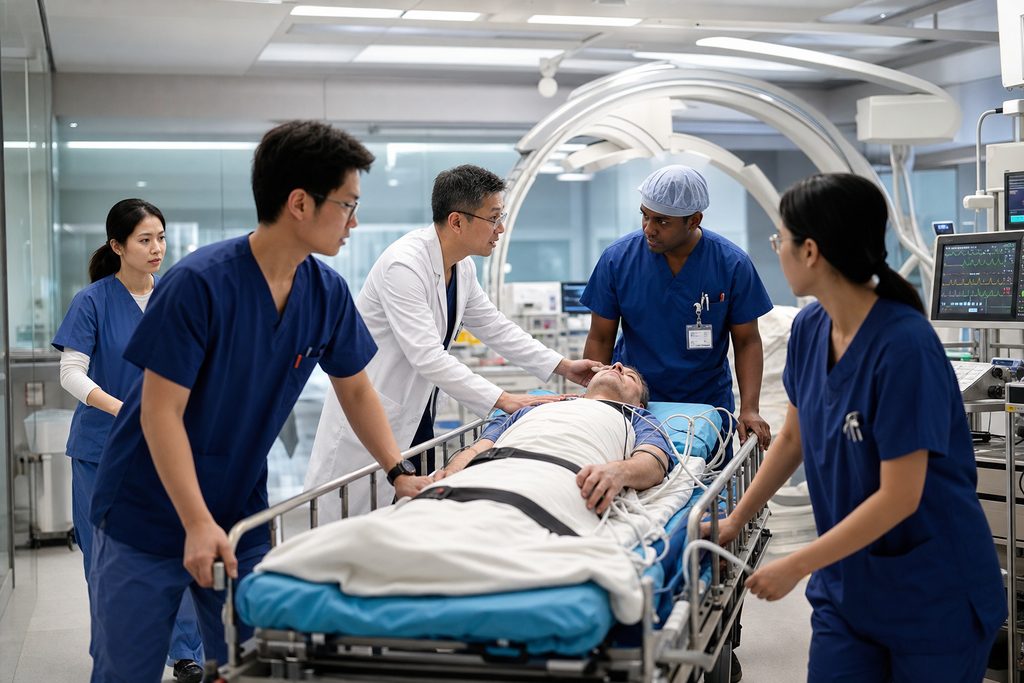
A heart attack does not wait for a convenient moment. It does not care about your travel itinerary or whether you speak the local language. When a coronary artery blocks completely—what doctors call a STEMI, or ST-Elevation Myocardial Infarction—the heart muscle starts dying within minutes. The clock ticks loudly. Every 30 minutes of delay in opening that blocked artery raises the risk of death by roughly 7.5 percent.
But here is the reality most foreign patients do not know: China’s top cardiac centers now achieve door-to-balloon times that rival or beat the best hospitals in the United States and Europe. Fuwai Hospital in Beijing, the world’s highest-volume cardiac surgery center, reports median door-to-balloon times under 60 minutes. That is the global gold standard. For a foreigner experiencing chest pain in Shanghai or Beijing, survival hinges on knowing where to go and how the system works before the emergency happens.
Our team at China Medical Services does not provide medical treatment. We are not a hospital. We are your logistical backbone—the team that coordinates your emergency cardiac care, navigates the hospital system, and ensures language barriers do not cost precious minutes when every minute counts.
Key Takeaways
- China’s top cardiac hospitals achieve door-to-balloon times under 60 minutes, matching or exceeding Western benchmarks for STEMI response.
- Emergency PCI for foreign patients typically costs $8,000 to $18,000 in top-tier Chinese hospitals—roughly one-fifth to one-tenth of US prices.
- Walking into a Chinese emergency room alone without Mandarin fluency creates dangerous delays. Bilingual coordination is not optional—it is clinically necessary.
- Not every hospital in China can handle a foreign patient STEMI. Only specific accredited centers have 24/7 cath lab activation and international patient protocols.
The Problem: A Heart Attack Abroad Turns Minutes Into a Maze
Imagine this. You are in Shanghai on business. At 2 a.m., crushing chest pressure wakes you. You call the front desk. They call an ambulance. The paramedics arrive and speak zero English. You cannot explain your symptoms clearly. They take you to the nearest public hospital—one without a 24-hour catheterization lab. The emergency room is crowded. Registration requires a local ID you do not have. Someone hands you a paper form entirely in Chinese characters. The clock keeps ticking.
This scenario is not hypothetical. It plays out regularly. China’s public hospital system treats over 3.5 billion outpatient visits annually. Emergency departments in major cities can see thousands of patients daily. The system is designed for volume and speed—but it assumes you speak the language and understand how things work. A foreign patient arriving alone faces a cascade of small delays that compound into dangerous territory.
STEMI treatment has a narrow window. Primary PCI—the emergency angioplasty that opens the blocked artery with a stent—is most effective within 90 minutes of first medical contact. Some guidelines push for 60 minutes. Every system-level friction point, from registration to payment to consent forms, eats into that window.
Who We Are
China Medical Services bridges the gap between international patients and China’s top-tier hospitals. We are not doctors. We do not diagnose, treat, or prescribe. What we do is remove every logistical obstacle between you and life-saving cardiac care. Our team handles hospital selection, emergency coordination, bilingual accompaniment, payment facilitation, and post-procedure recovery planning. We work with 340+ top-ranked hospitals across 37 cities. For a foreign patient facing a heart attack emergency treatment cost China foreign patient scenario, we make sure the system works for you—not against you.
Why China’s Cardiac Emergency System Delivers Results
Volume Creates Speed—and Speed Saves Heart Muscle
There is a straightforward relationship in interventional cardiology: hospitals that do more PCIs get better and faster at doing them. Fuwai Hospital in Beijing performs over 14,000 cardiac surgeries annually. Its catheterization labs run around the clock. The interventional cardiologists there handle more STEMI cases in a month than many Western cardiologists see in a year. That volume translates into streamlined protocols. The team does not need to think about what comes next—they have done it thousands of times.
China’s Chest Pain Center accreditation system, launched in recent years, has standardized emergency cardiac care across hundreds of hospitals. These centers must meet strict door-to-balloon time targets. They bypass emergency department triage for suspected STEMI patients and activate the cath lab directly from the ambulance ECG. The result? Median door-to-balloon times in accredited centers now hover between 50 and 70 minutes. Some report times as low as 30 minutes.
For context, the American College of Cardiology’s NCDR registry shows a median door-to-balloon time of approximately 64 minutes across US hospitals. China’s top centers are operating in the same league—and often faster.
Technology Deployed at Scale
Walk into the interventional cardiology department at Zhongshan Hospital in Shanghai or West China Hospital in Chengdu, and you will see equipment that matches any Western academic medical center. Siemens and Philips angiography systems. Intravascular ultrasound. Optical coherence tomography. Rotational atherectomy devices for calcified lesions. These are not rare, specialized tools reserved for a few cases. They are standard inventory.
What does this mean for a foreign patient? It means the interventional cardiologist treating your STEMI has access to the full toolkit. If your blockage is complex—a calcified left anterior descending artery, for example—they can handle it. They are not transferring you to another facility. The cath lab is equipped, the team is trained, and the stent inventory is comprehensive.
Cost Advantage Without Quality Compromise
Let us address the elephant in the room. Many foreign patients assume lower cost means lower quality. That assumption is wrong—and it is worth understanding why. Chinese hospital costs are structurally lower for reasons unrelated to clinical quality. Physician salaries are a fraction of US levels. Hospital construction and equipment costs are amortized differently. Malpractice insurance is negligible compared to American rates. The supply chain for stents and catheters benefits from domestic manufacturing and government price negotiations.
The outcome? Emergency PCI with drug-eluting stent placement costs between $8,000 and $18,000 at top-tier Chinese hospitals. That includes the procedure, the stent, the cath lab fees, and typically three to five days of inpatient monitoring. The same procedure in the United States runs $40,000 to $80,000 or more. Even with international travel costs factored in—for a planned procedure, not an emergency—the savings are substantial. For an unplanned emergency, understanding the PCI procedure price China for international patients helps you make informed decisions without financial panic compounding the medical crisis.
| Procedure | China (Top Public Hospital) | United States (Average) |
|---|---|---|
| Emergency PCI with 1 Drug-Eluting Stent | $8,000 – $18,000 | $40,000 – $80,000 |
| Coronary Artery Bypass Grafting (CABG) | $12,000 – $20,000 | $120,000+ |
| Diagnostic Coronary Angiogram | $1,500 – $3,000 | $10,000 – $25,000 |
How Fast Is STEMI Response in China Hospitals?
The question how fast is STEMI response in China hospitals deserves a direct answer. Fast—but only at the right hospitals. China’s hospital landscape spans 35,000+ facilities. The top 5 percent—those ranked by the Fudan University hospital rankings or holding JCI accreditation—operate at international standards. The rest vary widely. A county-level hospital in a smaller city may not have a 24-hour cath lab at all. A top-tier teaching hospital in Beijing or Shanghai will activate its STEMI protocol within minutes of receiving an ambulance ECG.
The key variable is not the country. It is the specific hospital. That is why pre-selecting a cardiac-capable facility matters enormously. Walking into the wrong emergency room costs time—and myocardium.
What You Need to Know Before Going Alone
China’s emergency cardiac care system is excellent—once you are inside the right hospital with the right support. Getting there alone presents real obstacles. We believe in being direct about these.
- Language Is a Clinical Barrier: Emergency room registration, symptom description, consent forms, procedure explanations—all happen in Mandarin. Google Translate cannot keep up with a cardiologist explaining your angiogram results at 3 a.m. Miscommunication about allergies, medications, or medical history can change treatment decisions.
- Payment Systems Require Upfront Deposits: Public Chinese hospitals operate on a prepaid model. You pay a deposit before the procedure begins. International credit cards may not work. Hospital payment terminals often connect only to UnionPay or local mobile payment systems like WeChat Pay and Alipay. A foreign patient without a local bank account or sufficient cash can face delays.
- Emergency Medical Records Do Not Cross Borders: Your medical history from home—previous stents, medication list, allergies, ejection fraction—may not be accessible. Chinese hospitals do not connect to Western electronic health record systems. Someone needs to translate and present your history clearly before the cardiologist makes decisions.
Can Foreigners Get Emergency Angioplasty in Shanghai?
The short answer is yes. Can foreigners get emergency angioplasty in Shanghai is a question we hear frequently, and the answer is unequivocal—Shanghai has multiple hospitals capable of treating foreign patients with STEMI. Zhongshan Hospital (Fudan University) runs one of China’s top cardiology departments. Ruijin Hospital (Shanghai Jiao Tong University) has a renowned chest pain center. Both treat international patients. Both have 24-hour cath lab activation.
The longer answer is that access depends on coordination. These hospitals have international patient departments, but they are not always staffed overnight. The emergency room may not know you are coming. Without someone calling ahead, verifying cath lab availability, and preparing the international patient intake process, you arrive as an unknown variable in a high-volume system. That creates friction. Friction creates delay.
Medical Evacuation China Heart Attack Emergency: When to Stay Versus When to Fly
Some foreign patients and their families immediately think about medical evacuation—flying home for treatment. For a STEMI, this is almost always the wrong decision. Medical evacuation China heart attack emergency package services exist, and they serve a purpose for stable conditions requiring repatriation. But a heart attack in progress is not a stable condition. The time required to arrange an air ambulance, obtain flight clearance, and transport a patient across continents far exceeds the 90-minute window for effective PCI.
The right move is to get treated where you are—at the nearest capable cardiac center. After stabilization, if you prefer follow-up care at home, medical evacuation becomes a reasonable discussion. During the acute event, stay. Get the artery open. Worry about logistics later.
How We Help You Navigate This
These barriers exist for structural reasons. They are not malice or incompetence—they are the natural result of a healthcare system designed for a domestic Mandarin-speaking population. Our job is to make that system work for you.
When a client contacts us with a cardiac emergency—or better yet, before one happens—we activate a clear sequence. First, we identify the nearest chest pain center with 24-hour PCI capability and international patient protocols. We call ahead. We alert the emergency department and the cath lab team. We confirm that an interventional cardiologist is available. Second, we dispatch a bilingual medical companion to meet you at the hospital. This person handles registration, translates your medical history, explains the consent form, and stays with you through the procedure and recovery. Third, we manage payment logistics—facilitating deposits, coordinating with your international insurance if possible, and ensuring the hospital’s financial requirements do not delay treatment. Fourth, we handle post-procedure coordination: follow-up appointments, medication instructions in English, discharge planning, and, if needed, arrangements for medical evacuation once you are stable.
Our bilingual medical companion service starts from $200 per day. Hospital appointment coordination starts from $300. For a full-service emergency cardiac coordination, including pre-arrival hospital activation, bilingual accompaniment, and post-procedure recovery support, we provide custom quotes based on your specific situation. Any consultation or coordination fee you pay is credited in full toward on-the-ground services if you proceed within 90 days.
We also help patients who are not yet in crisis. If you are planning travel to China and have known cardiac risk factors, we can pre-register you with a cardiology department at a top hospital. We can arrange a baseline consultation, translate your medical records, and ensure the hospital has your history on file. If an emergency happens, the system already knows you. That preparation saves precious time.
Choosing the Best Hospital in Beijing for a Foreigner Heart Attack
The question best hospital in Beijing for foreigner heart attack has a clear frontrunner: Fuwai Hospital. It is the National Center for Cardiovascular Diseases. It performs more cardiac procedures than any hospital on earth. Its emergency PCI program is mature, fast, and accustomed to international patients. But it is not the only option. Peking Union Medical College Hospital (PUMCH) has a strong cardiology department and extensive experience with foreign patients. Anzhen Hospital, also in Beijing, specializes in cardiac care and runs a high-volume chest pain center.
The best hospital is the one that is closest, prepared for your arrival, and equipped with a functioning cath lab when you need it. Our role is to make that determination in real time and ensure the doors are open when you arrive. Explore our database of top-ranked hospitals to understand which facilities meet international standards for cardiac care.
Frequently Asked Questions
Call 120 for an ambulance. This is China’s national emergency number. Operators may not speak English. If you have a bilingual contact, call them simultaneously. If you are a client of China Medical Services, call our emergency line immediately—we will coordinate with the ambulance and the receiving hospital while you focus on surviving. Do not drive yourself. Do not take a taxi. Ambulance paramedics can transmit your ECG to the hospital, which triggers cath lab activation before you arrive.
It depends entirely on your policy. Some international travel insurance plans cover emergency cardiac care abroad. Many exclude pre-existing conditions. Chinese public hospitals require upfront payment regardless of insurance—you pay first and seek reimbursement later. Private international hospitals like United Family may offer direct billing with certain insurers, but they may not have 24-hour PCI capability. Check your policy before travel. Know your coverage limits and exclusions.
This is a serious problem. Chinese hospitals will not waive deposits for foreign patients without established relationships. In a true life-threatening emergency, doctors may proceed with life-saving intervention while the financial office works out payment—but there is no guarantee. Our team can facilitate emergency payment bridges for pre-registered clients. For unregistered patients, the best preparation is carrying multiple payment methods and maintaining a local contact who can advance funds if needed.
You cannot know from the outside. A hospital building tells you nothing about its nighttime cath lab staffing. Accreditation as a Chest Pain Center is a good indicator, but the list is in Chinese and not easily searchable for foreigners. This is precisely the kind of information we maintain and verify. Before you travel—or at the first sign of cardiac symptoms—contact us. We know which hospitals in Shanghai, Beijing, Guangzhou, and other cities have round-the-clock PCI capability and international patient protocols.
Yes. Chinese hospitals use the same drug-eluting stents manufactured by global companies—Abbott, Boston Scientific, Medtronic—as well as high-quality domestic stents that have passed rigorous clinical trials. The Chinese government’s volume-based procurement program has driven down stent prices significantly without compromising quality standards. The cardiologist selects the stent based on your anatomy, not on cost or availability constraints.
Your Next Step
A heart attack in a foreign country is terrifying. But the medical capabilities exist in China to treat it as well as anywhere in the world—if you reach the right hospital in time. Preparation makes the difference between chaos and coordinated care. Understanding the costs, knowing which hospitals to trust,
For more medical information and treatment options in China, visit chinamedservices.com (China Medical Services).
