Guang’anmen Hospital TCM Dermatology: Costs, Booking, and What International Patients Need to Know
Key Takeaways
- Guang’anmen Hospital is one of China’s most respected TCM institutions, with a dermatology department that treats over 200,000 outpatient visits annually.
- TCM dermatology at Guang’anmen typically costs $50–$150 per consultation, with herbal medicine prescriptions adding $30–$200 per month depending on formula complexity.
- The hospital’s public outpatient system cannot be pre-booked from overseas — international patients must either use the on-site registration system or work through the hospital’s international coordination channels.
- You need an S2 visa for medical treatment in China, not an M visa. Bring translated medical records and a detailed symptom history for the most productive first consultation.
What Is TCM Dermatology — and Why Guang’anmen Hospital?
Traditional Chinese Medicine approaches skin disease differently than Western dermatology. Instead of targeting the lesion alone, TCM dermatology views conditions like eczema, psoriasis, acne, and urticaria as external manifestations of internal imbalance — what practitioners call patterns of disharmony involving heat, dampness, blood stasis, or wind. Treatment combines oral herbal formulas, topical herbal washes, acupuncture, and dietary guidance. If you are searching for Guang’anmen Hospital TCM dermatology cost and logistics, you are likely weighing whether this approach is worth the trip.
Guang’anmen Hospital, officially the China Academy of Chinese Medical Sciences Guang’anmen Hospital, sits in Beijing’s Xicheng District. It is not a small clinic. The hospital operates as a national center for TCM research and clinical practice, with a dermatology department that has built a reputation over decades. The department’s senior physicians routinely see complex, treatment-resistant skin conditions referred from across China and, increasingly, from overseas.
What makes this relevant for international patients? The department’s clinical volume. When a dermatology team sees hundreds of patients daily, patterns emerge. Physicians refine their diagnostic instincts. They learn which herbal combinations work for which subtypes of disease. That accumulated experience is what you are paying for — not just the herbs themselves.
The Problem: Chronic Skin Conditions That Western Medicine Hasn’t Resolved
Eczema affects approximately 1 in 10 Americans at some point in their lives. Psoriasis touches roughly 3% of the adult population in the United States. For many, topical corticosteroids and immunosuppressants manage symptoms — but do not eliminate them. A 2022 survey published in the Journal of the American Academy of Dermatology found that nearly 40% of psoriasis patients reported dissatisfaction with their current treatment, citing side effects, incomplete clearance, or loss of efficacy over time.
That frustration drives people to look beyond conventional options. Some try elimination diets. Others experiment with over-the-counter supplements. A growing number — particularly those with family or cultural ties to East Asia — consider TCM dermatology as a serious therapeutic route.
But searching for “is traditional Chinese medicine effective for eczema” online yields a mess of contradictory claims. Anecdotes dominate. Peer-reviewed evidence is thinner than for biologics, but it exists. A 2021 systematic review in Frontiers in Pharmacology examined 28 randomized controlled trials of Chinese herbal medicine for atopic dermatitis and found clinically meaningful improvements in EASI scores compared to placebo in the majority of studies. The evidence base is not conclusive by Western regulatory standards, but it is substantial enough that dismissing TCM dermatology outright would be intellectually dishonest.
The real question for international patients is not whether TCM works. It is whether Guang’anmen Hospital specifically delivers results that justify the cost and complexity of traveling to Beijing.
Why Guang’anmen Hospital’s TCM Dermatology Department Delivers Results
Clinical Volume and Pattern Recognition
Guang’anmen’s dermatology department handles an extraordinary patient load. On a typical weekday, the outpatient clinic sees between 600 and 1,000 dermatology patients. That volume translates into pattern recognition that smaller practices cannot replicate. A senior physician here has likely seen more cases of stubborn psoriasis in one year than a Western dermatologist sees in a decade.
This is not a claim about superiority — it is a statement about exposure. Volume breeds familiarity with atypical presentations, treatment-resistant variants, and the subtle differences between patients who respond well to certain herbal formulas and those who do not.
Integration with Modern Diagnostics
Guang’anmen is not a folk medicine clinic. The hospital operates full modern diagnostic facilities — dermatoscopy, skin biopsy, allergy testing, and laboratory analysis. Physicians use these tools to confirm diagnoses before prescribing TCM treatments. A patient with suspected psoriasis will likely receive a biopsy confirmation, not just a visual assessment. This integration matters. It means the TCM approach here is layered on top of Western diagnostic rigor, not replacing it.
The Best TCM Hospital Beijing for Skin Problems — What That Actually Means
When patients search for the “best TCM hospital Beijing for skin problems,” Guang’anmen consistently appears. The hospital’s affiliation with the China Academy of Chinese Medical Sciences gives it research depth that standalone TCM clinics lack. Its dermatology department publishes in peer-reviewed journals, participates in national treatment guideline development, and trains TCM dermatologists from across China.
For international patients, this matters in practical terms: the physicians you see at Guang’anmen are likely the same ones who shaped the treatment protocols other hospitals follow. You are seeing the source, not a franchise.
Guang’anmen Hospital TCM Dermatology Cost: What to Budget
Let’s get specific about numbers. The Guang’anmen Hospital TCM dermatology cost structure breaks down into several components, and understanding them before you travel prevents unpleasant surprises.
| Service Component | Typical Cost (USD) | Notes |
|---|---|---|
| Initial specialist consultation (public clinic) | $15–$50 | Varies by physician seniority; chief specialists cost more |
| Initial consultation (international/VIP channel) | $100–$300 | English coordination, priority scheduling, longer visit time |
| Oral herbal formula (1 month supply) | $30–$200 | Depends on ingredients; rare herbs cost significantly more |
| Topical herbal preparations | $10–$60 | Washes, ointments, plasters prepared by hospital pharmacy |
| Acupuncture session (if indicated) | $20–$60 | Often combined with herbal therapy for chronic conditions |
| Diagnostic workup (biopsy, labs, allergy testing) | $50–$300 | Full workup only if clinically necessary |
These figures represent the public hospital pricing. The international coordination channel — which provides English-language support and priority scheduling — typically runs 1.5 to 2 times the public rates. Compared to TCM psoriasis treatment China price points at private international clinics in Beijing, which often charge $200–$500 per consultation alone, Guang’anmen remains remarkably accessible.
For context, a single dermatology consultation in the United States averages $150–$300 without insurance. A biologic medication for psoriasis like secukinumab costs $60,000–$80,000 annually in the US. A full year of TCM treatment at Guang’anmen — consultations, herbs, and adjunctive therapies — typically totals $1,500–$5,000. The cost differential is structural, not qualitative.
How to Book Guang’anmen Hospital International Patient Services
This is where the process gets real. Guang’anmen Hospital dermatology for foreigners is not as simple as booking online. The hospital’s public outpatient system operates on a same-day registration model. You cannot reserve a specific specialist from overseas through the public channel. Period.
What are your actual options?
Option 1: On-site registration. You arrive in Beijing, go to the hospital early in the morning (think 6:00–7:00 AM), queue at the registration window, and take whatever dermatology slot is available that day. You will almost certainly not see a chief specialist this way. The process requires Chinese language ability or a local companion. Cost is minimal — the consultation fee itself is under $50.
Option 2: The hospital’s international department. Guang’anmen has channels for international patients that allow advance scheduling and English-speaking coordination. This is the route most overseas patients should consider. It costs more — typically $100–$300 for the consultation — but you get a confirmed appointment, a longer visit time, and someone who can bridge the language gap.
Option 3: Work with a coordination service. This is where our team at China Medical Services comes in. We handle the logistics: confirming which physicians are accepting international patients, translating your medical records into Chinese, scheduling through the hospital’s international channel, and providing a bilingual companion on the day of your visit. We are not the hospital, and we do not provide medical advice — we handle the practical coordination that makes the visit productive.
A note on visas: for medical treatment in China, you need an S2 visa. The M visa is for commercial and trade activities and is not appropriate for medical travel. Your accompanying family members also apply for S2 visas. Processing typically takes 1–2 weeks after submitting your application to the Chinese embassy or consulate, and you will need supporting documents from the hospital confirming your appointment.
What to Expect During Your First TCM Dermatology Consultation
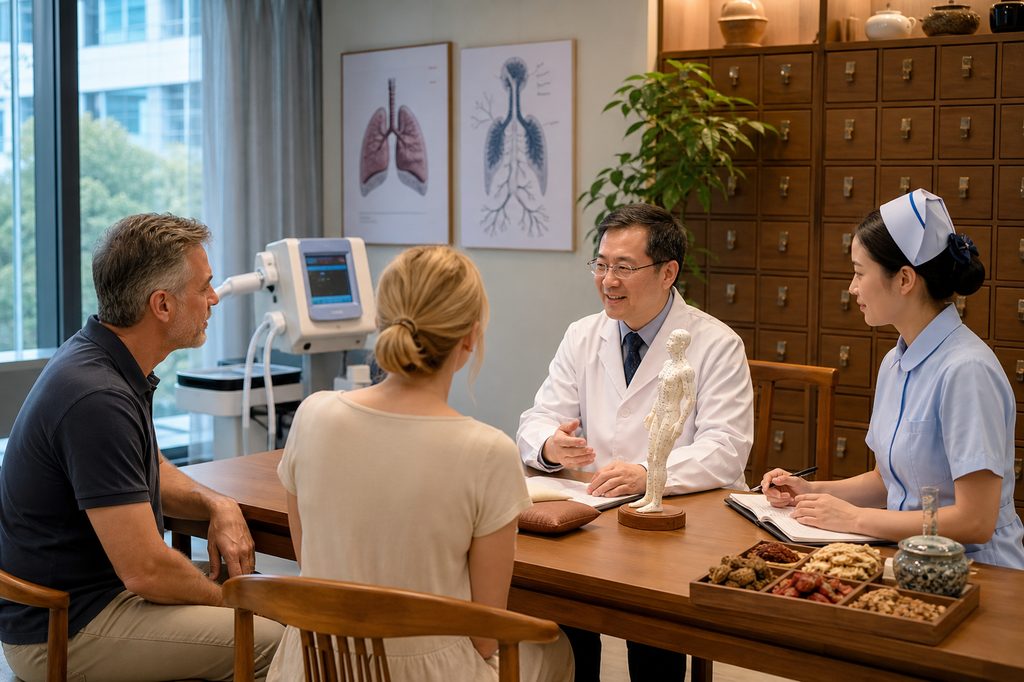
The consultation structure will feel different from a Western dermatology appointment. Expect it to last 15–30 minutes, during which the physician will do more than examine your skin.
They will ask about your sleep quality, digestion, menstrual cycle (if applicable), stress levels, temperature preferences, and dietary habits. They will look at your tongue carefully — its color, coating, and shape. They will take your pulse at both wrists, feeling for qualities like depth, strength, and rhythm. These diagnostic methods, unfamiliar to Western patients, are central to how TCM dermatologists determine your pattern of disharmony.
Bring everything. Translated medical records, biopsy reports, current medication lists, photographs of your skin at different stages, and a written timeline of when symptoms started and what triggered flares. The more complete your documentation, the more precise the physician’s assessment will be.
After the assessment, you will typically receive a herbal prescription. The hospital pharmacy compounds formulas on-site — often as loose herbs you boil at home, or as concentrated granules you dissolve in hot water. Topical preparations may also be prescribed. Follow-up consultations are usually scheduled every 2–4 weeks, either in person or, increasingly, via video consultation for international patients who have returned home.
Practical tip: If you plan to continue TCM treatment after returning home, ask your physician about the hospital’s international herbal shipping option. Many formulas can be dispensed and shipped overseas, though customs regulations vary by country. Confirm this before you leave Beijing.
Is TCM Dermatology Right for You? A Realistic Assessment
TCM dermatology is not a magic cure. If your condition requires urgent intervention — severe erythrodermic psoriasis, widespread blistering, or any skin condition with systemic involvement — Western emergency care should be your first stop. TCM works best for chronic, stable conditions where conventional treatment has plateaued or caused intolerable side effects.
Also be honest about your tolerance for ambiguity. TCM treatment is iterative. The first formula may not work. Your physician may adjust the prescription after each follow-up, fine-tuning based on your response. This process requires patience. If you expect a single visit to solve a decade-long skin condition, you will be disappointed.
What about evidence? The question “is traditional Chinese medicine effective for eczema” deserves a nuanced answer. Randomized controlled trials show mixed but generally positive results. A 2020 meta-analysis in Evidence-Based Complementary and Alternative Medicine pooled data from 23 trials of Chinese herbal medicine for eczema and found significant improvements in symptom scores compared to placebo, with low rates of serious adverse events. The evidence is not as robust as for topical corticosteroids, but it is not negligible either.
For psoriasis specifically, TCM psoriasis treatment China price points are attractive, but efficacy varies widely by individual. Some patients achieve near-clearance. Others see modest improvement. The honest answer: you will not know until you try, and you should budget for at least 3–6 months of treatment before evaluating results.
Practical Considerations: Documentation, Payments, and Follow-Up
Before you book a flight to Beijing, handle these logistics.
Medical records. Translate all relevant records into Chinese before your visit. This includes diagnosis summaries, biopsy reports, current and past medications, and treatment history. Professional medical translation costs $50–$150 per document but saves significant time during your consultation. Our team handles this as part of our coordination service.
Payment methods. Guang’anmen Hospital accepts cash (RMB), Chinese debit cards, and major international credit cards at the international department. The public outpatient clinic may not accept foreign cards. Assume you need cash or a Chinese payment method unless you are using the international channel. Budget for your entire treatment course in advance — public hospitals in China require payment before services are rendered.
Insurance. Most international insurance plans do not directly reimburse TCM treatment in China. You will likely pay out of pocket and submit claims afterward. Check with your insurer before committing. Some plans cover TCM when provided by a licensed physician at an accredited hospital, but reimbursement rates vary widely.
Follow-up after returning home. Many international patients continue treatment via video consultation. Guang’anmen’s international department supports this for established patients. Herbal formulas can often be shipped overseas, though shipping costs and customs clearance times vary by destination. Confirm the specifics with the hospital pharmacy before leaving.
Frequently Asked Questions
Through the public outpatient system, no — same-day registration only. Through the hospital’s international department or a coordination service, advance scheduling with specific physicians is possible, subject to the physician’s availability and the hospital’s international patient policies.
For a 3–6 month treatment course including initial consultation, follow-ups, herbal formulas, and basic diagnostics, budget $1,500–$5,000. This assumes public or international channel pricing, not private clinic rates. Complex formulas with rare herbs can push costs higher.
No treatment works for everyone. Guang’anmen’s physicians will adjust formulas based on your response, but if meaningful improvement does not occur within 3–6 months, they will typically recommend discontinuing or exploring combined Western-TCM approaches. You are not locked into a treatment plan that is not working.
For medical treatment, apply for an S2 visa with documentation from the hospital confirming your appointment. Entering as a tourist and then seeking medical care creates legal complications and is not recommended. Your accompanying family members also need S2 visas.
Potentially. Some Chinese herbs interact with immunosuppressants, anticoagulants, and other medications. Bring your complete medication list to your TCM consultation and inform your Western dermatologist about any herbs you are taking. Open communication between your providers is essential for safety.
Guang’anmen Hospital’s TCM dermatology department offers international patients a legitimate, evidence-informed alternative for chronic skin conditions that have resisted conventional treatment. The costs are reasonable, the clinical experience is deep, and the logistics — while not trivial — are manageable with proper preparation. Whether you pursue TCM treatment here or elsewhere, the key is making an informed decision based on your specific condition, budget, and tolerance for a treatment approach that works differently than Western medicine.
If you are ready to explore Guang’anmen Hospital dermatology for foreigners, start with our free consultation. We will help you understand your options, coordinate appointments, and handle the practical details so you can focus on your health.
For more medical information and treatment options in China, visit chinamedservices.com (China Medical Services).
