Discharge Meds in Guangzhou: Full Pharmacy Service with English Labels
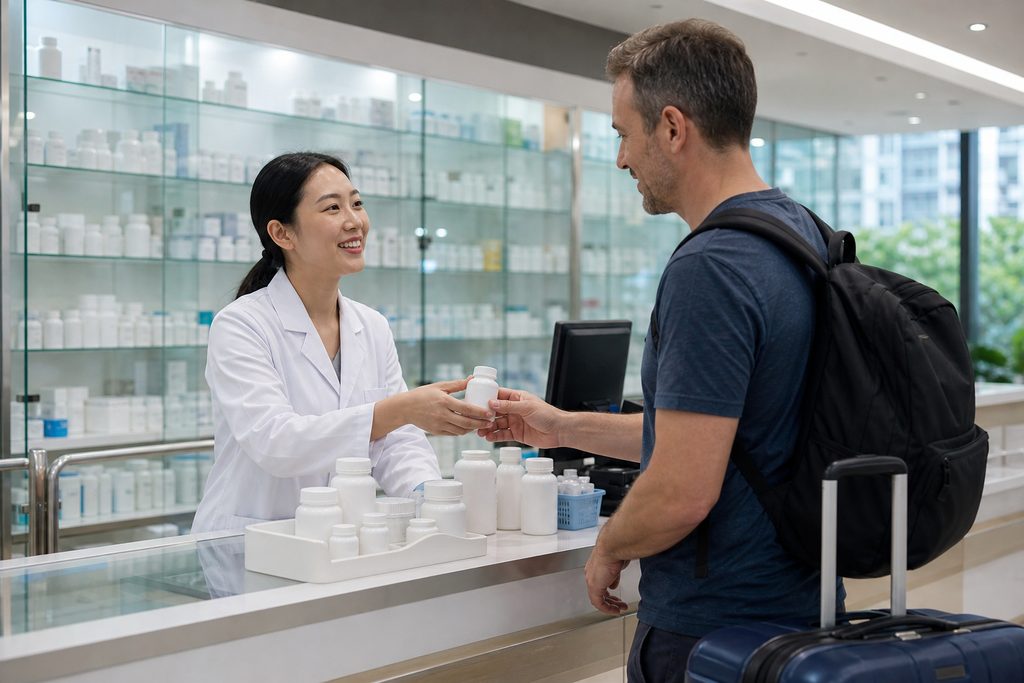
Leaving a hospital in a foreign country with a bag of medications you cannot read is a specific kind of anxiety. You are meant to be focused on recovery, yet you find yourself squinting at Chinese characters on a pill bottle, trying to match them against a prescription you barely understand. A 2023 report from the Guangzhou Health Commission noted that the city’s tertiary hospitals discharged over 180,000 international patients across a five-year period. Most of those patients walked out with prescriptions. Very few walked out with clear, actionable instructions in English. Finding a pharmacy with english labels for discharge meds Guangzhou patients can rely on is not a luxury. It is a safety requirement.
Key Takeaways
- Major Guangzhou hospitals with international departments operate in-house pharmacies that can produce English-labeled discharge medications, but the service is not automatic — you must request it before discharge.
- Full-service translation of medication labels, dosage instructions, and drug interaction warnings typically adds $30–80 to your pharmacy bill, depending on the number of prescriptions.
- The biggest risk is assuming the default process will serve you. Standard Chinese pharmacy workflows dispense in Chinese only. If you do not speak up, that is what you will receive.
- Independent translation services exist near major hospital clusters, but hospital-based pharmacy translation carries less risk of error because the pharmacist verifies the output.
The Problem: A Discharge Bag Full of Questions
Hospitals like the First Affiliated Hospital of Sun Yat-sen University and Nanfang Hospital run separate international or VIP pharmacy counters. These are not just fancier rooms. They are staffed by pharmacists who are trained to handle English-language documentation. When you are discharged through one of these departments, the pharmacy can generate labels that include the generic drug name in English, dosage in milligrams, frequency instructions, and key warnings — all printed clearly. The cost of this cost of discharge medication translation service China varies. At public hospital international departments, the translation add-on is modest, typically $30–50 for a full discharge prescription set. Private international hospitals like United Family Guangzhou bundle it into their pharmacy dispensing fee, which runs higher — $80–150 — but includes a pharmacist consultation in English.
Here is what actually happens. The pharmacist receives your discharge order from the ward. In a standard workflow, they fill the medication, print a Chinese label, and hand it over. For English labeling, someone has to step in and translate each field: drug name, strength, route, frequency, duration, storage instructions, and critical warnings. Then that translation must be verified against the original prescription. Then it gets printed on a separate label or as a bilingual sticker applied alongside the Chinese original. This takes time. At a busy public hospital pharmacy, expect to wait 30–60 minutes longer than the standard pickup time. At a private hospital, the process is smoother because the volume is lower and the workflow is built for it.
How to Get Prescription Medicine with English Instructions in Guangzhou: A Step-by-Step Timeline
This is the section most patients actually need. You have had your treatment. You are tired. You want to go back to your hotel. Here is exactly what to do, and when, to leave with medications you understand.
48 hours before expected discharge: Speak with your attending physician or the ward nurse. Tell them you need English-labeled discharge medications. Do not assume they know. Write it down if you need to. The doctor must note this on your discharge order so the pharmacy receives the instruction before they start filling. If you are working with a bilingual medical companion, they handle this conversation for you — but you can do it yourself with a translation app if needed.
24 hours before discharge: The international department (if you are admitted through one) will typically send a coordinator to confirm your pharmacy needs. This is your moment to be specific. Do you need just the drug name in English? Full dosage instructions? Allergy warnings? Drug interaction notes? The more you specify, the better the output.
Day of discharge, at the pharmacy: Go to the designated international pharmacy counter, not the general dispensing window. Present your discharge summary and prescription. Confirm that English labeling has been requested. The pharmacist will either have it ready or will ask you to wait while it is prepared. Before you leave, verify three things: the drug name matches what your doctor told you, the dosage is clear, and you understand when and how to take each medication.
After pickup: Take a photo of every label. Send it to your doctor back home. Ask them to review it. This is not about distrusting the Chinese pharmacy. It is about having a second set of eyes on your medication regimen during a vulnerable transition.
One hard truth: Not every discharge medication can be labeled in English on the spot. If a drug is a traditional Chinese medicine preparation or a compound medication unique to that hospital’s formulary, the pharmacy may only be able to provide a partial translation. In those cases, ask for the generic name of the active ingredient and the dosage in milligrams. That is the minimum you need for safety.
Full Service Pharmacy English Labels International Patients Guangzhou: What “Full Service” Actually Means
The phrase “full service pharmacy” gets thrown around loosely. In Guangzhou’s hospital context, it means something specific. A pharmacy offering full service pharmacy english labels international patients Guangzhou should deliver at least four things.
One: English drug names using international nonproprietary names (INN), so “metformin” not just “格华止.” Two: dosage expressed in milligrams or international units, not just “one tablet.” Three: administration instructions in plain English — “Take with food” not a literal translation of a Chinese idiom. Four: a printed medication list that you can show to any doctor anywhere in the world and they will immediately understand what you are taking and why.
Some hospitals go further. The international pharmacy at Clifford Hospital, for example, provides a bilingual medication chart that includes the brand name, generic name, indication (what each drug is for), and a column for notes. That level of detail is not universal. It is worth asking for. The pharmacy may charge an additional documentation fee of $20–40 for the printed chart, but it is the single most useful document you will carry home.
Practical tip: If you are discharged with more than five medications, ask the pharmacist to mark which ones are short-term (antibiotics, pain relief) and which are long-term (blood pressure medication, anticoagulants). This simple distinction prevents a common mistake: stopping a critical maintenance drug because you thought it was only for the recovery period.
Compare Pharmacy Prices for Discharge Meds Guangzhou Medical Tourism: Public vs. Private vs. Retail
Not all discharge prescriptions have to be filled at the hospital pharmacy. You have options, and the price differences matter — especially if you are paying out of pocket.
| Pharmacy Type | English Labeling | Typical Dispensing Fee | Translation Add-On | Wait Time |
|---|---|---|---|---|
| Public Hospital International Dept. Pharmacy | Available on request | $5–15 per prescription | $30–50 total | 30–60 min extra |
| Private International Hospital Pharmacy | Standard for all patients | $20–40 per prescription | Included in dispensing fee | 15–30 min |
| Public Hospital Standard Pharmacy | Not available | $2–8 per prescription | N/A | Standard queue |
| Retail Chain Pharmacy (e.g., Nepstar) | Not available | $0–3 markup on drug cost | N/A | Immediate |
| Hospital-Affiliated Outpatient Pharmacy with Translation Service | Available via third-party translator | $5–15 per prescription | $20–40 per document | 1–2 hours |
When you compare pharmacy prices for discharge meds Guangzhou medical tourism, the public hospital international department strikes the best balance. Drug prices are the same as the standard pharmacy — China regulates hospital drug pricing tightly — and the translation fee is modest. Private international hospitals charge more for the drugs themselves, sometimes 20–50% above public hospital prices, because they stock imported brands alongside domestic generics. The convenience is real, but the premium adds up fast if you are on multiple medications.
Retail pharmacies are the wildcard. Chains like Nepstar and Dashenlin are everywhere in Guangzhou. Their drug prices are competitive, sometimes lower than hospital pharmacies. But they will not translate your prescription or your labels. You would need to bring your hospital prescription, have it filled, and then take the medications to a separate translation service. That introduces a handoff where errors can creep in. For discharge medications — where the regimen is new and you are still recovering — the hospital pharmacy is the safer choice.
Can I Get My Hospital Discharge Drugs in English Packaging China: What the Regulations Allow
This question comes up constantly. Patients want to know if can i get my hospital discharge drugs in english packaging china is even legal. The answer is yes, with important caveats.
Chinese drug regulations require that medications dispensed within China carry labeling in Chinese. That is the legal requirement, and no pharmacy will violate it. What international pharmacies do is add a supplementary English label — a sticker or a separate printed sheet — alongside the mandatory Chinese labeling. The original Chinese packaging remains intact. The English is an addition, not a replacement. This is fully compliant with China’s Drug Administration Law, and it is standard practice at every hospital with an international patient program.
What you will not get is a box that looks like it came from a pharmacy in London or New York. The packaging will still be Chinese. The insert will still be in Chinese. The English label will be a pharmacy-generated sticker with the critical information extracted and translated. That is the reality. It works. It is safe. But it will not look familiar, and that can be unsettling. Knowing this ahead of time helps. You will not stand at the pharmacy counter confused about why the box looks “foreign” — because it is, and that is fine.
One more regulatory point. Certain controlled substances — strong opioids, some psychotropic medications — have additional dispensing requirements. The pharmacy must record your passport number. You may need a special prescription form, not the standard discharge order. If you are discharged on a controlled medication, the international department pharmacy will handle the paperwork, but expect it to take longer. And if you plan to travel internationally with these medications, you need documentation. Ask the pharmacy for a letter, in English, stating the drug name, dosage, and that it was prescribed to you as part of hospital treatment. Carry that letter with your medication. It will not guarantee smooth passage through every border, but it is the best protection you have.
Practical Considerations: Documentation, Payment, and Follow-Up
Discharge medications are not the end of the story. They are the beginning of your recovery at home. A few practical points that patients often overlook.
Documentation you need from the pharmacy: an itemized receipt with each drug name in English (ask for this — the default receipt will be in Chinese), the bilingual medication list discussed earlier, and if you are on any controlled or injectable medication, a physician’s letter explaining the medical necessity. Keep digital copies of all of these. Email them to yourself. You will need them for your home doctor, for travel, and potentially for insurance reimbursement.
Payment: Hospital pharmacies in Guangzhou accept WeChat Pay, Alipay, UnionPay cards, and cash. International credit cards are accepted at private international hospital pharmacies but are hit-or-miss at public hospital counters, even international ones. Carry a backup payment method. The total cost for a typical discharge prescription set — say, a week of antibiotics, pain medication, and a month of a maintenance drug — runs $40–120 at a public hospital pharmacy, plus the translation fee. At a private hospital, expect $100–300 all-in.
Insurance reimbursement: If your international health insurance covers treatment in China, discharge medications are typically covered as part of the inpatient episode. You will need the itemized English receipt and the discharge summary. Submit them together. If the pharmacy receipt is only in Chinese, ask the international department to stamp and annotate it with English drug names. Most will do this without an extra charge. Our team has seen claims denied simply because the insurer could not read the pharmacy documentation. A stamped bilingual receipt solves that problem before it starts.
Follow-up after returning home: Your home doctor needs the full picture. The bilingual medication chart from the Guangzhou hospital pharmacy is your most important document. But also bring the original Chinese prescription. Your doctor may want to verify the translation, especially for medications that are not commonly prescribed in your home country. Some Chinese hospital pharmacies dispense drugs that are not available in the US or Europe. If that happens, you and your doctor need to identify an equivalent available locally. Do not simply stop taking the medication because you cannot find it at your neighborhood pharmacy.
Frequently Asked Questions
What if the hospital pharmacy says they cannot provide English labels?
This happens at hospitals without a dedicated international department. If you are discharged from a standard ward at a public hospital, the pharmacy may genuinely not have the capability. In that case, do not leave empty-handed. Take the Chinese-labeled medications and your discharge summary to the hospital’s international department office — even if you were not admitted through them — and ask if they can assist with translation. Some will help for a fee. Alternatively, medical translation services in Guangzhou’s Tianhe district near the hospital cluster can produce a verified translation within a few hours. The cost is $30–60. It is not as seamless as getting it from the pharmacy directly, but it is far better than guessing.
Are English-labeled medications more expensive than Chinese-labeled ones?
The medications themselves cost the same. The additional charge is for the translation service and the bilingual documentation. At a public hospital international pharmacy, expect to pay $30–50 extra for the full set. At a private hospital, the cost is bundled into a higher dispensing fee. No one should be charging you more for the actual drug based on the label language — if they try, push back or ask to speak with the international department coordinator.
Can I fill my discharge prescription at a pharmacy outside the hospital?
Yes, but you lose the English labeling option. Retail pharmacies in Guangzhou do not offer translation services. You would need to take the medications to a separate translator after purchase. For discharge medications — where timing matters and you are often dealing with new, unfamiliar drugs — the hospital pharmacy is the recommended path. The extra coordination fee is small compared to the risk of a medication error.
What if I need a refill after I return home?
Chinese hospital pharmacies typically dispense a 7- to 30-day supply at discharge, depending on the medication. They do not ship internationally. Your bilingual medication chart is your tool for getting a prescription from your home doctor. The chart should list the generic name of each drug, which your doctor can use to write an equivalent prescription. If the drug is not available in your country, your doctor can identify a therapeutic alternative. Do not attempt to order Chinese medications online from unverified sources — counterfeit drugs are a real risk.
Is the English translation on the label verified by a pharmacist?
At hospital international department pharmacies, yes. The translation is either done by a bilingual pharmacist or by a trained staff member and then checked by the dispensing pharmacist. At private international hospitals, the pharmacist typically speaks English and verifies the label directly. If you use
For more medical information and treatment options in China, visit chinamedservices.com (China Medical Services).
