Medical Treatment in Guangzhou China: International Patient Service for Southern China Top Hospitals
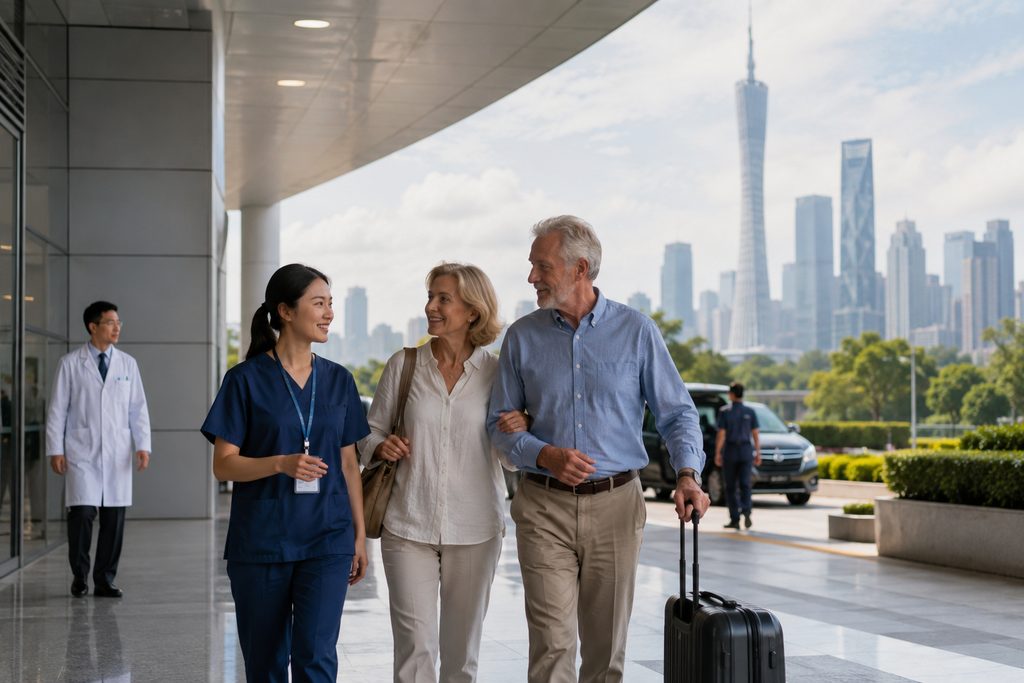
Have you ever wondered whether a city known for its Cantonese cuisine and sprawling trade fairs could also be your best bet for complex cardiac surgery or oncology care? That question leads more patients from the Middle East, Southeast Asia, and Africa to southern China every year. They are not coming for the dim sum. They are coming because Guangzhou hosts 10 of the country’s top 100 hospitals, a concentration of clinical firepower that ranks third nationally behind only Beijing and Shanghai. Our team at China Medical Services has spent years building the logistical bridges that connect international patients to these institutions. We handle the parts of the journey that have nothing to do with medicine and everything to do with whether you actually get treated.
Key Takeaways
- Guangzhou is home to 10 Fudan-ranked top 100 hospitals, with specific global leadership in ophthalmology, oncology, and respiratory medicine.
- The cost of cancer treatment in Guangzhou runs roughly 70-90% below US benchmarks for equivalent protocols, without a corresponding drop in clinical outcomes at top-tier centers.
- Foreigners cannot simply book surgery online. The public hospital system requires an in-person consultation first, and the language barrier in southern China is severe — Cantonese and Mandarin dominate, with limited English even in major institutions.
- JCI accreditation and international patient departments exist, but they are not standardized. You need to know which hospitals actually maintain English-speaking coordinators and which ones list the service on paper only.
The Problem: A World-Class Medical Hub Hidden Behind Language and Logistics
Southern China’s medical infrastructure is an anomaly. The Sun Yat-sen University cancer center treats over 200,000 patients annually. The Zhongshan Ophthalmic Center performs more than 80,000 eye surgeries per year. These are not small community hospitals. They are industrial-scale clinical operations with subspecialty depth that rivals any academic medical center in North America or Europe. But walk into the lobby of any of these hospitals without Mandarin or Cantonese, and you will understand the problem immediately. The signage is largely in Chinese characters. The registration kiosks require a local ID number to proceed. The triage nurses, working through queues of hundreds of patients before noon, do not have bandwidth for translation apps.
This is not a failure of the hospitals. They are designed to serve a domestic population of 1.4 billion people, and they do that with remarkable efficiency. The failure is the assumption that a foreign patient can navigate this system alone. Some try. We hear from them after they have spent three days in a hotel room, unable to secure the right visa category, unsure which department actually handles their condition, and increasingly anxious about the time and money draining away. That is the pain point our service exists to solve. We are not a hospital. We do not provide medical treatment or clinical diagnoses. We are your logistical architects — we bridge the gap between you and China’s top-tier medical expertise so that you arrive prepared, not panicked.
Why Guangzhou’s Top Hospitals Deliver Results That Rival the West
Clinical Volume Creates a Different Kind of Expertise
There is a straightforward relationship between how many times a surgeon performs a procedure and how well their patients do. The data on this is not controversial. A 2016 study in the New England Journal of Medicine found that for esophagectomy, moving from a low-volume to a high-volume surgeon reduced 30-day mortality by nearly half. Guangzhou’s top hospitals operate at volumes that are hard to find elsewhere. The thoracic surgery department at the First Affiliated Hospital of Guangzhou Medical University handles over 3,000 lung cancer resections annually. A typical US academic center might do 200-400. The surgeons here have seen more anatomical variations, more complex tumor presentations, and more intraoperative complications than most Western surgeons encounter in a decade. That volume translates into judgment — the kind you cannot get from a textbook.
Also worth noting: the best hospitals in Guangzhou for international patients are not just high-volume. They are high-volume in specific, concentrated areas. Zhongshan Ophthalmic Center does eyes and only eyes. The Sun Yat-sen University Cancer Center does oncology and only oncology. This focused model means the entire institutional infrastructure — pathology, radiology, nursing protocols, ICU management — is optimized for one category of disease. A general hospital cannot replicate that depth.
Technology Adoption Without the Procurement Delays
Western hospitals often face lengthy committee reviews before adopting new surgical platforms or imaging technology. Chinese top-tier hospitals, particularly those competing for Fudan ranking position, move faster. The robotic surgery programs in Guangzhou illustrate this. Several hospitals now run dual-console da Vinci Xi systems, allowing proctored training and complex multi-quadrant procedures. Proton therapy, still scarce in many countries, is operational at the Sun Yat-sen University Cancer Center. These are not experimental deployments. They are integrated into standard treatment pathways with teams that have accumulated thousands of cases.
What does this mean for an international patient? It means you are not compromising on the tools available. The limitation is not the technology. The limitation is knowing which hospital actually uses it for your specific diagnosis, and getting your case in front of the right team.
The Cost Gap Is Structural, Not a Quality Signal
Let us address the obvious question directly. What is the cost of cancer treatment in Guangzhou, and why is it so much lower than in the United States or Europe? A course of intensity-modulated radiation therapy (IMRT) for head and neck cancer at a top Guangzhou public hospital typically ranges from $8,000 to $15,000. The same treatment in the US averages $50,000 to $80,000. Surgical resection for early-stage lung cancer via video-assisted thoracoscopic surgery (VATS) runs $10,000 to $20,000 in Guangzhou. In the US, $40,000 to $70,000 is common.
These price differences do not reflect lower-quality care. They reflect structural economics. Physician salaries in China, while rising, are a fraction of US levels. Hospital construction costs are lower. Malpractice insurance premiums, a massive overhead line item for American providers, are far smaller. And the sheer patient volume allows fixed costs to be spread across many more cases. The outcome data, where it has been compared internationally, does not show a corresponding drop in survival or complication rates at the top-tier centers. The cost gap is real and it is durable. But accessing it requires navigating a system that was not built for international billing.
Is Guangzhou Hospital Safe for Foreigners? Separating Perception from Reality
The question “is Guangzhou hospital safe for foreigners” comes up in nearly every initial consultation. It is a fair question. Safety means different things to different patients. Clinical safety — infection rates, surgical complications, medication errors — is the most measurable dimension. On this front, top JCI accredited hospitals in southern China operate under standards that are audited and comparable to international norms. JCI, or Joint Commission International, is the same organization that accredits hospitals in Singapore, the UAE, and Europe. Guangzhou has several JCI-accredited facilities, including Clifford Hospital and parts of the United Family Healthcare network. These hospitals maintain English-language medical records, informed consent processes that will feel familiar to Western patients, and infection control protocols that are reviewed regularly.
But clinical safety is only one layer. There is also the experiential safety — feeling understood, knowing who to call when something goes wrong, trusting that your cultural and dietary needs will be respected during a vulnerable time. This is where the gap between JCI-accredited private hospitals and the public giants becomes most visible. The public hospitals offer the deepest subspecialty expertise. The private international hospitals offer a more familiar patient experience. Neither is universally better. The right choice depends on your diagnosis, your budget, and your tolerance for navigating ambiguity. Our job is to help you make that choice with clear eyes.
What You Need to Know Before Going Alone
We have seen patients attempt the solo route. Some succeed, usually after spending far more time and money than they anticipated. Many do not. The barriers are not insurmountable, but they are specific and unforgiving. Here is what you are up against.
- Visa Requirements Are Narrow and Non-Negotiable: Medical treatment in China requires an S2 visa with the specific purpose of medical treatment noted. This is not a tourist visa. It is not an M business visa. The consulate will expect documentation from the treating hospital — an invitation letter, a treatment plan, proof of appointment. Obtaining these documents from overseas, without a local contact inside the hospital’s international department, is extremely difficult. Hospitals do not publish direct email addresses for their international patient coordinators. You call a general switchboard, navigate a Chinese-language phone tree, and hope.
- Payment Systems Were Not Designed for Foreign Cards: Chinese hospitals operate on a prepaid deposit model. You load money onto a hospital account, and services are deducted as you go. Topping up that account typically requires WeChat Pay, Alipay linked to a Chinese bank account, or UnionPay. International credit cards are not reliably accepted at public hospital cashier counters, even at top-tier institutions. You can find yourself with a scheduled surgery and no way to pay the deposit without a local intermediary.
- Medical Records Must Be Translated and Contextualized: A pathology report from a hospital in Lagos or London is not immediately actionable for a Chinese oncologist. The format differs. The immunohistochemistry markers may be reported differently. The imaging may need to be re-read because slice thickness and contrast protocols vary. Simply translating the words is not enough. The clinical context must be restructured to match how Chinese treatment protocols are designed. This is specialized work that general translation services cannot do.
How We Help You Navigate This
These barriers exist for structural reasons, not because anyone is trying to exclude foreign patients. The Chinese hospital system was built to serve a domestic population, and it does that at extraordinary scale. International patients are a small fraction of total volume, and the infrastructure to serve them is uneven. That is where we fit.
Before you travel, we take your existing medical records — in whatever language and format they exist — and work with our network of bilingual medical professionals to produce a treatment-ready summary that a Chinese department head can review directly. We do not just translate words. We restructure the clinical narrative so that it matches the diagnostic and staging frameworks used in Chinese treatment guidelines. This step alone often saves weeks of back-and-forth. We then match your case to the specific department and hospital in Guangzhou that has the deepest relevant expertise. Sometimes that is a Fudan-ranked public hospital. Sometimes it is a JCI-accredited private facility. We make that recommendation based on your diagnosis, not on which hospital is easiest for us to work with.
Once a hospital accepts your case, we handle the invitation letter for your S2 visa application. We coordinate the appointment date so that you are not waiting in Guangzhou for weeks before seeing the specialist. On the ground, our bilingual medical companions meet you at the hospital entrance. They handle registration, queue management, payment deposits, and real-time interpretation during consultations. They translate not just the words but the clinical nuance — explaining what the doctor is looking for on a CT scan, what the treatment options mean in practical terms, what questions you should be asking. After discharge, we coordinate follow-up imaging, medication refills, and communication with your home-country physician so that continuity of care does not fracture.
Guangzhou medical tourism package prices vary widely depending on the complexity of the case and the hospital tier. A straightforward procedure with a short hospital stay might involve coordination fees starting from $300 for appointment booking, with bilingual companion services from $200 per day. More complex cases requiring multi-department coordination, extended inpatient stays, and ongoing interpretation run higher. We provide a detailed cost breakdown before any commitment, and our fees are always separate from hospital charges. You know exactly what you are paying us and what you are paying the hospital.
Frequently Asked Questions
Not through the standard public hospital pathway. Chinese public hospitals require an in-person consultation before scheduling surgery. The surgeon must examine you, review your imaging personally, and document the clinical indication in the hospital’s system. This is not negotiable. What you can do — and what we facilitate — is secure a confirmed appointment with the specific department and specialist before you travel, so that the in-person consultation happens within days of your arrival, not weeks. The VIP and international patient channels at some hospitals can then expedite the surgery scheduling after that initial consultation. But no reputable hospital in China will put you on an operating room schedule sight unseen.
Guangzhou’s top public oncology centers are generally 30-50% less expensive than private cancer hospitals in Singapore or Thailand for equivalent treatment protocols. A full course of chemoradiation for nasopharyngeal carcinoma — a cancer where Guangzhou’s hospitals have particular expertise given its high incidence in southern China — might run $15,000 to $25,000 in Guangzhou versus $40,000 to $60,000 in Singapore. The trade-off is the patient experience. Singapore’s private hospitals offer hotel-like amenities and seamless English communication. Guangzhou’s public hospitals offer world-class oncology but a more utilitarian environment. The clinical outcomes at the top centers are comparable. The decision often comes down to whether you prioritize the hospital experience or the clinical depth for your specific cancer type.
Look for two things. First, JCI accreditation — this is an external audit that verifies international patient safety standards, English-language documentation, and informed consent processes. Several hospitals in Guangzhou hold this, and you can find the full list on our private international hospitals page. Second, check whether the hospital has a dedicated international medical center or VIP department with full-time English-speaking coordinators — not just doctors who studied abroad, but administrative staff who handle foreign patient intake daily. A hospital can have brilliant surgeons and still be a nightmare for a non-Chinese speaker if the international patient infrastructure is weak. We maintain current information on which departments at which hospitals actually deliver on their international patient promises.
At JCI-accredited and Fudan-ranked hospitals, yes — with the caveat that safety is department-specific, not hospital-wide. A hospital can have an outstanding cardiac surgery program with infection rates below international benchmarks and a general surgery ward that is merely average. This is true everywhere in the world. The key is matching your specific procedure to the specific department with the best track record, not picking a hospital based on its overall brand. We help patients make that match. For reference, the nosocomial infection rates at top Guangzhou teaching hospitals are generally reported in the 2-4% range, comparable to OECD country averages, though direct comparisons are difficult due to different reporting methodologies.
This is the hardest question, and it deserves a direct answer. Medical complications happen in every healthcare system. The difference for a foreign patient in China is that you are far from your home support network, your family may not speak the language, and the medicolegal framework is different from what you are used to. This is precisely why having a bilingual medical companion present throughout your treatment is not a luxury — it is a risk management tool. If a complication arises, our team ensures that you understand exactly what is happening, what the proposed intervention is, and what your options are. We facilitate communication between the treating team and your family back home. We help you access your medical records in English if you need a second opinion. We do not provide medical advice, but we make sure you are never in a situation where you cannot understand the advice you are receiving.
Your Next Step
Guangzhou’s top hospitals offer something genuinely rare: deep subspecialty expertise, massive clinical volumes, and costs that make treatment accessible to patients who would otherwise face financial ruin or indefinite waiting. But that opportunity is locked behind a door that requires the right key. The language, the visa process, the payment systems, the medical record formatting — none of these are insurmountable, but each one can stop you cold if you are unprepared. We have spent years learning how to turn these barriers into manageable steps. If you are considering medical treatment in Guangzhou and want to understand your options without obligation, start with a free consultation. We will review your case, recommend specific hospitals and departments, and give you a clear picture of what the journey actually looks like — timelines, costs, and all.
For more medical information and treatment options in China, visit chinamedservices.com (China Medical Services).
