Gut Microbiome Test in China: What to Know Before You Go
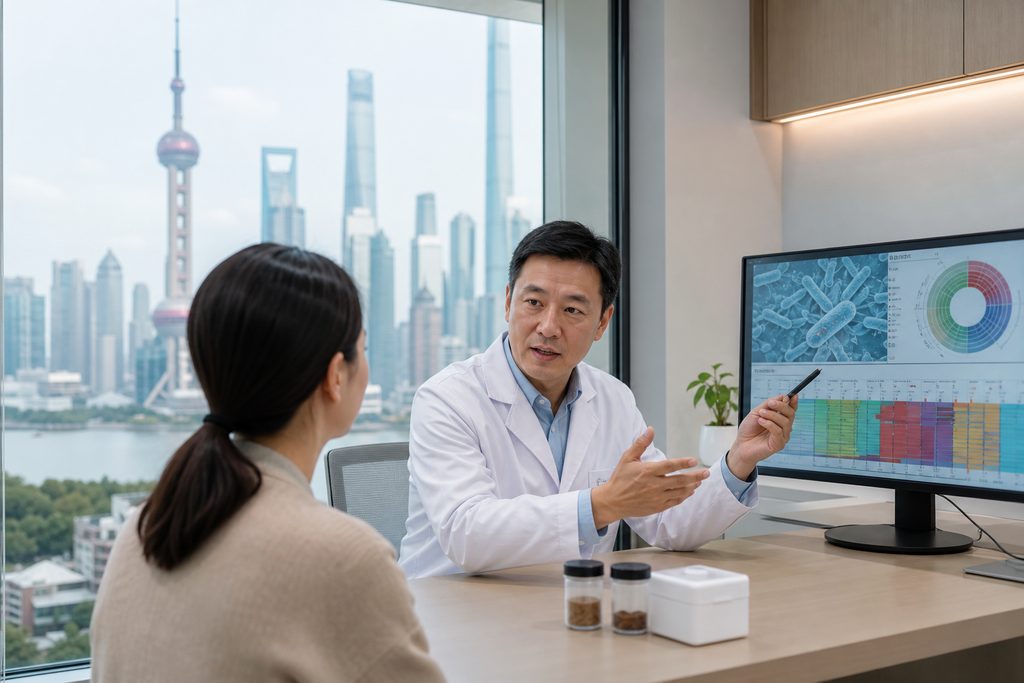
Gut Microbiome Test in China: What to Know Before You Go
A gut microbiome test is a stool-based analysis that maps the bacteria, fungi, and other microorganisms living in your digestive tract. Instead of guessing why you feel bloated, fatigued, or intolerant to certain foods, you get a data snapshot of what is actually happening inside your gut. China has become a genuinely interesting place to get this done — partly because the sequencing infrastructure at its top hospitals is world-class, and partly because the gut microbiome test cost China patients pay is often a fraction of what Western labs charge. But there are real caveats, and we will walk through all of them.
This guide covers what the test measures, where to get it, what it costs, how to book it as a foreign patient, and the honest limits of what any microbiome report can tell you.
How This Actually Works, Step by Step
Here is the real sequence, from your first inquiry to holding a report in your hands.
Step 1 — You send your context. Not just “I want a microbiome test.” A useful starting point includes your symptoms, how long you have had them, any diagnoses, current medications, and prior lab work. Antibiotics in the last three months matter enormously, because they distort results.
Step 2 — A specialty team reviews your file. At a top Chinese hospital, this usually means a gastroenterology or digestive disease department, sometimes working alongside a clinical nutrition unit. They decide whether a microbiome test is even the right tool, or whether you need something else first — a calprotectin test, a colonoscopy, a breath test for SIBO.
Step 3 — You receive a written second opinion. This is where the direction gets set. The team tells you what test panel makes sense, what it will cost, and how long results take. Written second opinions from top-hospital specialists typically run $300–500 through our coordination service.
Step 4 — Sample collection. If you are already in China, you collect a stool sample at the hospital or at home with a provided kit and return it. If you are abroad, some institutions accept shipped samples under cold-chain conditions — but not all, and this must be confirmed case by case.
Step 5 — Sequencing and analysis. Most advanced panels use 16S rRNA gene sequencing or, at the higher end, metagenomic shotgun sequencing. Turnaround ranges from roughly 5 to 21 days depending on the panel.
Step 6 — Interpretation. This is the step people underestimate. A raw report full of bacterial names is not a treatment plan. You need a clinician to read it against your symptoms.
What a Microbiome Test Measures — and What It Cannot Tell You
Most panels report on several things: the diversity of your bacterial population, the relative abundance of specific genera such as Bacteroides, Prevotella, or Faecalibacterium, the ratio of certain bacterial groups, and sometimes the presence of potential pathogens like Clostridioides difficile.
What it cannot do is diagnose a disease on its own. There is no single “healthy” microbiome. A 2019 review in Nature Reviews Microbiology made this point bluntly: microbiome composition varies enormously between healthy individuals, across geography, diet, and age. Two people with completely different profiles can both be perfectly well.
So treat the report as one input among several. Useful for spotting patterns. Not a verdict.
Is Gut Microbiome Testing in China Reliable?
This is the question we hear most, and the answer depends entirely on where you go.
China’s top-tier public hospitals — the ones ranked in the Fudan Hospital Rankings, which cover only the top 5% of the country’s 35,000+ hospitals — run sequencing labs that meet international standards. Several are actively publishing microbiome research in peer-reviewed journals. If your test is processed at a major academic medical center, the analytical quality is generally comparable to what you would get at a Western academic lab.
The reliability problem sits elsewhere: at commercial wellness clinics and direct-to-consumer testing companies that market aggressively but provide thin clinical support. A cheap test with no physician interpretation is not a bargain. It is a data point you cannot use.
Three practical checks before you commit:
- Does the testing lab operate inside a hospital with an academic affiliation, or is it outsourced to an unverified third party?
- Will a qualified clinician review your results with you, or do you just get a PDF?
- Is the sequencing method disclosed — 16S, shotgun metagenomics, or something vaguer?
If any of those answers is fuzzy, keep looking.
A Realistic Timeline
Everything below assumes you are starting from outside China. Timelines shift with hospital scheduling and visa processing, so treat these as working ranges.
| Stage | Typical Duration | What Slows It Down |
|---|---|---|
| Initial inquiry and records review | 2–5 days | Incomplete symptom history; records not translated |
| Written second opinion from specialty team | 3–7 days | Complex cases needing multiple departments |
| Appointment coordination at hospital | 1–3 weeks | Public general clinics cannot be pre-booked from abroad; international departments can |
| S2 visa application (if traveling to China) | 1–3 weeks | Consulate backlog; missing hospital invitation documents |
| Travel and in-person consultation | 1–3 days | Flight availability |
| Sample collection to report delivery | 5–21 days | Panel complexity; whether shotgun sequencing is used |
| Follow-up consultation to discuss findings | 1–2 weeks after report | Scheduling with the same specialist |
Add two to four weeks of buffer if you are coordinating this around work or family obligations. The single most common planning error we see is assuming the whole thing fits into one trip.
What Can Go Wrong — and What Happens Then
Let’s be direct about failure modes, because you deserve to know them before you spend money.
Your sample gets rejected. Stool samples are sensitive to temperature and transit time. If you ship from abroad and it arrives warm or delayed, the lab may reject it. Recourse: recollect locally, or travel to China for collection. Some hospitals will not accept mailed international samples at all — confirm this before paying.
The report arrives and nobody explains it. This happens constantly with direct-to-consumer kits. Recourse: book a follow-up consultation with a gastroenterologist who will read the report against your actual symptoms. Budget for this step from the start.
Results are inconclusive. Microbiome science is still maturing. Sometimes the data simply does not point anywhere useful. That is not a failed test — it is a real result, and it means your clinician should look elsewhere.
Someone tries to sell you a protocol. If a clinic’s business model is testing plus proprietary supplements, be skeptical. The test should serve the diagnosis, not the other way around.
Best Gut Microbiome Testing Clinic Shanghai and Other Options
Shanghai and Beijing have the deepest concentration of hospitals with both sequencing capability and English-speaking international departments. Guangzhou and Chengdu are viable second options, particularly if you are combining the trip with other care.
For a foreign patient, the practical distinction is not public versus private — it is whether you can actually access the service. General outpatient clinics at Chinese public hospitals cannot be pre-booked from overseas. You show up, queue, and register on the day. For a microbiome test that requires a specialist consultation first, that is a rough experience without language support.
Hospital international departments and VIP channels solve this. You get a senior specialist, English service, and pre-arranged appointments. Expect to pay roughly 1.5 to 2 times the standard channel price. For most international patients, that premium buys back days of confusion.
Private international hospitals — United Family, Jiahui, Parkway, Raffles — offer a Western-style experience with direct insurance billing at some facilities. They are comfortable and efficient. What they are not always is the deepest bench for complex digestive cases. For straightforward testing, they work well. For a case that needs academic-level interpretation, a top public hospital’s international department is usually the stronger choice.
You can browse ranked hospitals by city and specialty through our directory of Fudan-ranked hospitals and our specialty rankings for gastroenterology and related fields.
Gut Microbiome Test Cost China: What to Expect
Here is the part everyone wants. Prices vary by hospital, panel depth, and whether interpretation is included.
| Service | Typical Range (USD) |
|---|---|
| Basic 16S rRNA panel (test only) | from $150–400 |
| Shotgun metagenomic panel | from $400–900 |
| Specialist consultation (public, standard channel) | from $30–80 |
| Specialist consultation (international department) | from $150–400 |
| Written second opinion from top-hospital specialist | $300–500 |
| Video consultation with specialty team | $100–300 |
| Bilingual medical companion (per day) | from $300 |
For comparison, direct-to-consumer microbiome kits in the United States commonly run $200–500 for the test alone, with interpretation often sold separately or not offered at all. Chinese hospital-based testing is frequently cheaper at the panel level — but the real value is access to a clinician who will actually read the results.
Final pricing always depends on the hospital and your case complexity. Anyone quoting you an exact figure before reviewing your history is guessing.
Practical Considerations: Records, Visa, Payment, and Follow-Up
Records. Bring your full history in English or Chinese. If your records are in another language, get them translated before the consultation — not during it. Translation delays are one of the most common reasons appointments get pushed.
Visa. For medical travel to China, the applicable short-stay category is the S2 visa, which covers medical treatment and private affairs. Family members accompanying you apply for S2 as well. Stays beyond 180 days fall under S1. Requirements shift, so confirm current documentation with your nearest Chinese embassy or consulate, and note that supporting hospital documents are usually part of the application. Do not confuse this with the M visa, which is for commercial and trade activity and has nothing to do with medical care.
Payment. Public hospitals generally require prepayment, with insurance reimbursement handled afterward in your home country. Some private international hospitals offer direct billing with certain insurers. Check your policy before you travel.
Language. China’s top hospitals see tens of thousands of outpatients daily. Signage, registration systems, and lab instructions are predominantly in Chinese. A bilingual medical companion handles registration, queuing, payment, wayfinding, and translation so you are not navigating a 10,000-person outpatient hall alone.
Follow-up at home. Ask for your full report in English before you leave, including raw sequencing data if available. Your doctor at home will want it.
Frequently Asked Questions
Test panels generally range from about $150 for a basic 16S analysis to $900 for comprehensive shotgun metagenomic sequencing. Add consultation fees, which run $30–80 at standard public channels or $150–400 at international departments. Total cost varies by hospital and case complexity.
At major academic hospitals with in-house sequencing labs, analytical quality is generally comparable to Western academic labs, and several publish microbiome research internationally. Reliability drops sharply at commercial wellness clinics offering cheap tests without clinical interpretation. Verify the lab’s affiliation and whether a physician reviews results with you.
You can initiate the process remotely through a written second opinion or video consultation, and we can coordinate hospital appointments. However, public hospital general clinics cannot be pre-booked from overseas — that requires an international department or VIP channel. Sample collection typically needs to happen in China, since many hospitals do not accept internationally shipped stool samples.
If you travel to China for testing or consultation, the S2 visa is the applicable short-stay category for medical treatment. Accompanying family members apply under S2 as well. Requirements are subject to the latest embassy and consulate rules, and approval is never guaranteed.
Shanghai has several top-tier hospitals with strong gastroenterology departments and sequencing capacity, alongside private international hospitals offering English-language service and insurance billing. The right choice depends on whether your case needs academic-level interpretation or straightforward testing — a question worth settling through a preliminary consultation rather than guesswork.
Your Next Step
A microbiome test is a tool, not an answer. Used well — with a proper clinical question, a qualified lab, and a specialist who reads the results against your symptoms — it can genuinely sharpen a diagnosis that has been frustratingly vague. Used badly, it produces a PDF nobody can act on.
We are China Medical Services, a coordination team that connects international patients with top-ranked Chinese hospitals. We are not doctors, and we do not provide medical advice or promise clinical outcomes. What we do is handle the logistics that trip people up: records review, appointment coordination through official hospital channels, visa guidance, and bilingual support on the ground.
If you would like to know whether this test makes sense for your situation, start with a free consultation. No pressure, no obligation — just a clear answer about whether China is the right place for what you need.
This article is for general information only and is not a substitute for professional medical advice. Always consult a qualified physician about your individual condition before pursuing any testing or treatment.
For more medical information and treatment options in China, visit chinamedservices.com (China Medical Services).
