Hair Restoration in China: Typical Wait Times and How Booking Works
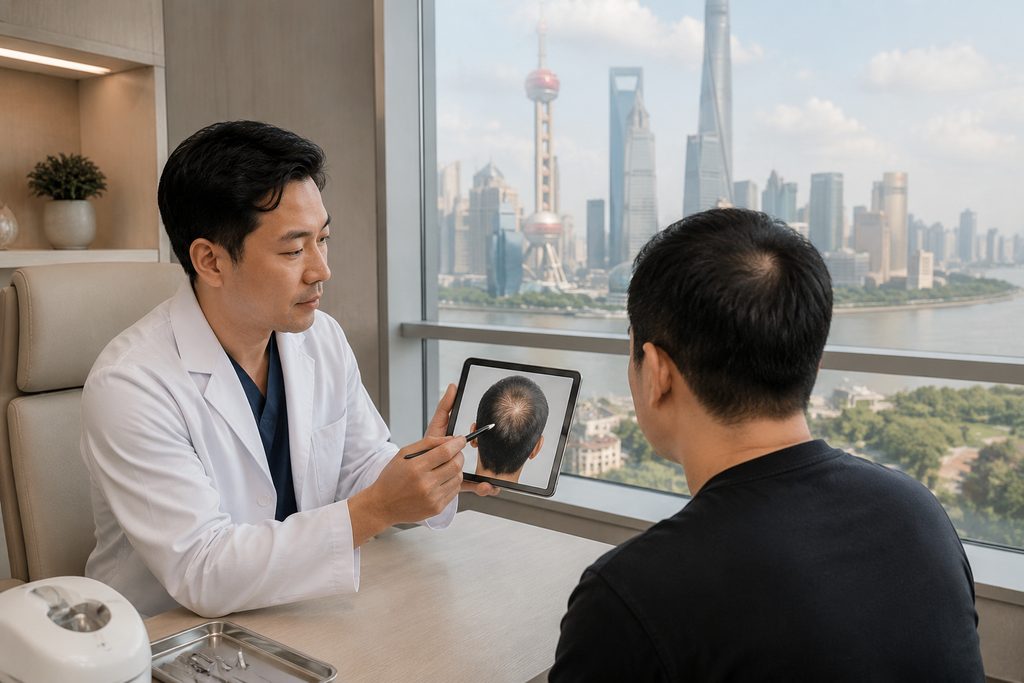
How Long Is the Wait for Hair Restoration in China?
While patients in Canada wait a median 28.6 weeks for orthopedic surgery, hair restoration in China operates on a different clock. Many private clinics in Shanghai and Beijing can schedule a hair transplant within 2 to 4 weeks of your initial consultation. Public hospital departments often run longer — sometimes 1 to 3 months. The hair transplant cost China clinics quote depends heavily on which route you choose.
That contrast matters. You are not looking at a nationalized queue. You are looking at a fragmented market where private providers compete on speed, and public hospitals compete on reputation. Understanding that split is the first step to a realistic plan.
How This Actually Works, Step by Step
The sequence from “I’m considering it” to sitting in the procedure chair follows a predictable path. Here is what actually happens when an international patient pursues hair restoration in China.
First, you send photos of your scalp — front, top, crown — plus your age and any history of hair loss medication. Clinics use these to estimate graft counts. For example, a Norwood III pattern might require 1,800 to 2,500 grafts. A Norwood V could need 3,500 to 4,500. The estimate drives the quote.
Second, the clinic responds with a proposed technique (FUE or FUT), a graft count range, and a price per graft. Some quote all-inclusive packages. Others itemize. You compare.
Third, you choose a date window. Private clinics typically offer slots 2 to 6 weeks out. If you need a specific surgeon, the wait stretches. Top surgeons in Shanghai might be booked 6 to 8 weeks ahead during peak seasons — October and November are busy months for medical tourism.
Fourth, you pay a deposit, usually 10% to 30% of the estimated total. The clinic then locks your date. Before flying, you arrange your S2 visa with the clinic’s invitation letter and hospital documentation.
Fifth, you arrive. A pre-operative consultation happens in person — blood work, scalp assessment, final graft count confirmation. Surgery happens the same day or the next day. Most FUE procedures run 6 to 8 hours.
So the realistic answer to “how long does it take” is: 4 to 10 weeks from first message to surgery day, depending on your surgeon preference and visa processing speed.
Hair Transplant Cost China: What the Numbers Actually Look Like
The hair transplant cost China patients pay varies more by clinic type than by city. Here is the honest breakdown as of 2026.
| Clinic Type | Price per Graft (USD) | Typical 2,500-Graft Procedure | Wait Time |
|---|---|---|---|
| Public hospital (international department) | $2.50 – $4.00 | $6,250 – $10,000 | 1 – 3 months |
| Private chain clinic (e.g., Yonghe, Biliansheng) | $1.50 – $3.00 | $3,750 – $7,500 | 2 – 6 weeks |
| Premium private clinic (international-focused) | $3.50 – $6.00 | $8,750 – $15,000 | 1 – 4 weeks |
Compare that to the United States, where FUE procedures commonly run $12,000 to $25,000 for the same graft count. Turkey sits lower, around $2,000 to $4,000 all-inclusive. China occupies the middle ground — cheaper than the US, pricier than Turkey, with stronger regulatory oversight than many discount destinations.
And the cost is not just the surgery. Budget for flights, a 7 to 10 day stay, and post-operative care products. Most clinics bundle the first wash and check-up into the package. Some include airport pickup.
A Realistic Timeline
The wait for hair restoration in China is rarely about the chair. It is about everything before the chair. Here is what a typical international patient timeline actually looks like.
| Stage | What Happens | Duration |
|---|---|---|
| Week 1 | Initial inquiry, photo submission, clinic shortlisting | 2 – 5 days |
| Week 2 | Quotes received, technique comparison, surgeon selection | 3 – 7 days |
| Week 3 | Deposit paid, date locked, visa documents requested | 1 – 3 days |
| Week 4 – 6 | S2 visa processing (varies by embassy and home country) | 5 – 15 business days |
| Week 6 – 8 | Travel, arrival, pre-op consultation, surgery | 2 – 3 days |
| Week 8 – 10 | Post-op check, first wash, return flight | 2 – 7 days |
Document translation is the step people forget. If your medical history or medication list is not in English or Chinese, factor in 2 to 3 extra days for certified translation. Clinics with international departments handle this in-house. Smaller private chains may ask you to bring translated documents.
Visa processing is the biggest variable. Some embassies turn around S2 applications in 4 business days. Others take 3 weeks. Check with your local Chinese embassy before booking flights.
What Can Go Wrong — and What Happens Then
Honesty about failure modes is rare in medical tourism marketing. Here is what actually goes wrong with hair restoration in China, and what recourse you have.
The surgeon you wanted is not the surgeon you get. Some private chains advertise a famous doctor, then assign your case to a junior surgeon. This happens less in public hospital international departments, where the named specialist is usually the operator. Before paying a deposit, ask in writing: “Who will perform the extraction and implantation?” Get the name. Confirm it again on surgery day.
Graft count inflation. A clinic quotes 3,000 grafts, but the surgeon only extracts 2,200. You paid for 800 grafts that were never harvested. Reputable clinics charge per actual graft extracted, with the final count confirmed during surgery. Ask how the final count is verified. If the answer is vague, walk away.
Deposit disputes. You cancel 2 weeks before surgery. The clinic keeps your 30% deposit. Is that legal? Depends on the contract. Read the cancellation clause before paying. Some clinics refund deposits minus a small processing fee if you cancel more than 14 days out. Others keep everything. Negotiate this up front.
Infection or poor yield. Rare but real. FUE infection rates in accredited Chinese clinics are below 1%. Poor yield — where fewer than 80% of transplanted grafts survive — is harder to quantify. Reputable clinics offer a free touch-up procedure within 12 months if yield falls below a stated threshold. Get that threshold in writing.
If a problem arises, your recourse is the contract. Chinese medical institutions respond to documented breaches. Verbal promises mean nothing. Written terms mean everything.
How Long Is Hair Transplant Waiting List in Beijing? And Other City Comparisons
The how long is hair transplant waiting list in Beijing question has a different answer than the Shanghai question. Beijing’s public hospitals — including the international departments of top institutions — carry longer queues. Expect 2 to 3 months for a named senior surgeon at a public hospital in Beijing. Private clinics in the capital move faster: 2 to 4 weeks is common.
Shanghai skews more private. The best hair restoration clinic Shanghai price question typically points to premium private clinics with English-speaking staff and JCI-style protocols. These charge $3.50 to $6.00 per graft and can often schedule within 7 to 14 days. That speed comes at a premium.
Guangzhou and Shenzhen sit in the middle. Private chains dominate, wait times run 2 to 5 weeks, and prices cluster around $2.00 to $3.50 per graft. Chengdu has emerged as a value destination, with competitive pricing and growing medical tourism infrastructure.
So the city you choose changes both the wait and the price. Beijing public = longer wait, lower cost, institutional reputation. Shanghai private = shorter wait, higher cost, international comfort. Guangzhou/Shenzhen = balanced. Chengdu = value.
Can I Get Hair Transplant Quickly in China? Yes — With Caveats
The short answer to can I get hair transplant quickly in China is yes. Private clinics routinely book patients within 10 to 14 days of first contact. Some can accommodate next-week slots during off-peak months.
But speed has a cost. You skip the careful surgeon vetting. You compress the decision window. You may end up with a competent but less experienced operator. If you need surgery within 2 weeks, you are choosing from whoever is available, not whoever is best.
The smarter play: use the wait productively. Spend 2 to 3 weeks comparing surgeons, reading before-and-after photos, and verifying clinic credentials. Then book. A 4-week wait with the right surgeon beats a 1-week wait with an unknown.
Hair Transplant Packages China for Foreigners: What Is Usually Included
Many clinics now offer hair transplant packages China for foreigners that bundle logistics with the procedure. A typical package includes:
- Pre-operative consultation and scalp mapping
- FUE or FUT procedure with a specified graft count
- Local anesthesia and post-operative medications
- First post-operative wash and check-up
- Airport pickup and drop-off
- One or two nights of hotel accommodation
- English-speaking coordinator
Packages usually start around $4,000 for 2,000 grafts at a mid-tier private clinic and climb to $12,000+ at premium international clinics. What they rarely include: flights, visa fees, extended hotel stays, and follow-up care after you return home.
Read the package inclusions carefully. Some clinics list “PRP therapy” or “laser therapy” as add-ons that sound medical but add $500 to $1,000 without strong evidence of benefit for every patient. Ask what is medically necessary versus optional.
Practical Considerations: Visa, Payment, and Follow-Up
You will need an S2 visa for medical treatment in China. The clinic provides an invitation letter and hospital documentation. Submit these with your application. Processing times vary by embassy — check before booking flights. Accompanying family members also apply for S2 visas.
Payment is typically upfront. Public hospitals require pre-payment, and your insurance may reimburse later if the procedure is covered. Most international insurers do not cover elective hair restoration. Check your policy before assuming reimbursement.
Language is a real barrier in public hospitals. Private international clinics employ English-speaking staff. If you choose a public hospital, a bilingual medical companion can handle registration, payment, and translation. Our team provides this service — learn more about bilingual medical companion support.
Follow-up after you return home is mostly remote. Clinics ask for photos at 1, 3, 6, and 12 months. Some offer video check-ins. If a touch-up is needed, you may need to return — factor that into your decision.
Frequently Asked Questions
The phrase book hair transplant China no waiting is mostly marketing. Every clinic has some lead time — even if it is just 5 to 7 days for document review and pre-op testing. “No waiting” usually means “no long public hospital queue.” Private clinics can move fast, but a zero-wait promise is a red flag. Legitimate clinics need time to review your scalp photos, confirm graft counts, and run pre-operative blood work.
At accredited clinics, yes. FUE is a minimally invasive procedure with a low complication rate. The key is choosing a clinic with proper licensing and an experienced surgical team. Public hospital international departments and JCI-accredited private clinics maintain rigorous standards. Smaller, unaccredited clinics are riskier. Verify the clinic’s license and ask about the surgeon’s annual procedure volume before committing.
Look for three things. First, a verifiable medical license from the local health commission. Second, a surgeon with documented experience — ask how many hair transplant procedures they perform annually. A busy surgeon does 300 to 500 per year. Third, transparent pricing with a written contract. If the clinic avoids written commitments on surgeon identity or graft counts, that is a warning sign. You can also check our database of top-ranked hospitals for institutions with strong reputations.
FUE (Follicular Unit Extraction) harvests individual follicular units from the donor area, leaving tiny dot scars that are barely visible. FUT (Follicular Unit Transplantation) removes a strip of scalp, leaving a linear scar. FUE is more popular for international patients because recovery is faster and scarring is less visible. FUT may be recommended for patients needing very high graft counts. Both techniques are widely available in China.
Most clinics recommend staying 5 to 7 days after the procedure. The first wash happens on day 2 or 3. A check-up follows on day 5 or 7. After that, you can fly home. The transplanted grafts are secure by day 10. Avoid strenuous exercise and direct sun exposure for 2 to 4 weeks after returning home.
Your Next Step
The wait for hair restoration in China is manageable — 2 to 10 weeks depending on your choices. The real work is choosing well: the right clinic, the right surgeon, the right technique. That decision shapes your results far more than the wait time does.
We help international patients navigate Chinese healthcare. We do not perform surgery or make medical decisions. What we do is connect you with verified clinics, coordinate appointments, and provide bilingual support on the ground. If you are considering hair restoration in China, start with a conversation. Request a free consultation and we will help you map out a realistic plan.
Hair restoration in China is accessible, affordable, and safe when you choose carefully. The wait is not the obstacle — the preparation is.
For more medical information and treatment options in China, visit chinamedservices.com (China Medical Services).
