Hair Restoration Treatment in China: What Patients Should Know First
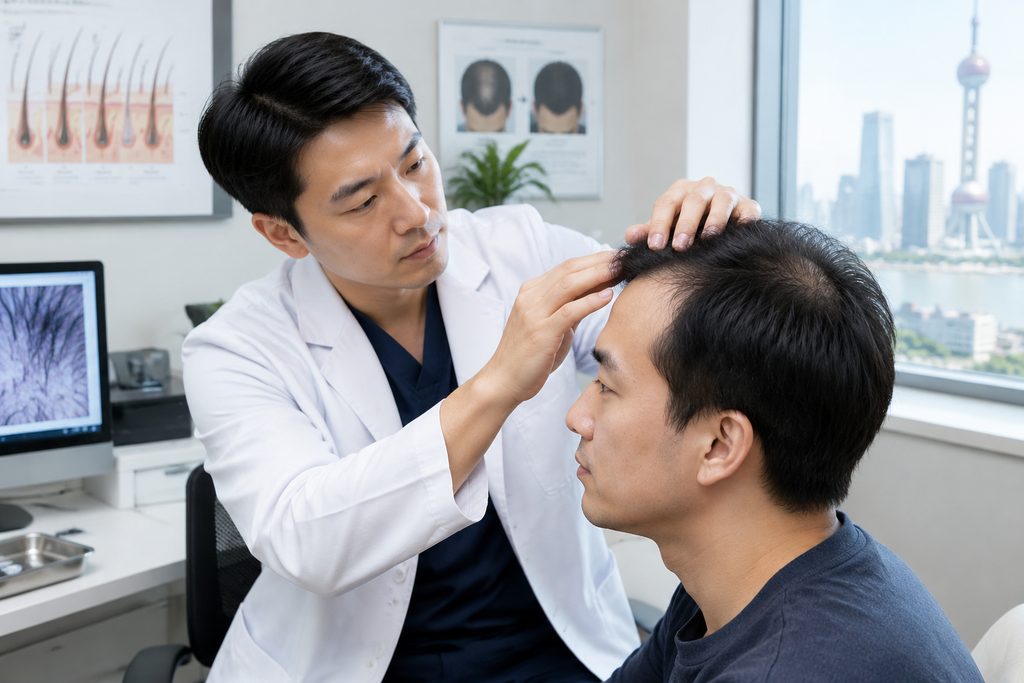
Hair Restoration Treatment in China: The Basics
You’ve probably heard that going abroad for medical care means gambling on quality. For hair restoration, the opposite is often true. China performs more hair transplant procedures than any country in the world, and a growing share of international patients are flying in for them. The reason is simple arithmetic: hair transplant cost China pricing typically runs one-third to one-fifth of what a comparable procedure costs in the United States or Western Europe, at hospitals with dedicated hair restoration departments and surgeons who perform hundreds of cases a year.
That’s the headline. The details matter more.
This guide covers what hair restoration in China actually involves — the techniques available, realistic price ranges, how to evaluate a clinic, the visa category you need, and the sequence of steps from first inquiry to follow-up. We are not surgeons. We’re a medical concierge team that helps international patients navigate Chinese hospitals. Everything below is orientation, not medical advice.
How This Actually Works, Step by Step
The process is more sequential than most people expect. You cannot simply book a surgery date from overseas and show up. Here’s the real order of operations.
Step one: gather your records. You send us photos of your hairline, crown and donor area from several angles, plus any relevant history — previous transplants, medications, blood test results if you have them. A dermatologist or hair restoration specialist at a Chinese hospital reviews this material.
Step two: a written assessment or video consultation. The specialist tells you whether you’re a candidate, which technique fits your pattern of loss, roughly how many grafts are needed, and what the realistic outcome looks like. This is where a lot of people learn that their expectations need adjusting. Diffuse thinning responds differently than a receding hairline. Scarring alopecia is a different conversation entirely.
Step three: hospital and surgeon matching. Once there’s a clinical direction, we identify hospitals with the right department — plastic surgery, dermatology, or a dedicated hair restoration unit. Public tertiary hospitals and private international hospitals both offer these services, and they differ in price, waiting time and English-language support.
Step four: appointment coordination and travel. You need an in-person consultation before surgery is scheduled. That’s the rule at essentially every Chinese public hospital. So the trip has two phases: consult first, operate a day or two later if everything checks out.
Step five: the procedure and short recovery. FUE sessions typically run four to eight hours. Most patients fly home within three to five days.
What Hair Restoration in China Actually Costs
Pricing in China is usually quoted per graft, not per session. That’s a meaningful difference from the flat-rate packages common in Turkey or Thailand, because it means the quote scales with the actual work required.
| Market | Typical FUE cost (2,000–3,000 grafts) | Notes |
|---|---|---|
| United States | $12,000–$25,000 | Per-graft rates of $5–$8 common |
| United Kingdom | £7,000–£15,000 | London pricing at the top of range |
| China (top public hospital) | $3,000–$8,000 | Varies by city and surgeon seniority |
| China (private international hospital) | $6,000–$14,000 | English-speaking staff, insurance billing |
Those ranges are indicative only. Final pricing depends on graft count, technique, surgeon seniority and hospital tier — it varies by hospital and case complexity, and no responsible provider quotes a firm number before seeing your scalp.
So how much does a hair transplant cost in Beijing specifically? Expect the upper end of the public-hospital range at the largest tertiary centers, where senior surgeons at well-known plastic surgery departments command higher per-graft rates. Shanghai pricing runs broadly similar. Second-tier cities — Chengdu, Wuhan, Hangzhou — often come in 20 to 35 percent lower for equivalent technique, though the international-patient infrastructure is thinner.
A Realistic Timeline
People consistently underestimate the front end of this process. The surgery itself is one day. Everything around it takes weeks.
| Stage | Duration | What happens |
|---|---|---|
| Initial inquiry and record submission | Day 1–3 | Photos, history, goals submitted |
| Written assessment or video consult | Day 4–10 | Specialist reviews, recommends technique and graft estimate |
| Hospital selection and appointment request | Week 2–3 | Coordination with hospital international office |
| Visa application (S2 category) | 2–4 weeks | Requires hospital invitation documents |
| Travel and in-person consultation | Day of arrival + 1 | Surgeon examines scalp, confirms plan |
| Procedure | 1 day | 4–8 hours depending on graft count |
| Initial recovery in China | 3–5 days | Wound check before flying |
| Visible results | 6–12 months | Grafts shed, then regrow; density builds gradually |
Total planning window from first contact to surgery: roughly six to ten weeks. Add time if your documents need translation or if you’re traveling during a major Chinese holiday period, when hospital appointment slots tighten considerably.
What Can Go Wrong — and What Happens Then
Honest failure modes, because you deserve them before you book a flight.
The surgeon declines you as a candidate. This happens more than people expect. Active diffuse thinning, insufficient donor density, or unrealistic expectations about density all lead to a “no” or a modified plan. The recourse is straightforward: you’ve spent nothing on surgery, and you have a documented clinical opinion you can take to another provider.
Graft count comes in higher than the estimate. Photos underrepresent reality. If the surgeon recommends 3,500 grafts instead of 2,500, your cost rises accordingly. Ask upfront whether the quote is a ceiling or an estimate.
Poor aesthetic outcome. This is the real risk in any market, including China. Hairline design is where dissatisfaction concentrates — unnatural hairlines, pluggy density at the front, donor scarring. The recourse is a revision procedure, which costs money and requires enough remaining donor hair. This is why surgeon selection matters more than price. Look for a surgeon whose department publishes case volumes and who shows you results at 12 months, not 3.
Infection or poor wound healing. Rare with FUE, but possible. Chinese tertiary hospitals have robust post-operative protocols, and follow-up care at the hospital is generally included in the surgical fee. Get this confirmed in writing before you pay.
Choosing a Clinic: What to Actually Look For
The best hair restoration clinic in Shanghai is not necessarily the one with the biggest advertising budget. Here’s how to evaluate.
Start with the department, not the brand. Hair restoration in China sits inside plastic surgery, dermatology, or a dedicated hair center. A hospital ranked among China’s top departments in plastic surgery or dermatology carries more weight than a standalone clinic with a polished website. You can browse specialty rankings by department on our department rankings page, and filter by city through our top hospitals directory.
Then ask three questions. How many FUE procedures does this surgeon perform per month? What’s the graft survival rate they report, and how do they measure it? Can I speak to the surgeon directly before committing?
If a clinic can’t answer the first question with a number, walk away.
On safety — is hair transplant safe in China? FUE is a minimally invasive procedure with a low complication rate anywhere it’s performed competently. The variables that matter are surgeon skill, sterile technique and appropriate patient selection, not the country. Chinese tertiary hospitals operate under the same sterilization and anesthesia standards you’d find in any high-income country, and JCI-accredited private hospitals meet international benchmarks directly. What you should verify is the individual surgeon’s volume and the hospital’s accreditation status, not the passport on the building.
Practical Considerations: Visas, Payment, Language, Follow-Up
You can arrange the consultation and coordinate logistics remotely, but surgery at Chinese public hospitals requires an in-person examination first. That means two phases to your trip: consultation, then the procedure a day or two later. Packages that promise a guaranteed surgery date before a physical exam are skipping a step that protects you.
FUE is a low-risk procedure when performed by an experienced surgeon under proper sterile conditions. Chinese tertiary hospitals and JCI-accredited private hospitals meet international standards. The meaningful variables are surgeon case volume, patient selection and post-operative protocol — ask about all three, and be cautious of any provider offering guarantees.
Patient reviews are useful for logistics — communication, punctuality, aftercare responsiveness — and unreliable for judging aesthetic outcomes, because happy and unhappy patients both post early, before results are visible. Results at 12 months are the only meaningful benchmark. Ask clinics for long-term case documentation rather than relying on review scores.
Yes. Short-stay medical treatment uses the S2 visa category, with S1 for stays over 180 days. Family accompanying you applies under S2 as well. Hospital invitation documents are required, so visa processing should begin only after your appointment is confirmed. Always verify current requirements with your local Chinese embassy or consulate.
Your Next Step
Hair restoration in China is a mature, high-volume field with genuine cost advantages and real hospitals behind it. The catch is navigation — records, matching, visa documents, appointment sequencing and on-the-ground language support. That’s the gap we exist to close. China Medical Services connects international patients with 340+ top-ranked hospitals across 37 cities, and we handle the coordination, interpretation and logistics so you can focus on the clinical decision. We don’t perform procedures and we don’t promise outcomes. If you’d like a written assessment or a video consultation to clarify whether you’re a candidate and what it would realistically cost, you can request a free consultation with no obligation.
This article is for general information only and does not constitute medical advice. Treatment decisions should be made in consultation with a qualified physician who has examined you.
Frequently Asked Questions
Yes. The hospitals used for international patients are JCI-accredited and follow the same international safety standards as top hospitals in the US and Europe. Surgical teams perform high volumes of procedures — often more than their Western counterparts — which studies show leads to better outcomes.
Costs vary by procedure and hospital, but international patients typically save 40-80% compared to US prices — even when factoring in travel and accommodation. A consultation with our team will give you an exact, all-inclusive quote with no hidden fees.
Send us your existing medical reports to get started. We handle everything from hospital selection and appointment scheduling to visa assistance and post-operative recovery planning. Your medical records are reviewed by the specialist before you even book a flight.
For more medical information and treatment options in China, visit chinamedservices.com (China Medical Services).
