Hair Transplant Cost China: Our 2026 Budget Overview
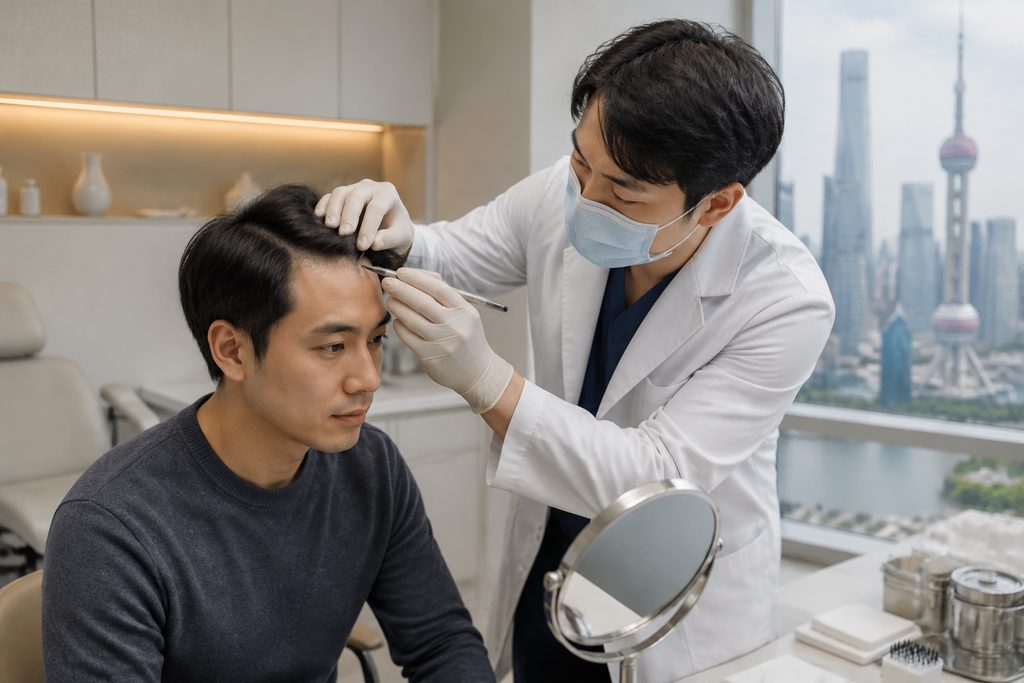
Hair restoration simply means moving healthy hair follicles from the back of your scalp to areas that are thinning or bald. The medical term is follicular unit extraction, or FUE. If you are researching hair transplant cost China, you are likely comparing prices against clinics in Turkey, Thailand, the US, or the UK. The honest answer is that China sits in a comfortable middle zone: significantly cheaper than Western Europe and North America, often competitive with Bangkok, but rarely as cheap as Istanbul’s aggressive package deals. A realistic budget for a standard FUE session of 2,500 to 3,500 grafts in a reputable Chinese hospital ranges from $3,500 to $9,000 USD, depending on city, hospital tier, and the technology used. That range excludes flights and accommodation.
How This Actually Works, Step by Step
You cannot simply book a surgery date from overseas at a Chinese public hospital. The system does not work that way. Here is the real sequence.
First, you send photos of your scalp — front, top, crown, and donor area — along with your age, any history of hair loss medication, and your goals. A dermatologist or hair restoration specialist reviews these remotely. They estimate your Norwood stage and roughly how many grafts make sense. That remote review is not a medical prescription; it is a triage step to see if you are even a candidate.
Second, you choose a hospital or clinic. Public top-tier hospitals, private international clinics, and specialized hair centers all perform FUE in China. The price difference between them can be 2x or more. We help patients compare options across top-ranked hospitals in major Chinese cities and dedicated private facilities.
Third, you travel to China for an in-person consultation. No reputable surgeon will operate without seeing your scalp under magnification, checking donor density, and discussing your expectations. This consultation happens a day or two before surgery, or sometimes the same morning if the clinic has a slot.
Fourth, the procedure itself. FUE takes six to eight hours for a typical session. You are awake, local anesthesia only. The team extracts follicles one by one from the donor area, then implants them into recipient sites. You walk out the same day.
Fifth, follow-up. You return the next morning for a wash and check. Most international patients stay in China for five to seven days after surgery before flying home.
Hair Transplant Cost China: What the Numbers Actually Include
When a Chinese clinic quotes you a price, you need to know exactly what that number covers. This is where budgets break. A headline price of $2,500 might cover only the surgery. Or it might cover everything. You must ask.
Here is a breakdown of typical cost components for FUE in China as of 2026:
| Cost Component | Typical Range (USD) | Notes |
|---|---|---|
| Surgery fee (2,500–3,500 grafts FUE) | $2,800–$7,500 | Varies by hospital tier and city |
| Pre-op blood work and scalp analysis | $80–$250 | Required, sometimes bundled |
| Post-op medications and shampoo kit | $60–$180 | Usually included in private clinics |
| PRP add-on (optional, 1–2 sessions) | $300–$700 | Platelet-rich plasma injections |
| Interpreter or bilingual companion (per day) | from $300/day | Optional but recommended in public hospitals |
| Hotel near hospital (7 nights, mid-range) | $350–$700 | Shanghai and Beijing cost more |
| Flights (round trip, economy) | $800–$2,200 | Depends on origin |
So a realistic all-in budget for an international patient is $5,500 to $11,000. That is still roughly one-third to one-half of what the same procedure costs in the US, where FUE commonly runs $12,000 to $20,000 for a comparable graft count.
How Much Is Hair Restoration in Shanghai Compared to Beijing?
Shanghai and Beijing are the two most common entry points for international patients. Prices are similar, but not identical. How much is hair restoration in Shanghai depends heavily on whether you choose a public hospital’s international department or a private clinic.
In Shanghai, private clinics with English-speaking staff and JCI-style protocols typically quote $4,500 to $8,000 for 3,000 grafts. Public hospital dermatology departments with strong hair restoration units can come in lower — $3,500 to $6,000 — but English support is limited and you will need someone to help you navigate registration, payment, and post-op instructions.
Beijing runs in the same band. FUE hair transplant price Beijing at a reputable private clinic usually starts around $4,000 and climbs to $9,000 for senior surgeons or advanced implanter pens. The capital has several well-known hair restoration centers attached to military and university hospitals, but those are harder for foreigners to access without local assistance.
Guangzhou and Shenzhen tend to be 10–15% cheaper than Shanghai for equivalent quality. Chengdu and Hangzhou are cheaper still, though fewer clinics there have English-speaking teams. You can browse city-specific hospital options through our department rankings across 45 specialties to see where dermatology and plastic surgery units concentrate.
A Realistic Timeline
People underestimate the calendar. A hair transplant is not a weekend trip. Here is what a sensible timeline looks like from first inquiry to final result.
| Stage | What Happens | Duration |
|---|---|---|
| Week 1–2 | Remote photo review, graft estimate, clinic shortlist | 7–14 days |
| Week 3–5 | Choose clinic, book in-person consultation slot, prepare visa documents | 2–3 weeks |
| Week 5–7 | S2 visa processing (varies by embassy) | 1–3 weeks |
| Week 8 | Travel to China, in-person consultation, blood work | 1–2 days |
| Week 8–9 | Surgery day (6–8 hours), next-day wash | 2 days |
| Week 9–10 | Recovery in China, scab removal, check-up | 5–7 days |
| Month 1–3 | Shedding phase — transplanted hairs fall out (normal) | — |
| Month 4–6 | New growth begins visibly | — |
| Month 12 | Final result assessment | — |
The part patients forget is the shedding phase. Around week three to six, most transplanted hairs fall out. This is expected. It does not mean the transplant failed. But if you do not know this in advance, it feels like disaster.
What Can Go Wrong — and What Happens Then
Let us be direct about failure modes. They exist in every country, including China.
Poor graft survival. If the clinic is careless with follicle handling, survival can drop below 70%. You will not know until month six. Recourse is limited — you can request a partial refund or a free touch-up session, but Chinese consumer protection for medical services is weaker than in Western Europe. This is why clinic selection matters more than price.
Overharvesting the donor area. An aggressive extraction leaves the back of your head looking patchy. This is permanent. A conservative surgeon will refuse to exceed safe donor density. Ask your surgeon to show you their donor management plan before you agree.
Unnatural hairline design. A straight, low hairline looks fake. A skilled surgeon designs a slightly irregular, age-appropriate hairline. Ask to see before-and-after photos of patients with your hair type and Norwood stage.
Language breakdown. In public hospitals, post-op instructions may be given in Chinese only. Miss a critical instruction — like not sleeping flat for five days — and you can damage grafts. This is exactly where a bilingual companion earns their fee.
Visa problems. If you arrive on the wrong visa category, the hospital may still treat you, but you risk complications at immigration. Medical travelers to China use the S2 visa, not the M visa. The M visa is for commercial and trade activities only. We guide patients through this paperwork as part of our coordination service.
Is Hair Transplant Safe in China? Evaluating a Clinic From Abroad
Is hair transplant safe in China? The short answer is yes, when you choose a hospital or clinic with verifiable credentials and high procedure volume. The longer answer is that safety depends on three things you can check before you fly.
First, ask how many FUE procedures the surgeon performs per year. A surgeon doing 300 to 500 procedures annually has seen every complication and knows how to avoid most of them. A surgeon doing 30 a year is a risk.
Second, ask about the extraction method. Manual FUE punches (0.8–1.0 mm) leave less scarring than motorized punches in inexperienced hands, but they are slower. Robotic systems exist but are uncommon in China. Most top clinics use motorized extraction with very small punch diameters, which is fine when the surgeon is experienced.
Third, verify the facility. Public hospitals listed in the Fudan rankings or holding JCI accreditation meet baseline safety standards. Private clinics should be able to show their medical license and the surgeon’s registration number. You can cross-check some of this through our private hospital directory with JCI-accredited options. If a clinic refuses to share the surgeon’s name before you book, walk away.
One more thing: read reviews carefully. Best hair transplant clinic China reviews on Google or Trustpilot are useful but often filtered or incentivized. Look for reviews that mention specific details — the surgeon’s name, graft count, post-op experience. Generic five-star reviews with no specifics are less trustworthy.
Practical Considerations: Budget, Visa, Payment, and Follow-Up
Money first. Chinese public hospitals require prepayment. You pay the estimated surgery fee upfront at the cashier, then settle the difference after. Private clinics usually take credit cards; public hospitals sometimes do not accept foreign cards, so bring a UnionPay-compatible card or enough cash. International wire transfers to hospitals are possible but slow.
Insurance almost never covers elective cosmetic hair restoration. Budget as if you are paying everything out of pocket, because you are.
Visa: S2 is the correct category for short-term medical treatment and private affairs. Processing times vary by embassy, so start early. You will need an invitation letter or supporting documents from the hospital. We help prepare these.
Language: expect very limited English in public hospitals, even top-tier ones. Private international clinics are better, but even they may route complex medical explanations through a nurse with moderate English. For anything beyond a simple consultation, having someone who speaks both languages in the room changes the experience entirely.
Follow-up at home: hair transplant follow-up is mostly visual. You send photos at month three, six, and twelve. Your Chinese surgeon can review them remotely. If you need a touch-up session, you will likely need to return to China, since local dermatologists in your home country may be reluctant to manage another surgeon’s work.
Frequently Asked Questions
Prices typically range from $1.20 to $3.50 per graft depending on the clinic tier and city. A 3,000-graft FUE session therefore lands between $3,600 and $10,500 before travel costs. Some clinics offer flat package pricing instead of per-graft billing, which can be simpler for budgeting.
Yes, many private clinics offer packages that bundle surgery, hotel, airport pickup, and post-op care. But you should not commit to surgery before an in-person consultation. A responsible clinic will let you book the consultation and travel logistics first, with surgery scheduled after the surgeon evaluates you. Any clinic that pushes you to pay for surgery sight-unseen is a red flag.
Technique-wise, top Chinese surgeons are on par with their Western counterparts. The difference is consistency. Turkey has industrialized the process with high-volume clinics that produce predictable, if sometimes conservative, results. The US offers the strongest regulatory oversight. China’s strength is value: good surgeons at mid-range prices, especially in Shanghai and Beijing. Your outcome depends more on the individual surgeon than the country.
For the first two weeks, yes — there will be scabs, redness, and swelling. After scab removal around day ten, most patients look presentable. By month three, the transplanted area is often indistinguishable from normal scalp, though new hair is thin at first. By month twelve, a well-executed FUE is undetectable to anyone who is not a hair restoration specialist.
If graft survival is poor, your options are a second procedure, a refund, or both. Chinese clinics vary in their willingness to offer compensation. Before you book, ask in writing what the clinic’s policy is for suboptimal results. If they will not put something in writing, consider that a warning sign.
Your Next Step
Hair restoration in China offers real savings without sacrificing surgical quality, provided you choose carefully and budget honestly. Our team at China Medical Services helps international patients match with suitable hair restoration units, coordinate consultations, arrange bilingual companions, and navigate the visa and logistics. We do not perform surgery, and we do not promise outcomes. We help you make an informed decision and handle the practical friction. If you want a realistic budget for your specific case, start with a free consultation through our patient coordination service.
The core message is simple: hair transplant cost China is competitive, but the real value comes from choosing the right surgeon, not the cheapest quote. Budget $5,500 to $11,000 all-in, give yourself eight to ten weeks from first inquiry to surgery day, and expect the real result to show at month twelve. That is the honest timeline. Plan for it, and the process becomes manageable.
For more medical information and treatment options in China, visit chinamedservices.com (China Medical Services).
