Hand Therapy in China: Fast-Track Fine Motor Recovery After Hand Surgery
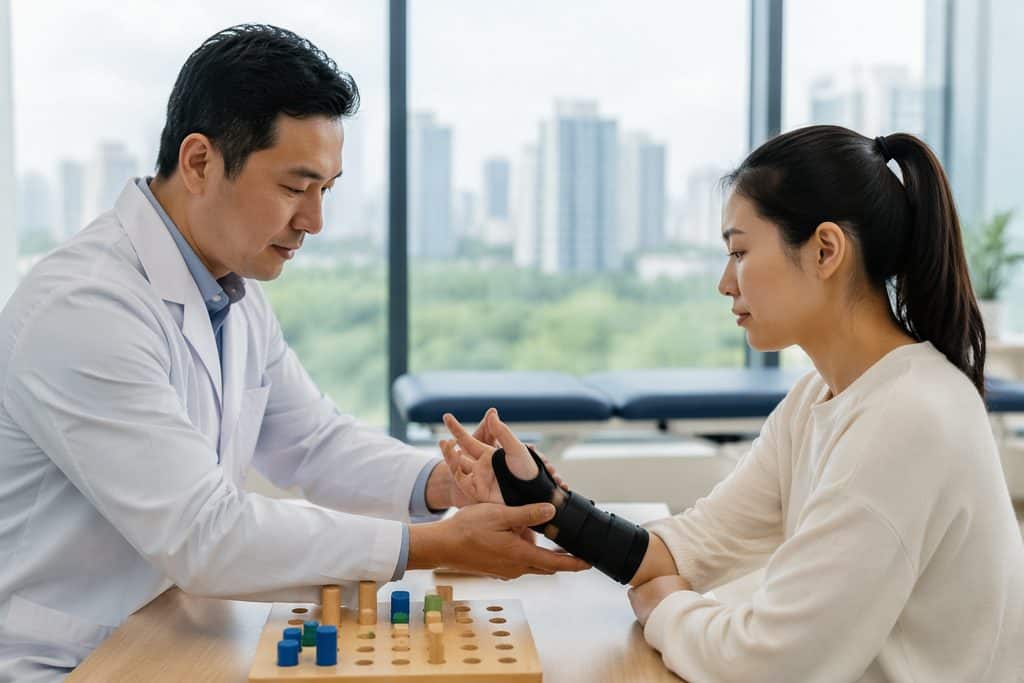
Can you button a shirt right now? For someone weeks after a complex hand surgery, that simple question can feel like a mountain. Stiff fingers. Nerves that misfire. A grip strength that simply vanished. The gap between a successful surgical repair and actually using your hand again is wide. That gap is exactly where occupational hand therapy lives. And for international patients facing long rehab wait times or staggering out-of-pocket costs at home, looking abroad is no longer a fringe idea. It is a calculated, practical move.
Key Takeaways
- Dedicated hand therapy in China typically begins within days of surgery, not weeks — a timeline that directly impacts long-term fine motor recovery.
- The hand therapy China cost runs approximately 60–80% lower than comparable private-pay rates in the US and UK, without sacrificing therapist specialization.
- Language and continuity of care are the real barriers. A rehabilitation plan only works if every instruction is perfectly understood — and followed — across cultures.
- China’s top rehabilitation centers now integrate occupational therapy directly into the surgical team, meaning your therapist and surgeon share the same patient file from day one.
The Problem: Your Hand Heals, But It Does Not Move
Approximately 1 in 5 patients who undergo tendon repair or nerve reconstruction will develop significant stiffness that requires intensive therapy to reverse. The American Society for Surgery of the Hand reports that without early mobilization guided by a specialist, adhesion formation — essentially scar tissue gluing tendons to surrounding tissue — can permanently limit range of motion. The window for optimal intervention is brutally short.
Now layer in reality. In the UK, the NHS wait for outpatient hand therapy after surgery averages 4 to 8 weeks in many trusts. In the US, even with good insurance, finding a certified hand therapist (CHT) who can see you three times a week for the first month is a scheduling nightmare. Co-pays for specialized occupational therapy easily hit $75 to $150 per session. Private pay? $200 to $350 per visit. A full 12-week protocol can drain $7,000 to $12,000 before you factor in a single surgical bill.
So patients wait. They watch YouTube videos. They try to guess at the right pressure, the right angle, the right resistance. Some improve. Many do not. A stiff, partially functional hand after a $20,000 surgery is a terrible return on investment.
Who We Are
We are China Medical Services, a medical concierge team that connects international patients with China’s top-tier hospitals. We are not a hospital. We do not provide medical treatment or clinical diagnoses. We are your logistical architects — we bridge the gap between you and China’s highest-ranked rehabilitation and hand surgery departments. Our network spans 340+ top-ranked hospitals across 37 cities, representing the top 5% of China’s 35,000+ medical institutions as ranked by Fudan University and JCI standards. We handle hospital matching, appointment coordination, bilingual medical companion support, and every practical detail from visa guidance to post-operative accommodation. Our job is to make sure you arrive at the right therapist’s door, fully prepared, with nothing lost in translation.
Why Occupational Hand Therapy in China Delivers Results
The Timeline Advantage: Early Mobilization Is Standard
In many Western systems, hand therapy is a separate referral. The surgeon operates. Weeks later, someone else evaluates you. In China’s top rehabilitation hospitals — particularly those integrated with orthopedic and hand surgery departments — the therapist is often in the operating room or reviewing the surgical notes within 24 hours. This is not a luxury. It is protocol.
A 2022 study published in the Journal of Hand Therapy found that patients who began controlled active motion within 5 days of flexor tendon repair had significantly better total active motion scores at 12 weeks compared to those who started after day 10. When you ask how long does hand therapy take after surgery in China, the answer depends on the injury — but the clock starts sooner. A typical zone II flexor tendon repair protocol runs 12 to 14 weeks. Nerve repair rehabilitation can extend to 6 months or more. But the critical early phase, where adhesions are prevented, is compressed and intensive. Three to five sessions per week are normal, not aspirational.
Volume and Specialization at Scale
Shanghai’s Huashan Hospital, affiliated with Fudan University, runs one of the world’s highest-volume hand surgery centers. Their rehabilitation department sees a volume of post-surgical hand patients that few Western centers match. A therapist there may manage 20 to 30 post-operative hands per day. Repetition at that scale builds an intuitive sense for when a joint is stalling, when a scar is binding, and when a patient is protecting too much.
This matters for best hand surgery rehabilitation Shanghai searches because the city concentrates both surgical and therapeutic expertise. Patients travel from across Asia and increasingly from Europe and the Middle East specifically for staged reconstruction and the intensive rehab that follows. The therapist you see in Shanghai has likely managed your exact injury pattern dozens of times this month. That pattern recognition is hard to replicate in lower-volume settings.
Fine Motor Rehab That Mirrors Real Life
Fine motor rehab after hand surgery abroad often gets reduced to putty squeezes and pegboards. Those have their place. But China’s leading occupational therapy departments increasingly incorporate task-specific training that reflects actual hand use. Weaving resistance into chopstick practice. Adapting calligraphy brush techniques for wrist control. Using textured objects of varying diameters to retrain sensory discrimination. These are culturally embedded activities that translate directly to Western tasks — buttoning, typing, gripping a coffee cup.
The equipment is modern. The protocols are evidence-based. But the volume of hands passing through means therapists develop creative, individualized progressions that go well beyond a printed handout. That matters when you are trying to regain the ability to write your own name.
The Cost Equation
Let us address the question directly. Hand therapy China cost runs from approximately $40 to $120 per session, depending on the hospital tier and whether you are accessing the international VIP department or the standard outpatient rehabilitation center. A full 12-week protocol of three sessions weekly — 36 sessions total — typically falls between $1,500 and $4,500. Compare that to $7,000 to $12,000 for the same intensity of private-pay therapy in the US. The structural reasons are straightforward: lower labor costs, hospital efficiency at scale, and a healthcare system designed for high throughput.
Lower cost does not mean lower quality. The top rehabilitation centers affiliated with Fudan-ranked hospitals employ therapists with international certifications, including CHT credentials recognized globally. The cost difference reflects economics, not expertise.
What You Need to Know Before Going Alone
We are direct about this because it matters. China’s rehabilitation system is excellent, but it is not designed for independent international patients. The barriers are real.
- Language in the Therapy Room: Occupational hand therapy is conversation-heavy. Your therapist explains exactly how much force to apply, where to feel the stretch, when to stop. A mistranslated instruction — “push harder” versus “push until you feel a gentle pull” — can rupture a tendon repair. Most public hospital therapists do not speak medical English fluently. The international departments do, but those slots fill fast.
- Appointment Density and Scheduling: Public rehabilitation departments operate on high volume. You cannot book a block of 36 sessions from overseas. You need an in-person assessment first. Then you enter the scheduling flow. Without local coordination, you may get scattered appointment times that break the recommended therapy frequency.
- Payment and Documentation: Public hospitals require upfront payment, typically via Chinese payment platforms or cash. International insurance reimbursement requires detailed English-language documentation that standard hospital receipts do not provide. You need someone who can generate and translate the right paperwork for your insurer.
- Visa Reality: Medical treatment in China requires an S2 visa with a clear treatment purpose annotation. The hospital must provide an official invitation letter and treatment confirmation. Rehabilitation alone, without a linked surgical procedure, can be harder to document. You need the hospital’s international office to issue the correct paperwork — and they will only do that after confirming your treatment plan.
How We Help You Navigate This
These barriers exist for structural reasons. They are not insurmountable. Our team handles each one systematically.
Before you travel, we match your surgical history and current functional deficits to the appropriate rehabilitation department. We work with hospitals that have dedicated hand therapy units — not general physical therapy departments where the therapist splits time between shoulder patients, stroke patients, and post-surgical hands. We confirm that the therapist assigned to your case has specific experience with your injury type.
During your stay, a bilingual medical companion accompanies you to every session. This person translates instructions in real time, clarifies home exercise programs, and ensures you understand exactly what to do between sessions. They also handle the practical flow — registration, payment, scheduling the next appointment — so you focus entirely on your recovery.
After you return home, we coordinate the handoff. We ensure your discharge summary, therapy protocols, and progress notes are translated into English in a format your home therapist can use immediately. Continuity of care does not end at the airport.
If you are asking is occupational therapy for hands safe in China, the answer depends on where you go and who translates for you. In a top-10 rehabilitation hospital with a bilingual companion, the safety profile is excellent. In an unvetted facility without language support, the risks rise. We only work with the former.
For those ready to book hand rehabilitation program China, the process starts with a consultation. We review your surgical records, your current functional status, and your goals. We then present you with hospital options, therapist profiles, cost estimates, and a timeline. You decide. We coordinate.
Frequently Asked Questions
The full protocol depends entirely on the injury. A flexor tendon repair typically requires 12 to 14 weeks of guided therapy. Nerve transfers or complex reconstructions can require 6 months or longer. The critical difference is that intensive early-phase therapy — three to five sessions per week — begins within days of surgery, not weeks later. This early start directly impacts long-term range of motion and fine motor control.
In a top-ranked hospital with a specialized hand therapy unit, the safety and quality are comparable to leading Western centers. The risk lies in communication breakdowns and in choosing a general rehabilitation department without hand-specific expertise. A bilingual medical companion who understands hand therapy terminology mitigates the communication risk. Hospital selection mitigates the expertise risk. We only place patients in departments with documented hand therapy specialization.
For a 12-week intensive protocol with three sessions per week, expect $1,500 to $4,500 total, depending on the hospital tier and whether you access the international department. This compares to $7,000 to $12,000 for equivalent private-pay therapy in the US. The cost varies by hospital and case complexity. We provide a detailed estimate before you commit to anything.
You cannot book individual therapy sessions remotely. A therapist must assess your hand in person first. However, you can coordinate the entire program in advance — hospital selection, therapist assignment, initial assessment appointment, and a provisional therapy schedule. We handle this coordination so you arrive with a confirmed plan, not a hope. The initial assessment happens on day one or two. Therapy begins immediately after.
This is actually the ideal scenario. Several top hand surgery departments in Shanghai and Beijing have integrated rehabilitation teams. Your surgeon and therapist collaborate from the start. We can coordinate a combined surgical and rehabilitation stay, with the hospital issuing a single invitation letter that covers both the procedure and the post-operative therapy. This simplifies the visa process and ensures seamless care.
Your Next Step
Regaining fine motor control after hand surgery is not about patience alone. It is about timing, specialized guidance, and doing the right thing in the right window. China’s top rehabilitation centers offer world-class hand therapy at a fraction of Western private-pay costs, with the added advantage of early, intensive protocols that protect your surgical result. The logistical barriers are real — language, scheduling, documentation — but they are solvable with the right coordination.
If you want to understand your options, including specific hospital recommendations and a cost estimate tailored to your injury, reach out for a free consultation. No pressure. Just clarity. Visit our patient coordination page to start the conversation. Your hands deserve a full recovery. Let us help you get there.
For more medical information and treatment options in China, visit chinamedservices.com (China Medical Services).
