Orthopedic Surgery: A Companion After Surgery Changes Everything
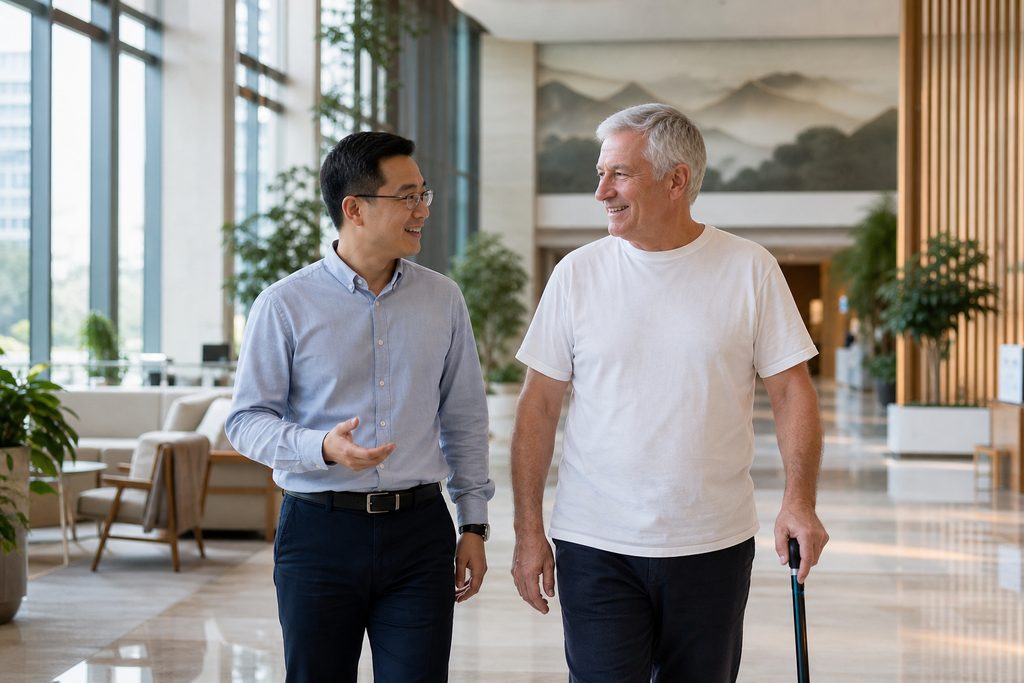
You’ve probably heard that surgery in China means compromising on quality. The reality is exactly the opposite for joint replacement. A knee or hip that costs $40,000 in the United States typically runs $8,000 to $15,000 at a top-tier Chinese public hospital. The surgeons complete hundreds of procedures annually. The implants are the same global brands. What changes is the price, not the clinical standard.
But here’s what most international patients don’t plan for. The surgery itself is only half the challenge. The days and weeks after—when you’re discharged from the hospital, navigating a foreign city on crutches, reading medication labels in Mandarin, and trying to figure out whether that swelling is normal—that’s when the real test begins. A companion after surgery isn’t a luxury. It’s the difference between a smooth recovery and a stressful one.
Key Takeaways
- Total orthopedic surgery cost China for joint replacement ranges from $8,000 to $20,000, roughly one-fifth to one-third of US prices.
- Top Chinese orthopedic departments perform 5,000+ joint replacements per year, creating deep clinical experience that directly benefits patients.
- Language barriers and post-discharge logistics are the biggest risks for international patients—not surgical quality.
- Recovery timelines in China follow international protocols; the variable is how well you manage the first 14 days after surgery.
The Problem: A $40,000 Surgery You Can’t Afford—Or a $10,000 One You Can’t Navigate
In the United States, a total hip replacement averages $39,000 to $45,000 without complications. A total knee replacement lands in the same range. Even with insurance, out-of-pocket costs routinely hit $5,000 to $10,000. For uninsured patients or those facing long waits in Canada, the UK, or Australia, the math doesn’t work.
Approximately 1 in 8 adults over 45 will need joint replacement surgery at some point. The demand keeps rising. Wait times for elective orthopedic surgery in Canada’s public system average 6 to 12 months. In the UK’s NHS, patients routinely wait 18 weeks or more just for a first consultation, then months longer for surgery. Every month of waiting means more pain, more muscle atrophy, and a harder recovery.
So patients look abroad. Thailand, India, Turkey, Mexico—all offer lower prices. China enters that conversation for a specific reason: the combination of world-class orthopedic volume, modern hospital infrastructure, and costs that undercut most medical tourism destinations without sacrificing implant quality or surgical protocol. But the logistics are real. And most patients underestimate them.
Why China Delivers Results for Orthopedic Surgery
Clinical Volume That Western Surgeons Rarely Match
A senior orthopedic surgeon at a major Chinese teaching hospital performs 300 to 500 joint replacements annually. The average American orthopedic surgeon completes around 60 to 70. Published research in the Journal of Bone and Joint Surgery and other peer-reviewed journals consistently links higher surgeon volume with lower complication rates and better long-term outcomes for hip and knee replacement. China’s hospital system concentrates cases at scale. Peking Union Medical College Hospital, West China Hospital in Chengdu, and Shanghai’s top orthopedic centers each handle thousands of joint procedures every year.
That volume creates pattern recognition. A surgeon who sees 400 knees a year has encountered nearly every anatomical variation, every intraoperative surprise. That matters more than any marketing brochure.
Technology and Efficiency at Scale
Chinese top-tier orthopedic departments adopted robotic-assisted joint replacement systems years ago. MAKO, CORI, and domestic platforms like TiRobot are in routine use at major centers. Computer navigation for alignment, 3D-printed custom cutting guides, and enhanced recovery after surgery (ERAS) protocols are standard at Fudan-ranked hospitals. One of the most important details: many Chinese hospitals use the same implant brands you’d receive in the US or Europe—Zimmer Biomet, DePuy Synthes, Stryker, Smith+Nephew. The hardware is identical. The surgical environment is where the difference lies.
Efficiency shows up in length of stay too. In the US, a total knee replacement typically means 1 to 3 nights in the hospital. In China, that range is 3 to 7 nights for international patients at public hospital international departments. Longer inpatient monitoring can actually be an advantage—more supervised physical therapy, more controlled pain management, fewer surprises after discharge.
Cost Advantage Without Quality Compromise
Why does orthopedic surgery cost China so much less? Not because corners are cut. Chinese labor economics differ fundamentally. A senior orthopedic surgeon’s salary is a fraction of a US surgeon’s. Hospital operating costs, nursing salaries, and facility fees are all lower. The implant itself—often the single biggest line item—costs roughly the same globally. But the professional fees and facility charges that inflate American hospital bills simply don’t exist at the same scale in China.
That’s the structural reason. You’re not buying a cheaper surgery. You’re buying the same surgery in a lower-cost economic environment. The clinical result doesn’t depend on what the hospital charges. It depends on the surgeon’s hands, the implant quality, and the rehabilitation protocol.
Is Orthopedic Surgery Safe in China for Foreigners?
This question deserves a direct answer. Yes—when you choose the right hospital. The key distinction is between public hospital international departments and the general outpatient system. A foreign patient walking into a standard Chinese public hospital without language support will struggle. Registration, consultation, imaging, payment, and discharge instructions all happen in Mandarin. The system is designed for high-volume domestic care, not international navigation.
International departments at top hospitals are different. Staffed with English-speaking coordinators, offering private or semi-private rooms, and priced 1.5 to 2 times higher than the standard pathway—but still far below Western prices—these departments exist precisely for patients like you. JCI-accredited private international hospitals in Shanghai and Beijing offer another option: Western-style care, direct insurance billing, and English as the working language. Both routes are safe. Both require planning.
Safety data supports this. China’s top orthopedic centers report infection rates and revision rates comparable to international benchmarks. The implants are regulated by the National Medical Products Administration (NMPA) using standards aligned with international norms. The risk isn’t the surgery. The risk is choosing a hospital you can’t verify, or arriving without a plan for the post-operative period.
Recovery After Knee Surgery in China: What the Timeline Actually Looks Like
Patients searching “how long is recovery after knee surgery in China” usually want a number. Here’s the honest version. The timeline in China follows the same biological reality as anywhere else. What changes is the support structure around it.
| Phase | Timeline | What Happens | Where You Are |
|---|---|---|---|
| Inpatient | Days 1–5 | Surgery, early mobilization, pain management, first PT sessions | Hospital ward |
| Early outpatient | Days 6–14 | Wound care, daily PT, walking with assistive device, swelling management | Hotel or serviced apartment |
| Intermediate recovery | Weeks 3–6 | Building range of motion, reducing pain medication, longer walks | Home country or China |
| Functional recovery | Months 2–4 | Return to normal gait, stairs, light exercise | Home country |
| Full recovery | 6–12 months | Complete tissue healing, maximum strength, return to sports | Home country |
The first 14 days matter most. That’s when complications show up—deep vein thrombosis, wound infection, stiffness from inadequate mobilization. In your home country, you’d have a physical therapist, a follow-up nurse, and a familiar pharmacy. In China, without preparation, you have none of that. With a bilingual companion, you have someone who reads your discharge instructions, schedules your follow-up imaging, translates your questions to the surgeon, and makes sure you’re doing the exercises correctly. The surgery was the same. The recovery is where the companion changes the outcome.
Best Hospital for Joint Replacement Shanghai: How to Choose
This is the question everyone should ask before surgery abroad. The honest answer: your Chinese surgeon remains accessible by video consultation for follow-up. Your home physician manages day-to-day recovery. In the rare event of a complication like infection or implant loosening, revision surgery may be needed—either in China or at home. That’s why choosing a hospital with documented low complication rates matters more than choosing the cheapest option. Ask for the hospital’s infection rate and revision rate before committing.
Some patients manage alone. Most don’t. The first two weeks after joint replacement involve wound care, medication schedules, physical therapy exercises, and follow-up imaging—all communicated in Mandarin at most public hospitals. If you speak fluent Chinese and have experience navigating Chinese healthcare, you can handle it yourself. If you don’t, a bilingual companion removes the single biggest source of stress during recovery. The cost—from $300 per day—is small relative to the total investment in your surgery.
No. Chinese public hospitals require a surgeon to review your imaging and conduct a consultation before scheduling surgery. You can complete the initial consultation via video from your home country. The surgical date gets confirmed after that. Any provider claiming to lock in a surgery date sight unseen is not representing the process accurately.
Your Next Step
Orthopedic surgery in China offers a rare combination: top-tier
Frequently Asked Questions
Yes. The hospitals used for international patients are JCI-accredited and follow the same international safety standards as top hospitals in the US and Europe. Surgical teams perform high volumes of procedures — often more than their Western counterparts — which studies show leads to better outcomes.
Costs vary by procedure and hospital, but international patients typically save 40-80% compared to US prices — even when factoring in travel and accommodation. A consultation with our team will give you an exact, all-inclusive quote with no hidden fees.
Send us your existing medical reports to get started. We handle everything from hospital selection and appointment scheduling to visa assistance and post-operative recovery planning. Your medical records are reviewed by the specialist before you even book a flight.
For more medical information and treatment options in China, visit chinamedservices.com (China Medical Services).
