Hearing Test in Beijing: What to Expect, Costs & How to Book
Key Takeaways
- A comprehensive hearing test in Beijing at a top-tier hospital typically costs far less than the same panel in the US or Europe — often a fraction of the price for equivalent equipment.
- China’s leading ENT departments see enormous patient volumes, which means audiology teams perform these tests daily and read results with practiced speed.
- The real friction isn’t the test itself — it’s the language barrier, same-day registration rules, and figuring out which hospital to walk into.
- You can get a written second opinion or a video consultation before you ever book a flight, so you know the plan makes sense first.
A hearing test sounds simple enough. You put on headphones, raise a hand when you hear a tone, and a machine prints a chart. In plain terms, that chart — called an audiogram — maps exactly which frequencies you can and cannot hear, and how well your middle ear and nerve pathways are working. It is the difference between “my hearing feels off” and a precise, measurable diagnosis. If you are searching for a hearing test in Beijing, you are probably weighing three things at once: what it costs, whether the results will be trustworthy, and how on earth a foreigner navigates a Chinese hospital to get one. This guide answers all three.
We are China Medical Services. Our team connects international patients with more than 340 top-ranked hospitals across 37 cities, and we have walked hundreds of people through exactly this kind of appointment. What follows is what we tell them.
Why a Hearing Test Abroad Feels Harder Than It Should
Start with the numbers back home. In the United States, a full audiology evaluation — pure-tone testing, speech recognition, tympanometry — commonly runs $150 to $300 out of pocket, and far more if it is bundled into a specialist visit. In the UK, NHS waiting lists for audiology can stretch for weeks or months depending on your region. In Canada and Australia, the wait for a non-urgent ENT referral is frequently measured in months, not days.
That delay matters. Hearing loss is not a cosmetic problem. The World Health Organization estimates that over 1.5 billion people live with some degree of hearing loss, and untreated loss is linked to social isolation, cognitive decline, and falls in older adults. Waiting six months for a test that takes forty minutes is a poor trade.
So people look east. And then they hit the wall every first-time medical traveler hits: Chinese public hospitals do not work like Western clinics. You generally cannot book a routine outpatient slot online from overseas. You show up, register, queue, and get seen — often the same day, but on the hospital’s terms, not yours. That is the honest version. It is manageable, but it helps enormously to know the rules before you land.
What a Hearing Test in Beijing Actually Involves
An audiology workup at a major Chinese hospital is not one test. It is a short battery, usually completed in a single visit of 45 to 90 minutes. Here is what the technician will run you through.
Pure-tone audiometry
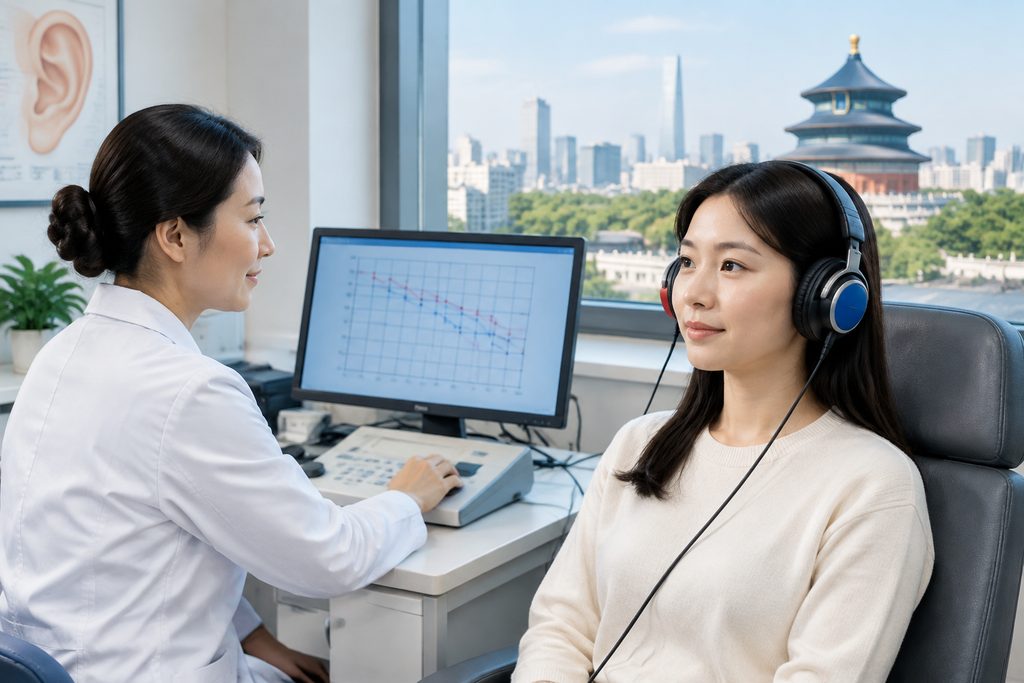
You sit in a soundproof booth wearing headphones. Tones play at different pitches and volumes. You press a button or raise a hand each time you hear one. This produces the audiogram — the core of your diagnosis. It is painless and takes about 20 minutes.
Speech audiometry
Instead of tones, you hear words and repeat them back. This measures how well your brain processes speech, not just whether your ear detects sound. Fair warning: at a Chinese public hospital, the word lists may be delivered in Mandarin. If you do not speak Mandarin, ask in advance for an English or non-verbal alternative, or bring an interpreter. This is one of the few places where language genuinely affects the test, and it is worth flagging early.
Tympanometry and acoustic reflex testing
A small probe sits in your ear canal and gently changes air pressure. It checks how well your eardrum and middle-ear bones are moving. Takes two minutes. Tells the doctor whether your problem is conductive (mechanical) or sensorineural (nerve-related).
Otoacoustic emissions (OAE) and, if indicated, auditory brainstem response (ABR)
These are more common in pediatric and complex cases. OAE measures the inner ear’s own faint echo. ABR tracks nerve signals from ear to brainstem. Neither hurts. ABR requires you to lie still for a while, so it is scheduled separately.
Hearing Test Cost in Beijing: Real Numbers
This is where the value case becomes concrete. At a top-tier Beijing hospital, a full audiology panel — pure-tone, speech, tympanometry — generally falls in the range of $40 to $120 USD depending on the hospital tier and whether you use the standard or international/VIP channel. A single pure-tone test alone can be under $20. Compare that to the US figures above.
| Test / Service | Typical Beijing Cost (USD) | Typical US Cost (USD) |
|---|---|---|
| Pure-tone audiometry | $15 – $40 | $60 – $150 |
| Full audiology panel (pure-tone + speech + tympanometry) | $40 – $120 | $150 – $300 |
| Otoacoustic emissions (OAE) | $30 – $80 | $100 – $250 |
| Auditory brainstem response (ABR) | $80 – $200 | $300 – $800 |
| ENT specialist consultation | $20 – $60 | $150 – $400 |
| Hearing aid fitting (per device) | $300 – $2,500 | $1,000 – $6,000 |
Prices vary by hospital and case complexity, and the international/VIP channel runs roughly 1.5 to 2 times the standard channel because it includes English-speaking staff and shorter waits. Even at the top of that range, you are looking at a fraction of Western pricing. For a broader picture of how costs compare across specialties, see our breakdown of top-ranked Chinese hospitals by city and specialty.
Is a Hearing Test in China Reliable? The Quality Question
This is the fair objection, and it deserves a straight answer. Yes — at the hospitals we work with, and here is why.
China’s top ENT departments are not small clinics. They are high-volume academic centers attached to medical universities, using the same calibrated audiometers, soundproof booths, and evoked-potential equipment you would find in a Western teaching hospital. Equipment calibration follows international standards. The specialists who read your audiogram often hold positions on national guideline committees and publish in the same journals their Western peers read.
Volume does the rest. A senior audiologist at a major Beijing hospital may run dozens of these panels every week. Repetition builds pattern recognition — the ability to spot an unusual asymmetry or a notch in the audiogram that a low-volume clinic might miss. The Fudan University Hospital Rankings, which grade China’s 35,000-plus hospitals, place the country’s best ENT departments in a top tier that is genuinely world-class.
What is not reliable is going to a random neighborhood clinic with no English support and no way to verify credentials. That is the scenario to avoid, and it is exactly the scenario a coordinator prevents.
How to Book a Hearing Test in Beijing as a Foreigner
Here is the sequence that actually works, step by step.
Step one — decide the channel. Standard outpatient: cheapest, but you register on the day, queue, and navigate in Chinese. International or VIP channel: you can often pre-arrange an appointment, staff speak English, and the price is higher. For a hearing test, the standard channel is usually fine if you have help; the VIP channel is worth it if you are also seeing a specialist for a complex problem.
Step two — get a remote opinion first (optional but smart). If your situation is more than a routine screening — sudden hearing loss, one-sided loss, tinnitus with dizziness — you can send your existing reports to a Chinese ENT team and receive a written second opinion before booking anything. This is the “consult first” model, and it prevents wasted travel.
Step three — handle the visa correctly. For medical treatment in China, the applicable short-stay category is the S2 visa, annotated for medical/private affairs, subject to the latest embassy or consulate requirements and supporting hospital documents. Accompanying family members apply under the same category. Note clearly: the M visa is for commercial and trade activities and has nothing to do with medical treatment. Do not let anyone tell you otherwise.
Step four — bring documents. Passport, visa, previous audiograms and imaging, medication list, and payment method. Chinese public hospitals require prepayment; private international hospitals often bill insurance directly.
Step five — get to the right department. Audiology sits under ENT (Otolaryngology). At a large hospital, registration, payment, and the testing room may be on three different floors. This is where a bilingual companion earns their keep.
Common Mistakes to Avoid
Three traps catch most first-timers. The first is assuming you can book a public hospital outpatient slot from abroad like a restaurant reservation — you generally cannot. The second is arriving without prior records, which forces the doctor to start from zero and can mean a repeat scan. The third is underestimating the language issue: registration screens, department signs, and payment kiosks are in Chinese, and a wrong floor can cost you an afternoon.
One more: do not treat a hearing test as a one-off. If your audiogram shows loss, the follow-up — hearing aids, further imaging, or a treatment plan — is where the real decisions happen. Plan for continuity, not just the test.
Frequently Asked Questions
At a top-tier Beijing hospital, a full audiology panel typically runs $40 to $120 USD, with a single pure-tone test under $20. International/VIP channels cost more but include English support. Prices vary by hospital and case complexity.
For standard outpatient care at a public hospital, same-day registration is the norm and you generally cannot pre-book from overseas. International departments can often arrange appointments in advance. If you want certainty, coordinate ahead.
At international and VIP departments, usually yes. At standard public hospital audiology rooms, often not. Speech audiometry in particular may be delivered in Mandarin, so arrange interpretation if needed.
At the top-ranked hospitals, yes — calibrated audiometers, soundproof booths, and evoked-potential systems meeting international standards. The gap is in communication and logistics, not the technology.
Yes. You can send existing reports to a Chinese ENT specialty team for a written second opinion, or speak with them by video, before committing to travel.
Your Next Step
A hearing test in Beijing is affordable, fast, and — at the right hospital — as accurate as anything you would get at home. The hard part is the navigation, not the medicine. Our team is not a hospital and we do not diagnose or treat anyone; we handle the coordination, the language, and the logistics so you can focus on your health. If you would like help matching with an ENT department or arranging a remote opinion first, you can start a free consultation here — no pressure, just a conversation about what fits your situation.
For more medical information and treatment options in China, visit chinamedservices.com (China Medical Services).
