Heart Checkup in Wuhan: Costs, Top Hospitals, and Options
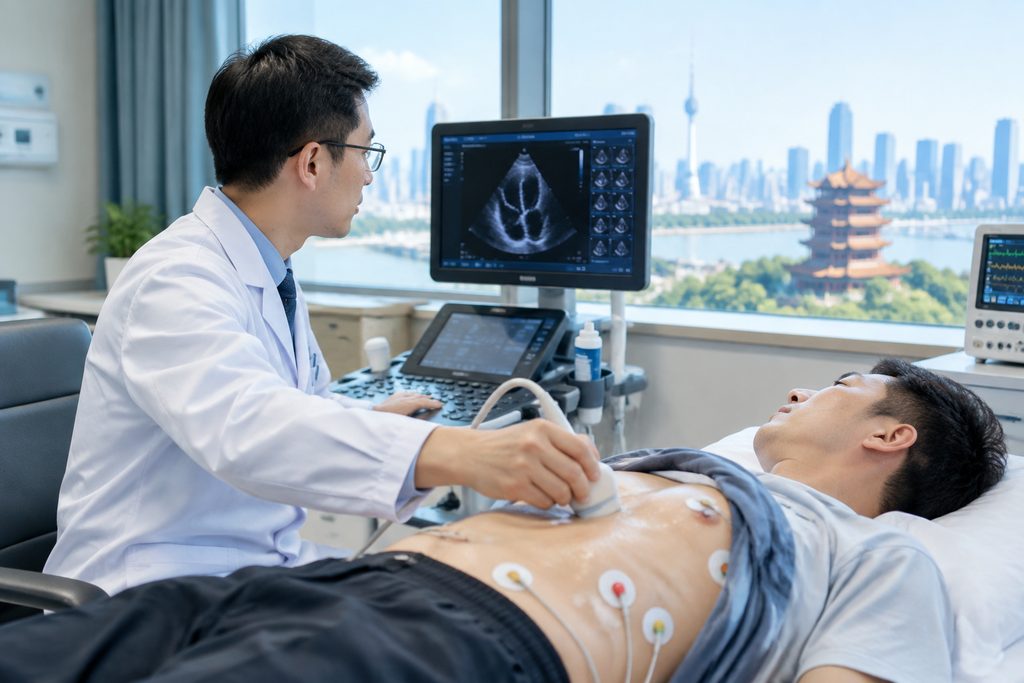
Heart Checkup in Wuhan: Your Options
A heart checkup is a set of tests that looks at how well your heart is working before symptoms become an emergency. It usually means an electrocardiogram (ECG), an echocardiogram, blood work, and often a stress test or a CT scan of the coronary arteries. In Wuhan, the heart checkup cost for international patients typically lands between $400 and $1,800 depending on how deep the workup goes and whether you use a public hospital’s international department or a private international clinic. That range is a fraction of what the same panel costs in the United States, where a cardiac CT alone can run past $1,000.
Wuhan is not the first city most foreigners picture when they think about medical care in China. Beijing and Shanghai get the headlines. But Wuhan sits at the center of the country, it is a major academic medical hub, and its largest hospitals handle patient volumes that would overwhelm most Western institutions. The catch is navigation. Public hospitals in China do not work like the clinics you may be used to, and that gap is where most international patients get stuck.
Heart Checkup Cost in Wuhan, China: The Short Answer
Expect $400 to $1,800 for a comprehensive cardiac workup as an international patient. A basic screening panel with ECG, echo, and blood tests sits at the low end. Add a coronary CT angiography, a treadmill stress test, or a 24-hour Holter monitor and you climb toward the top of that range. Prices vary by hospital and case complexity, and a final quote only comes after the hospital reviews your history.
Here is the part people miss. The sticker price is not the whole story. Public hospitals in China require prepayment, and you settle insurance afterward on your own. Private international hospitals often bill your insurer directly but charge more. Neither is wrong. They serve different patients.
Key takeaway: A full heart checkup in Wuhan generally costs 70–90% less than the same panel in the US, but the total depends on which tier of hospital you choose and how many advanced imaging tests your doctor orders.
Who This Is Right For — and Who It Isn’t
Wuhan works well for a specific kind of patient. It does not work for everyone, and pretending otherwise wastes your time and money.
Good candidates:
- Expats and long-term residents in central China who want a thorough cardiac screening without flying to Shanghai or Hong Kong
- Travelers with a family history of heart disease, high blood pressure, or elevated cholesterol who want baseline imaging
- Patients whose home-country waitlist for a cardiac CT or stress test stretches weeks or months
- Anyone seeking a second read on an existing diagnosis, where a written review of your records can be arranged before you travel
Poor candidates:
- Anyone with active chest pain, shortness of breath at rest, or a suspected heart attack. That is an emergency. Go to the nearest emergency room, wherever you are.
- Patients who need a procedure that same week. In Chinese public hospitals, surgery and most interventions require an in-person consultation first. You cannot lock in a procedure date from overseas through the standard channel.
- People who cannot travel or who have conditions that make flying risky without a physician’s clearance
If you fall into the second group, staying home and stabilizing first is genuinely the better call. A checkup is elective. Emergencies are not.
The Options, Compared
Wuhan gives you three realistic paths. They differ in price, language support, and how much of the logistics you handle yourself.
| Option | Typical Cost (USD) | English Support | Booking Lead Time | Best For |
|---|---|---|---|---|
| Public hospital, standard outpatient | $400–$900 | Limited; interpreter usually needed | Same-day queue, no advance booking | Budget-focused patients comfortable with local navigation |
| Public hospital, international/VIP channel | $900–$1,800 | English-speaking staff, dedicated coordinator | Several days to two weeks | Patients wanting senior specialists and smoother logistics |
| Private international clinic | $1,200–$2,500 | Full English service, Western-style care | Days | Insurance direct-billing and maximum comfort |
Which column fits you? If you have travel insurance that reimburses rather than pays directly, and you are comfortable with a bilingual companion handling the queue, the public standard route saves the most. If your insurer settles directly with private facilities, or you simply want a calmer experience, the private tier earns its premium. The middle option — a public hospital’s international department — is where many readers land, because it pairs top-tier specialists with English-language coordination at roughly 1.5 to 2 times the standard public price.
Finding the Best Hospital in Wuhan for a Heart Checkup
Wuhan’s strongest cardiac care concentrates in its large teaching hospitals, several of which appear in national specialty rankings. Tongji Hospital and Union Hospital, both affiliated with Tongji Medical College, are the names that come up most often for cardiology and cardiac surgery. These are high-volume centers where the teams see more heart cases in a month than many Western hospitals see in a year.
Volume matters for a checkup in a quiet way. Experienced imaging teams read echocardiograms and coronary CTs more consistently, and that consistency is the whole point of screening. A test is only as good as the person interpreting it.
For a broader view of how Chinese hospitals are ranked, our directory of top-ranked hospitals by city groups facilities by national tier. If you want to compare Wuhan against other options, the Wuhan city page lists the local institutions international patients use most. And if your checkup uncovers something that needs a specialist’s eye, the department-level rankings show which hospitals lead in cardiology and cardiac surgery nationally.
One honest note. The “best” hospital is the one that fits your case, your budget, and your timeline. A famous name means little if you cannot get an appointment or communicate with the staff.
How Long Does a Full Heart Checkup Take?
Most patients finish in one to two days. Here is how the time typically breaks down.
- Day 1, morning: Registration, medical card creation, blood draw, ECG, and echocardiogram. Roughly three to four hours including waiting.
- Day 1, afternoon or Day 2: Stress test, Holter monitor fitting, or coronary CT, depending on what your physician orders.
- Day 2 to Day 3: Results review with the cardiologist. Some advanced imaging takes 24 to 48 hours to report.
If you add a coronary CT angiography, budget an extra half day. If you need a 24-hour Holter, the monitor stays on overnight, so plan for a second visit. The single biggest variable is not the testing itself. It is the queue. Large public hospitals can see over ten thousand outpatients a day, and without help, the registration and payment lines alone can eat a morning.
Practical Considerations for International Patients
Records and documentation. Bring your prior ECGs, imaging, medication list, and any recent lab results, translated into English or Chinese where possible. A cardiologist who can see your baseline reads the new tests far more accurately.
Visa. For medical travel, the applicable short-stay category is the S2 visa, used for medical treatment and private affairs, subject to the latest embassy or consulate requirements and supporting hospital documents. Accompanying family members apply under the same category. Do not confuse this with the M visa, which is for commercial and trade activities and has nothing to do with medical treatment. Approval is never guaranteed, and requirements change, so confirm current rules with your nearest Chinese embassy or consulate before booking flights.
Payment. Public hospitals require prepayment. Keep every receipt, because your insurer at home will want them. Private international hospitals frequently bill insurers directly, which removes the reimbursement headache but raises the upfront price.
Language. This is the practical wall most patients hit. Signage, forms, and queue systems are in Chinese. A bilingual medical companion can handle registration, payment, wayfinding, and interpreting during the consultation, so the cardiologist hears your history accurately and you understand the plan.
Book your checkup for a Tuesday or Wednesday if you can. Monday mornings and the days after public holidays are the busiest, and shorter queues mean faster results.
Frequently Asked Questions
Yes, for routine screening at accredited hospitals. China’s large teaching hospitals use the same imaging equipment found in Western centers, and their cardiology teams are experienced. The real risks are not clinical. They are logistical: language barriers, unfamiliar payment systems, and the difficulty of navigating a hospital that sees thousands of patients daily. Those are manageable with preparation.
Standard public outpatient registration cannot be reserved from overseas in advance. You take a number on the day. To secure a specific date and a senior specialist, you generally need the hospital’s international or VIP channel, which costs more but offers English coordination. A service like ours can handle that booking on your behalf and confirm what is available before you travel.
It depends entirely on your policy. Many travel insurance plans exclude routine screening and cover only emergencies. Some international health plans reimburse overseas treatment, and a few bill Chinese private hospitals directly. Call your insurer before you book and ask two questions: does the policy cover elective diagnostic testing abroad, and does it pay upfront or reimburse after?
That is exactly why you do it. If the results show something that needs treatment, the cardiologist will explain the options, and you can decide whether to proceed in Wuhan or return home. No one will pressure you into a procedure on the spot. For anything complex, a written second opinion from another hospital’s specialists is a reasonable next step before committing to treatment.
Your Next Step
A heart checkup in Wuhan is affordable, thorough, and within reach for most international patients — provided you plan the logistics before you fly. The testing itself is straightforward. The navigation is the hard part, and that is precisely what a good coordinator removes. Our team is not a hospital and we do not diagnose or treat anyone. We match you with appropriate hospitals, coordinate appointments through official international departments, arrange bilingual accompaniment, and help with visa and travel planning. When you are ready, start with a free consultation and we will walk through your options with no obligation.
This article is for general information only and is not medical advice. Always consult a qualified physician about your individual health and before making any treatment decisions.
For more medical information and treatment options in China, visit chinamedservices.com (China Medical Services).
