A Hospital Payment Kiosk in China: How Foreign Patients Pay
Key Takeaways
- Most large Chinese public hospitals now run self-service kiosks for registration, top-ups, and fee collection — but the kiosk is usually one step in a longer payment chain, not a complete solution.
- Payment happens in stages: registration and consultation fees first, then investigation fees, then a pre-payment before surgery or admission. Each stage may be collected differently.
- The honest difficulty: many kiosks are Chinese-first, some accept only domestic payment tools, and staff at a busy counter may have limited English. A kiosk is not a substitute for a person who can read the screen.
- Before you travel, understand which payment instrument you will actually use in China, and confirm with the hospital’s international department what they accept. Do not assume your home credit card will work.
Can you walk up to a machine in a Chinese hospital, tap a card, and pay your bill like you would at an airport check-in desk? Sometimes yes — and sometimes the machine will stop you at the first screen. Understanding a hospital payment kiosk in China, how to pay at each stage, and where the process breaks down for foreign patients is the difference between a smooth appointment and a wasted morning.
This guide explains what the kiosks actually do, what they accept, how the payment stages fit together, and what to arrange before you arrive. It is written for international patients and families planning treatment at a Chinese hospital, and it is deliberately candid about the friction points.
The Problem: A Payment System Built for Domestic Patients
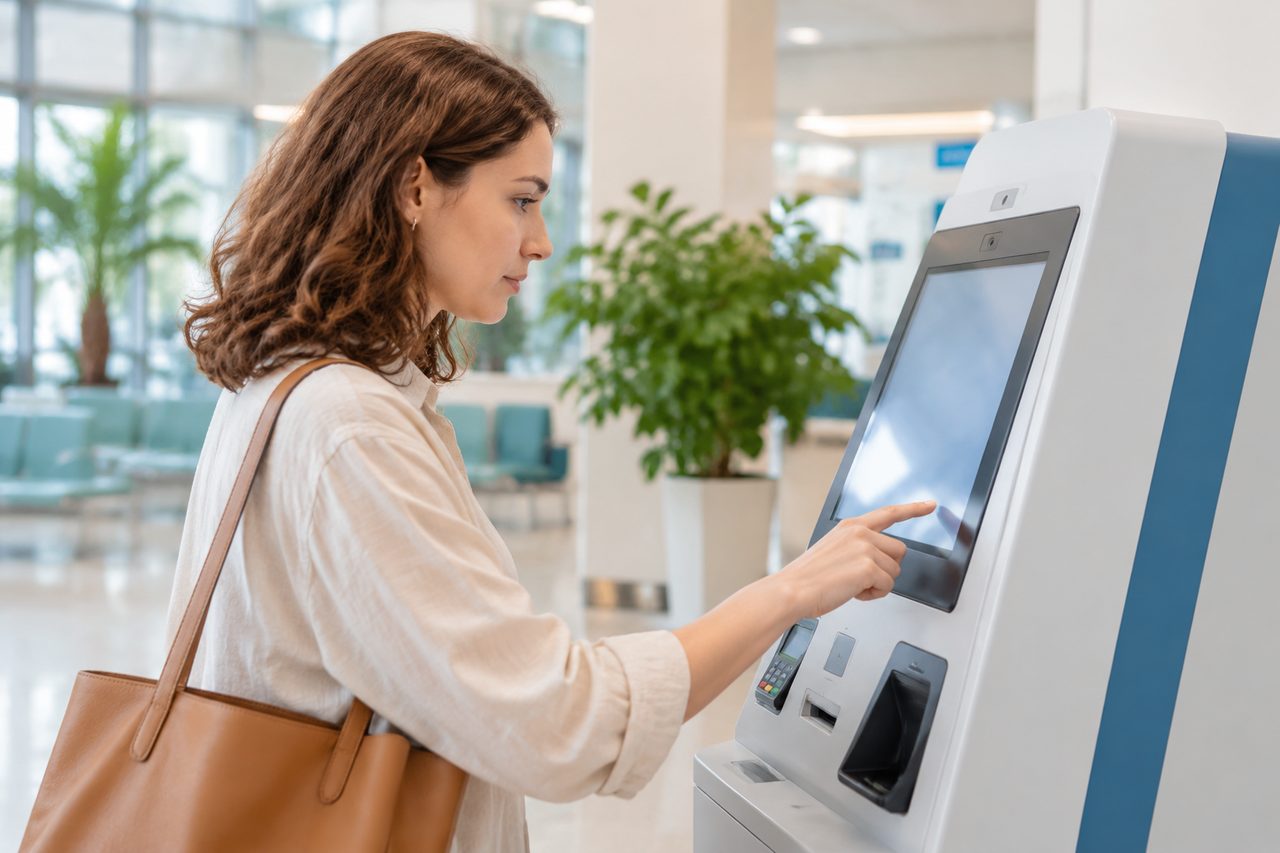
China’s top public hospitals operate at a scale that has no Western equivalent. A single major tertiary hospital can see more than 10,000 outpatient visits in a day. To move that volume, hospitals automated the front desk years ago: instead of queuing at a window, patients use self-service terminals — often called self-service registration and payment machines — to create or activate a hospital card, book a same-day slot, pay the consultation fee, and settle investigation charges.
That system works well for a local patient with a Chinese ID card, a domestic bank card, and a mobile payment app. For a foreign patient, the same system can feel like a wall. The interface may default to Chinese. The card reader may not recognize an international card. The identity field may expect an 18-digit resident ID number rather than a passport number. None of this means you cannot pay — it means the kiosk is designed around a different user.
The practical consequence is that payment is the moment where language barriers become financial barriers. A patient who has traveled thousands of miles can find themselves holding a queue ticket, a paper slip, and no clear idea which window or machine takes their money.
Why China’s Kiosk System Exists — and Where It Leaves You
Volume forced automation
Self-service terminals spread because manual counters could not absorb outpatient demand. Registration that once required a queue at 6 a.m. can now be done at a machine or a phone. For hospitals, kiosks reduce crowding and staff load. For patients, they shorten waits — if you can use them.
The hospital card is the key
Almost everything routes through a hospital card (就诊卡) or a virtual card tied to your passport in the hospital’s system. Creating that card is often the first kiosk task, and it usually requires an identity document. Passport support varies by hospital and by machine generation; newer terminals at international departments are more likely to handle foreign passports.
Payment is staged, not one bill
Chinese public hospitals typically collect fees in stages rather than presenting one invoice at the end. You pay the registration and consultation fee to see the doctor. The doctor orders tests; you pay for those before they are performed. If surgery or admission follows, the hospital asks for a pre-payment (预交金) against the expected cost, with settlement afterward. Private international hospitals more often bill in a Western style, sometimes settling directly with insurers.
What the Kiosks Actually Accept
This is the question foreign patients ask most, and the answer is genuinely hospital-specific. Broadly, self-service terminals in Chinese public hospitals are built around domestic payment rails:
- Mobile payment — WeChat Pay and Alipay, which can be linked to an international card in some configurations but not all.
- Domestic bank cards — UnionPay debit and credit cards are the most reliably accepted.
- Cash — often handled at a staffed window rather than the kiosk itself.
- International cards — acceptance is inconsistent. Some international departments and private hospitals accept Visa and Mastercard; many ordinary outpatient kiosks do not.
Because this varies, treat any specific claim about a specific machine as something to verify with the hospital’s international office before you rely on it. The safest planning assumption is that you will need a payment method that works on Chinese rails, plus a fallback.
Do not assume your home debit or credit card will work at an outpatient kiosk. Confirm acceptance in writing with the hospital’s international department, and carry a backup method. Card blocking by your home bank is also common on first use abroad — tell your bank you are traveling.
How to Pay at a Chinese Hospital, Step by Step
Here is the sequence a foreign outpatient typically moves through at a large public hospital. Exact steps differ by hospital, but the shape is consistent.
Step 1: Create or activate your hospital card
At the international department or a staffed registration window, present your passport. Staff create the card or link your passport to a hospital record. Ask them to confirm which kiosks can read your document.
Step 2: Register for the department
Registration assigns you a queue number for a specific department. At some hospitals this is done at a kiosk; at others, the international office handles it. Same-day registration is common; advance booking of an ordinary outpatient slot from overseas is generally not possible, which is why many international patients route through the international or VIP channel.
Step 3: Pay the consultation fee
This is usually a small amount, paid before you see the doctor. Pay at the kiosk if it accepts your method, otherwise at the cashier window.
Step 4: Pay for investigations
After the consultation, tests and imaging are ordered. Payment typically precedes the test. This is where a top-up to your hospital card balance is common: you load funds, the test fee is deducted, and any remainder stays on the card for later use.
Step 5: Pre-payment before admission or surgery
If admission or surgery is planned, the hospital asks for a pre-payment against estimated costs. This is a deposit, not a final bill. Settlement happens at discharge, with refund of any excess. Amounts vary widely by procedure and hospital.
Step 6: Settle and collect records
At discharge you settle the account and collect itemized invoices and discharge documents. Keep every receipt: they are what your insurer or home reimbursement scheme will ask for.
Reading the Kiosk Screen: What Each Option Usually Means
Even where an English interface exists, the labels are terse. The table below maps the functions you are most likely to encounter. Wording differs between hospital systems, so use this as orientation, not as a translation guarantee.
| On-screen function | What it does | What you need |
|---|---|---|
| Registration / appointment | Assigns a queue number for a department | Hospital card or passport; department selection |
| Top-up / recharge | Loads money onto the hospital card balance | Accepted card or mobile payment |
| Fee payment | Pays pending consultation, test, or pharmacy charges | Card balance or direct payment |
| Report collection | Prints lab or imaging reports | Hospital card or receipt barcode |
| Pre-payment / deposit | Records an admission deposit | Staff assistance is usually required |
| Refund / balance | Returns unused card balance at discharge | Staffed window, identity document |
Two habits help. First, photograph the screen before you press anything, so a bilingual companion or the international office can confirm what you selected. Second, keep the printed receipt from every transaction — it carries the transaction number staff need to correct an error.
Practical Considerations Before You Rely on a Kiosk
Language. English menus exist at many newer terminals and at international departments, but coverage is uneven. At a hospital seeing thousands of outpatients daily, counter staff may have limited English. If you do not read Chinese, plan for interpretation rather than hoping the machine will guide you.
Payment instruments. Arrange a payment method that works in China before departure. Linking an international card to a Chinese mobile payment app is possible in some cases but not guaranteed, and setup usually requires a local phone number and verification. Confirm what the hospital accepts in writing.
Visa and timing. For medical treatment in China, the applicable short-stay category is the S2 visa, used for medical treatment and private affairs, with accompanying family members applying in the same category; stays beyond 180 days involve S1. Requirements are set by the latest embassy or consulate guidance and depend on supporting hospital documents. The M visa is for commercial and trade activity and is not a medical visa. Build visa processing time into your plan, and do not book a procedure date before your documents are in order.
Insurance and reimbursement. Chinese public hospitals generally require payment at the point of service, with insurance reimbursement claimed afterward. Private international hospitals more often offer direct billing with certain insurers. Check your policy’s requirements for itemized invoices and diagnosis documentation before you travel.
Records. Bring existing reports, imaging, and a medication list in English and, where possible, Chinese. These are what the treating team reviews, and they reduce repeat testing.
If you are still choosing where to be treated, our overview of top-ranked Chinese hospitals by city and the department-level rankings help narrow the field. For patients weighing public versus private settings, the private international hospital guide explains insurance direct billing and English-language staffing. The broader context for planning a trip sits on our China Medical Services homepage.
Ask the international department three questions before you travel: Which payment methods do your kiosks and cashier windows accept for foreign passports? Is an English-language interface available on the terminals I will use? Who assists a foreign patient if a transaction fails? Written answers remove most of the uncertainty.
Frequently Asked Questions
Sometimes, but not reliably at ordinary outpatient kiosks. International departments and private hospitals are more likely to accept Visa and Mastercard, while standard self-service terminals are built around UnionPay and Chinese mobile payment. Confirm acceptance with the hospital directly, and carry a backup method.
Many newer terminals and international-department machines offer an English interface, but coverage varies by hospital and machine generation. Where English is missing, staff assistance or a bilingual companion is the practical route. Assume you may need help rather than counting on the screen.
No. Surgical and admission costs are usually handled as a pre-payment deposit recorded by staff, with final settlement at discharge. Kiosks mostly handle registration, test fees, and card top-ups. Exact deposit amounts vary by hospital and procedure.
Keep the printed receipt and take it to the cashier window or international office the same day. Transaction numbers on the receipt let staff trace and reverse an error. Unused card balances are normally refunded at discharge with your identity document.
Your Next Step
The kiosk is only a tool; the real work is knowing which hospital fits your case, what the payment stages will be, and who can stand beside you when the screen is in Chinese. We are a coordination service, not a hospital — we do not diagnose or treat, and we do not promise access to any specific doctor or date. What we do is help you compare options, prepare records, and arrange practical support on the ground. If you would like a clearer picture of the process for your situation, you can start with a free consultation and we will map the steps with you. Understanding the payment chain in advance turns an intimidating morning at a Chinese hospital into a manageable one.
For more medical information and treatment options in China, visit chinamedservices.com (China Medical Services).
