Request Room Change in Chinese Hospital: Your Guide to Service Adjustment
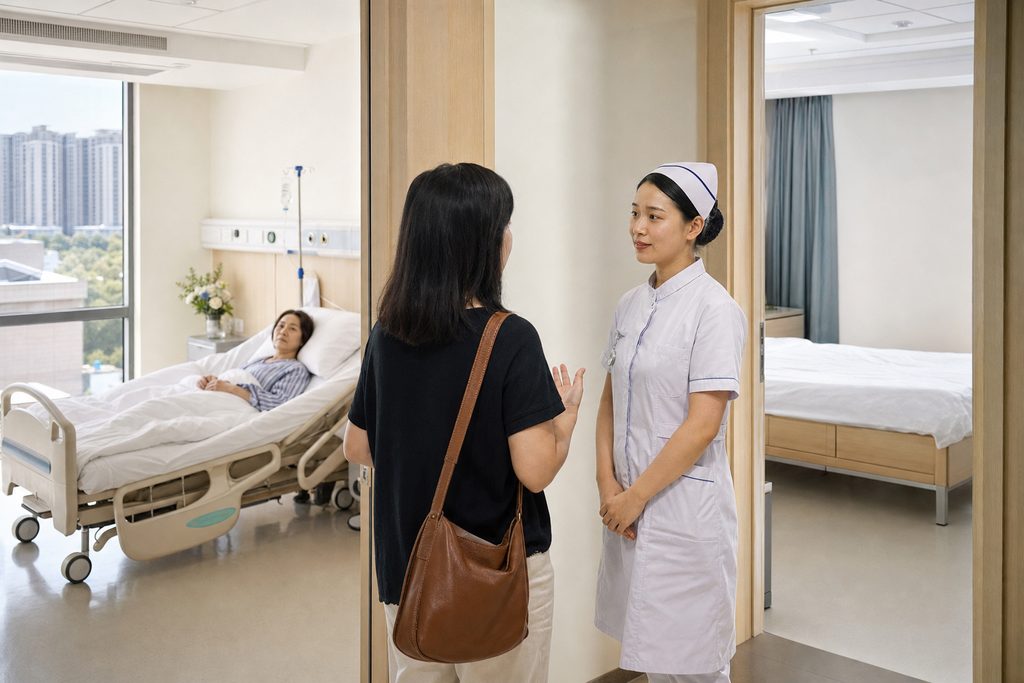
While an overnight hospital stay in the U.S. can easily cost $2,500 just for the bed, a private VIP suite in a top-tier Beijing hospital runs approximately $200–$400 per night. That gap is real. But the path from a standard six-bed ward to that private room isn’t always obvious. The question isn’t whether upgrades exist. It’s how to navigate the request without getting lost in a system that operates on different rules than most Western patients expect.
How to Request Room Change in Chinese Hospital: The Short Answer
You ask the head nurse on your floor. That’s the starting point for any room change in a Chinese public hospital. There is no central patient-relations desk that handles this. No online portal. The head nurse controls the ward’s bed inventory and makes the call. But the real answer is more complicated. Availability drives everything. A private room might be open today and gone tomorrow. The upgrade also has to be approved by your attending physician, who must confirm that your condition doesn’t require the closer monitoring that a multi-bed ward provides.
Who This Is Right For — and Who It Isn’t
Some patients genuinely benefit from a private or semi-private room. Others are better off staying put. Understanding which camp you fall into saves time and frustration.
You are a good candidate for a room upgrade if:
- You are in stable condition post-surgery and no longer need constant nursing-station visibility
- You have a family member acting as your caregiver who needs space to stay overnight
- You require a quiet environment for work calls or sensitive discussions during a longer admission
- Your primary challenge is comfort and privacy, not acute medical monitoring
You should probably stay in your current room if:
- You are within 24 hours of a major procedure and need rapid-response access
- The attending physician has specifically ordered close observation
- You are in a specialized unit like an ICU step-down ward where bed placement is clinical, not elective
- Moving would disrupt a treatment schedule that depends on your current bed’s equipment or location
This isn’t about status. It’s about medical appropriateness. The head nurse will defer to the physician’s judgment every time.
The Options, Compared
| Room Type | Typical Beds | Bathroom | Caregiver Bed | Approximate Cost/Night (Beijing Public Hospital) |
|---|---|---|---|---|
| Standard Multi-Bed Ward | 3–6 | Shared on floor | Not provided | $15–$40 |
| Semi-Private Room | 2 | Shared between 2 patients | Small cot sometimes available | $60–$120 |
| Private Standard Room | 1 | Private en-suite | Basic fold-out bed | $120–$250 |
| VIP Suite (International Dept.) | 1 | Private en-suite | Full companion bed + sitting area | $200–$400 |
| Private Room in Private International Hospital | 1 | Private en-suite, hotel-style | Sofa bed, often separate visitor area | $400–$800+ |
These figures cover the room charge only. They do not include treatment, medication, nursing care, or meals. The private room in Beijing hospital price range varies significantly by institution — a VIP suite at Peking Union Medical College Hospital‘s international department sits at the higher end, while a standard private room at a district-level hospital might cost less than $100 per night. Private international hospitals like United Family operate on a different model entirely, with room charges bundled into comprehensive care packages.
If comfort is your main driver and your budget is flexible, the VIP suite in a public hospital’s international department gives you the best of both worlds: top-tier clinical teams with hotel-like amenities. If you need English-speaking staff from admission to discharge, a private international hospital may be the simpler choice.
The Actual Room Change Procedure in China
The hospital room change procedure China follows is straightforward in theory. In practice, timing and relationships matter.
Step one: Identify the head nurse. On any inpatient floor in a Chinese hospital, one senior nurse manages bed assignments. This person is usually in the nurses’ station during morning rounds. You or your companion should approach between 9:00 AM and 11:00 AM — after the morning shift handover, before lunch breaks begin.
Step two: State your request clearly. Do not frame it as a complaint about your current room. Say you are willing to pay the upgrade fee and would like to be placed on the waiting list for a private or semi-private room. The head nurse will check the day’s discharge schedule. If a room is opening up, you might get moved the same afternoon.
Step three: The physician sign-off. The head nurse will not move you without the attending doctor’s approval. This is a clinical safeguard, not bureaucracy. If your doctor says no, the conversation ends there. You can revisit the request in a day or two as your condition evolves.
Step four: Payment. Once approved, you will be directed to the hospital cashier to pay the room-rate difference. Chinese public hospitals operate on a prepaid deposit system. Your existing deposit may need to be topped up to cover the higher daily room charge for the remainder of your stay.
Here is where a language barrier turns a five-minute task into an hour of confusion. The cashier likely speaks no English. The payment slip will be in Chinese characters. If you are navigating this alone, factor in extra time and bring a translation app. Our bilingual medical companions handle exactly these moments — queuing, translating, confirming the new room number, and making sure your belongings get moved without incident.
Can I Change My Hospital Room in China If I’m a Foreign Patient?
The short answer: yes. The honest answer: it depends on where you are admitted.
If you were admitted through the standard public outpatient channel, you are subject to the same room-change rules as any Chinese patient. The head nurse controls the list. You pay the difference. No special foreigner premium applies. But you also get no special priority. You wait like everyone else.
If you were admitted through a hospital’s international medical department, the dynamic shifts. These departments are designed for foreign and high-end domestic patients. Most rooms are already private or semi-private. The staff speaks English. The question “can I change my hospital room in China” becomes less about whether it’s possible and more about which room category fits your budget. The international department coordinator handles the request directly.
One practical reality: some public hospital towers have international wards on specific floors only. If your treating specialist is based in the general ward building, moving to a VIP room might mean being on a different floor from your primary care team. That’s a trade-off worth discussing with your doctor before pushing for the change.
What a VIP Room Chinese Hospital Request Actually Costs
The Chinese hospital room upgrade cost is not a fixed menu price. It is a daily surcharge on top of your treatment fees. The variance comes from three factors: city, hospital tier, and room category.
In a city like Shanghai or Beijing, expect the higher end of every range. A VIP room Chinese hospital request at Zhongshan Hospital or Huashan Hospital will land between $250 and $400 per night. The same request in a provincial capital like Changsha or Kunming might cost $150 to $250. These prices reflect real estate and operational costs in China’s tier-one cities versus the rest of the country.
What is included: the room itself, a private bathroom, a companion bed, sometimes a small refrigerator and television. What is not included: any medical treatment, surgical fees, medications, diagnostic imaging, or specialist consultations. Those are billed separately on your discharge statement.
For patients considering treatment at one of China’s 340+ top-ranked hospitals, the room upgrade is often a fraction of the total admission cost. A cardiac procedure that runs $18,000 might carry a $2,000 room charge for a week-long stay in a VIP suite. The upgrade is the smaller line item by far.
Practical Considerations: Documentation, Payment, and Language
The room change itself requires no special paperwork beyond the payment slip. But the broader hospital admission does, and a room upgrade often triggers a deposit recalculation. Bring your passport, your admission paperwork, and a payment method that works in China.
Chinese hospitals accept UnionPay, WeChat Pay, and Alipay. International credit cards work at international departments and private hospitals but rarely at standard public hospital cashiers. Cash in RMB is always accepted. Plan to carry enough to cover the room upgrade deposit, or arrange for someone to handle the electronic payment on your behalf.
Insurance adds another layer. If you are paying out of pocket and claiming reimbursement later, keep every receipt. The room upgrade charge will appear as a separate line item. Some international insurers classify private-room upgrades as a non-covered comfort expense. Check your policy before you request the move.
Language is the silent cost in every step of this process. The head nurse likely does not speak English. The cashier definitely does not. The upgrade form is in Chinese. A bilingual companion turns what could be a full-day ordeal into a 30-minute task. That is not a sales pitch — it is the reality of navigating a system built for 1.4 billion Chinese speakers. Our team handles the hospital room change procedure China requires while you focus on recovery.
Frequently Asked Questions
Anywhere from same-day to never. If a private room opens up on your floor and your doctor approves, you can be moved within hours. If the ward is full, you stay on a waiting list. Some patients are discharged before a room opens. There is no guaranteed timeline. The head nurse manages the queue based on medical need first, then request order.
The clinical team does not change based on your room category. Your attending physician and surgeons remain the same whether you are in a six-bed ward or a private suite. What changes is the nursing ratio and the environment. VIP floors often have more nurses per patient and more comfortable facilities. But the doctors making the clinical decisions are the same people.
That refusal is based on medical judgment. Your doctor believes you need the monitoring level of your current placement. You can ask for the specific clinical reason and when a reassessment might be appropriate. You cannot override the decision. If comfort is critical and your condition is stable, discuss whether transferring to an international department within the same hospital is an option — sometimes that satisfies both the clinical and comfort requirements.
No. Smaller city-level hospitals and older public hospital buildings may have no private rooms at all. The ward might be entirely multi-bed. Top-tier hospitals in major cities almost always have private and VIP options, especially within their international departments. If a private room is non-negotiable for you, confirm availability before admission. Our hospital matching process includes room-type verification as a standard step.
Your Next Step
Requesting a room change in a Chinese hospital is entirely possible. It requires the right timing, the right person, and the right approach. The system works once you understand who holds the keys — the head nurse, with the attending physician’s sign-off. We help international patients navigate these exact situations every day. Our team is not a hospital. We do not diagnose or treat. We handle the logistics: identifying the right facility from our network of 340+ top-ranked hospitals across 37 cities, coordinating admission through international departments, and providing bilingual support on the ground so that language never stands between you and a comfortable recovery. If you are planning treatment in China and want to understand your room options before you arrive, reach out for a free consultation. No pressure. Just practical answers.
For more medical information and treatment options in China, visit chinamedservices.com (China Medical Services).
