Hospital to Hotel Transfer After Treatment: A Practical Guide for Medical Travelers in China
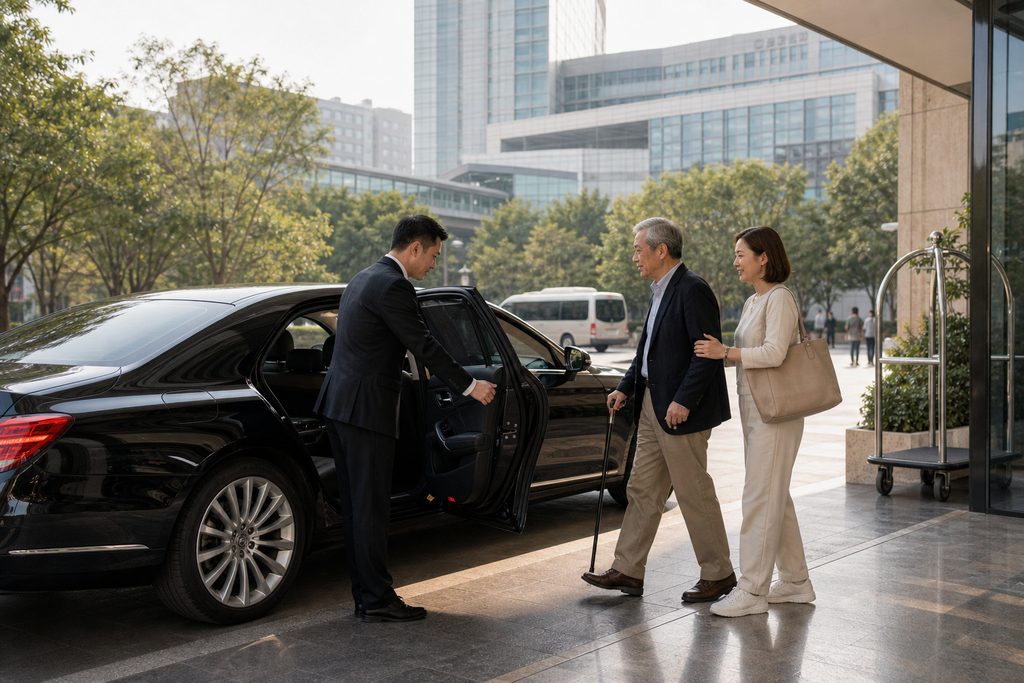
While patients in Canada wait a median 27.4 weeks between specialist consultation and orthopedic surgery, surgeons at Beijing Jishuitan Hospital perform over 300 joint replacements monthly — with clinical outcomes that match or exceed Western benchmarks. The math is stark. But flying across the world for surgery raises a question most patients don’t think about until discharge day: what happens between the hospital bed and the hotel room?
Hospital to Hotel Transfer After Surgery China: The Short Answer
Most international patients transfer from hospital to hotel within 1 to 3 days after a standard procedure, though complex surgeries can extend the stay to 5–7 days. The transfer itself takes 30–90 minutes depending on traffic and distance. The real question is not when you leave — it’s whether your recovery setup at the hotel is safe enough for the specific surgery you had.
Discharge timing is a clinical decision, not a logistical one. Chinese surgeons generally keep patients under observation longer than their American counterparts, which works in your favor. But once the surgeon signs off, you become responsible for wound care, mobility, pain management, and recognizing complications. A comfortable hotel room does not replace a nurse call button.
Who This Is Right For — and Who It Isn’t
Recovering in a hotel after surgery in China works well for a specific profile of patient. It does not work for everyone.
Good candidates for hotel recovery:
- Patients undergoing elective procedures with predictable recovery curves — orthopedic joint replacement, hernia repair, cosmetic surgery, minor cardiac interventions
- Patients traveling with a companion who can assist with daily tasks, medication schedules, and communication
- Patients who have already completed the acute post-operative observation period without complications
- Patients staying within 15–20 minutes of the hospital, ideally in a hotel with 24-hour front desk and elevator access
Who should not plan an early hotel transfer:
- Patients undergoing major open surgeries — cardiac bypass, complex spinal fusion, organ-related procedures — where post-operative monitoring is critical for 5–7 days
- Patients with uncontrolled diabetes, hypertension, or a history of poor wound healing
- Patients traveling alone for procedures that limit mobility or require assistance with toileting and bathing
- Patients on anticoagulation therapy who need frequent INR checks
Being honest about which group you fall into saves money, stress, and potentially your life. The hospital will not discharge you if you are unstable — but “stable enough to leave” and “stable enough to recover in a hotel” are different thresholds.
The Options, Compared
Medical travelers in China face three realistic post-discharge scenarios. Each has different cost structures, supervision levels, and risk profiles.
| Option | Typical Cost (USD) | Supervision Level | Best For |
|---|---|---|---|
| Extended hospital stay (private/international ward) | $150–$400 per day | Full nursing care, daily physician rounds | Major surgery, solo travelers, patients with complications |
| Recovery hotel near hospital (standard 4-star) | $60–$120 per night | None — self-managed or companion-assisted | Stable patients with a companion, minor to moderate procedures |
| Serviced apartment / medical recovery suite | $80–$180 per night | Limited — some offer nursing visits at extra cost | Longer recoveries (2–4 weeks), patients wanting kitchen access and more space |
Extended hospital stays cost more but mean zero transfer risk. A medical tourism recovery hotel Shanghai or Beijing puts you closer to the hospital but shifts all care responsibilities onto you and your companion. Serviced apartments split the difference — more comfort, less supervision. Most patients choose the middle option: a hotel within a 10-minute drive of the hospital, with the surgeon’s WeChat contact saved and a clear escalation plan.
How Soon Can I Leave Hospital After Surgery Abroad? Reading Your Discharge Signal
Chinese hospitals use objective discharge criteria, not insurance-driven timelines. You will typically be cleared to leave when:
- Vital signs have been stable for 24+ hours
- You can walk (or transfer) independently or with expected assistance
- Pain is controlled with oral medication
- Wound drainage is minimal and you understand dressing changes
- You have passed gas or had a bowel movement (for abdominal surgery)
- Your surgeon or attending physician has done a final assessment
Expect 2–3 days for laparoscopic procedures, 3–5 days for joint replacement, and 5–7 days for open abdominal or cardiac surgery. These are general ranges — your surgeon’s word is final. And “how soon can I leave hospital after surgery abroad” is the wrong question if it’s driven by hotel costs. Staying one extra night in a monitored bed costs less than an emergency readmission from a hotel room at 2 a.m.
What a Hospital to Hotel Transfer Actually Costs
Transfer logistics in China are inexpensive by Western standards. A private medical transfer — ambulance or wheelchair-accessible van with a medical escort — runs $80–$150 for distances under 10 km. A standard private car with a driver costs $30–$60 for the same trip. Some hotels near major hospitals offer complimentary shuttle services, though availability is inconsistent.
If you book a hospital to hotel transfer medical tourism China package through a coordination service, expect bundled pricing from $200–$350. That typically includes the vehicle, a bilingual escort, hotel check-in assistance, and sometimes a follow-up call the next morning. Airport transfers run $200 round-trip, a useful benchmark for understanding the market.
Best Recovery Hotels Near Hospitals in China: What to Look For
The best recovery hotels near hospitals in China share specific features. Proximity matters most — traffic in Beijing, Shanghai, and Guangzhou can turn a 5-km trip into a 40-minute crawl. Target hotels within 3 km of your hospital, ideally on the same side of major intersections.
Beyond location, prioritize:
- Elevator reliability — you cannot climb stairs on crutches
- Walk-in shower — bathtubs are fall hazards after hip or knee surgery
- 24-hour front desk — complications don’t respect business hours
- On-site restaurant or reliable food delivery — you will not cook for the first week
- Quiet floors — Chinese hotels can be loud; request a high floor away from elevators and banquet halls
A post surgery hotel package Beijing price typically ranges $60–$120 per night for a 4-star property. Shanghai runs slightly higher, $70–$140. Guangzhou and Chengdu are 10–20% cheaper. Some hotels near international hospital clusters — like those around Beijing’s Lufthansa Center or Shanghai’s Hongqiao medical zone — offer discounted weekly rates for medical travelers. Ask. The worst they can say is no.
Practical Considerations: Documentation, Payment, and the Ride Itself
Before discharge day, assemble a folder. It should contain your discharge summary (in Chinese and English if possible), medication list with dosages, wound care instructions, the surgeon’s contact information, and your passport. Chinese hospitals provide discharge summaries in Chinese — request an English translation before leaving. Some international departments provide this automatically; public hospital standard wards usually do not.
Payment: public hospitals require a deposit at admission and settle the balance at discharge. International departments and private hospitals like United Family or Jiahui accept major credit cards and often bill international insurers directly. Standard public hospital wards are cash or Chinese mobile payment only — WeChat Pay and Alipay. Set these up before you travel, or have your companion handle settlement.
Visa: you entered on an S2 visa for medical treatment. Discharge to a hotel does not change your visa status, but your total stay must remain within the visa’s validity window. Extensions require a trip to the local Exit-Entry Administration bureau — your coordination service can arrange this if recovery takes longer than planned.
The ride itself: sit in the front passenger seat if you had leg surgery, or recline the back seat. Bring a pillow for the seatbelt line if you had abdominal surgery. Every bump hurts more than you expect. The driver will not know this. Tell your companion to remind them.
Frequently Asked Questions
No. Most surgeons require a minimum 5–10 day observation period after discharge before clearing you for long-haul flights. The risk is deep vein thrombosis and wound complications at altitude. Your surgeon will give you a specific clearance date. Do not book a non-refundable flight before you have it.
Call your surgeon. Chinese specialists routinely give patients their WeChat contact and expect post-discharge questions. If the situation is urgent — uncontrolled bleeding, fever above 38.5°C, sudden shortness of breath — go back to the hospital’s emergency department immediately. Do not wait for a reply. Emergency care in China does not require an appointment, and you will be seen quickly. Bring your discharge summary and passport.
Standard hotels are not. Some serviced apartments near international hospital clusters offer nursing visits at extra cost, typically $50–$100 per visit. But these are not medical facilities. If you need daily wound care, IV antibiotics, or monitoring, you should stay in the hospital or arrange a private nurse through your coordination service. A hotel room with a minibar does not substitute for a clinical environment.
Plan $1,000–$1,700 for 14 nights at a 4-star hotel near a major hospital, plus $300–$500 for food delivery, taxis, and incidentals. Add $200–$350 for the transfer itself. If you want a serviced apartment with a kitchenette and laundry, budget $1,300–$2,500. These figures fluctuate by season — October and April are peak conference months in Shanghai and prices rise 20–30%.
Your Next Step
Recovering in a hotel after surgery in China is a manageable, often pleasant experience — if you plan for it before you travel. The patients who struggle are the ones who booked a cheap hotel 45 minutes from the hospital, assumed they could take taxis, and never asked about walk-in showers.
Our team at China Medical Services coordinates hospital-to-hotel transfers, bilingual companions, and recovery logistics for international patients across 37 cities. We are not a hospital and we do not provide medical advice. We handle the in-between parts — the transfer, the check-in, the follow-up appointment scheduling — so you can focus on healing. If you are planning surgery in China, request a free consultation to map out your discharge and recovery plan before you commit to anything.
For more medical information and treatment options in China, visit chinamedservices.com (China Medical Services).
