Implant Failure in China: What to Do When a Dental Implant Fails
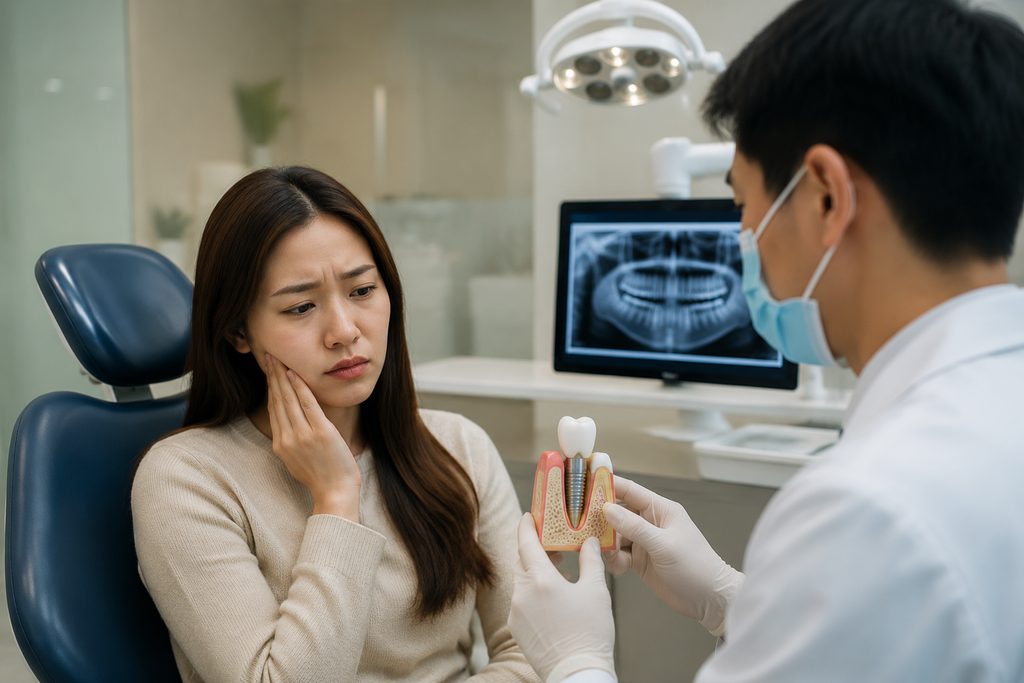
When 47-year-old Michael from Portland had a dental implant placed in Tijuana, the price was impossible to argue with. Eighteen months later, the implant was loose, the gum around it was swollen, and his dentist at home told him the bone had started to recede. His first question wasn’t about money. It was simpler and scarier: what now? If you are searching for dental implant failure treatment cost China, you are probably in a similar spot — an implant that never integrated, one that worked for years and then failed, or a quote from a local surgeon that made you put off treatment entirely. This guide walks through the real options, the honest price ranges, and the practical steps for getting implant revision care in China without wasting a second trip.
Dental Implant Failure Treatment Cost China: The Short Answer
Revision treatment in China’s top-ranked hospitals typically runs $1,500 to $6,000 depending on what failed and how much reconstruction is needed — roughly one-fifth to one-third of comparable U.S. pricing. A straightforward removal and re-implantation might sit near the low end. A case involving bone grafting, sinus lift, or replacement of multiple implants pushes toward the top. These are ranges, not quotes. Final pricing varies by hospital and case complexity, and only an in-person examination can confirm which category you fall into.
The complication is that “implant failure” is not one diagnosis. It’s at least four, and they don’t cost the same or heal the same way.
Who This Is Right For — and Who It Isn’t
Dental implant revision in China is a reasonable path for a specific kind of patient. It is a poor fit for others, and saying so upfront saves everyone time.
Typically a good candidate:
- You have an implant that is mobile, painful, or showing peri-implantitis on X-ray, and your local quote exceeds what you can reasonably pay
- Your case has been assessed and you have imaging — panoramic X-ray, CBCT scan, and any prior treatment records
- You can travel for 7-14 days for the surgical phase and return home for follow-up with a local dentist
- You are medically stable: controlled diabetes, non-smoker or willing to stop, no active infection elsewhere
- You need one to four implants addressed, not full-mouth reconstruction spanning multiple visits over a year
Who should think twice:
- Uncontrolled diabetes, active smoking, or immunosuppressive conditions that impair osseointegration — these raise failure risk for the revision too, and no hospital can change that
- Bisphosphonate use or a history of osteoradionecrosis after head and neck radiation
- Cases requiring long-term staged reconstruction where you’d need to fly back three or four times — the travel cost can erase the savings
- Anyone hoping to skip diagnostics and go straight to surgery. Reputable hospitals will refuse this, and you should be suspicious of anyone who doesn’t
The Options, Compared
Four realistic paths exist once an implant fails. The differences are not just financial.
| Option | Typical Cost (USD) | Time in Country | Best Suited To |
|---|---|---|---|
| Local removal, no replacement | $300 – $900 | None | Patients who want the source of infection gone and will decide on replacement later |
| Local revision with grafting | $3,500 – $8,000 | None | Simple single-implant cases with adequate local surgical capacity |
| China top-tier public hospital | $1,500 – $6,000 | 7 – 14 days | Complex cases, grafting needed, cost-sensitive patients |
| China private international clinic | $4,000 – $12,000 | 5 – 10 days | English-first care, direct insurance billing, tighter scheduling |
If your case is a single failing implant with healthy surrounding bone, the local revision column is genuinely competitive — and staying home is the sensible answer. The calculus shifts once grafting, multiple implants, or a failed full arch enters the picture. That’s where China’s volume advantage in oral and maxillofacial surgery starts to matter, because high-volume departments see complications constantly and have protocols for them.
Reading Your Failure Correctly Before You Book Anything
Not all implant failures are equal, and the treatment differs sharply. Knowing which one you have determines whether you need a two-week trip or a six-month plan.
Early failure happens within the first few months. The implant never fused to bone. Common causes are insufficient primary stability, overheating of bone during drilling, infection at placement, or premature loading. These are often salvageable with removal, curettage, and re-implantation after a healing window of 8-16 weeks.
Late failure shows up a year or more later, usually as peri-implantitis — bacterial inflammation that eats away supporting bone. This is the most common pattern and the one most affected by smoking and oral hygiene. Treatment ranges from nonsurgical debridement to flap surgery with grafting, and sometimes explantation.
Mechanical failure is different again. The implant itself is fine; the crown, abutment, or screw has fractured. This is often the cheapest and fastest fix — sometimes a same-week repair.
Positional or esthetic failure means the implant is stable but angled poorly or placed too shallow. Revision here is about prosthetics and soft tissue, not infection control.
What It Costs, and What Drives the Variance
Two patients with “a failed implant” can receive quotes that differ by a factor of four. Here’s what actually moves the number.
Bone grafting. This is the single biggest variable. A small localized graft runs roughly $400-$900. A large block graft or sinus lift can add $1,500-$3,000. If your previous implant site has significant bone loss, budget for this.
Number of implants involved. One implant revised is straightforward. A failed full-arch restoration — All-on-4 or similar — is a different procedure entirely and prices accordingly.
Implant system compatibility. If your original implant is a well-known brand with available components, the revision is easier. If it’s an unbranded or discontinued system, the surgeon may need to remove it entirely rather than reuse the connection. This matters more than most patients realize.
Hospital tier. Public tertiary hospitals in China carry lower procedure fees than private international clinics. The trade-off is scheduling, language support, and waiting areas that hold several hundred people on a busy morning.
What’s typically included: consultation, imaging done at the hospital, the surgical procedure, and standard follow-up during your stay. What’s usually not included: your flights, accommodation, medication after discharge, and any follow-up performed after you return home. Budget $800-$1,500 for a 10-day stay in a mid-range hotel near a major hospital district.
Practical Considerations: Records, Visas, and Payment
The logistics trip up more patients than the surgery does. Get these right and the clinical side is comparatively simple.
Records. Gather everything: the original implant invoice with brand and lot number if you have it, all X-rays and CBCT files in DICOM format, any treatment notes, and a list of your current medications. Send digital copies ahead. Hospitals that review your file before you fly can tell you whether your case is treatable in one trip or needs staging.
Visa. Foreign patients traveling to China for medical treatment generally use the S2 visa, which covers short-stay private affairs including medical treatment, and requires supporting documentation from the receiving hospital. Accompanying family members apply under the same category. Requirements change, so confirm current rules with the nearest Chinese embassy or consulate before applying. Note that the M visa is for commercial and trade activities and is not the correct category for medical travel.
Payment. Chinese public hospitals typically require prepayment, with insurance reimbursement handled afterward in your home country. Private international hospitals more often bill insurers directly. International credit cards are accepted at major hospitals, but confirm before arrival — and check your card’s foreign transaction limits.
Language. This is the practical wall. A top-tier Chinese dental hospital may see well over a thousand outpatient visits in a day. Signage, registration systems, and queue management operate in Chinese. Interpreters exist, but arranging one independently on short notice is difficult. This is precisely the gap bilingual medical companion services fill.
Follow-up after you fly home. Plan this before you leave. Your Chinese surgeon should provide a written operative report, imaging, and a follow-up schedule your local dentist can execute. Most revision cases need a healing check at 2-4 weeks and a loading assessment at 3-6 months. Confirm in advance that a dentist near you will take on post-surgical monitoring.
Frequently Asked Questions
At accredited tertiary hospitals and JCI-certified international clinics, yes — implant revision follows the same evidence-based protocols used in Europe and North America. The variable that matters most is not the country but the specific department’s volume and your own risk factors. A high-volume oral and maxillofacial department in a major Chinese teaching hospital will have seen far more failed implants than a typical suburban practice. Ask directly how many revision cases the department handles per month.
You cannot typically book surgery directly from overseas at a Chinese public hospital. The standard pathway is: submit your records for remote review, complete a video or written consultation with the specialty team, receive a treatment plan and cost estimate, then travel for an in-person examination that confirms the plan before surgery is scheduled. Private international clinics are more flexible and can sometimes compress this into a shorter timeline.
It happens, and honest surgeons will tell you the risk is higher on a revision than on a first implant — often in the range of 5-15% depending on site, bone quality, and smoking status. If a second failure occurs, the usual next step is either a different implant system, a grafting procedure with a longer healing window, or a prosthetic alternative such as a bridge. No surgeon can guarantee success, and any clinic that does should be treated with caution.
Yes, and it’s the sensible first move. A written second opinion based on your existing imaging typically costs $300-$500 at a top-tier hospital, with video consultations ranging from $100 to $800 depending on the specialist’s seniority. If you later proceed with treatment coordination in China, those consultation fees are credited in full toward the on-the-ground service — a one-time credit that applies to the coordination fee, not to hospital treatment charges.
Your Next Step
The core message is this: a failed implant is a solvable problem, but the solution depends entirely on which type of failure you have — and that can only be determined from imaging, not from a description over email. Our organization is not a hospital and we do not diagnose or treat anyone. What we do is connect international patients with appropriate departments across China’s top-ranked hospitals, arrange record translation and specialist review, and provide bilingual support on the ground once you arrive. If you’d like a straight assessment of whether your case is worth traveling for, start with a records review through our patient consultation page — no commitment, and you’ll know within days whether China is the right answer for you or whether staying home is.
This article is for general information only and does not constitute medical advice. Treatment decisions should be made with a qualified dental or medical professional who has examined you and reviewed your imaging.
For more medical information and treatment options in China, visit chinamedservices.com (China Medical Services).
