InBody Scan in China: What It Shows, Costs, and Where to Book
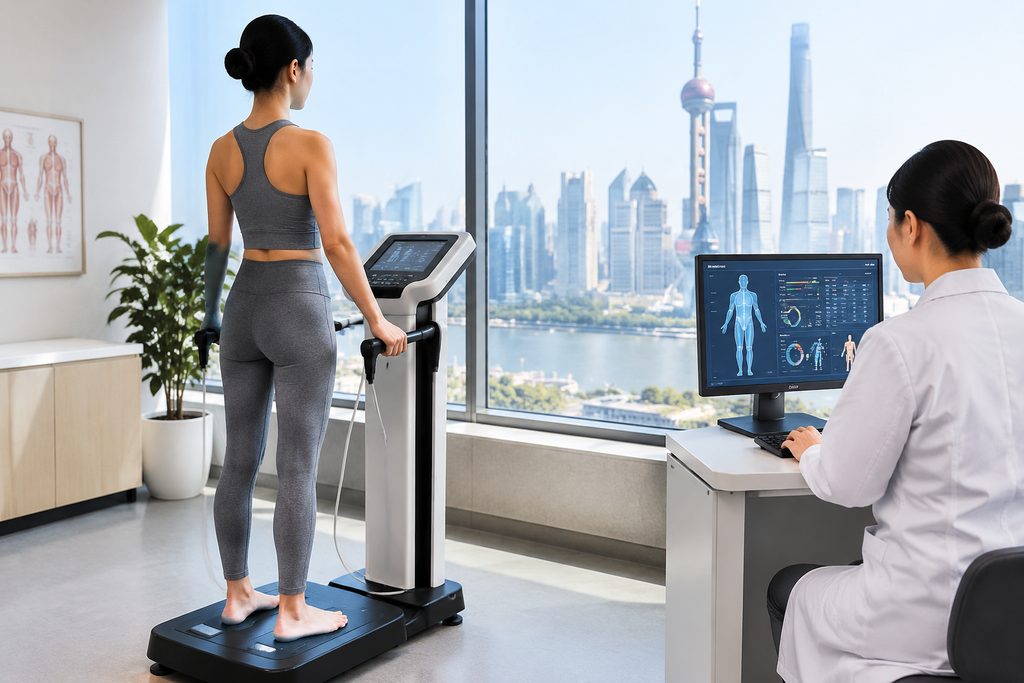
When 44-year-old Daniel from Melbourne moved to Shanghai for a two-year work assignment, he did what a lot of health-conscious expats do: he joined a gym, hired a trainer, and started tracking his progress. Six weeks in, the scale hadn’t moved. His trainer pointed at a machine in the corner of the locker room — a tall white device with handles and foot electrodes — and said, “Stop weighing yourself. Get on the InBody.” Daniel had never heard of it. He assumed it was a fancy scale. It isn’t. It’s a medical-grade body composition analyzer, and in China it’s available at a fraction of what he’d pay back home.
That gap between assumption and reality is exactly why people search for the InBody scan cost in China and what the results actually mean. So let’s answer it directly.
InBody Scan in China: The Short Answer
An InBody scan in China typically costs between $15 and $60 (roughly 100–450 RMB) depending on the hospital tier, city, and whether it’s bundled into a broader health checkup package. At private international clinics in Shanghai or Beijing, expect the higher end — $40 to $60. At public tertiary hospitals, it can be as low as $15–$25.
What it shows: your body composition broken into four compartments — body fat mass, skeletal muscle mass, body water, and a segmental breakdown by limb. Not just a single body-fat percentage. The report also gives visceral fat area, basal metabolic rate, and an intracellular-to-extracellular water ratio that flags inflammation or edema risk.
Here’s the caveat that makes this more complicated than a one-line answer. The InBody uses bioelectrical impedance analysis (BIA), not X-ray. It sends a weak, painless current through your body and measures resistance. That means hydration status, recent exercise, and even room temperature can shift your numbers by a few percent. It’s excellent for tracking trends. It’s less reliable as a one-time absolute measurement.
Who This Is Right For — and Who It Isn’t
The scan is genuinely useful for a specific set of people. And genuinely misleading for others.
Good candidates:
- Anyone tracking muscle gain or fat loss over weeks and months — the trend line matters more than any single reading
- People whose BMI says “overweight” but who carry significant muscle mass (BMI can’t tell the difference)
- Patients preparing for bariatric surgery, metabolic treatment, or a structured weight-management program at a Chinese hospital
- Older adults screening for sarcopenia — the muscle-mass-by-limb breakdown is genuinely informative here
- Expats and medical travelers who want a baseline before starting a fitness or nutrition plan
Who should skip it or look elsewhere:
- Anyone with a pacemaker or implanted electronic device — the current, however weak, makes this a hard no
- Pregnant women, for the same electrical-safety reason
- People with significant limb amputation, who need a different measurement approach entirely
- Anyone wanting a single definitive body-fat number for a medical decision — DEXA or a clinical assessment is the better tool
- Patients who simply want a diagnosis. The InBody is a measurement device, not a diagnostic one. It won’t tell you why your numbers look the way they do.
The Options, Compared
Body composition testing isn’t one product. It’s a category, and the methods differ in accuracy, cost, radiation exposure, and availability across China. Here’s how the main options stack up.
| Method | Typical Cost in China | Accuracy for Body Fat | Radiation | Best For |
|---|---|---|---|---|
| InBody (BIA) | $15–$60 | ±3–5% vs. reference | None | Trend tracking, muscle distribution, routine screening |
| DEXA scan | $50–$150 | ±1–2% (clinical standard) | Very low | Precise fat/muscle/bone breakdown, research, medical decisions |
| Air displacement (Bod Pod) | $40–$100 | ±2–3% | None | Accurate fat measurement; limited availability in China |
| Skinfold calipers | $5–$20 | ±5–8% | None | Quick field estimates; highly operator-dependent |
| Underwater weighing | Rare in China | ±2–3% | None | Research settings; impractical for most patients |
Which column suits you? If you’re a healthy adult tracking a fitness plan, the InBody’s cost-to-convenience ratio is hard to beat — it’s fast, radiation-free, and available in nearly every major Chinese city. If you need a number you can act on medically — say, before a metabolic surgery consult — pay the extra $50 for DEXA. And if a doctor has asked for a precise body composition assessment as part of a treatment plan, DEXA is usually what they mean.
Is InBody Scan Accurate for Body Fat? What the Evidence Says
This is the question that trips people up, so let’s be precise.
InBody devices are among the better-performing BIA machines because they use multi-frequency currents and segmental measurement — separate readings for each arm, leg, and your trunk. That’s a real technical advantage over simple foot-to-foot scales, which estimate your whole body from a single lower-body circuit. Studies comparing multi-frequency BIA to DEXA generally find correlation coefficients around 0.90–0.95 for fat mass in healthy adults. That’s strong agreement.
Strong agreement, though, is not the same as identical numbers. In practice, InBody tends to slightly underestimate body fat in very lean individuals and can over- or under-estimate in people with obesity, where the assumptions built into the algorithm travel less well. The manufacturer’s own validation studies acknowledge this range.
So the honest answer to “is InBody scan accurate for body fat” is: accurate enough to track change over time, not accurate enough to serve as a standalone clinical reference. If your body fat reads 22% on an InBody and 24% on a DEXA, neither is “wrong.” They’re measuring with different physics.
How to Book an InBody Scan in Shanghai, Beijing, and Beyond
Availability in China is genuinely broad — wider than most Western patients expect. Here’s how to think about where to go.
Public tertiary hospitals. Most Grade 3A hospitals with a health management center (体检中心) include an InBody segment in their standard checkup packages. You’ll typically pay for the whole package, not the scan alone. Prices for a basic package run $100–$300. If you only want the scan, some hospitals will accommodate a standalone request, but it’s not the default. Walk-in is often possible; advance booking is safer.
Private international hospitals and clinics. This is the practical route for most foreign visitors. English-speaking staff, direct insurance billing in some cases, and a scan you can book as a standalone service. Expect $40–$60. Chains like United Family, Jiahui, and Parkway operate across multiple cities — you can browse options through our private international hospital directory.
Gyms and fitness studios. Many premium gyms in Shanghai, Beijing, Shenzhen, and Chengdu have an InBody machine on-site and offer scans to members for free or $5–$15. Convenient, but the operator may not be clinically trained, and nobody will interpret the results for you.
For a broader look at what’s available city by city, our ranking of China’s top-ranked hospitals breaks down the leading facilities across 37 cities.
If you want the scan as part of a proper health assessment — with a physician reviewing the output rather than a trainer — that’s where coordination matters. Public hospital health checkup centers rarely take overseas bookings directly, and the appointment process assumes Chinese-language navigation. This is one of the situations where a bilingual medical companion earns their keep.
InBody Scan vs DEXA Scan: Which Should You Choose?
The InBody scan vs DEXA scan comparison comes down to what you’re doing with the result.
DEXA (dual-energy X-ray absorptiometry) is the clinical reference standard. It separates fat, lean tissue, and bone mineral content with roughly ±1–2% precision, and it’s the method used in most published research. It also gives you regional bone density, which matters if you’re screening for osteoporosis. The trade-offs: slightly higher cost, a small radiation dose (comparable to a few hours of background exposure), and less availability outside major Chinese cities.
The InBody wins on convenience, cost, and repeatability. No radiation means you can scan monthly without a second thought. It’s portable, fast — under two minutes — and the output is genuinely easy to read.
For most readers searching this topic, the answer is: start with InBody for tracking, and get a DEXA if a physician needs a precise baseline or if you’re monitoring bone health alongside body composition. Many Chinese hospitals offer both, sometimes on the same visit.
What It Costs, and What Drives the Variance
Body composition test price in Beijing and Shanghai clusters in a predictable band, but the range across the country is real.
- Standalone scan at a public hospital: $15–$30
- Scan bundled into a health checkup package: $100–$300 total, scan included
- Private international clinic, standalone: $40–$60
- Gym or fitness studio: free to $15
- DEXA at a major hospital: $50–$150
What moves the number? City tier matters — Beijing, Shanghai, and Shenzhen run higher than Chengdu or Xi’an. Hospital tier matters more. And bundling changes the economics entirely: a package that includes bloodwork, ECG, ultrasound, and an InBody scan often costs less than booking each item separately.
One thing to note on the low end: a $15 scan at a public hospital usually means no English-language report interpretation and no physician review. You get the printout. What you do with it is your problem. That’s a legitimate trade-off, not a scam — but it’s worth knowing before you book.
Practical Considerations for Medical Travelers
If you’re coming to China specifically for a health assessment that includes body composition testing, a few logistics matter.
Records. Bring any prior DEXA or body composition results with you. Trend comparison across methods is imperfect but useful, and having a baseline helps the physician interpret your current numbers.
Visa. For short medical visits, the S2 visa is the applicable category for treatment and related private affairs, subject to the latest embassy or consulate requirements and supporting hospital documents. It is not the M visa — M is for commercial and trade activities and has nothing to do with medical care. If your stay will exceed 180 days, S1 applies instead. Accompanying family members generally apply under the same category as the patient.
Payment. Public hospitals require upfront payment, with insurance reimbursement handled afterward in your home country. Private international hospitals often bill insurers directly. Bring a card that works internationally, and expect public hospital payment counters to be cashless but Chinese-language.
Language. This is the practical bottleneck. A hospital health checkup center in a major Chinese city may see thousands of patients a day. Signage, forms, and staff communication are in Chinese. Without support, even a simple scan appointment becomes a navigation exercise.
Follow-up. If the scan is part of a larger evaluation, make sure you leave with a written report and, ideally, an English translation. Results you can’t read six months later are results you can’t act on.
Frequently Asked Questions
No. At private clinics and gyms, you can book directly. At public hospitals, the scan is usually part of a health checkup package that you can purchase without a referral, though a physician may review the results as part of the package. If you want the scan interpreted clinically rather than just printed out, ask specifically for that when booking.
Sometimes, but rarely for a standalone scan. Insurers generally treat body composition testing as elective or wellness, not medically necessary. It’s more likely to be covered when it’s part of a diagnostic workup ordered by a physician — for example, ahead of bariatric or metabolic surgery. Check with your insurer before assuming reimbursement. Private international hospitals that offer direct billing may still require you to pay out of pocket for this specific service.
An InBody result is a data point, not a diagnosis. High visceral fat area is a risk marker worth discussing with a physician, but it needs context — bloodwork, blood pressure, family history, and a clinical exam. Don’t let a single reading alarm you, and don’t let it substitute for actual medical evaluation. If the number concerns you, the right next step is a consultation, not another scan.
Every 4 to 8 weeks is a reasonable cadence for tracking a fitness or nutrition program. Scanning more often than that mostly captures noise — hydration shifts, recent meals, exercise timing. If you’re tracking a medical intervention, your physician will set the schedule.
Your Next Step
An InBody scan in China is cheap, fast, and genuinely informative — as long as you understand what it measures and what it doesn’t. Use it for trends. Use DEXA when precision matters. And standardize your conditions so the numbers mean something.
We’re China Medical Services, a coordination team that helps international patients navigate Chinese hospitals. We’re not a hospital and we don’t diagnose anything — we handle the logistics that make a medical visit in China actually workable, from appointment coordination to bilingual accompaniment. If you’d like help figuring out where to get a body composition assessment, or how it fits into a broader health evaluation, you can start with a free consultation. No pressure, no obligation — just a conversation about what you’re trying to accomplish.
This article is for general information only and does not constitute medical advice. Body composition testing should be interpreted by a qualified healthcare professional in the context of your overall health. Always consult a licensed physician before making decisions about your health or treatment.
For more medical information and treatment options in China, visit chinamedservices.com (China Medical Services).
