Inpatient Companion: Helping You Rest and Recover in Chinese Hospitals
Key Takeaways
- An inpatient companion in China typically costs from $300 per day for bilingual support — far less than equivalent private nursing in the US or Europe.
- Chinese public hospitals expect family members to handle bedside care like feeding, toileting, and mobility assistance; nursing staff focus on clinical tasks.
- Language barriers inside Chinese wards are real: even top-tier hospitals in Beijing and Shanghai have limited English-speaking nursing coverage.
- You cannot book an inpatient companion through the hospital itself. This is arranged through a third-party medical coordination service before you travel.
What an Inpatient Companion Actually Does
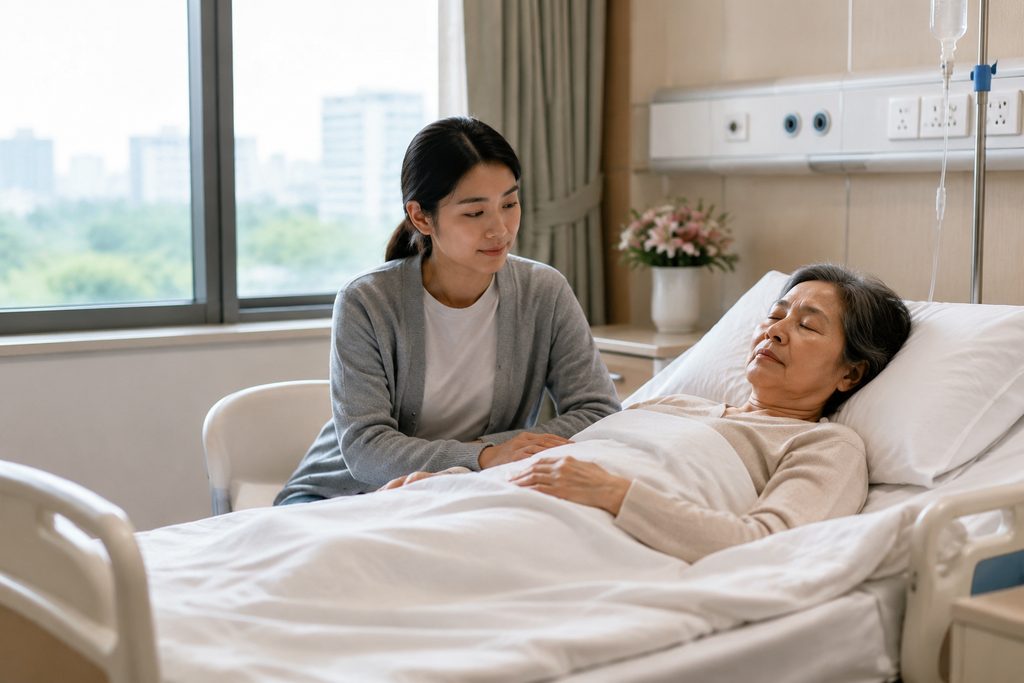
An inpatient companion is a trained, bilingual person who stays with you or your family member during a hospital admission in China. They are not a registered nurse. They do not administer medications, change surgical dressings, or make clinical decisions. Instead, they bridge the gap between what Chinese hospitals provide and what international patients expect.
Chinese public hospitals operate on a different staffing model than Western ones. Nurses handle medications, IVs, vital signs, and physician orders. Bedside care — helping someone sit up after surgery, walking them to the bathroom, getting them water, communicating discomfort to staff — falls to family members. If you travel alone for surgery, or your family cannot stay 24 hours a day, that gap becomes dangerous.
So what does a companion do? They translate between you and the nursing team. They help you reposition in bed. They fetch meals from the hospital canteen or nearby restaurants. They navigate the payment counters and pharmacy windows. They keep notes on what doctors said during rounds. They call your family back home with updates. In short, they are your advocate and your hands when yours are recovering.
Private Nurse for Hospital Stay China Cost: A Real Breakdown
Let’s address the search directly. The private nurse for hospital stay China cost varies by city, hospital tier, language requirements, and shift length. A bilingual medical companion from a reputable coordination service starts at approximately $300 per day for an 8-hour shift. Half-day coverage of 4 hours costs less, typically from $180 to $200.
Here is how that compares to what you would pay elsewhere:
| Service | China (USD) | United States (USD) | Thailand (USD) |
|---|---|---|---|
| Bilingual inpatient companion (8 hrs) | $300–400/day | $600–1,200/day | $250–350/day |
| Private duty RN (8 hrs) | Not typical in public wards | $800–2,000/day | $400–600/day |
| 24-hour companion rotation | $500–700/day | $1,500–3,000/day | $500–800/day |
Prices vary by hospital and case complexity. A companion in Shanghai at a major teaching hospital will cost more than one in Chengdu. If you need overnight coverage, expect to pay for two shifts or a flat 24-hour rate. These are coordination service fees, not hospital charges. The hospital bill for your surgery and room is separate.
One thing to understand: China does not have a widespread “private duty nurse” culture inside public hospitals the way the US does. What you are actually hiring is a bilingual medical companion — someone with healthcare experience, often a nurse by training, but working outside the hospital’s clinical hierarchy. They supplement, not replace, the ward nursing staff.
Is It Safe to Have Surgery in Shanghai?
The question comes up constantly. And it deserves a straight answer.
Shanghai is home to some of China’s best hospitals. Zhongshan Hospital, Ruijin Hospital, and Huashan Hospital all appear in the Fudan University hospital rankings — the most authoritative hospital evaluation system in China. These are not small facilities. Zhongshan alone performs over 14,000 cardiac surgeries annually, more than any single center in the United States. Volume matters in surgery. A surgeon who does a procedure 500 times a year has seen complications that a surgeon doing 50 a year has only read about.
But safety is not just about surgeon skill. It is about communication, infection control, and post-operative monitoring. This is where the companion question becomes central. A patient who cannot tell a nurse they are in pain, or who cannot understand discharge instructions, faces real risk — regardless of how good the surgeon is. The surgery itself may be safe. The recovery depends on support.
So the honest answer: yes, surgery in Shanghai at a top-tier hospital is safe by any international standard. The risk comes from navigating the system alone. That is a solvable problem.
How Much Is a Companion for Inpatient Care Abroad?
This question deserves a broader view. If you are comparing China to other medical tourism destinations, the companion cost is one line item among many. But it is the line item that most directly affects your daily experience in the hospital.
In Germany, a private patient attendant runs €400–800 per day. In Singapore, expect SGD $500–900. In South Korea, $350–600. China sits at the lower end of that range while offering hospital infrastructure that frequently exceeds what you find in Southeast Asia. The companion fee is not where you save the most money — surgery costs are. A cardiac bypass in China runs $12,000–20,000 compared to $120,000+ in the US. But the companion fee is where you buy peace of mind, and it is comparatively affordable.
You should also understand what you are paying for. A good companion service includes pre-admission coordination, translation of your medical records, communication with the ward before you arrive, and a handoff plan for when you are discharged. You are not just paying for someone to sit in a chair. You are paying for someone who knows how Chinese hospitals actually work.
What Recovery Is Like After Surgery in China
Recovery in a Chinese public hospital is different from what Western patients expect. Wards are often shared rooms with 3–6 beds. Privacy is limited. Visiting hours are strict. Meals are simple — rice, vegetables, soup — and not tailored to individual dietary preferences unless you arrange otherwise.
Pain management protocols differ too. Chinese physicians tend to prescribe fewer opioids than American doctors. That is not necessarily worse — it reduces dependency risk — but it can feel uncomfortable if you expect aggressive pain control. Your companion can advocate for you here, explaining your pain levels to the medical team and ensuring you are heard.
Mobility is encouraged early. Chinese post-surgical culture emphasizes getting patients moving sooner rather than later, which aligns with modern enhanced recovery protocols. But you will need help doing that safely. A companion who knows how to support a fresh surgical patient makes the difference between a confident first walk and a dangerous fall.
Most international patients stay in the hospital for 3–7 days after major surgery, then move to a hotel or serviced apartment for continued recovery. Your companion can transition with you, helping with follow-up appointments and medication management during that first week out of the ward.
Book Medical Escort Service Beijing Hospital: How It Works
Beijing is the other major destination for international patients, alongside Shanghai. The capital hosts Peking Union Medical College Hospital, Fuwai Hospital, and Beijing Tiantan Hospital — all among China’s most respected institutions.
If you are trying to book medical escort service Beijing hospital, here is the process. First, you need a confirmed admission or at minimum a scheduled consultation. No legitimate service will send a companion to sit in a hospital lobby without a clear medical plan. Second, you provide your medical records — translated into Chinese — so the companion understands your case before you arrive. Third, the service coordinates with the hospital’s international department to confirm ward rules, visiting policies, and any restrictions on third-party companions.
Some hospitals have their own international medical centers with English-speaking staff. But that does not mean they provide bedside companions. The international department handles scheduling and billing. The companion service handles the human support. These are complementary, not overlapping.
Book early. Good companions in Beijing get reserved weeks in advance, especially during conference seasons or around Chinese holidays when hospital staff are stretched thin.
Best Hospitals in China with English Speaking Staff
If language support is your top concern, you have two paths. The first is a private international hospital. Facilities like United Family Healthcare, Jiahui Health, and ParkwayHealth have English-speaking clinical staff, JCI accreditation, and direct insurance billing. They feel familiar to Western patients. But they are expensive — sometimes 3–5 times the cost of a public hospital for the same procedure.
The second path is a top-tier public hospital with an international medical department. Peking Union Medical College Hospital, Zhongshan, Ruijin, and West China Hospital all operate VIP or international wards with English-speaking coordination staff. The clinical care is identical to what Chinese patients receive in the main wards. The difference is administrative support, better rooms, and scheduled appointments rather than queueing. Expect to pay 1.5–2 times the standard public hospital rate for these wards.
Neither path guarantees English at the bedside 24/7. Even in international wards, night-shift nurses may have limited English. This is why the companion question persists even for patients choosing the best hospitals in China with English speaking staff. The companion fills the gaps that even excellent hospitals cannot always cover.
Who Should NOT Rely on an Inpatient Companion Alone
An inpatient companion is not a substitute for clinical care. If you need intensive monitoring, you will be in an ICU where companions are typically not allowed at all. If you need complex wound care, that is a nursing function — your companion can observe and report, but they should not be doing it.
Patients with significant cognitive impairment need more than a companion. They need a family member or legal guardian present to make decisions. A companion cannot sign consent forms or make treatment choices on your behalf. If you are traveling alone for a procedure that may leave you incapacitated, you need a medical power of attorney arrangement before you fly.
And if you are considering surgery in China primarily to save money, be honest about the total cost. Flights, visa fees, companion fees, hotel recovery time, and follow-up care add up. The savings are real — often 50–80% compared to US prices — but they are not unlimited. Budget realistically.
Practical Considerations: Documentation, Payment, and Insurance
You will need a valid passport with at least six months of remaining validity. For medical treatment in China, you apply for an S2 visa, which covers short-term private affairs including medical treatment. Your accompanying family members also apply for S2 visas. The hospital or your coordination service will provide an invitation letter and treatment confirmation to support your application. Processing typically takes 1–2 weeks, so start early.
Payment inside Chinese public hospitals is prepaid. You deposit funds at admission and the hospital draws down from that balance. Bring a credit card that works internationally — Visa and Mastercard are accepted at major hospital international departments, though not everywhere. Cash in RMB is still common for smaller payments like meals and pharmacy items.
Insurance is the hard part. Most Chinese public hospitals do not bill international insurers directly. You pay upfront and seek reimbursement after returning home. Private international hospitals like United Family do offer direct billing with major insurers. Check your policy carefully before committing to a hospital. Some insurers require pre-authorization for treatment abroad.
Bring all medical records translated into Chinese or English. Bring a list of current medications with generic names. Bring contact information for your doctor back home. Your companion service should help with record translation before you travel — this is part of what you pay for.
Frequently Asked Questions
Yes, and many Chinese families do exactly this. Hospitals expect it. But your family member needs to speak enough Chinese to communicate with nursing staff, navigate the payment system, and understand physician instructions. If they do not, they may struggle as much as you would. Some families hire a companion for the first few days, then transition to family support once the routine is established.
Ask about their background. Many companions are former or current nurses, medical interpreters, or healthcare coordinators with years of hospital experience. A reputable service will share the companion’s qualifications before you commit. You should also have a video call with the companion before your admission to make sure communication feels comfortable. Trust your instincts here.
Your companion’s role is to escalate, not to treat. If something goes wrong, they alert the nursing staff immediately and stay with you while the clinical team responds. They can also contact your family back home and help coordinate communication with the hospital’s international department. They are your advocate in a stressful moment, not your clinician.
Outpatient visits in Chinese public hospitals involve a lot of queueing — registration, payment, lab tests, pharmacy pickup. A companion for outpatient appointments is often booked as a half-day service. For a single consultation, you might manage with the hospital’s international department support. For a full day of diagnostic tests across multiple departments, a companion saves hours of confusion.
Your Next Step
The decision to have surgery abroad is never simple. But the support system around that surgery does not have to be complicated. An inpatient companion is a practical, affordable way to make a Chinese hospital feel navigable — and to make sure you are never alone when it matters most.
Our team at China Medical Services helps international patients arrange treatment at top-ranked Chinese hospitals, including bilingual inpatient companion support. We are not a hospital and we do not provide medical advice or diagnoses. What we do is handle the logistics — hospital matching, appointment coordination, visa guidance, and bedside companionship — so you can focus on recovery. If you are considering treatment in China, start with a conversation. We will help you understand your options before you commit to anything.
For more medical information and treatment options in China, visit chinamedservices.com (China Medical Services).
