Inpatient Companion: When Something Changes Mid-Treatment
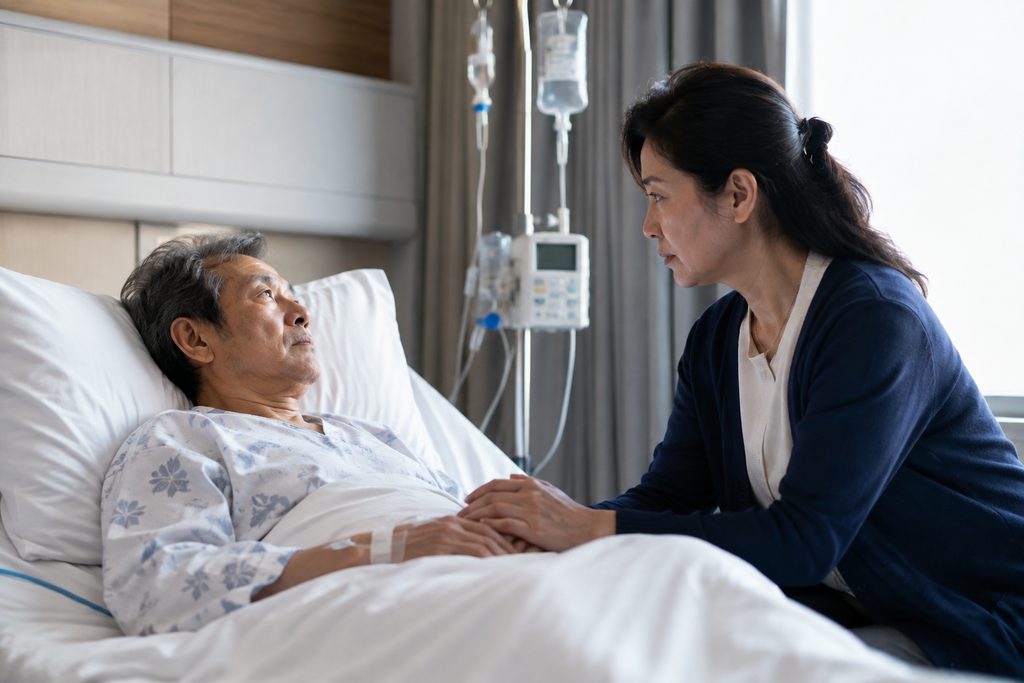
When 61-year-old Robert flew from Manchester to Shanghai for a scheduled cardiac valve evaluation, he expected a week of tests and a flight home. Then the cardiology team at Zhongshan Hospital found an arrhythmia that required an additional three days of monitoring. His wife had already returned to the UK for work. Robert spoke no Mandarin. The hospital ward was excellent, but the nursing model assumed family members would handle meals, pharmacy runs, and communication with the ward desk. He needed someone on the ground. That is where an inpatient companion steps in.
An inpatient companion is a non-medical professional who stays with a patient during a hospital admission. They translate, coordinate with nurses, manage paperwork, arrange meals, and act as the patient’s advocate when family cannot be present. The inpatient companion service cost China typically ranges from $300 to $500 per day depending on the city, hospital tier, and whether overnight coverage is required. What drives that number? We’ll break it down below, including the uncomfortable parts nobody puts in the brochure.
Inpatient Companion Service Cost China: The Short Answer
Expect to pay between $300 and $500 per 24-hour day for a bilingual inpatient companion in a major Chinese city. Half-day coverage runs from $180 to $250. That is the direct labor cost. You may also pay a one-time coordination fee of $150 to $300 for matching, hospital credential checks, and shift scheduling.
The caveat: this is not a regulated profession in China. Prices vary wildly. A companion arranged informally through a WeChat group might charge $80 per day. A vetted professional placed through a medical services company with hospital-issued access credentials and liability coverage will cost more. The gap between those two numbers is the gap between “someone in the room” and “someone who can actually fix problems.”
Who This Is Right For — and Who It Isn’t
An inpatient companion makes sense in specific situations. Here is who typically benefits:
- International patients admitted to Chinese public hospitals where nursing staff handle clinical care but not personal logistics
- Patients undergoing surgery who will be immobile or sedated for 24–72 hours and need someone to fetch medication, communicate with the ward, and monitor IV drips
- Elderly patients traveling alone or with a spouse who cannot manage stairs, pharmacy queues, or Chinese-language meal ordering
- Patients whose family members cannot stay in China for the full admission due to visa limits or work obligations
And here is who should not hire one:
- Patients admitted to private international hospitals like United Family or Jiahui, where English-speaking nursing staff and patient coordinators are already included in the room rate
- Patients whose condition requires licensed nursing care (wound care, catheter management, ventilator monitoring). A companion is not a nurse. Do not confuse the two.
- Patients with a family member who speaks Mandarin and can stay on-site. Paying $400 a day for translation when your daughter is fluent is unnecessary.
- Anyone whose budget cannot absorb $300–$500 per day without cutting into the treatment itself.
Being honest about the last point matters. A companion improves comfort and safety. It does not improve surgical outcomes. If the choice is between a companion and a better surgeon, choose the surgeon.
The Options, Compared
When a patient’s condition changes mid-treatment, families typically weigh three responses. Here is how they actually compare:
| Option | Daily Cost | Language Support | Clinical Oversight | Best For |
|---|---|---|---|---|
| Family member flies in | $0 direct, but $800–$2,500 flight + lost wages | Only if family speaks Mandarin | None — family observes, nurses decide | Short admissions, emotionally close support |
| Hospital-provided caregiver (护工) | $30–$80 | Usually Mandarin only | Basic — often untrained in medical terminology | Budget-conscious patients with simple needs |
| Bilingual inpatient companion via medical service company | $300–$500 | English + Mandarin, sometimes third language | None clinically, but strong coordination with ward staff | International patients needing advocacy and translation |
| Private international hospital room | $800–$2,000 all-inclusive | English-speaking staff | Full nursing + physician rounds | Patients who can afford to switch facilities entirely |
Which column fits you? If you are already admitted to a top-tier public hospital like Fuwai or Ruijin and your condition has stabilized but your logistics have not, the bilingual companion is the surgical strike. You keep the clinical team, add the missing layer. Switching to a private hospital means starting over with a new medical team — sometimes worth it, often not.
How Does Inpatient Companion Work in China When Something Changes
Here is the scenario the search phrase implies: something changed. A planned 3-day admission became 10 days. A scheduled procedure became an emergency one. A family member’s visa expired. A physician added a consultation with a second department. The companion’s role in these moments is not passive sitting. It is active re-coordination.
A competent companion does the following when plans shift:
- Re-confirms the updated treatment schedule with the head nurse and writes it down in English for the patient
- Escorts the patient to any newly added imaging or lab appointments in a different building — Chinese hospital campuses are enormous, and departments are often 15 minutes apart on foot
- Handles pharmacy pickup for newly prescribed medications, including the payment window queue
- Communicates with the patient’s family back home via WhatsApp or WeChat at agreed intervals
- Negotiates meal delivery, bed linen changes, and discharge paperwork timing
One thing a companion cannot do: make medical decisions. They cannot sign consent forms. They cannot override a physician’s order. If the change in condition requires a family member’s legal signature, the companion’s job is to get that family member on a video call and translate the conversation accurately. That boundary is critical and is exactly why we tell families to keep their own phone lines open during any admission.
Is It Safe to Hire a Private Nurse in Chinese Hospital
Let’s reframe the question, because the term “private nurse” is misleading. In China, the person you hire through a medical services company is rarely a licensed nurse. They are a patient companion, sometimes called a 陪护 (péihù). Licensed nurses are hospital employees. A private individual offering “nursing services” without a Chinese nursing license is operating outside the law and should be avoided.
So the safety question becomes: is it safe to hire a vetted, non-clinical companion to stay with you in a Chinese hospital? The answer is generally yes, with three conditions.
First, the companion must have hospital access credentials. Many Chinese public hospitals restrict ward entry to registered family members or agency staff with a hospital-issued pass. A companion who cannot get past the security desk is useless. Reputable medical services companies pre-verify this.
Second, the companion must have a background check and references you can verify. Ask for a copy of their ID, their employment history, and at least one reference from a previous international patient. If the company hesitates, walk away.
Third, the companion must understand the boundary between support and clinical care. A companion who offers to adjust an IV drip or interpret lab results is dangerous. A companion who says “I’ll get the nurse for that” is doing their job correctly.
For patients considering 24 hour caregiver for hospital stay Beijing price, the same safety logic applies. Beijing public hospitals like Peking Union Medical College Hospital have strict ward access rules. A companion arranged through a company with existing relationships at PUMCH will have smoother entry than one hired off the street. The price difference reflects that access.
What It Costs: A Realistic Breakdown
Let’s get specific about the inpatient companion service cost China so you can budget without surprises.
| Service Component | Typical Cost | Notes |
|---|---|---|
| Companion daily rate (8-hour day shift) | $300–$350 | Covers translation, errands, ward coordination |
| Overnight shift (12 hours) | $150–$200 | Often split between two companions to avoid fatigue |
| Full 24-hour coverage | $450–$500 | Usually one primary + one relief companion |
| One-time coordination fee | $150–$300 | Matching, credential verification, scheduling |
| Transportation for companion (if hospital far from their home) | $10–$30/day | Often waived if booked for 5+ days |
| Meals for companion | $10–$20/day | Sometimes included; clarify in advance |
What is not included: the companion’s accommodation if the hospital does not provide a cot in the room. Some wards allow companions to sleep in a folding bed next to the patient. Others do not. Ask before booking. Also not included: any hospital charges, medications, or physician fees. The companion fee is entirely separate from your treatment bill.
Prices vary by city. Shanghai and Beijing run at the top of the range. Chengdu, Hangzhou, and Nanjing often run 20–30% lower. If you are comparing options, remember that a companion in a cheaper city may still be excellent — the variance is driven by cost of living, not skill.
Book Inpatient Companion for Surgery China: Timing and Logistics
If you are planning surgery and know you will need a companion, book before you fly. Here is the sequence that works:
- Confirm your surgery date and hospital. The companion must match the hospital’s ward access rules. A companion who works regularly at Shanghai’s Zhongshan Hospital may not have credentials at Beijing’s Fuwai Hospital.
- Request a companion profile. You want to see their language proficiency, years of experience, and which hospitals they have worked in. Ask specifically about experience with your type of surgery.
- Sign a service agreement. The agreement should state the daily rate, shift hours, cancellation policy, and what happens if the companion is sick or unavailable. A professional company will have a backup companion on call.
- Arrange a pre-admission video call. Meet the companion before you arrive. Confirm they understand your medical history, your dietary needs, and your communication preferences. This 20-minute call prevents 20 hours of confusion later.
- Confirm the payment method. Most companies accept bank transfer or Alipay. Some accept credit cards with a processing fee. Clarify whether you pay upfront, daily, or after the service. Never pay cash to an individual companion without a receipt.
For patients searching best hospital with private nurse Shanghai, the honest answer is that Shanghai’s top public hospitals — Zhongshan, Ruijin, Renji — do not offer “private nurses” in the Western sense. They offer excellent clinical care and allow companions in the room. If you want a nurse dedicated to you, the private international hospitals like Jiahui or Parkway are the better fit, and their room rates reflect that. If you want a companion in a top public hospital, you arrange that separately through a service company. The two models are different and rarely overlap.
Practical Considerations: Documents, Visas, and Payment
If your condition changes mid-treatment and you need to extend your stay, several non-medical issues demand attention.
Visa. Foreign patients in China for medical treatment use an S2 visa with the treatment purpose noted. If your admission extends beyond your visa’s validity, you must apply for an extension at the local Public Security Bureau Exit-Entry Administration before it expires. Your companion can help you gather the hospital’s admission certificate and treatment plan, which are required documents. They cannot apply on your behalf. You must appear in person.
Payment. Chinese public hospitals require prepayment for inpatient stays. When your condition changes and treatment costs rise, the hospital will ask you to top up your deposit. Your companion can help you navigate the payment window and obtain receipts, but the payment itself must come from your account or a family member’s. Carry at least two payment methods — a Visa or Mastercard and a local payment app if you have one. Some hospital payment windows do not accept foreign cards.
Insurance. Most international insurance plans reimburse rather than pay directly at Chinese public hospitals. You will pay out of pocket, then file for reimbursement. Keep every receipt. Your companion can help you organize them and translate the Chinese line items into English for your insurer. Private international hospitals often offer direct billing — if your condition changes and you transfer to one, that becomes simpler.
Medical records. When something changes, you need updated records in English for your home physician. Request a discharge summary in Chinese and have it professionally translated. A companion can facilitate the request but should not be your medical translator for formal documents. Use a certified medical translation service for anything your home doctor will rely on.
Frequently Asked Questions
Chinese public hospital nurses handle clinical tasks: medications, vital signs, wound care, physician coordination. They do not help with meals, translation, pharmacy runs, or advocacy. The companion fills that gap. In private international hospitals, this gap largely disappears because the staffing model is different. That is why companions are most valuable in public hospitals.
Yes, but expect to pay a premium and accept limited choice. Same-day or next-day bookings typically cost 20–30% more than advance bookings. The pool of available companions shrinks, and you may be matched with someone who has not worked at your specific hospital before. If a change in condition is foreseeable — for example, your surgeon warned you about a possible extended observation period — book a companion on standby in advance. Some companies offer a reduced standby rate.
This happens. The remedy is to have a clear replacement clause in your service agreement. A professional company will replace a companion within 24 hours if there is a personality conflict or performance issue. You should not be locked into a multi-day contract with no exit. If you hired informally, you have less protection. That is the trade-off for the lower price.
It depends on the ward. Some Chinese public hospital wards allow one family member or companion to stay overnight in a folding bed. Others prohibit it entirely. Your companion should know the specific rule for your ward before you book. If overnight stays are not allowed, the companion leaves at the end of the evening shift and returns the next morning. For patients who need someone present 24 hours, a private international hospital may be the only option.
In practice, yes — but not in the way you might fear. Chinese ward staff are often more communicative when a bilingual companion is present because the companion can relay information accurately. The companion’s presence reduces miscommunication and speeds up routine requests. It does not change the quality of clinical care, which is determined by the medical team. But it does change the quality of communication, and communication is half the battle in a foreign hospital.
Your Next Step
When something changes mid-treatment in a Chinese hospital, the medical question is for your doctors. The logistical question — who will translate, coordinate, and advocate — is ours. China Medical Services maintains a network of vetted bilingual companions across 37 cities, including Beijing and Shanghai. We are not a hospital, we do not diagnose or treat, and we do not make medical decisions. What we do is make sure you are never alone in a foreign ward when the plan changes.
If you are planning surgery or facing an extended admission, request a free consultation to discuss companion availability, pricing for your specific hospital, and what to prepare before you arrive. No pressure. Just a clear conversation about what you need and what it costs.
An inpatient companion will not change your diagnosis. But when the plan shifts, they change how you experience it — from isolated and overwhelmed to informed and supported. That is the whole point.
For more medical information and treatment options in China, visit chinamedservices.com (China Medical Services).
