Complex Joint Reconstruction in Shanghai: Options, Costs, and Top Hospitals
Key Takeaways
- Complex joint reconstruction cost Shanghai hospitals typically runs $12,000 to $28,000 all-in for revision knee or hip work — a fraction of U.S. pricing, which frequently exceeds $80,000 per revision procedure.
- Shanghai is home to 18 hospitals on the Fudan Top 100 ranking, the second-highest concentration in China after Beijing, with deep orthopedic subspecialty expertise in revision arthroplasty and limb salvage.
- Public hospital outpatient slots cannot be reserved from overseas in advance. Locking in a surgeon and a surgery date usually means going through a hospital’s international department, at roughly 1.5 to 2 times the standard fee.
- Recovery after complex joint reconstruction is measured in months, not weeks. Anyone promising a fast return to normal is selling something.
What if the joint replacement you already had is failing — and your surgeon at home says a second revision carries real risk?
That is the situation thousands of patients face each year. Revision joint surgery is harder than the first operation. Bone stock is thinner. Scar tissue changes the anatomy. And in the United States, the bill for a complex revision knee or hip can pass $80,000 before rehabilitation even starts. So patients start searching for alternatives, and the phrase complex joint reconstruction cost Shanghai keeps coming up. Here is what that search actually turns up.
The Problem: Revision Joint Surgery Is Expensive, Slow, and Getting Harder to Schedule
Roughly 1 in 8 knee replacement patients will eventually need revision surgery within their lifetime, according to long-term registry data from countries that track implants. Hip revision rates run lower, but the procedures are technically harder. Each revision removes more bone. Each one narrows the options for the next.
In the U.S. and Western Europe, the cost side is brutal. Aseptic revision knee arthroplasty commonly bills between $60,000 and $120,000 depending on the hospital system and the complexity of the reconstruction. Add imaging, hardware, inpatient days, and months of physical therapy, and the total climbs further. Insurance may cover part of it. High-deductible plans often do not.
Then there is the wait. In several publicly funded systems, patients wait 6 to 12 months for an initial joint replacement. Revisions sit further back. During that wait, function declines. Muscle atrophies. Some patients lose the ability to work.
That combination — high cost, long waits, and rising technical difficulty — is exactly why international patients start looking at China.
Why Shanghai Delivers Results in Complex Joint Reconstruction
Shanghai is not a budget destination that happens to do surgery. It is one of the most concentrated orthopedic hubs in Asia. Of the 340+ top-ranked hospitals in our database, 18 sit on the Fudan Top 100 list in Shanghai alone, and several rank among China’s top 10 for orthopedics on the Fudan specialty reputation ranking.
Clinical Volume Changes What a Surgeon Can Do
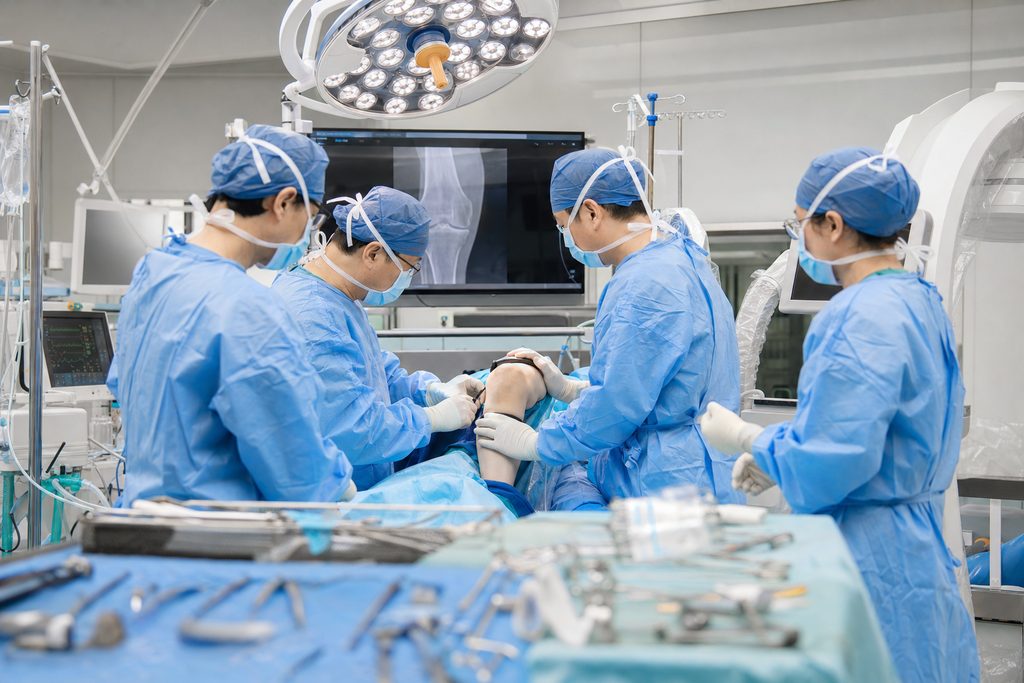
Volume matters in revision surgery more than almost anywhere else in orthopedics. A senior surgeon at a major Shanghai tertiary hospital may perform several hundred joint procedures a year, and a meaningful share of those are complex revisions, tumor resections, or infected joint reconstructions. That exposure builds pattern recognition you cannot get from a low-volume practice. When a case involves compromised bone stock or a previous periprosthetic infection, experience with the failure modes is the difference between a salvageable joint and an amputation.
Technology and Workflow at Tertiary Scale
Top Shanghai hospitals run 3D-printed patient-specific implants, navigation-assisted and robotic-assisted arthroplasty platforms, and dedicated musculoskeletal radiology. Preoperative planning often uses CT-based 3D reconstruction to model the defect before anyone enters the operating room. None of this is exotic in Shanghai’s top tier — it is routine workflow.
The scale is also different. A single major hospital may see more than 10,000 outpatient visits a day. That volume is why costs stay low. It is also why navigating the system without help is genuinely difficult.
Cost Advantage Without a Quality Trade-Off
Here is the objection every patient raises: if it costs one-fifth as much, something must be worse. The structural reasons for the gap are labor economics, implant procurement at national scale, and hospital throughput. Surgeon fees in China are a small fraction of U.S. surgeon fees for the same procedure. Implants are sourced through centralized procurement that has cut prices dramatically in recent years. The operating room runs efficiently because it runs constantly.
What patients should verify is not the price. It is the surgeon’s revision volume, the implant system used, and whether the hospital has an international department that can manage a foreign patient’s full episode of care.
What Complex Joint Reconstruction Cost in Shanghai Actually Looks Like
Prices vary by hospital and case complexity. The figures below are realistic ranges for self-paying international patients at major Shanghai tertiary hospitals, using standard or international department channels.
| Procedure | Shanghai Range (USD) | Typical U.S. Range (USD) | Notes |
|---|---|---|---|
| Primary total knee replacement | $8,000 – $15,000 | $35,000 – $60,000 | Standard implant, 3–5 inpatient days |
| Complex revision knee reconstruction | $15,000 – $28,000 | $70,000 – $120,000 | Includes revision implants, bone grafting |
| Complex revision hip reconstruction | $14,000 – $26,000 | $60,000 – $110,000 | Acetabular reconstruction adds cost |
| Two-stage infected joint revision | $25,000 – $45,000 | $100,000 – $200,000 | Two surgeries plus antibiotic spacer |
| Preoperative imaging and planning | $400 – $1,200 | $2,000 – $5,000 | CT, MRI, 3D reconstruction |
| Inpatient rehabilitation (per week) | $500 – $1,500 | $3,000 – $8,000 | Varies widely by facility tier |
One number needs to be said plainly. These ranges exclude complications, extended ICU time, and rare implant customization. A quoted price is an estimate, not a guarantee. Any provider who tells you otherwise is not being straight with you.
How the Process Actually Works, Step by Step
This is the part most articles skip. Here is the real sequence for an international patient.
Step 1 — Records review. You send existing imaging, operative notes from prior surgeries, pathology reports if there was infection, and current labs. A Chinese orthopedic specialist reviews them and gives a written assessment. This usually takes a few days to two weeks.
Step 2 — Remote consultation. If the case looks feasible, you speak with the specialty team by video. You explain your goals, they explain what they see and what they would recommend. This is where you find out whether you are a candidate at all. Some patients are told surgery is not advisable — that is a useful answer, not a rejection.
Step 3 — Visa. Medical travel to China uses the S2 visa, annotated for medical treatment purposes. Family accompanying you applies for S2 as well. Stays beyond 180 days require the S1 category. Requirements shift, so confirm current rules with the nearest Chinese embassy or consulate and bring the hospital’s invitation and treatment documents.
Step 4 — Arrival and in-person consultation. Public hospital general outpatient slots cannot be booked from overseas in advance. This is the single biggest practical obstacle. Going through a hospital’s international department is the usual way to secure a specific senior specialist and a planned admission.
Step 5 — Surgery and inpatient stay. Complex revisions typically mean 4 to 8 inpatient days. Payment at public hospitals is upfront; international private hospitals often bill insurance directly.
Step 6 — Rehabilitation and follow-up. You will need supervised physical therapy. Most patients stay in Shanghai for 3 to 6 weeks after discharge before flying home.
Choosing a Hospital: What to Check Before You Commit
Shanghai has excellent orthopedic departments and some that are simply not set up for foreign patients. Both facts matter.
The first filter is whether the hospital has a functioning international department. Without one, you will be standing in a queue of thousands with no English-language support. The second is the surgeon’s revision caseload, which you can and should ask about directly.
For public tertiary hospitals, start with the Fudan specialty rankings by department, which list the top 10 hospitals nationally for orthopedics. For a broader city-level view, the Shanghai hospital directory groups options by ranking tier and hospital type. Private international hospitals — JCI-accredited, English-speaking staff, direct insurance billing — are a separate category and suit patients who prioritize comfort and predictability over the lowest possible price.
One more filter: ask whether the hospital handles infected revisions. Not every orthopedic department does. If your case involves a prior periprosthetic joint infection, this question narrows the list fast.
And be honest about who this is not for. Patients with active uncontrolled infection elsewhere, severe cardiac or pulmonary contraindications, or unrealistic recovery expectations should not be booking surgery abroad. Neither should anyone who cannot commit to 4 to 6 weeks on the ground after the operation.
Practical Considerations for International Patients
Records. Bring prior operative notes, not just imaging discs. Revision surgeons need to know what implant is already in your body, and the manufacturer and model matter.
Visa timing. Apply for S2 with enough lead time. Processing varies by consulate and season.
Payment. Public hospitals require prepayment and reimbursement happens afterward through your insurer. International private hospitals frequently settle directly with major insurers. Confirm with your insurer before you travel, in writing.
Language. China’s top hospitals are enormous and operate almost entirely in Chinese. Bilingual medical interpretation is not a luxury in this setting.
Follow-up at home. Arrange a local orthopedic surgeon who will accept your postoperative imaging and progress notes before you leave China. This is the most commonly skipped step, and the most regretted.
Frequently Asked Questions
At top-tier Shanghai tertiary hospitals, revision arthroplasty is performed at volumes and with technology comparable to major Western centers. Safety depends far more on your specific case — bone quality, infection history, comorbidities — than on the country. That is why a records-based assessment should come before any travel decision.
Plan on 6 to 12 weeks before walking without significant support, and 6 to 12 months for maximum functional recovery. Complex revisions recover more slowly than primary replacements. Most international patients stay in Shanghai 3 to 6 weeks after discharge before flying home, and long-haul flights carry clot risk that your surgeon will want to manage.
Not through the standard public outpatient channel — those slots are issued on the day of the visit, in person. Securing a specific specialist and an admission date generally requires going through a hospital international department or a coordination service. No one can guarantee a specific surgeon or date; the honest commitment is to coordinate the request and refund the coordination fee if the appointment cannot be arranged.
Some international policies reimburse treatment abroad; many do not, or cover only emergencies. Call your insurer and ask specifically about elective revision arthroplasty in China, and request the answer in writing. Public hospitals require upfront payment regardless.
Your Next Step
Complex joint reconstruction is a decision worth getting right the first time — especially when it is a revision. The cost advantage in Shanghai is real, the surgical expertise at the top hospitals is real, and so are the logistical obstacles. Knowing all three before you commit is what separates a good outcome from a costly mistake.
We are China Medical Services. We are not a hospital and we do not diagnose or treat anyone. We help international patients understand their options, obtain written second opinions from Chinese specialists, and coordinate appointments through official hospital channels. If you would like a records review or a straightforward conversation about whether Shanghai makes sense for your case, you can request a free consultation with our patient coordination team — no pressure, no obligation.
This article is for general information only and is not medical advice. Treatment decisions should always be made with a qualified physician who has reviewed your individual case.
For more medical information and treatment options in China, visit chinamedservices.com (China Medical Services).
