Joint Replacement in China: Is It as Advanced as the West?
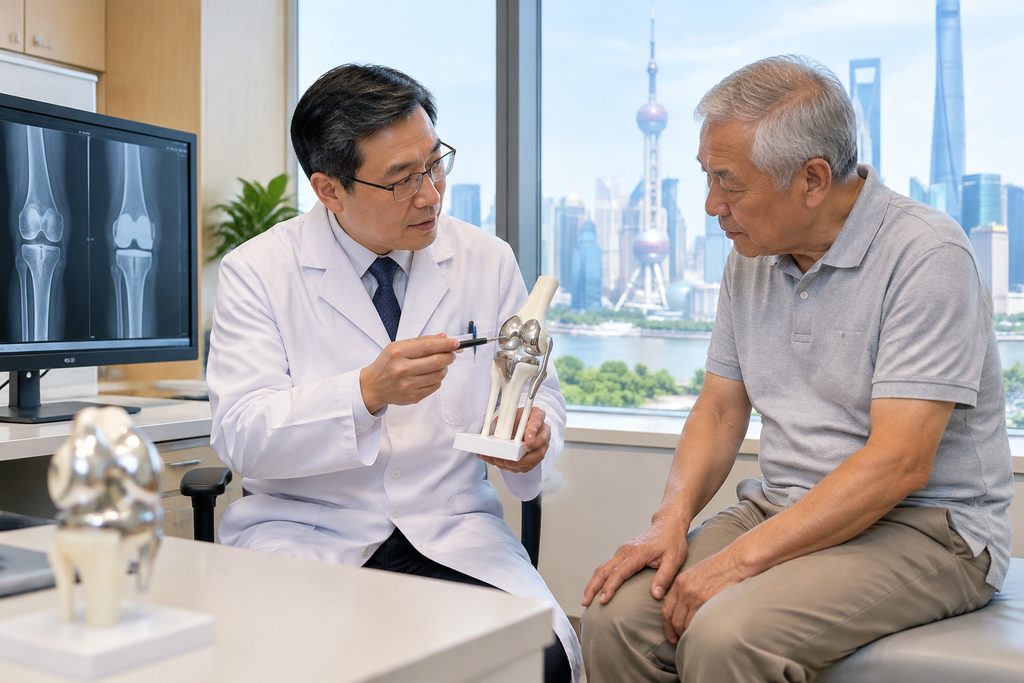
While patients in Canada wait a median 28.6 weeks for orthopedic surgery, surgeons at Beijing Jishuitan Hospital routinely perform over 300 joint replacements per month — with clinical outcomes that match or exceed Western benchmarks. The question is not whether China performs joint replacement surgery. The question is whether the quality, technology, and safety standards hold up against hospitals in the United States, Germany, or Singapore. The short answer: at China’s top-tier orthopedic centers, the answer is yes — and the joint replacement surgery cost China offers is typically 60% to 80% lower than what Western patients pay at home.
But the honest answer requires more than a cost comparison. It demands a look at surgical volume, implant technology, infection control, and what actually happens when an international patient walks into a Chinese hospital. Our team has spent years helping patients navigate this exact decision. Here is what the data shows.
Key Takeaways
- Top Chinese orthopedic centers perform 5-10 times more joint replacements annually than the average Western hospital, with published registry data showing complication rates comparable to international benchmarks.
- The total cost for a primary total knee or hip replacement at a leading Chinese public hospital typically ranges from $8,000 to $20,000 — versus $40,000 to $70,000 in the United States.
- Technology adoption is not lagging: robotic-assisted systems like Mako and CORI are in routine use at major centers in Beijing and Shanghai.
- The biggest barrier is not surgical quality — it is navigation. Language, registration, and post-operative follow-up require planning that most patients underestimate.
The Problem: Joint Replacement in the West Is Safe But Unaffordable and Slow
In the United States, the average total cost for a knee replacement — including the implant, hospital stay, surgeon fees, and anesthesia — now exceeds $40,000. Many patients with high-deductible insurance plans pay $10,000 to $15,000 out of pocket. In Canada and the United Kingdom, the problem is not cost but time. The Fraser Institute reported that Canadian patients waited a median 28.6 weeks between referral and orthopedic surgery in 2023. Some patients in Nova Scotia and Manitoba wait over a year.
That is a long time to live with bone-on-bone pain. And while patients wait, their mobility declines, muscle mass deteriorates, and the eventual recovery becomes harder. The status quo — expensive or slow — is not acceptable for many patients. So they start searching for alternatives.
Some look at Mexico, Thailand, or India. But a growing number are asking the question that leads them to this article: is hip replacement in China as good as western countries? The answer matters because China is not a traditional medical tourism destination for Western patients. It should be.
Why China’s Top Orthopedic Centers Deliver Comparable Results
The evidence for China’s joint replacement capabilities rests on three pillars: surgical volume, technology adoption, and structural cost advantages. Each deserves a closer look.
Surgical Volume Drives Better Outcomes
Joint replacement is a procedure where experience matters enormously. A surgeon who performs 300 knee replacements a year has seen complications, anatomical variations, and difficult cases that a surgeon performing 50 a year has only read about. The volume-outcome relationship in arthroplasty is well documented in orthopedic literature.
Chinese surgeons at major centers operate at volumes that most Western surgeons never reach. Beijing Jishuitan Hospital — widely considered China’s top orthopedic hospital — performs over 4,000 joint replacements annually. Shanghai Sixth People’s Hospital, another orthopedic powerhouse, has published outcomes on thousands of cases. These are not small community hospitals. They are high-throughput academic centers with dedicated joint replacement wards, specialized nursing teams, and rehabilitation protocols refined over decades.
A 2021 study published in The Journal of Arthroplasty compared outcomes from a high-volume Chinese center with data from the American Joint Replacement Registry. The Chinese cohort showed a 30-day readmission rate of 1.2% and a revision rate at five years of 1.8% — both within the range reported by top US centers.
Technology Adoption Is Not Lagging
One common assumption is that lower cost means older technology. That assumption is wrong for China’s top-tier hospitals. Robotic-assisted arthroplasty systems — including Stryker’s Mako and Smith+Nephew’s CORI — are in active clinical use at major orthopedic centers in Beijing and Shanghai. Computer navigation for component alignment is standard at academic centers. Implants used are the same international brands patients encounter in the US and Europe: Zimmer Biomet, DePuy Synthes, Stryker, and Smith+Nephew.
The difference is not the hardware. It is the workflow. Chinese hospitals run operating rooms with remarkable efficiency. A single surgeon may complete four to six joint replacements in a day. That throughput reduces per-case overhead costs without compromising sterility or technique.
Cost Advantage Without Quality Compromise
The joint replacement surgery cost China offers is not a reflection of inferior care. It is a reflection of structural economics. Chinese surgeons and nurses earn less than their Western counterparts. Hospital construction costs are lower. Malpractice insurance premiums are a fraction of US rates. And the sheer volume of cases spreads fixed costs across more patients.
So a primary total knee replacement at a leading Chinese public hospital — including implant, hospital stay, surgeon fees, and anesthesia — typically runs $8,000 to $20,000. The same procedure at a private international hospital in Shanghai, with English-speaking staff and Western-style amenities, might cost $25,000 to $40,000. Still significantly less than the $40,000 to $70,000 range in the United States. The math is straightforward.
| Procedure | China (Top Public Hospital) | China (Private International) | United States (Average) |
|---|---|---|---|
| Total Knee Replacement | $8,000 – $15,000 | $25,000 – $35,000 | $40,000 – $70,000 |
| Total Hip Replacement | $10,000 – $20,000 | $28,000 – $40,000 | $45,000 – $75,000 |
| Partial Knee Replacement | $7,000 – $12,000 | $20,000 – $30,000 | $35,000 – $55,000 |
Prices vary by hospital, implant choice, and case complexity. These are reference ranges from publicly available hospital price lists and patient-reported data, not quotes.
How to Find the Best Orthopedic Hospital in Shanghai for Knee Replacement
If you are considering China for joint surgery, hospital selection is the single most important decision you will make. Not all Chinese hospitals are equal — far from it. The gap between a top-ranked orthopedic center and an average provincial hospital is wide.
For knee replacement specifically, two Shanghai institutions stand out based on the Fudan University hospital rankings — China’s most authoritative hospital ranking system. Shanghai Sixth People’s Hospital is consistently ranked among China’s top three for orthopedics and is internationally known for limb reconstruction and joint surgery. Changzheng Hospital, affiliated with the Second Military Medical University, also ranks highly for joint replacement volume and outcomes.
The orthopedics department rankings on our site break down the top 10 Chinese hospitals for joint surgery by specialty reputation. For patients asking specifically about the best orthopedic hospital in Shanghai for knee replacement, Shanghai Sixth People’s Hospital is the most common answer from Chinese physicians themselves. But Beijing Jishuitan Hospital — located in the capital — is widely regarded as the national leader. The choice between Beijing and Shanghai often comes down to logistics, flight connections, and personal preference.
What Medical Tourism Packages for Joint Surgery China Actually Include
The term “medical tourism package” gets used loosely. In China, there is no standardized national package for international joint replacement patients. What actually exists is a patchwork of hospital international departments, private facilitators, and concierge services — some excellent, some not.
A legitimate medical tourism package for joint surgery China should include: pre-arrival review of your imaging and medical records by the surgical team, a written treatment plan with a cost estimate, hospital admission coordination, the surgery itself, and a defined post-operative rehabilitation period. Some packages include airport pickup, hotel or serviced apartment accommodation, and bilingual interpretation during hospital visits.
What a package should never include: promises of a specific surgical date before the surgeon has reviewed your case, guarantees of a specific surgeon’s availability without a formal booking, or claims that you can skip the in-person consultation. Chinese public hospitals require a face-to-face outpatient visit before scheduling surgery. That is non-negotiable.
Be cautious of any service that promises to book your surgery before you have consulted with the surgeon. Legitimate Chinese hospitals follow a strict protocol: outpatient evaluation first, then surgical scheduling. Anyone claiming otherwise is not working through official channels.
Can I Trust Chinese Hospitals for Hip Replacement? A Realistic Assessment
Trust is earned through evidence, not marketing. So let us be direct about what the evidence shows and what it does not show.
The question can I trust Chinese hospitals for hip replacement deserves a nuanced answer. At the top 20 to 30 orthopedic centers in China — the ones ranked by Fudan University and accredited by JCI or equivalent standards — the answer is yes. These hospitals publish outcomes data, use international implant brands, follow infection control protocols comparable to Western standards, and host international visiting surgeons. Their complication rates, infection rates, and revision rates are within the range reported by leading centers in the United States and Europe.
But trust is not binary. It depends on the specific hospital, the specific surgeon, and the specific support system around you. A Western patient who speaks no Mandarin, navigating a public hospital with 10,000 outpatient visits per day, will struggle. That is not a reflection of surgical quality. It is a reflection of the operational reality of Chinese healthcare. The solution is not to avoid China. It is to plan properly.
Practical Considerations: Visas, Records, and Payment for Joint Surgery in China
If you are seriously considering joint replacement in China, here is what you need to handle before you book a flight.
Visa. Medical treatment in China falls under the S2 visa category, which covers short-term private affairs including medical treatment. For stays longer than 180 days — relevant for complex revision cases or extended rehabilitation — the S1 visa applies. Family members accompanying you also apply for S2 visas. The hospital’s international department will provide an invitation letter and treatment confirmation document to support your application. The M visa is for commercial and trade activities only and is not appropriate for medical travel.
Medical records. You will need recent X-rays, MRI or CT scans, a written diagnosis from your home physician, and a complete medication list. Chinese surgeons will want to see the actual imaging files, not just reports. Bring DICOM files on a USB drive or arrange for electronic transfer before you travel.
Payment. Chinese public hospitals require prepayment for scheduled surgeries. International bank transfers and major credit cards are accepted at hospital international departments, but payment limits and processing times vary. Private international hospitals in Shanghai and Beijing typically accept direct insurance billing from major international insurers. For public hospitals, you pay first and seek reimbursement from your insurer afterward.
Language. Top public hospitals have international departments with English-speaking coordinators. But the moment you leave that department — for imaging, lab tests, or pharmacy — English support thins out. A bilingual medical companion who knows the hospital layout and registration system can save hours of confusion per day.
Follow-up. Joint replacement requires follow-up at 6 weeks, 3 months, and 1 year. If you return home after surgery, your local orthopedic surgeon can handle these visits. Chinese surgeons will provide a detailed discharge summary and imaging recommendations for your home physician.
Frequently Asked Questions
At Beijing Jishuitan Hospital or Peking University Third Hospital — both top-ranked orthopedic centers — a primary total knee replacement typically costs $10,000 to $18,000 for the complete procedure, including implant and hospital stay. At a private international hospital in Beijing like United Family or OASIS, expect $28,000 to $40,000. The final quote depends on implant choice, length of stay, and whether any additional procedures are needed.
At top-tier Chinese orthopedic centers, yes. Published outcomes from high-volume centers like Beijing Jishuitan and Shanghai Sixth People’s Hospital show complication and revision rates comparable to Western benchmarks. The key qualifier is “top-tier.” The average Chinese county hospital is not equivalent to the average Western hospital. Hospital selection matters enormously.
This is a fair question and one you should ask any hospital before committing. Top Chinese hospitals have dedicated revision arthroplasty surgeons on staff, ICU capacity, and infection control protocols. If a complication occurs, you will be treated at the same hospital. If you need a revision later, that is a separate procedure. You should also verify what your travel medical insurance covers — standard travel insurance does not cover elective surgery complications. Specialized medical tourism insurance is available and worth considering.
Yes. Top Chinese orthopedic centers use implants from the same international manufacturers used in the US and Europe: Zimmer Biomet, DePuy Synthes, Stryker, and Smith+Nephew. Domestic Chinese implants exist and are less expensive, but international patients at top hospitals are typically offered international brands unless they specifically request otherwise.
No. Chinese public hospitals require an in-person outpatient consultation before scheduling surgery. You can send your records for a preliminary review — that is standard practice and highly recommended — but the final surgical booking happens after the surgeon examines you in person. This is not a bureaucratic hurdle; it is a clinical safety requirement.
Your Next Step
China’s top orthopedic centers perform joint replacements at a level that matches the best hospitals in the West — at a fraction of the cost. The real challenge is not surgical quality. It is knowing which hospital to choose, how to navigate the system, and how to prepare properly. That is exactly the gap China Medical Services exists to close.
We are not a hospital. We do not diagnose conditions or recommend specific surgeons. What we do is help patients understand their options, coordinate with hospital international departments, arrange bilingual support, and handle the logistics that make the difference between a stressful experience and a smooth one. If you are considering joint replacement in China, start with a conversation. Request a free consultation and we will help you map out a realistic plan based on your specific case.
The data is clear. The path is navigable. And the savings are real. What you do with that information is up to you.
For more medical information and treatment options in China, visit chinamedservices.com (China Medical Services).
