Spine Surgery in China: A Full-Service Hub for Discectomy, Fusion & Deformity
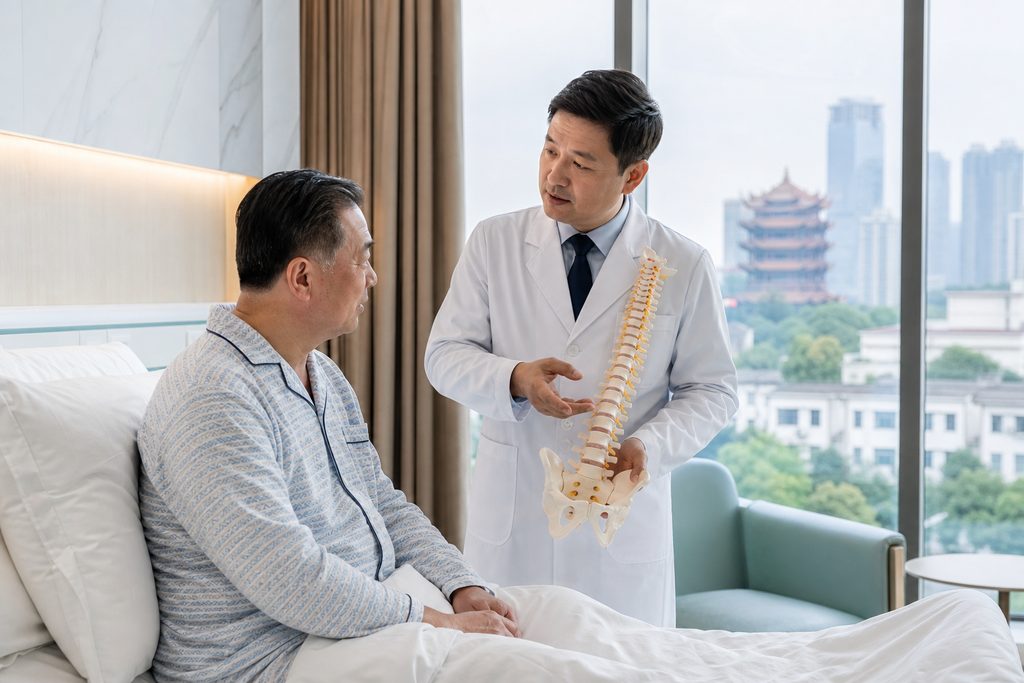
Have you ever stared at a six-figure surgical quote and wondered if there was another way to get your life back? A way that does not drain your retirement fund or force you to wait eighteen months in debilitating pain. What if the solution is not a compromise on quality, but a shift in geography? For a growing number of international patients, the answer lies in the specialized orthopedic centers of China, where the spine surgery cost China model has matured into a sophisticated, high-volume system that directly addresses the two biggest fears in healthcare: financial ruin and clinical uncertainty.
Key Takeaways
- A complex spinal fusion in a top-tier Chinese hospital averages $15,000–$25,000, compared to $110,000+ in the United States, without sacrificing implant quality or surgical precision.
- China’s top orthopedic departments, ranked by the Fudan University specialist reputation list, handle case volumes that simply do not exist in most Western centers, creating deep, procedure-specific expertise.
- Navigating a foreign hospital system alone is the single biggest risk factor for international patients—language gaps and administrative friction can derail even the best surgical plan.
- You are not buying a “package deal” online. Safe, transparent care starts with a remote written second opinion or video consultation before you ever book a flight.
The Problem: When the Price of Relief Is Just Another Injury
Spinal pathology does not care about your insurance deductible. A herniated disc pressing on a nerve root will steal your sleep. A degenerative spondylolisthesis will shrink your world to the distance between your bed and the bathroom. And when conservative measures fail, the numbers hit hard. In the US, a single-level anterior cervical discectomy and fusion (ACDF) carries a mean cost of roughly $54,000, according to a 2020 study published in JAMA Network Open. A complex thoracolumbar fusion for adult deformity? That can easily exceed $175,000. Even with insurance, the out-of-pocket exposure can be catastrophic.
Price is only one head of this monster. The other is time. In systems like the UK’s NHS, the waiting list for non-emergency spinal surgery has ballooned. The Royal College of Surgeons of England reported that over 40% of patients were waiting longer than 18 weeks for treatment after a decision to admit. For a patient with progressive neurological symptoms, that delay is not an inconvenience. It is a clinical deterioration waiting to happen.
You are left with a brutal equation: deplete your life savings for timely, private care at home, or risk permanent nerve damage while languishing on a public waitlist. Neither option is acceptable. This is the exact trap that pushes rational people to look beyond their borders.
Why China’s Orthopedic Ecosystem Delivers Results That Rival the West
The question is rarely “can they do it?” It is “how do they do it for a fraction of the cost?” The answer is not a mystery. It is a function of structural economic advantages and brutal clinical efficiency. The spine surgery cost China hospitals offer is not an indicator of a discount product. It reflects a system built on high patient throughput, lower administrative bloat, and a medical device market that has seen massive domestic innovation. Let us break down the three pillars that make this viable.
Clinical Volume: The Unfair Advantage You Want Your Surgeon to Have
There is a direct, well-documented correlation between surgical volume and patient outcomes, particularly in complex procedures like spinal deformity correction. A surgeon who performs 300 pedicle subtraction osteotomies a year simply sees and solves intraoperative challenges differently than one who does 20. In China’s top-tier public hospitals, the patient flow is staggering. A single orthopedic department at a hospital like Peking University Third Hospital—a national center for spinal surgery—manages a surgical volume that would cover a small European country. Our database tracks 340+ top-ranked hospitals across 37 cities, many housing spine units that function as dedicated factories of expertise. This is not assembly-line medicine. It is hyper-specialization. When you ask “is back surgery safe in China,” the answer starts with asking if your surgeon is operating at the top of their license, and in these centers, the case logs prove they are.
Technology Parity and the Implant Reality
Walk into the operating theater of a Fudan-ranked A++++ hospital in Shanghai. You will find intraoperative CT navigation, O-arm surgical imaging, and neuromonitoring systems that are standard in any Mayo Clinic or Charité campus. The implants themselves are where the cost narrative shifts. While Western multinationals like Medtronic and Johnson & Johnson have a strong presence, China’s domestic orthopedic implant industry—companies like Wego and Double Medical—has matured rapidly. They produce FDA-clearance-equivalent pedicle screw systems and fusion cages at a fraction of the import price. The result? The hardware in your spine is clinically equivalent, but the line item on your bill is 60% lower. That is not a safety compromise. That is a supply chain advantage.
The Structural Cost Gap: Why “Cheaper” Is Not “Worse”
Let’s talk about the elephant in the room directly: how much is spinal fusion abroad, and why is the number so different? A single-level lumbar fusion at a top private international hospital in Shanghai might run $20,000–$28,000 all-in. At a high-volume public hospital’s international VIP wing, it could be $15,000–$22,000. The same procedure in the US averages over $100,000. The gap is not magic. It is labor costs. It is the absence of multi-million-dollar executive salaries baked into your hospital bill. It is a malpractice insurance environment that, while robust, does not force surgeons to practice extreme defensive medicine. The cost savings are structural, not a reflection of surgical skill.
What a Full-Service Spine Hub Actually Looks Like on the Ground
You are not just searching for a surgeon. If you type “book spinal surgery package Beijing” into a search bar, you are really asking for a system that can hold your hand from the moment you land, often in significant pain, to the moment you walk upright through airport security to fly home. A genuine full-service hub for spine deformity treatment in China must offer three distinct phases, and you need to understand what each phase demands of you.
Phase one is the remote evaluation. No reputable center will book a surgery package sight unseen. The standard is a written second opinion. You send your existing MRI, CT scans (DICOM format is preferred), and clinical history. The specialist team reviews it and provides a written analysis. This step alone often saves patients from unnecessary surgery. We have seen cases where a proposed multi-level fusion was revised to a targeted microdiscectomy after a fresh set of eyes reviewed the imaging. The cost for this remote review ranges from $300 to $500. It is the best money you will spend, even if you decide not to travel.
Phase two is the on-site confirmation. You cannot skip this. Even with a remote plan, the surgeon must physically examine you. Reflexes, motor strength, and the exact location of radicular pain cannot be assessed via Zoom. Expect to spend a few days in the city for pre-operative consultation and fresh imaging before a surgery date is locked. This is where the logistical friction hits hardest—registering at a massive public hospital without Mandarin is a Kafkaesque nightmare. This is precisely the gap that a bilingual medical companion fills, handling registration, queuing, and translation so the surgeon gets accurate information and you get a clear plan.
Phase three is the procedure and recovery. For a microdiscectomy, the hospital stay might be 2–3 days. For a complex scoliosis correction, you are looking at 7–10 days in the hospital, followed by 1–2 weeks in a nearby serviced apartment before you are cleared to fly. The best hubs coordinate this entirely: hospital admission, hotel-like recovery suites, and post-operative physiotherapy. The full service spine deformity treatment China provides is not just the hours in the OR. It is the two weeks of supervised recovery that determines whether the fusion takes hold properly.
Discectomy, Fusion, or Deformity: Matching the Procedure to the Provider
Not every hospital excels at every procedure. The center that is the best discectomy hospital Shanghai has to offer might not be the ideal choice for a severe adolescent idiopathic scoliosis correction. This is a critical distinction. Discectomy—whether open or microendoscopic—is a high-precision, low-morbidity procedure. You want a neurosurgery or orthopedic spine team that does hundreds per year, using tubular retractors and operating microscopes. Shanghai’s top centers, such as Huashan Hospital’s neurosurgery department, are globally recognized for this. They rank consistently in the Fudan specialist reputation top 10 for neurosurgery.
Spinal fusion for degenerative disease is a different animal. It requires mastery of biomechanics and implant selection. Hospitals with dedicated joint and spine research institutes, like those affiliated with major military medical universities or Peking University, often lead here. They are involved in the clinical trials for the next generation of 3D-printed fusion cages.
And then there is deformity. Correcting a 70-degree kyphotic curve is a marathon surgery. It demands a multi-disciplinary team, intraoperative neuromonitoring, and often a plastic surgeon for closure. Only a handful of centers in China perform these at a volume that generates true mastery. When you ask is back surgery safe in China for a procedure this complex, the answer hinges entirely on whether you are at one of those five or six national referral centers that see these cases daily. Do not settle for a general orthopedist. Use a database that filters by Fudan specialist ranking to find the exact department head who has dedicated their career to spinal deformity.
| Procedure | Est. Cost China (USD) | Est. Cost US (USD) | Typical Hospital Stay (China) |
|---|---|---|---|
| Lumbar Microdiscectomy | $8,000 – $12,000 | $35,000 – $50,000 | 2 – 3 days |
| Single-Level Cervical Fusion (ACDF) | $14,000 – $20,000 | $54,000 – $80,000 | 3 – 5 days |
| Single-Level Lumbar Fusion (PLIF/TLIF) | $15,000 – $22,000 | $80,000 – $110,000 | 4 – 7 days |
| Complex Scoliosis Correction | $35,000 – $55,000 | $175,000 – $250,000+ | 7 – 14 days |
Note: These are all-inclusive estimates for the hospital portion (surgeon, anesthesia, implants, room) at top-tier public hospital international departments. Actual quotes vary by hospital and case complexity. Airfare, visa, and post-discharge accommodation are separate.
Practical Considerations: Visas, Payments, and the Paper Trail
The clinical plan is only half the battle. The administrative layer is where international plans often collapse. You need to enter China legally, pay securely, and leave with a complete medical record that your doctor back home can use.
First, the visa. For medical treatment, the applicable short-stay category is the S2 visa. This is not a “medical visa” by name—China does not have a standalone medical visa for short stays. The S2 is for private affairs, and medical treatment falls squarely into this category. Your supporting documents will include an invitation letter from the hospital’s international department and a treatment plan confirmation. The accompanying family member also applies for an S2. Do not let anyone tell you to come on a tourist (L) visa for surgery. That is a violation of the terms of stay and can void your hospital admission agreement. M visas are for commercial trade, not for patients.
Payment is another friction point. Public hospitals in China operate on a pre-payment system. You deposit a lump sum upfront, and the hospital draws down against it. International credit cards are not universally accepted at public hospital cashiers, even in VIP wings. Be prepared to initiate a large international wire transfer in advance. Private international hospitals like United Family or Jiahui are more flexible, with direct insurance billing and card terminals. However, their all-inclusive spine surgery quotes will be higher, closer to $35,000–$45,000 for a fusion, reflecting the concierge-level service and English-speaking environment. You trade cost for convenience.
Finally, your medical records. Insist on receiving a full discharge summary, operative note, and implant log in English before you leave. Do not walk out the door with only a Chinese-language document and a CD of images. A proper hub will provide this as a standard part of the discharge process. Your home spine surgeon needs to know the exact make and model of the pedicle screws to interpret future imaging correctly.
Frequently Asked Questions
Do not look at generic hospital advertisements. Use the Fudan University Hospital Ranking, specifically the specialist reputation list for Orthopedics or Neurosurgery. The top 10 hospitals in these categories are national referral centers. Their department directors are typically fellowship-trained, often with stints in the US or Europe, and publish in international peer-reviewed journals. Check their publication record on PubMed. It is a public, verifiable track record.
This is the hardest question, and the answer is not a simple guarantee. The risk of surgical site infection in a top Chinese center is comparable to international benchmarks—around 1–2% for instrumented spinal fusion. If a complication arises after you return home, the Chinese surgical team will typically offer remote follow-up via video consultation at no extra charge for a defined period. However, the physical management of the complication will fall to your local healthcare system. This is why it is critical to establish a relationship with a local spine surgeon before you travel, one who agrees to handle post-operative care. You are not burning a bridge; you are building a relay team.
No ethical hospital will let you book a surgery date and pay in full before a face-to-face consultation. What you can—and should—arrange is a remote written second opinion and a video consultation. This locks in the specialist’s preliminary assessment. Once that is done, you can coordinate a fixed window for travel, consultation, and anticipated surgery. The coordination service can reserve a provisional slot, but the final “go” decision happens only after the surgeon examines you in person. Anyone offering a rigid, pre-paid surgical package with no pre-travel clinical evaluation is operating outside standard safety protocols.
Your Next Step
Deciding to travel for spine surgery is not a transaction. It is a calculated bet on quality, safety, and your own resilience. The information asymmetry is the real enemy—not knowing which hospital is genuinely ranked, or whether a quote is reasonable. Our team at China Medical Services exists to close that gap. We do not provide medical advice or diagnoses. We provide the verified data, the bilingual coordination, and the on-ground support that turn a chaotic process into a clear, step-by-step plan. If you are ready to see whether a top-tier Chinese spine center is the right fit for your specific case, we are here to walk you through the first, low-risk step: a remote evaluation. Request a free, no-obligation consultation to discuss your case and explore your options.
For more medical information and treatment options in China, visit chinamedservices.com (China Medical Services).
