Kazakh Patient Medical Service to China: Almaty Cross-Border Treatment Full Support
You have probably heard that seeking surgery abroad means rolling the dice on quality. That you trade safety for savings. The data from China’s top-tier hospitals tells a different story entirely. Fuwai Hospital in Beijing performs over 14,000 cardiac surgeries annually—more than any center on earth. Peking Union Medical College Hospital handles complex cases most Western institutions see a handful of times per year. The question is not whether the clinical expertise exists. It is whether you can access it without getting lost in a system not designed for international patients.
That is where the real challenge sits. Not in the operating room. In the logistics.
Key Takeaways
- China’s top-ranked hospitals deliver clinical outcomes comparable to Western centers at 20% to 40% of the cost for major procedures, with some cardiac surgeries priced at $12,000–$20,000 versus $120,000+ in the United States.
- Direct access to public hospital outpatient departments is effectively impossible for overseas patients without on-the-ground coordination—no online booking exists for standard outpatient visits.
- Kazakh citizens must obtain an S2 visa specifically endorsed for medical treatment; the M business visa is legally invalid for this purpose and will result in denied care at legitimate institutions.
- Any video consultation or second opinion fee paid to a coordination service should be fully creditable toward future in-person treatment coordination—if it is not, walk away.
The Problem: When Waiting Is Not an Option
Kazakhstan’s healthcare system has made real strides. Nobody disputes that. But for certain diagnoses—aggressive oncology, congenital cardiac defects in children, complex orthopedic reconstructions—the specialist density and case volume simply do not match what exists 4.5 hours east by direct flight from Almaty.
Consider cancer care. China’s Fudan University Hospital Ranking identifies 45 clinical specialties with dedicated top-10 lists. Within oncology alone, multiple hospitals in Beijing, Shanghai, and Guangzhou treat more esophageal and liver cancer cases annually than entire national registries in smaller countries. Surgical volume correlates with outcomes. A 2023 analysis published in The BMJ found that hospitals performing over 20 esophagectomies annually had 30-day mortality rates roughly half those of low-volume centers. China’s top thoracic surgery departments routinely exceed 200 per year.
The patient from Almaty faces a structural problem. The window between diagnosis and optimal treatment is narrow. Coordinating international care independently—visa paperwork, hospital selection, appointment scheduling, language interpretation, payment systems—can consume months. Months a patient may not have.
Who We Are
We are not a hospital. We do not employ doctors, we do not provide clinical diagnoses, and we will never offer you a medical opinion. What we do is build the bridge between you and the 340+ top-ranked hospitals across 37 Chinese cities that form our network. Our team handles the architecture of your medical journey: matching your diagnosis to the right department in the right institution, securing appointments through official international patient channels, arranging bilingual medical companions who physically guide you through every step inside the hospital, and ensuring your visa documentation is correct before you book a flight. We are logistics specialists for cross-border care. Nothing more. Nothing less.
Why Chinese Hospitals Deliver Results for Kazakh Patients
Clinical Volume Drives Surgical Precision
A cardiac surgeon at Fuwai Hospital performs roughly 300–400 bypass procedures annually. The average cardiac surgeon in Western Europe performs approximately 80. This is not a reflection of individual talent—it is a function of system design. China’s top-tier public hospitals serve catchment areas of tens of millions of people. The sheer repetition creates a level of procedural fluency that shows up in outcome data. For Kazakh families researching medical tourism china from kazakhstan cost, this volume-to-quality ratio matters enormously. You are not paying for a brand name. You are paying for a surgical team that did your procedure three times last week.
Orthopedics tells the same story. Joint replacement surgeons in Shanghai’s top hospitals complete 200–500 procedures annually. The average US orthopedic surgeon does roughly 65. Infection rates and revision surgery rates drop measurably once a surgeon crosses the 100-case annual threshold. China’s busiest joint replacement centers are well past that mark by March.
Technology Deployed at Scale
There is a misconception that lower costs mean older equipment. Walk into the radiology department at Zhongshan Hospital Fudan University or West China Hospital in Chengdu and you will find the same Siemens and GE imaging platforms installed in Munich or Boston. The difference is utilization. A PET-CT scanner in a top Chinese hospital runs 14–16 hours daily, scanning 40–50 patients. This operational intensity drives per-scan costs down without any compromise in image quality. For Kazakh patients trying to understand how to arrange surgery in china from almaty, this means diagnostic workups that would take weeks at home can often be completed in 48–72 hours once you arrive.
Robotic surgery platforms are another example. China now has over 300 da Vinci surgical systems deployed, with the highest-volume centers in urology and gynecology performing robotic procedures at a pace that generates outcome data Western surgeons travel to study. The technology is identical. The experience base is deeper.
Cost Structure: Why the Numbers Are What They Are
Let us address the obvious question directly. How can a coronary artery bypass graft cost $15,000 in Beijing when the same procedure bills at $120,000 in Houston? The answer has nothing to do with quality differentials and everything to do with structural economics. Chinese public hospitals operate on nonprofit models with state-subsidized infrastructure. Physician compensation is salaried, not fee-for-service. Malpractice insurance costs are a fraction of US levels. Pharmaceutical pricing is negotiated nationally. Hospital administration is lean relative to Western peers.
For Kazakh patients, these economics translate into real numbers. A comprehensive cancer treatment package—surgery, chemotherapy regimen, and 30-day post-operative monitoring—typically ranges from $25,000 to $45,000 at a top-tier Chinese oncology center. Comparable care in Western Europe runs $80,000 to $150,000. The savings are structural, not promotional.
We see many patients asking about the best hospital in china for kazakh patients. The honest answer is that there is no single best hospital. There is the right department within the right hospital for your specific diagnosis. A hospital that excels in liver surgery may not be the optimal choice for a pediatric cardiac case. Our matching process starts with the diagnosis, not the institution.
What You Need to Know Before Going Alone
We have watched capable, resourceful families from Almaty attempt to navigate this system independently. Some succeed. Many lose weeks to fixable mistakes. Here are the barriers that consistently trip people up.
- Visa Category Errors: The china medical visa for kazakhstan patients is the S2 visa, endorsed specifically for medical treatment purposes. Not the M visa. The M visa is for commercial trade activities. Presenting an M visa at a hospital international department will result in refused registration. Your accompanying family members also require S2 visas. If your treatment plan exceeds 180 days, you need the S1 visa. The Chinese consulate in Almaty requires a formal invitation letter from the treating hospital as part of the S2 application. Obtaining that letter requires a confirmed hospital acceptance—which requires a diagnosis review—which requires translated medical records. The sequence is rigid. Getting it wrong means restarting the process.
- Payment Architecture: Chinese public hospitals operate on a prepayment model. You deposit funds at admission, the hospital draws down against that balance, and you settle the remainder at discharge. International credit cards are not accepted at most public hospital cashiers. Alipay and WeChat Pay dominate, but linking a foreign bank account is not straightforward. Wire transfers to the hospital’s account are possible but take 3–5 business days. You need working capital on the ground. Private international hospitals like United Family and Jiahui accept direct insurance billing, but public top-tier hospitals—where the deepest specialty expertise resides—do not.
- Appointment Reality: Standard outpatient departments at public hospitals do not accept online bookings from overseas. You cannot email a professor’s office and secure a Tuesday morning slot. Appointments require physical presence at the hospital’s registration window, often queuing at 6:00 AM for a same-day number. The international patient channel bypasses this entirely—pre-scheduled appointments, dedicated coordinators, English-speaking staff—but costs roughly 1.5 to 2 times the standard rate. For patients trying to book full package treatment china from almaty, the international channel is effectively the only viable route.
How We Help You Navigate This
These barriers are not arbitrary. They exist because China’s hospital system was built to serve a domestic population of 1.4 billion people. International patients were an afterthought. The infrastructure was never optimized for someone arriving from Almaty with translated medical records and a Kazakh passport.
Our process starts before you leave home. You send us your medical documentation—diagnostic reports, imaging files, pathology results, treatment history. Our team translates these into clinical Chinese, not generic translation, but terminology that Chinese specialists recognize and trust. We route your case to the appropriate department at the appropriate hospital, not based on marketing relationships, but based on Fudan specialty rankings and case-volume data.
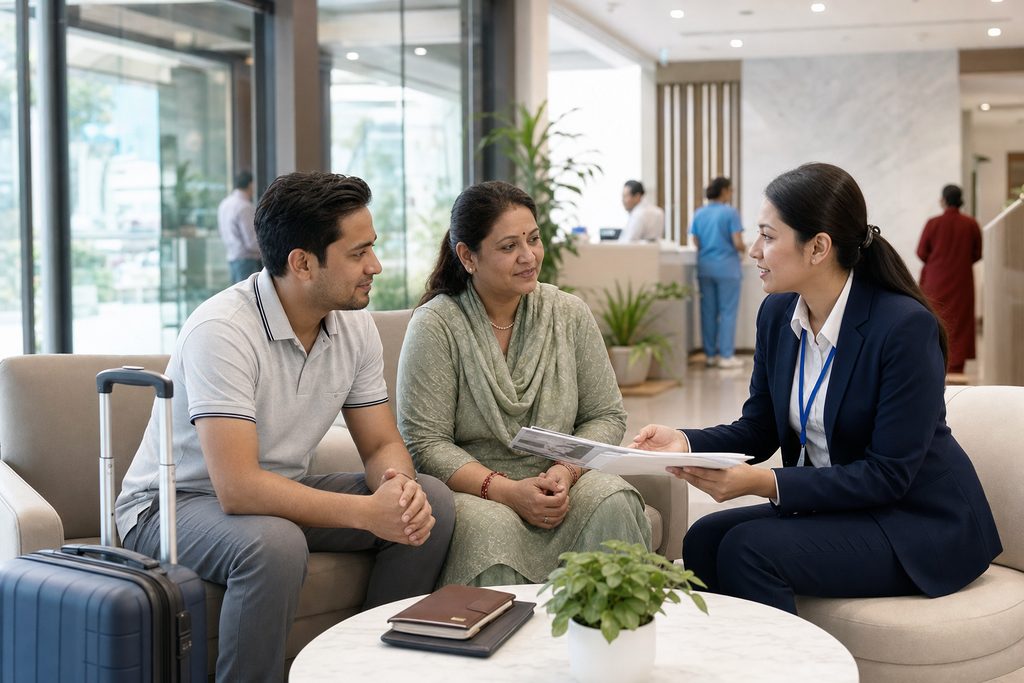
Once a hospital confirms acceptance, we handle the invitation letter that unlocks your S2 visa application at the Chinese consulate in Almaty. We coordinate your arrival—airport transfer, accommodation near the hospital, a scheduled first consultation that does not require a 6:00 AM queue. On the day of your appointment, a bilingual medical companion meets you at the hospital entrance. This person handles registration, payment deposits, navigating between departments, and real-time interpretation with your attending physician. They are not a translator on a phone. They are physically next to you for the duration of your visit.
For patients who need surgical scheduling, the companion coordinates pre-operative testing, admission paperwork, and post-discharge follow-up appointments. If your case requires a multidisciplinary review—oncology cases often do—we arrange MDT video consultations with specialists across surgery, medical oncology, and radiology before you commit to travel. That consultation fee, by the way, is fully credited toward your in-person coordination costs if you proceed with treatment within 90 days.
We also work with Kazakh families who already have a diagnosis and a treatment recommendation but want a written second opinion from a Chinese specialist before making the trip. A $300–$500 investment in a documented second opinion often clarifies whether the journey is worth taking at all.
For patients researching whether can kazakh citizens get cancer treatment in china, the answer is straightforward: yes, and the oncology departments at hospitals like Fudan University Shanghai Cancer Center and Peking University Cancer Hospital treat international patients regularly. The question is not whether treatment is available. It is whether you can get through the door efficiently.
Frequently Asked Questions
Visa decisions rest solely with the Chinese consular authorities. We cannot guarantee approval. What we can guarantee is that your application package will be complete and correctly formatted—invitation letter from an accredited hospital, diagnosis summary, treatment plan, financial documentation. Incomplete paperwork is the most common cause of rejection, and we eliminate that variable entirely.
No. And any service that makes that promise should be treated with skepticism. Top specialists at public hospitals have clinical, academic, and administrative obligations that shift weekly. We coordinate through the hospital’s official international patient department to secure an appointment with the appropriate senior specialist in your required subspecialty. If a specific professor is unavailable, the department assigns another attending physician of equivalent seniority. We cannot promise a named individual. We can promise the right department and the right level of expertise.
This happens. A Chinese specialist reviewing your imaging and pathology may reach a different clinical conclusion than your doctor in Almaty. You are never obligated to proceed with a treatment plan you are uncomfortable with. Our role is to ensure you understand the recommendation clearly—our medical companions provide real-time interpretation, not filtered summaries—so you can make an informed decision. If you choose not to proceed, you are responsible for the hospital consultation fees incurred and our coordination service days used. There is no penalty for saying no.
Most public hospital international departments accept wire transfers and cash deposits in RMB. Some now accept UnionPay cards issued outside China. We guide you through the payment logistics before you travel, including estimated deposit amounts based on your treatment plan, so you arrive with funds properly structured. For patients using international health insurance, we provide the itemized documentation required for reimbursement claims, but the hospital expects payment upfront—reimbursement is between you and your insurer.
China’s major medical cities—Beijing, Shanghai, Guangzhou—are well-policed, modern metropolitan areas with established international communities. Hospital international departments have treated overseas patients for decades. The clinical environments are accredited, regulated, and subject to the same infection control standards you would expect in any advanced healthcare system. Personal safety in these cities is generally high. The risks are logistical, not physical—delays, miscommunication, payment friction. That is what our service is designed to mitigate.
Your Next Step
You now have a clear picture of what cross-border treatment from Almaty to China actually involves. The clinical resources are world-class. The cost savings are real and structural. The logistical barriers are genuine but entirely navigable with the right support on the ground.
If you have a diagnosis and want to understand whether a Chinese hospital is the right option for your specific case, start with a free consultation. Send us your medical records. We will review them, recommend appropriate hospitals and departments, and give you an honest assessment of timelines, costs, and feasibility. No commitment. No pressure. Just the information you need to make a clear decision.
For more medical information and treatment options in China, visit chinamedservices.com (China Medical Services).
