Knee MRI in China: What to Expect, Costs, and How to Book It
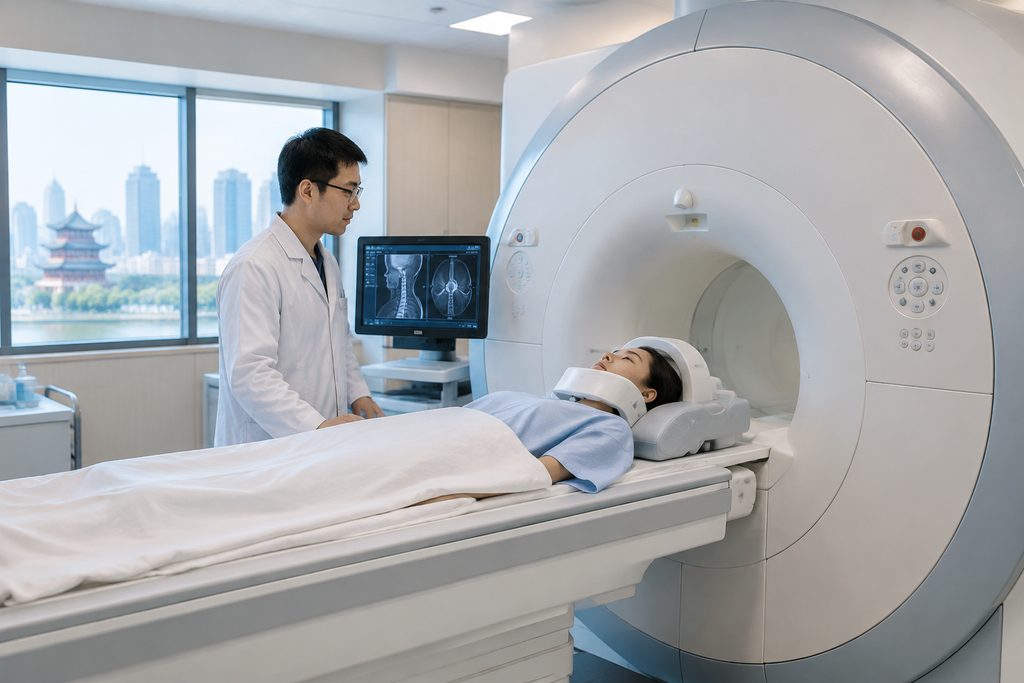
Knee MRI in China: What to Expect
You have probably been told that getting medical care abroad means gambling with quality. For a knee MRI in China, the opposite is often true. The scanners are frequently newer than the ones in your home city, the radiologists read a high volume of musculoskeletal cases, and the knee MRI cost in China is a fraction of what you would pay in the United States or Western Europe.
That said, nobody should book a scan in a foreign country based on price alone. You need to know what the machine actually is, who reads the images, how long it takes, and what happens if the report comes back with something serious. This guide walks through all of it — the real sequence, the honest friction points, and the numbers.
How This Actually Works, Step by Step
Here is the real sequence, start to finish. No marketing gloss.
Step one: you send your existing records. That means your referral note, any prior X-rays or CT scans, and a short description of your symptoms — where the knee hurts, when it started, whether there was an injury. If you have an old MRI on disc or in a cloud link, send that too. Radiologists compare.
Step two: a Chinese orthopedic or radiology team reviews the file. Not a call center. An actual clinician looks at what you sent and confirms whether an MRI is the right next test, which sequences are needed, and whether contrast dye is appropriate. Sometimes the answer is that you need an X-ray first, or a ultrasound, or nothing at all. That saves you money.
Step three: you get a written plan and a price range. Which hospital, which scanner, roughly what it costs, and how many days it takes to get an appointment slot. This is where a written second opinion or video consultation fits — you can see the reasoning before committing to travel.
Step four: appointment coordination. A public hospital’s ordinary outpatient queue cannot be booked from overseas in advance. That is simply how the system works. To lock a date before you fly, you go through the hospital’s international department or VIP channel. That costs more — often 1.5 to 2 times the standard rate — but you get English-speaking staff and a confirmed slot.
Step five: the scan itself. You arrive, register, change, lie down, and hold still. A knee MRI takes roughly 20 to 45 minutes depending on the protocol and whether contrast is used. You will hear loud knocking and buzzing. Earplugs are standard.
Step six: the report. A radiologist writes it up, usually within 24 to 72 hours. If you need it in English for your doctor at home, request a translated version when you book — do not assume it comes automatically.
What to Expect During a Knee MRI in China
The experience inside the scanner room is nearly identical to what you would find in Cleveland or Munich. The differences are mostly logistical.
Chinese tertiary hospitals are enormous. A single top-tier facility can see more than 10,000 outpatients in a day. Signage is often Chinese-only outside the international wing. Registration, payment, and the imaging department may sit in three different buildings. If you do not speak Mandarin, this is where a bilingual medical companion earns their fee — not for the scan, but for the two hours around it.
What you should confirm before the appointment:
- Field strength. A 3T scanner gives better cartilage and meniscus detail than a 1.5T. Most major Chinese hospitals have 3T machines, but not every department uses them for every knee case.
- Contrast or no contrast. Standard knee protocols usually skip gadolinium. If your doctor at home asked for it, say so in writing.
- Whether the radiologist subspecializes in musculoskeletal imaging. A general radiologist can read a knee. A musculoskeletal specialist reads it better.
- Report language and format. Ask for DICOM images on a disc or a secure download link, plus the written report.
Is MRI Safe in China Hospitals?
Yes, with the usual caveats that apply anywhere. MRI uses a strong magnetic field and radio waves, not ionizing radiation. The main risks are projectiles, implanted devices, and contrast reactions.
China’s top hospitals follow standard screening protocols. You will fill out a safety questionnaire asking about pacemakers, cochlear implants, aneurysm clips, metal fragments in the eye, and pregnancy. Answer honestly. A pacemaker that is not MRI-conditional is an absolute contraindication, and no amount of hospital prestige changes that physics.
Gadolinium contrast, when used, carries a small risk of allergic reaction and a very small risk of nephrogenic systemic fibrosis in patients with severe kidney disease. If you have kidney problems, tell the team. They will check your eGFR before injecting anything.
One practical note: the accreditation landscape differs from the West. JCI-accredited private international hospitals in China — United Family, Jiahui, Parkway, Raffles among them — follow familiar Western safety standards and often bill insurance directly. Public tertiary hospitals are held to China’s national standards, which are rigorous but documented differently. Neither is unsafe. They are simply different systems.
A Realistic Timeline
These ranges assume you are starting from outside China and want a confirmed appointment. Add buffer if you need a visa.
| Stage | Typical Duration | What Slows It Down |
|---|---|---|
| Records collection and translation | 2–7 days | Missing prior imaging; non-English reports needing certified translation |
| Remote review and written plan | 2–5 business days | Specialist availability; need for additional records |
| Appointment coordination | 3–14 days | International department scheduling; scanner availability; peak season |
| S2 visa application | 4–10 business days | Consulate processing times; invitation letter from the hospital |
| Travel and arrival | 1–2 days | Flight routing; jet lag before a scan |
| The MRI itself | 20–45 minutes | Contrast use; patient motion requiring repeat sequences |
| Radiology report | 24–72 hours | Weekend scheduling; complex findings needing a second read |
| English translation of report | 1–3 days | Requested at booking or not |
Total, from first email to report in hand: roughly two to five weeks. If you are already in China and paying out of pocket at a private hospital, you can sometimes be scanned within 48 hours.
What Can Go Wrong — and What Happens Then
Honest failure modes, and the actual recourse.
You cannot get the appointment date you wanted. Public hospital international departments fill up. If a coordinator cannot secure the slot you asked for, the standard arrangement is a full refund of the coordination fee. That is why coordination fees exist as a separate line item rather than being bundled into a vague package.
The report says something unexpected. A meniscal tear, a ligament rupture, a bone lesion. This is the moment a scan stops being a transaction. You will want a specialist to explain the finding and outline options — arthroscopy, conservative rehab, further imaging. A written second opinion from an orthopedic surgeon, not just a radiologist, is usually the right next step.
The images are poor quality. Motion artifact happens. If the radiologist cannot read the study, the hospital will typically repeat it. Ask about this policy before you pay.
Language breaks down at the wrong moment. You arrive, and the registration desk does not speak English. This is the single most common complaint from international patients at Chinese public hospitals. A bilingual companion who handles registration, payment, and wayfinding prevents it.
Your insurance will not reimburse. Public hospitals in China generally require prepayment, with reimbursement handled afterward by your insurer. Private international hospitals often bill directly, but only if your plan has a China network. Call your insurer before you book. Do not assume.
Knee MRI Cost in China vs. the US and Europe
This is where the numbers get interesting. A knee MRI in the United States typically runs $1,500 to $4,000 before insurance, depending on the facility. In the UK, private rates land around £500 to £900. In China, at a top public hospital, you are generally looking at a fraction of the US figure.
Exact prices vary by hospital, city, and whether contrast is used. As a working range for international patients at major tertiary hospitals and private international facilities, expect a few hundred dollars for the scan itself, with higher totals when you add international department fees, English reporting, and translation.
For a specific figure on how much does a knee MRI cost in Shanghai, the honest answer is that it depends on which tier you choose. A standard public hospital scan and a private international hospital scan differ by several multiples. Both are usually cheaper than the same study in the US.
If you are considering a broader diagnostic workup, some hospitals offer medical imaging packages in China for international patients that bundle multiple studies at a discount. These make sense for executive health screening. They make less sense if you have one specific knee problem — targeted imaging is cheaper and faster.
To book a knee MRI in Beijing or Shanghai through a confirmed channel, the practical route is appointment coordination through a hospital’s international department. That is what a medical concierge service in China arranges.
Practical Considerations for International Patients
Records. Bring prior imaging, a medication list, and a note from your referring doctor. If your records are not in English or Chinese, get them translated before you travel.
Visa. Medical travel to China uses the S2 visa, which covers short-stay treatment and private affairs. Family members accompanying you apply for S2 as well. Stays beyond 180 days require S1. The M visa is for commercial and trade activity — it is not a medical visa, and using it for treatment creates problems at the border. Requirements change, so verify current rules with the nearest Chinese embassy or consulate and secure supporting documents from the hospital.
Payment. Public hospitals want payment upfront. Private international hospitals may bill your insurer directly if you are in-network. Bring a card that works internationally, and confirm whether the hospital accepts foreign cards before you arrive.
Language. Assume you will need help outside the international wing. Budget for a bilingual companion if you are going to a large public hospital.
Follow-up at home. Get the DICOM images and the written report before you leave China. Your orthopedic surgeon at home will want both. A report without images is half a record.
Frequently Asked Questions
It is substantially less. US rates typically run $1,500 to $4,000 before insurance. In China, a scan at a top public hospital usually costs a fraction of that, with private international hospitals sitting higher but still generally below US pricing. Final cost varies by hospital, city, and whether contrast is used.
Not through the ordinary public outpatient queue — that system does not accept overseas advance bookings. You can secure a date in advance through a hospital’s international department or VIP channel, which costs more but provides English service and a confirmed slot. Appointment coordination services handle this on your behalf.
Yes. Top Chinese hospitals follow standard MRI safety screening for implants, metal, and pregnancy, and use the same 1.5T and 3T equipment found in Western facilities. The main practical risk is communication, not the machine. If you have a non-MRI-conditional pacemaker or severe kidney disease, disclose it before the scan.
Not automatically. Most public hospital reports are issued in Chinese. Request an English translation when you book, and ask for the DICOM images on disc or a secure download. Your doctor at home needs both.
The next step is a specialist review, not panic. A written second opinion or video consultation with an orthopedic surgeon can clarify whether you need surgery, conservative treatment, or further imaging. Nothing about a scan commits you to treatment in China.
Your Next Step
A knee MRI in China is faster, cheaper, and technically comparable to what you would get at home — the friction is logistical, not clinical. Know the sequence, confirm the scanner and the report language, and sort the visa before you book flights.
China Medical Services connects international patients with more than 340 top-ranked hospitals across 37 cities, and handles the parts that trip people up: records, appointment coordination, bilingual accompaniment, and visa guidance. We are not doctors and we do not provide medical advice. We are the bridge.
If you want to know what a knee MRI would cost for your specific situation, start with a free consultation. No pressure, no obligation — just a clear answer.
For more medical information and treatment options in China, visit chinamedservices.com (China Medical Services).
