Knee Surgery Recovery: Will You Need a Walker and What It Costs
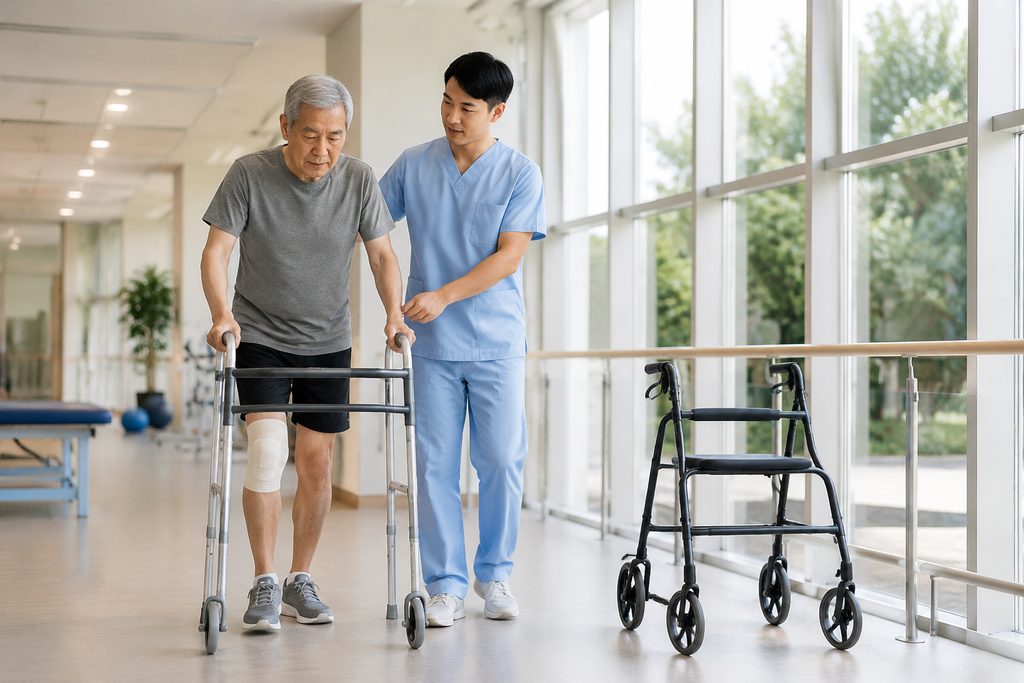
While patients in Canada wait a median 28.6 weeks for orthopedic surgery, surgeons at Beijing Jishuitan Hospital routinely perform over 300 joint replacements per month — with clinical outcomes that match or exceed Western benchmarks. The question isn’t just whether you’ll get the surgery. It’s what happens in the six weeks after. And the first thing most patients ask us: will I need a walker?
The short answer is yes, almost certainly. The longer answer involves how long, what type, and what the knee replacement walker rental cost China actually looks like compared to what you’d pay at home. Our team has coordinated recovery logistics for hundreds of international patients across 340+ top-ranked hospitals in 37 cities. Here’s what the data and clinical experience tell us.
How This Actually Works, Step by Step
You don’t fly to China, get surgery, and figure out mobility aids afterward. The sequence matters. Here’s what actually happens from where you are now to walking independently.
First, you send us your existing imaging and medical records. X-rays, MRI reports, any prior surgical notes. A Chinese orthopedic team reviews them remotely. They assess whether you’re a candidate for total knee replacement, partial replacement, or something less invasive. This written second opinion typically costs $300–500 and takes 5–7 business days.
Once the surgical plan is confirmed, we coordinate your hospital admission through the international department. You’ll need an S2 visa noting medical treatment purposes. Processing takes 2–4 weeks depending on your home country’s Chinese embassy or consulate. Your companion or family member applies for the same S2 category.
You arrive. Pre-operative assessment happens over 1–2 days. Surgery itself takes 1–2 hours. You’ll wake up with a drain in your knee and a physical therapist at your bedside within 24 hours. The walker appears on day one, not day three.
Most international patients stay in the hospital for 5–7 days after total knee replacement. During that time, physical therapy happens twice daily. You’ll practice standing, transferring from bed to chair, and taking short walks with the walker. By discharge, you should manage 50–100 meters independently with the walker.
After discharge, you either stay in a nearby serviced apartment or hotel for 2–4 weeks, or you fly home. If you stay, outpatient physiotherapy continues 3–5 times weekly. If you fly home, you’ll need a clear handoff plan to your local physical therapist.
Do I Need a Walker After Total Knee Replacement?
The clinical answer is unambiguous. Yes, you need a walker after total knee replacement. Not a cane. Not crutches. A walker.
Why the distinction matters: a walker provides four points of ground contact and a stable frame you can lean your full body weight into. A cane gives you one point. Crutches require upper body strength and coordination that’s compromised when you’re dealing with post-anesthesia fatigue, swelling, and the proprioceptive confusion of a new joint.
Orthopedic rehabilitation protocols at Chinese tertiary hospitals — including Peking Union Medical College Hospital and West China Hospital — uniformly prescribe a walker for the first 2–4 weeks post-op. The walker’s frame prevents the lateral sway that stresses a healing knee. It also protects against the single most common post-operative accident: a stumble during a half-awake trip to the bathroom at 3 a.m.
You’ll transition from walker to cane typically between weeks 3 and 6, depending on quadriceps strength, pain control, and balance. Some patients with excellent pre-op conditioning manage the switch at day 18–21. Others need the walker for 8 weeks. No reputable surgeon will promise you a specific date. The knee decides.
How Long Use Walker After Knee Surgery: What the Data Shows
The honest answer: most patients use a walker for 2–6 weeks. Here’s the breakdown by phase.
Week 1: walker required for all weight-bearing movement. You’ll use it for every step, including bathroom trips. Physical therapy focuses on range of motion and quad activation, not walking endurance.
Weeks 2–3: walker for longer distances and outdoor movement. You may start short, supervised walks without it indoors — 10–20 steps at a time. Many patients still prefer the walker for stability.
Weeks 4–6: transition to a cane. By week 6, most patients walk with a cane or no aid at all. A 2023 study in the Journal of Arthroplasty tracking 1,200 total knee replacement patients found that 71% had discontinued the walker by day 28, and 89% by day 42.
But those are medians. Your timeline depends on age, pre-op strength, body weight, and whether you had a simultaneous bilateral replacement (both knees at once). Bilateral patients typically need the walker 2–3 weeks longer. Patients over 70 often keep it for the full 6 weeks even if they technically could manage without it — and that’s the right call. Falls after knee replacement lead to periprosthetic fractures, and those are far worse than a few extra weeks of walker use.
Knee Replacement Walker Rental Cost China: The Real Numbers
Here’s where the economics get interesting. In the United States, a basic walker costs $30–60 to buy, and rental through a medical supply company typically runs $25–40 per week — if you can find a rental at all. Most American patients just buy one and donate it afterward.
In China, the knee replacement walker rental cost is dramatically lower, and the equipment is often provided as part of the hospital’s rehabilitation package. Many international departments include walker use in the daily room rate or as a standard post-op supply item. When rented separately, expect to pay roughly $5–15 per week. Purchase prices for a standard folding walker at Chinese medical supply stores run $15–30.
What about the premium options? A wheeled walker with a seat and hand brakes — useful for older patients who need rest breaks — costs $40–80 to buy in China, compared to $100–200 in Western markets. Rental for these runs $10–20 per week.
| Equipment | China Rental (weekly) | China Purchase | US Rental (weekly) | US Purchase |
|---|---|---|---|---|
| Standard folding walker | $5–15 | $15–30 | $25–40 | $30–60 |
| Wheeled walker with seat | $10–20 | $40–80 | $35–55 | $100–200 |
| Quad cane (transition aid) | $3–8 | $8–15 | $15–25 | $20–40 |
These figures vary by hospital and case complexity, and international department packages sometimes bundle equipment costs into the overall surgical quote. Always ask for an itemized breakdown before committing.
A Realistic Timeline
| Stage | Duration | What Happens |
|---|---|---|
| Remote evaluation | 1–2 weeks | Records reviewed, surgical plan drafted, written second opinion delivered |
| Visa processing (S2) | 2–4 weeks | Hospital invitation letter issued, embassy application submitted |
| Arrival & pre-op assessment | 2–3 days | Blood work, ECG, anesthesia consult, final surgical clearance |
| Surgery & hospital stay | 5–7 days | Total knee replacement, twice-daily physiotherapy, walker training |
| Early recovery (local) | 2–4 weeks | Outpatient PT 3–5x weekly, walker to cane transition, wound checks |
| Flight home | Day 14–28 post-op | Most airlines clear knee replacement patients after 10–14 days with medical clearance |
| Full walker independence | Day 28–42 | 71% off walker by day 28, 89% by day 42 |
| Return to normal gait | Month 3–6 | Swelling resolution, quad strength recovery, stair negotiation without aids |
The step people forget is document translation. Your medical records, imaging reports, and surgical history must be translated into Chinese for hospital review. This adds 3–5 business days to the front end. Plan for it.
What Can Go Wrong — and What Happens Then
Knee replacement is one of the most successful surgeries in modern medicine, with satisfaction rates above 85% in most registries. But things do go wrong, and you deserve to know what those look like.
Stiffness is the most common complication. If you don’t achieve 90 degrees of flexion by week 2, or 110 degrees by week 6, you may need manipulation under anesthesia. This is a 15-minute procedure where the surgeon bends the knee forcefully while you’re asleep to break up scar tissue. It’s done in about 3–5% of cases. Chinese hospitals handle this routinely, and it’s typically included in the original surgical package if performed at the same facility.
Infection is the complication everyone fears. The rate is 0.5–1% in most high-volume centers. If it happens, treatment involves surgical washout, IV antibiotics, and sometimes a two-stage revision. This is why we only work with hospitals that perform at least 500 knee replacements annually — volume correlates directly with lower infection rates. Jishuitan, Peking Union, and West China all exceed this threshold by a wide margin.
Blood clots are the silent risk. Without prophylaxis, DVT rates after knee replacement run 40–60%. With modern protocols — mechanical compression, early mobilization, and anticoagulants — the rate drops below 1%. Every hospital we coordinate with uses the full protocol. You’ll receive compression stockings and possibly a short course of anticoagulant injections.
What if you fall? It happens. The walker exists precisely to prevent this. But if you do fall in the early weeks, you go back to the hospital for X-rays immediately. The concern is periprosthetic fracture — a break in the bone around the implant. These require surgery. The good news: at the hospitals we work with, same-day imaging and orthopedic consult are standard for post-op international patients.
Can I Walk Without Walker After Knee Replacement? The Decision Criteria
Every patient asks this. The answer is yes — eventually. But the timing isn’t a matter of willpower. It’s a matter of meeting four objective criteria.
One: quadriceps control. You must be able to perform a straight leg raise without your knee bending, holding it for 5 seconds. If your quad fires properly, your knee is stable. If it lags, the walker stays.
Two: pain below 4 out of 10 during weight-bearing. Walking through significant pain creates compensatory gait patterns that persist for months. The walker offloads the joint while tissues heal.
Three: no knee buckling. If your knee gives way even once during a supervised trial without the walker, you’re not ready. Buckling means the dynamic stabilizers aren’t yet doing their job.
Four: surgeon clearance. Not a checklist. Not a timeline. Your surgeon watches you walk, tests your strength, and makes the call. At Chinese high-volume centers, this assessment happens at every follow-up visit — typically days 7, 14, and 28.
The patients who walk soonest aren’t the ones who push hardest. They’re the ones who did pre-habilitation — strengthening their quads and hamstrings for 6–8 weeks before surgery. If you’re reading this before your operation, start there. It’s the single highest-yield thing you can do.
Knee Surgery Recovery Package Shanghai: What’s Included
Shanghai has become a hub for international orthopedic patients, and for good reason. The city hosts several of China’s top-ranked orthopedic departments, including those at Shanghai Sixth People’s Hospital and Ruijin Hospital. Both are ranked among China’s top 10 for orthopedics in the Fudan specialty reputation rankings.
A typical knee surgery recovery package in Shanghai bundles several elements. The surgical fee itself — including the implant, surgeon’s fee, anesthesia, and 5–7 days of hospital stay — runs $12,000–20,000 at top public hospital international departments. That compares to $35,000–50,000 in the United States for the same procedure without complications.
The recovery package extends beyond the hospital walls. Most include 2–4 weeks of outpatient physiotherapy at $30–60 per session, accommodation coordination in serviced apartments near the hospital, and bilingual companion support for follow-up visits. Some packages bundle the walker and other mobility aids into the total price. Others itemize them separately.
What you won’t get in Shanghai: a resort-style recovery retreat. Chinese rehabilitation is clinical and efficient. You’ll be in a functional physiotherapy gym, not a spa. If you want luxury recovery, private international hospitals like United Family and Jiahui offer Western-style care with English-speaking staff and direct insurance billing — at roughly 1.5–2 times the cost of public hospital international departments.
Practical Considerations: Records, Visa, Payment, and Follow-Up
Let’s talk about the unglamorous logistics that determine whether your recovery actually works.
Records. You need everything: operative notes from any prior knee surgery, recent X-rays and MRI (within 6 months), a list of current medications, and your vaccination history. Chinese hospitals require a complete picture before scheduling surgery. Incomplete records delay everything.
Visa. The S2 visa is the correct category for medical treatment. Processing times vary by country — 1 week in some Southeast Asian nations, 3–4 weeks in parts of Europe and North America. Your hospital issues an invitation letter that you submit with your application. We guide this process but never guarantee approval; embassy decisions are outside any hospital’s or coordinator’s control.
Payment. Public hospital international departments require pre-payment — typically 50–100% of the estimated surgical fee before admission. Insurance reimbursement is your responsibility; Chinese public hospitals don’t bill Western insurers directly. Private international hospitals do, which is why some patients choose them despite higher prices.
Language. Top-tier Chinese orthopedic surgeons often speak some English, but nurses, physiotherapists, and administrative staff usually don’t. A bilingual medical companion — from $300 per day — handles registration, payment, translation during consultations, and communication with the care team. This isn’t a luxury. It’s the difference between understanding your recovery instructions and guessing.
Follow-up at home. Before you leave China, your surgeon provides a written summary in English: what was done, what implant was used, what medications to continue, and what your local doctor needs to monitor. You’ll also receive a recommended physiotherapy protocol to hand to your home therapist. If complications arise after you return, a video consultation with your Chinese surgical team costs $100–300.
Frequently Asked Questions
Yes. Every reputable orthopedic protocol requires a walker for the first 2–4 weeks after total knee replacement. It provides four-point stability while your quadriceps regain control and the surgical swelling subsides. Transitioning to a cane typically happens between weeks 3 and 6, depending on your strength and balance.
Most patients use a walker for 2–6 weeks. Clinical data from a 2023 Journal of Arthroplasty study shows 71% of patients discontinue the walker by day 28 and 89% by day 42. Bilateral knee replacement patients and those over 70 often need it for the full 6 weeks or slightly longer.
Eventually, yes. But only after meeting four criteria: a straight leg raise held for 5 seconds without knee bend, pain below 4 out of 10 during weight-bearing, no episodes of knee buckling, and explicit surgeon clearance. Pushing to walk unaided too early increases fall risk and can compromise the implant.
Standard folding walkers rent for roughly $5–15 per week in China, and many hospital international departments include walker use in the room rate or surgical package. Purchase prices run $15–30. This compares favorably to US rental rates of $25–40 per week.
Which hospital in China is best for knee surgery recovery?
For more medical information and treatment options in China, visit chinamedservices.com (China Medical Services).
