What Laser Eye Surgery Costs in China: 2026 Price Guide for Foreigners
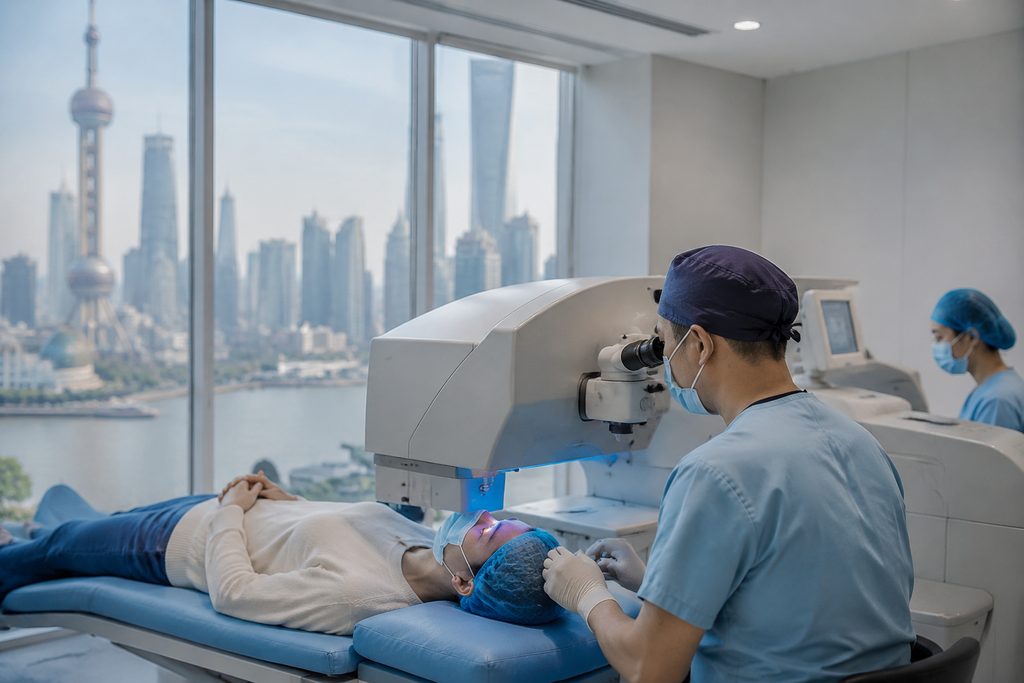
What if the price gap between laser eye surgery in your home country and the same procedure in China is large enough to cover a round-trip flight and still leave thousands in your pocket?
That question is why so many international patients now search for the laser eye surgery cost China clinics actually charge — and the numbers are genuinely striking. At top Chinese hospitals, LASIK commonly runs between $1,500 and $3,500 per eye depending on technique, while the same procedure in the United States averages $2,200 to $3,000 per eye before facility fees. In the UK, private LASIK often exceeds £2,000 per eye.
But price alone is a poor reason to get on a plane. Our team at China Medical Services has coordinated care for international patients across 340+ top-ranked hospitals in 37 cities, and we’ve seen what separates a smooth outcome from a frustrating one. It’s almost never the laser. It’s the preparation.
How This Actually Works, Step by Step
Here is the real sequence, from your first email to the moment you’re cleared to fly home.
Step one: you send your existing eye examination records. A proper refraction report, corneal topography, pachymetry (corneal thickness), and your prescription history. If you wear contact lenses, you’ll need to stop — soft lenses for at least 2 weeks, rigid gas-permeable lenses for 4 weeks — before any reliable measurement can be taken. This is not a formality. Surgeons cannot assess candidacy on outdated numbers.
Step two: a Chinese ophthalmology team reviews your file. This happens remotely, through a written second opinion or a video consultation with the hospital’s international department. You’ll get an honest read on whether you’re a candidate at all. Roughly 15-20% of people who want LASIK turn out to be poor candidates because of thin corneas, unstable prescriptions, or conditions like keratoconus.
Step three: you receive a treatment recommendation and a cost estimate. Not a menu. A recommendation tied to your corneal data — SMILE, femtosecond LASIK, PRK, or ICL if laser isn’t suitable.
Step four: appointment coordination. We help register you with the hospital, create your medical card, and lock in a consultation slot through the official international or VIP channel. Public hospital general ophthalmology queues generally cannot be booked from overseas in advance — you’d be standing in line the morning of. The international department exists precisely to solve this.
Step five: you arrive, get examined in person, and — if cleared — surgery is scheduled. Often within 24 to 72 hours of the in-person exam. Then follow-up checks at day 1, week 1, and month 1.
What Drives the Laser Eye Surgery Cost China Clinics Quote
Two patients can walk into the same hospital and receive quotes that differ by $1,500. Here’s why.
| Factor | Typical Price Impact | Notes |
|---|---|---|
| Technique (PRK vs. LASIK vs. SMILE) | $800–$1,800 per eye | SMILE and femtosecond LASIK cost more than surface ablation |
| Public general vs. international/VIP channel | 1.5x–2x multiplier | VIP buys English service, senior specialists, shorter waits |
| Private international hospital | $3,000–$5,500 per eye | JCI-accredited, direct insurance billing, Western-style care |
| Corneal thickness / prescription complexity | Varies | Thin corneas may require ICL, which costs more |
| City | 10–25% | Beijing and Shanghai run higher than Chengdu or Wuhan |
So when someone asks how much does LASIK cost in Beijing, the honest answer is a range: roughly $1,800 to $3,800 per eye at a top-tier public hospital’s international department, and higher at private international facilities. Shanghai is comparable. Both cities have genuine depth in refractive surgery — Shanghai’s eye hospitals handle volume that most Western clinics never approach.
What about the best LASIK clinic Shanghai price shoppers keep hunting for? There isn’t a single answer, and anyone who tells you otherwise is selling something. The right clinic depends on your corneal data, your prescription, and whether you need a technique that only certain centers offer. Our ophthalmology department rankings list the hospitals with the strongest specialty reputations, drawn from the Fudan specialist reputation rankings.
A Realistic Timeline
People underestimate this constantly. Surgery itself takes about 10 minutes per eye. Everything around it takes weeks.
| Stage | Duration | What’s Happening |
|---|---|---|
| Records gathering | 3–10 days | Eye exam, topography, stopping contact lenses |
| Remote review | 3–7 days | Written second opinion or video consultation |
| Document translation | 2–5 days | If your records aren’t in English or Chinese |
| Appointment coordination | 1–3 weeks | International department scheduling lead time |
| S2 visa application | 1–3 weeks | Processing varies by consulate; apply early |
| In-person exam + surgery | 2–4 days in China | Exam day one, surgery within 24–72 hours if cleared |
| Early recovery | 3–7 days | Blurriness, halos, dry eye — normal and expected |
| Stabilization | 1–3 months | Vision sharpens gradually; final refraction at 3–6 months |
Total realistic planning window: four to eight weeks from first contact to surgery. Anyone promising you surgery next week is skipping steps that matter.
What Can Go Wrong — and What Happens Then
Let’s be direct, because this is where trust is earned.
You arrive and you’re not a candidate. It happens. The in-person exam is more thorough than any remote review, and sometimes the cornea says no. Your recourse: a refund of coordination fees for services not rendered, and a conversation about alternatives — ICL, PRK, or simply not operating. No reputable surgeon will proceed on a cornea that shouldn’t be operated on.
Insurance doesn’t cover it. Most international health insurance treats refractive surgery as elective. Public Chinese hospitals require prepayment, and you file for reimbursement afterward — which usually fails. Private international hospitals often bill insurance directly, but again, only if your policy covers refractive correction. Check before you book anything.
Dry eye or night halos persist. These are the most common complaints after any laser refractive procedure, anywhere in the world. They usually improve over 3–6 months. Occasionally they don’t fully resolve. This risk exists in Seoul, London, and Houston too — it is not a China-specific issue, and any clinic claiming zero side effects is lying.
You need follow-up after you fly home. This is the one people forget. Arrange a local optometrist or ophthalmologist before you leave China, and bring your post-operative report with you. Most Chinese hospitals will provide English-language discharge documentation on request — ask early, not on your last day.
The clinic isn’t what you expected. Volume at top Chinese public hospitals is enormous — some see over 10,000 outpatient visits a day. Without language support, navigating registration, payment, and pharmacy is genuinely difficult. This is the single most common source of patient frustration, and it has nothing to do with surgical quality.
Is Laser Eye Surgery Safe in China — and How Do You Judge a Clinic?
China’s top ophthalmic centers perform refractive surgery at volumes that exceed most European national totals. High volume correlates with surgeon experience, and surgeon experience correlates with outcomes. That’s the structural argument.
But “China” is not a quality label. A clinic is. So judge the specific one:
- Does the surgeon hold a recognized ophthalmology board certification and specialize in refractive surgery — not general ophthalmology?
- Does the clinic run corneal topography and pachymetry on every candidate, or only on some?
- Will they tell you no? Ask directly what percentage of candidates they turn away.
- Is there an English-speaking coordinator, or will you be relying on a translation app during a consent conversation?
- What’s the follow-up protocol, and will they coordinate with a doctor in your home country?
On the question of whether is laser eye surgery safe in China — the honest answer is that safety tracks the individual clinic and surgeon, not the country. The complication rates reported by major Chinese ophthalmic centers fall within the ranges published in international refractive surgery literature. What varies more is the service layer around the surgery.
One more thing worth knowing: for foreign patients, the international or VIP department is usually the right entry point. It costs roughly 1.5 to 2 times the general channel, but it gives you a senior specialist, English-language support, and a scheduling process that works from overseas. Our guide to China’s top-ranked hospitals by city shows which centers have established international departments.
Practical Considerations: Visas, Payment, and Records
Visa. Medical treatment in China falls under the S2 visa category, which covers short-stay visits for medical treatment and private affairs. Accompanying family members apply under the same category. You’ll typically need a hospital invitation or appointment confirmation letter as supporting documentation. Requirements change — always confirm with the latest embassy or consulate guidance before applying. Note that the M visa is for commercial and trade activities and has nothing to do with medical treatment.
Payment. Public hospitals: prepay, then attempt reimbursement. Private international hospitals: often direct insurance billing if your policy covers the procedure. Bring a card that works internationally, and confirm accepted payment methods in advance.
Records. Bring your full refractive history, not just the latest prescription. Surgeons want to see stability over time — typically two years of stable refraction. If your prescription has shifted in the last 12 months, that’s a conversation, not necessarily a disqualifier.
Language. Assume nothing. Even in international departments, the clinical staff may not speak English fluently. A bilingual medical companion handles registration, queueing, payment, pharmacy, and interpretation — from $300 per day for a half or full day. For a procedure this quick, one or two days of support usually covers everything.
Recovery time after laser eye surgery abroad. Most patients see functional vision within 24 to 48 hours and can fly home after their day-7 follow-up. Full visual stabilization takes one to three months. Plan your trip so you’re not on a long-haul flight the day after surgery — dry cabin air is unpleasant on a healing cornea.
Frequently Asked Questions
Yes, and it’s common. The practical route is through a hospital’s international or VIP department, which can schedule from overseas. General public ophthalmology queues usually can’t be pre-booked from abroad, and surgery is only scheduled after an in-person examination confirms you’re a candidate.
For a single eye at a top public hospital’s international department, expect roughly $1,800–$3,800. Add flights, 5–10 nights of accommodation, visa costs, and about $300–600 for bilingual companion support. Total realistic budget for a two-eye procedure with a one-week stay: $5,000–$9,000. It varies by hospital and case complexity, so treat any single figure as an estimate only.
It happens, and it’s not a failure of planning — it’s the system working. In-person corneal measurement is more accurate than anything done remotely. You would not be charged for surgery, and coordination fees for unrendered services are refundable. You’d then discuss alternatives like ICL or PRK, or decide not to proceed.
At the top-ranked ophthalmic centers, the equipment and surgical technique are current-generation and the case volumes are high. The variable is service infrastructure — language, scheduling, and follow-up coordination. That’s the part worth planning carefully, and it’s the part a good coordinator solves.
Your Next Step
The core message is simple: laser eye surgery in China can cost a fraction of Western prices at genuinely strong hospitals, but the savings only matter if the clinic is right for your eyes and the logistics don’t derail your recovery.
We’re China Medical Services — a coordination team, not a clinic. We don’t perform surgery, we don’t promise outcomes, and we don’t guarantee you’ll be accepted as a candidate. What we do is connect you with the right hospital, arrange remote review of your records, handle appointment coordination through official international departments, and provide bilingual support on the ground.
If you’d like an honest read on your options, start with a free consultation. Send your eye records, tell us what you’re hoping for, and we’ll tell you what’s realistic.
This article is for general information only and is not medical advice. Refractive surgery suitability depends on individual clinical assessment. Consult a qualified ophthalmologist before making any treatment decision.
For more medical information and treatment options in China, visit chinamedservices.com (China Medical Services).
